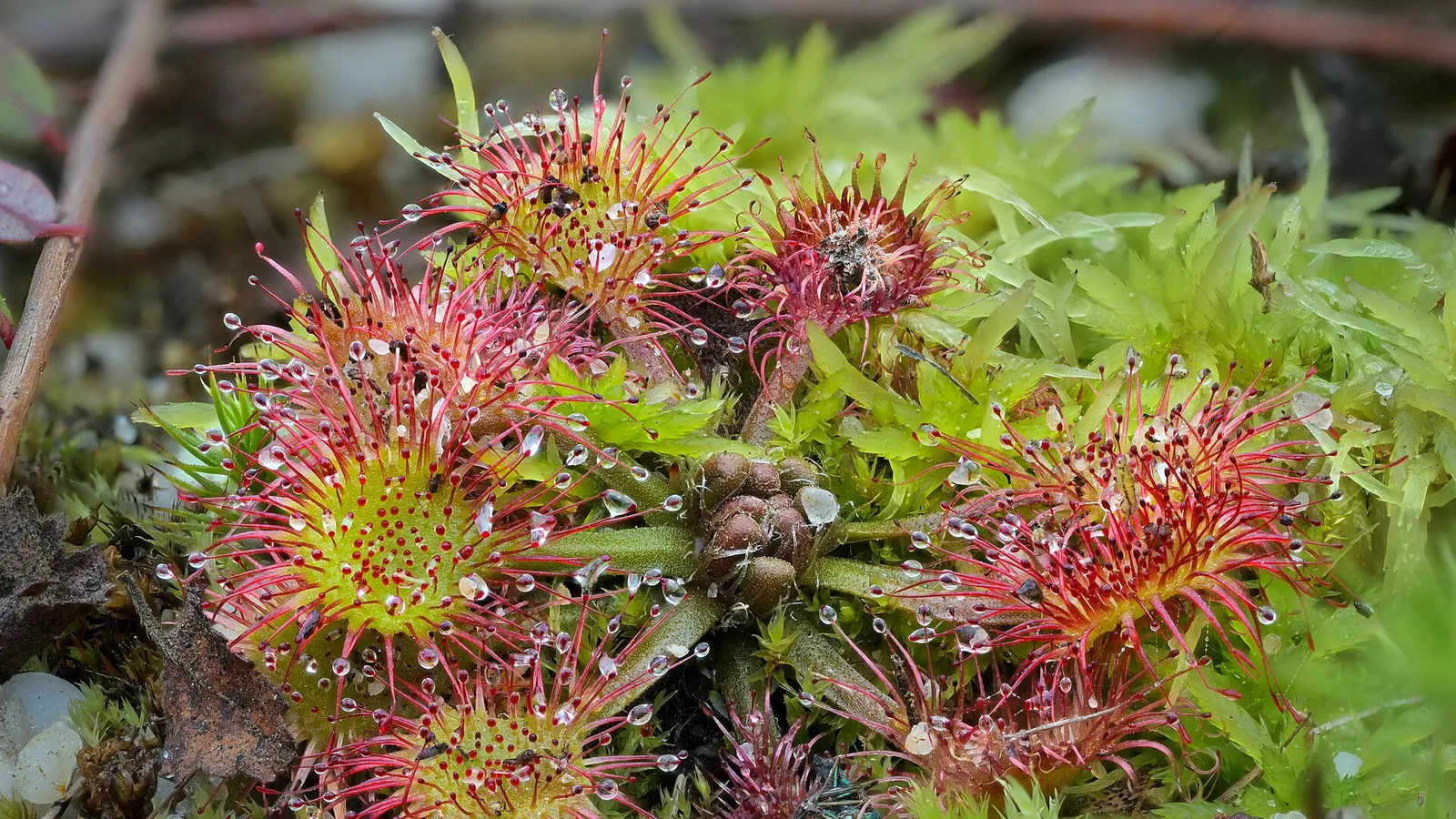

Round-leaved Sundew (Drosera rotundifolia)
Contents
TL;DR
- established Scientists have recently overturned a long-held assumption about how sundews digest their prey: rather than breaking down insects using only their own secreted enzymes, research has identified Acrodontium crateriforme, an acidophilic fungus, as the dominant microbial species living in sundew mucilage worldwide, actively enhancing digestion by producing peptidases that work alongside the plant's own enzymes — a specific, documented recent discovery this article states directly rather than presenting sundew digestion as a purely plant-only process.
- established In controlled experiments, the presence of this fungus reduced trap reopening time by approximately one-quarter and measurably increased protein breakdown, demonstrating that sundew carnivory functions as what researchers now describe as a "holobiont" phenomenon, a cooperative system between plant and fungus rather than an adaptation achieved by the plant alone — a specific, documented experimental result this article names directly rather than a vague claim that "fungi live on sundew leaves."
- established Round-leaved sundew evolved carnivory specifically to compensate for growing in nutrient-poor, highly acidic bog and fen habitats where nitrogen availability is severely limited, extracting ammonia from captured insects to supplement what it cannot obtain from the soil — a specific, documented ecological reason this article states directly rather than a vague claim that the plant "eats insects for food."
- established Research shows the plant can adapt its reliance on carnivory: when placed in nitrogen-rich soil with limited prey available, round-leaved sundew relies more heavily on nutrients absorbed through its roots rather than hunting, demonstrating that insect capture is a flexible response to nutrient scarcity rather than a fixed, unconditional behaviour — a specific, documented behavioural flexibility this article names directly rather than treating carnivory as the plant's only possible feeding strategy.
- established Within Britain, round-leaved sundew is the most widespread of the native sundew species, found widely across the west and north, including throughout Scotland, while remaining rare and scattered across the Midlands and eastern England — a specific, documented uneven UK distribution this article states directly rather than treating the species as uniformly common across Britain.
Key Facts
- Scientific name
- Drosera rotundifolia
- Category
- Flora
- Plant type
- Carnivorous, trap-leaf sundew
- Key fungal partner
- Acrodontium crateriforme
- Digestion boost (fungus present)
- ~25% faster trap reopening
- UK status
- Most widespread native sundew; common in Scotland
- Key nutrient habitat gap
- Nitrogen-poor, highly acidic bogs/fens
- Captured prey nutrient
- Ammonia (from insect proteins)
Scottish Impact Index (SI Score)
- Scottish Significance
- 8/10
- Ecological Persistence
- 8/10
- Ecological Importance
- 8/10
- Botanical Distinctiveness
- 10/10
- Conservation Significance
- 8/10
- Recognition
- 9/10
51/60
Ranked =9th of 45 in Flora
A Note on Claims and Evidence
The carnivorous mechanism, ecological reason for carnivory, nutrient-adaptive behaviour, UK and Scottish distribution, and traditional medicinal compound details are drawn from the species' Wikipedia-summarised research record. The recent discovery of the fungal digestive partnership, including the specific experimental findings on trap reopening time and protein breakdown, is drawn directly from the published Nature Microbiology research paper on this topic.
Timeline
Round-leaved sundew establishes itself across nutrient-poor, highly acidic bog and fen habitats throughout Britain, becoming the most widespread of the native sundew species, found widely in the west and north, including throughout Scotland, while remaining rare and scattered in the Midlands and eastern England.
The species captures insects using red glandular hairs that secrete sticky mucilage, with enzymes dissolving trapped prey to extract ammonia and other nutrients the plant cannot obtain from its nitrogen-poor soil; research shows the plant adapts this behaviour, relying more on root-absorbed nutrients when placed in nitrogen-rich soil with limited prey available.
For much of the period scientists have studied sundew digestion, the process is understood as achieved by the plant's own secreted enzymes alone, even though microorganisms are known to inhabit the mucilage, with their specific role remaining unclear.
Scientists identify Acrodontium crateriforme, an acidophilic fungus thriving in the acidic environment of sundew glands, as the dominant microbial species in sundew mucilage globally, demonstrating through controlled experiments that its presence reduces trap reopening time by roughly a quarter and measurably increases protein breakdown, with both organisms upregulating specific digestive genes during the process.
Round-leaved sundew's carnivory is now understood by researchers as a "holobiont" phenomenon, a cooperative system between plant and fungal partner rather than a plant-only adaptation, redefining how scientists understand this form of botanical carnivory.
Details
A digestion mechanism recently revealed as a genuine partnership
This article states directly that scientists have overturned a long-held assumption about sundew digestion: rather than relying solely on its own secreted enzymes, the plant's digestion is actively enhanced by Acrodontium crateriforme, an acidophilic fungus identified as the dominant microbial species in sundew mucilage worldwide. This article names this specific fungus and its mechanism because it represents a genuine, recent, documented scientific discovery, not a settled or assumed fact about how carnivorous plants digest prey.
An experimental result stated with its real documented figures
This article names the measured impact of this fungal partnership with real specificity rather than a vague claim that "fungi live on sundew leaves": in controlled experiments, the fungus's presence reduced trap reopening time by approximately one-quarter and measurably increased protein breakdown. This article states these specific figures because they represent genuine, quantified experimental findings, demonstrating that the fungus's role is not merely incidental but functionally significant to digestion.
A carnivorous adaptation explained through its real ecological necessity
This article names the specific reason round-leaved sundew evolved carnivory rather than a vague claim that the plant "eats insects for food": it grows in nutrient-poor, highly acidic bog and fen habitats where nitrogen availability is severely limited, extracting ammonia from captured insects to compensate. This article states this specific ecological driver because it clarifies that carnivory is a targeted nutritional solution to a particular habitat constraint, not an arbitrary or decorative feeding behaviour.
A behavioural flexibility named rather than assumed fixed
This article states directly that round-leaved sundew's reliance on carnivory is adaptable rather than fixed: when placed in nitrogen-rich soil with limited prey available, research shows the plant relies more heavily on nutrients absorbed through its roots instead of hunting. This article names this flexibility because it demonstrates that insect capture is a conditional response to nutrient scarcity, not an unconditional or purely instinctive behaviour the plant performs regardless of circumstances.
A UK distribution stated honestly as uneven
This article names round-leaved sundew's British range with real specificity rather than treating the species as uniformly common: it is the most widespread native sundew species, found widely across the west and north, including throughout Scotland, while remaining rare and scattered across the Midlands and eastern England. This article states this uneven pattern because it reflects a genuine, documented geographic distribution, not a species evenly spread across the whole of Britain.
Sundew in Flora Britannica
shared Richard Mabey, in Flora Britannica (1996), describes sundews as plants confined to acid peat-bogs and damp moorland where nutrients in the ground are very scarce, and notes that they "don't rely wholly on insect protein". That fits the flexible feeding described above. He also describes the sight of a sundew "meadow" against the setting sun, the red leaves and beads of dew catching the light.
established Peter Marren's appendix on Scottish vernacular plant names in the same book gives the Gaelic for sundews as lus na fearnaich, "plant of earnach". Earnach was a cattle disease reputed to be caused by eating sundews. Marren notes another reading, "plant with the shields", because the leaves of great sundew, Drosera anglica, are shaped like the shields on the Bayeux Tapestry. The name therefore records a herders' belief about the plant, not proof that it harmed cattle.
traditional Mabey traces the plant's long reputation as a tonic. Early herbalists were struck that the dew survived even the hottest sun. John Gerard (1597) wrote that its distilled water preserved and cherished the body's natural heat. In the Lancashire peat-digging country it was called "youth grass" and gathered as a kind of catch-crop, and across Europe it was mixed with spices into a liquor called Ros Solis, credited with keeping people young and strong. These are historical beliefs, not evidence of any benefit.
traditional Sundew was also a love charm, a reputation Mabey thinks grew once its power to lure and trap insects was understood. The belief survived in the Isle of Man: a contributor from the Manx Museum told him that in 1968 a labelled dish of the plant on display was gradually pilfered by Douglas schoolchildren, who slipped it into the pocket of anyone they wanted to attract.
Did You Know?
- Scientists recently discovered that sundews don't digest their prey alone — a specific fungus, Acrodontium crateriforme, actively helps break down captured insects.
- In experiments, this fungal partnership sped up trap reopening by roughly a quarter and increased protein breakdown.
- Researchers now describe sundew carnivory as a "holobiont" phenomenon — a cooperative system between plant and fungus, not a plant-only adaptation.
- Round-leaved sundew evolved to eat insects specifically to compensate for growing in extremely nitrogen-poor, acidic bogs.
- The plant can adapt its feeding strategy: in nitrogen-rich soil with few insects around, it relies more on nutrients absorbed through its roots instead.
- It's the most widespread native sundew species in Britain, common throughout Scotland, though rare and scattered in the Midlands and eastern England.
- Round-leaved sundew is the county flower of Shropshire.
- The Gaelic name for sundews, lus na fearnaich, links them to a cattle disease once blamed on eating the plant.
- In Lancashire peat country sundew was called "youth grass" and gathered to make a tonic.
- In 1968 Manx schoolchildren gradually stole a museum display of sundew to use as a love charm.
FAQ
1Does sundew really digest insects entirely on its own?
No — recent research has shown a specific acidophilic fungus, Acrodontium crateriforme, actively assists digestion by producing enzymes that work alongside the plant's own, speeding up the process measurably.
2Why does sundew eat insects at all?
Because it grows in extremely nutrient-poor, acidic bog habitats where nitrogen is scarce, and captured insects provide ammonia the plant can't otherwise obtain from the soil.
3Does sundew always rely on catching insects?
Not necessarily — research shows that in nitrogen-rich soil with few insects available, the plant relies more heavily on nutrients absorbed through its roots instead.
4How does sundew actually catch its prey?
Its leaves have red glandular hairs that secrete sticky mucilage to trap insects, which are then broken down by digestive enzymes, with recent research showing a fungal partner significantly assists this process.
5Is round-leaved sundew common in Scotland?
Yes — it's the most widespread native sundew species in Britain and common throughout Scotland, though it's rare and scattered in parts of the Midlands and eastern England.
6What does "holobiont" mean in relation to sundew?
It describes sundew carnivory as a cooperative system between the plant and its fungal partner, rather than something the plant achieves entirely on its own.
7Does sundew have any traditional medicinal uses?
Extracts have shown anti-inflammatory and antispasmodic properties in research, linked to specific flavonoid compounds found in the plant. In herbal tradition, sundew is used mainly for coughs and chest complaints: Richard Mabey's The Complete New Herbal (1988) lists it among the herbs herbalists used for asthma. That is a traditional use, not a proven treatment, and nothing here is health advice.
8What is sundew called in Gaelic?
Peter Marren's appendix to Richard Mabey's Flora Britannica (1996) gives lus na fearnaich, "plant of earnach", a cattle disease reputed to be caused by eating sundews. Another reading is "plant with the shields", after the shape of great sundew's leaves.
9What was Ros Solis?
A liquor made from sundew mixed with spices, made in Lancashire and across Europe and believed to bring youthful looks, strength and long life. Mabey records it as a historical tradition, not a remedy.
Sources and Further Reading
Primary/Institutional
Scholarly/Critical
- An acidophilic fungus promotes prey digestion in a carnivorous plant — Nature Microbiology
- Drosera rotundifolia (Roundleaf Sundew) — MLBS, University of Virginia
- Richard Mabey (ed.), The Complete New Herbal (Elm Tree Books, 1988).
- Richard Mabey, Flora Britannica (Sinclair-Stevenson, 1996), including Peter Marren's appendix on Scottish vernacular plant names.
General
Caveats: Myths and Disputed Claims
- Clarification: This article does not describe sundew digestion as achieved by the plant alone; recent research specifically documents a fungal partner, Acrodontium crateriforme, as actively enhancing the process.
- Note: This article does not treat insect capture as an unconditional, fixed behaviour; research shows the plant adapts its reliance on carnivory depending on available soil nutrients and prey.
- Do not read sundew's herbal reputation for coughs and asthma as proven. Laboratory findings on its flavonoids are not clinical evidence, and wild sundew should not be picked: it is a characteristic plant of fragile bog habitat.
- Do not treat the Gaelic name lus na fearnaich as evidence that sundew poisons cattle; it records a belief, and Marren gives a second, unrelated reading of the name.
Card 037 · Flora