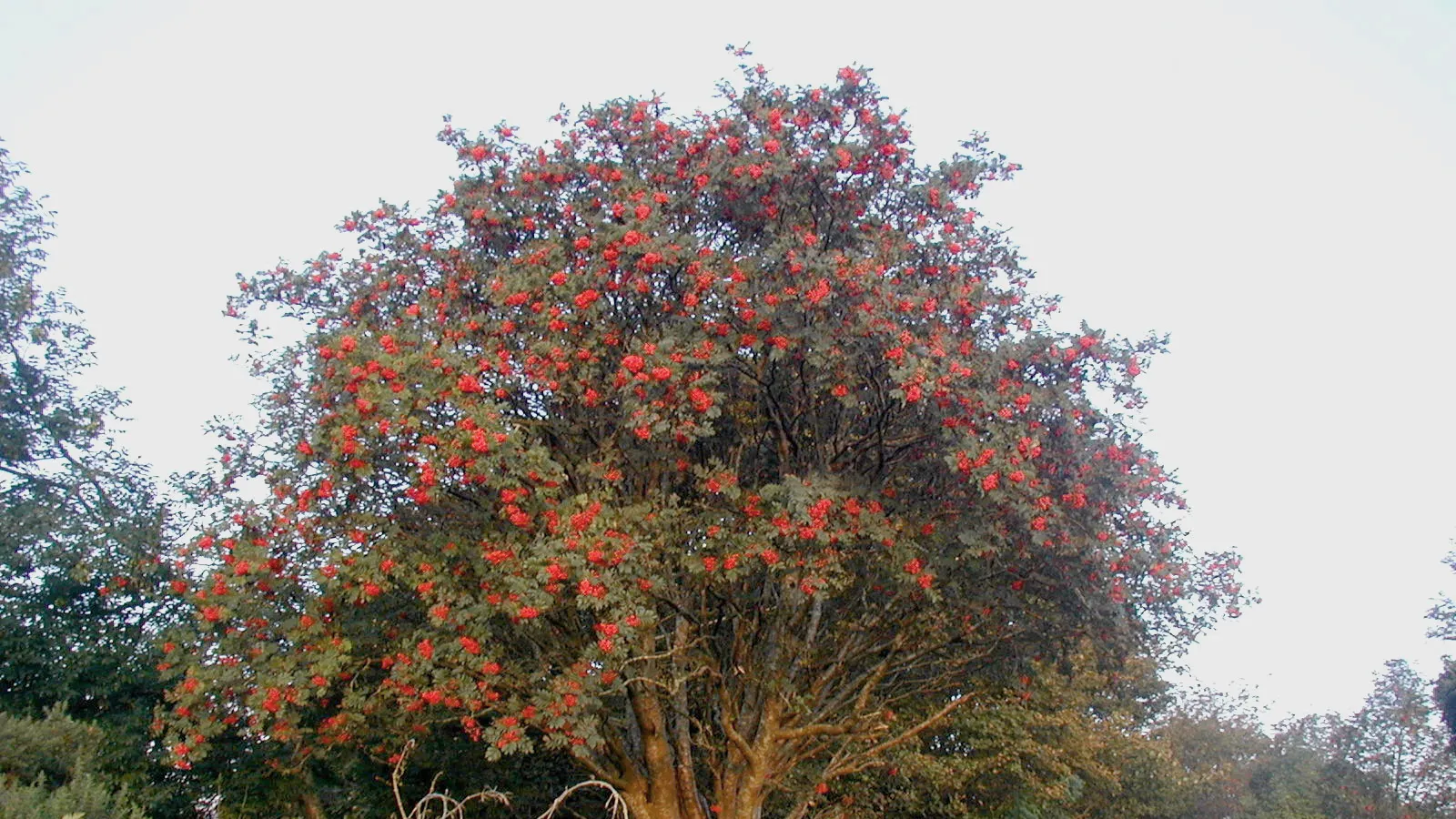

Rowan (Sorbus aucuparia)
Contents
TL;DR
- established Rowan can grow at higher altitudes than any other native British tree, with recorded specimens up to 1,000m in the Scottish Highlands, often surviving alone as a windswept, solitary tree where no other native tree can establish — a specific, documented elevation record this article states directly rather than a vague claim that rowan is "hardy."
- established Scottish folk tradition held rowan as powerful protection against witchcraft and enchantment: cattle were protected with rowan sprigs, crosses of rowan twig were sewn into clothing, and the old saying "Rowan tree and red thread, make the witches tine their speed" was widely known — a specific, documented strand of belief this article states directly rather than a vague reference to "folklore."
- established The berries themselves carry a natural five-pointed star marking at the base of each fruit, a pentagram-like pattern that reinforced the tree's protective reputation in folk belief — a specific, documented physical detail this article names directly rather than treating the plant's symbolic status as arbitrary.
- established Rowans growing out of reach in inaccessible rock crevices and crags were given a distinct name, "flying rowan," and credited with especially potent protective magic in traditions shared between Scotland and Scandinavia — a specific, documented variant of the belief this article states directly rather than treating all rowan folklore as uniform.
- established Rowan berries provide a genuinely important late-autumn food source for migratory and resident thrush species, including redwings, fieldfares, and waxwings arriving from Scandinavia, as well as blackbirds, mistle thrushes, redstarts, and song thrushes — a specific, named set of dependent bird species this article states directly rather than a vague claim that "birds eat the berries."
Key Facts
- Scientific name
- Sorbus aucuparia
- Also known as
- Mountain ash
- Category
- Trees
- Typical lifespan
- Up to 200 years
- Maximum height
- Up to 15m
- Elevation record
- Up to 1,000m — higher than any other native British tree
- Key dependent bird species
- Redwing, fieldfare, waxwing, blackbird, mistle thrush, redstart, song thrush
- Folk status
- Traditional protection against witchcraft and enchantment
Scottish Impact Index (SI Score)
- Scottish Significance
- 9/10
- Ecological Persistence
- 10/10
- Ecological Importance
- 8/10
- Botanical Distinctiveness
- 8/10
- Conservation Significance
- 7/10
- Recognition
- 9/10
51/60
Ranked =9th of 45 in Flora
A Note on Claims and Evidence
Biology, distribution, wildlife relationships, and elevation record details are drawn from the Woodland Trust's and Scottish Wildlife Trust's published species assessments. Folklore and traditional belief details, including the "flying rowan" tradition and protective dye and divination uses, are drawn from Trees for Life's published folklore record.
Timeline
Rowan establishes itself across cooler regions of the northern hemisphere, becoming particularly abundant in the Scottish Highlands, where it grows at higher altitudes than any other native British tree, often surviving as a solitary windswept specimen on exposed mountainsides, heathland, and woodland edges.
Rowan becomes deeply embedded in Scottish Highland and Irish folk tradition as protection against witchcraft and enchantment, with sprigs carried to protect cattle, crosses sewn into clothing, and trees deliberately planted near rural dwellings and left undamaged out of respect for their believed protective power; rowans growing in inaccessible rock crevices are given the distinct name "flying rowan" and credited with especially potent magic.
An Irish poem, "Deirdre Remembers a Scottish Glen", opens with a "Glen of rowans with scarlet berries".
Rowan boughs are hung over stables and byres in the Highlands, according to Richard Mabey.
Flora Britannica reports a continuing taboo against cutting down rowans near houses in parts of Scotland.
Rowan's bark and berries are used to produce a black dye for ceremonial purposes, and its twigs are used in traditional metal divination, while Highland taboos restrict most uses of the wood itself beyond its berries, reflecting the tree's distinct, semi-sacred status compared with ordinary timber species.
Rowan's hermaphrodite, creamy-white flowers open in dense clusters and are insect-pollinated, developing into scarlet berries by autumn that provide crucial late-season food for both resident birds and migratory thrushes arriving from Scandinavia.
Rowan remains a widespread and ecologically significant species across the Scottish uplands, valued both for its genuine ecological role supporting birds and pollinating insects and, in some restoration contexts, for its ability to colonise exposed, high-altitude ground where few other native trees can establish.
Details
An elevation record stated with its real specificity
This article names rowan's altitudinal tolerance precisely rather than a vague claim that the tree is "hardy": it can grow at higher altitudes than any other native British tree, with recorded specimens up to 1,000m in the Scottish Highlands, frequently surviving alone as a solitary, windswept tree where no other native species can establish. This article states this specific record directly because it is a genuinely distinctive ecological trait, not an incidental detail of the tree's range.
A protective folk tradition named with its real documented practices
This article states rowan's role in Scottish folk belief with real specificity rather than a vague reference to "folklore": sprigs were used to protect cattle from enchantment, crosses of rowan twig were sewn into clothing, and the saying "Rowan tree and red thread, make the witches tine their speed" was widely known. This article names these specific practices because they represent genuinely documented strands of belief, not a generalised sense that the tree was considered "lucky."
A physical detail that reinforced the tree's symbolic status
This article names the natural five-pointed star marking found at the base of each rowan berry directly, because this pentagram-like pattern is a real, observable physical feature of the fruit that reinforced the tree's protective reputation in folk tradition. This article states this detail because it clarifies that the symbolism was not arbitrary but anchored in something people could actually see on the plant itself.
A distinct, named variant within the wider folklore tradition
This article states directly that not all rowan folklore was uniform: rowans growing out of reach in inaccessible rock crevices and crags were given the specific name "flying rowan" and credited with especially potent protective magic, in a tradition shared between Scotland and Scandinavia. This article names this distinct variant because it shows the folklore had its own internal structure and hierarchy of significance, rather than treating every rowan tree as equally imbued with the same belief.
Rowan lore in Flora Britannica (1996)
established Names and practices. Richard Mabey, in Flora Britannica (1996), lists the vernacular names mountain-ash, witch wiggin tree, keirn and cuirn. He records that, up to the early twentieth century, rowan boughs were hung over stables and byres in the Highlands, while elsewhere the wood was used for stirring cream in the Lake District, for divining rods in Yorkshire and for pocket charms against rheumatism in Cornwall. He notes that it was the wood, more than the berries, that was regarded as the potent part of the tree.
established A taboo that outlived the belief. Mabey reports that in parts of Scotland there was still, in the 1990s, "a strong taboo against cutting down a rowan tree", especially close to houses. His most famous example is the rowan outside Gavin Maxwell's house at Camusfearna, the setting of Ring of Bright Water. The poet Kathleen Raine cursed the tree, and Maxwell believed the curse brought disastrous consequences.
established Rowan in Highland and Island charms. A contributor told Flora Britannica that in the Highlands and Islands ivy was plaited into wreaths with rowan and honeysuckle as a good-luck charm. These were hung on the lintel of the byre or hidden beneath the churn to keep evil from milk, butter and cows. In the Hebrides people went to great lengths to gather the plants; one man in the Uists regularly swam out to an island in a loch to collect them.
established A Scottish glen in early Irish poetry. Mabey quotes a fourteenth-century Irish poem, "Deirdre Remembers a Scottish Glen", which begins "Glen of rowans with scarlet berries", a reminder of how long the tree has stood for the Highland landscape in Gaelic literature.
shared Why rowan was thought protective. Explanations differ. Modern folklore accounts point to the five-pointed star at the base of each berry. Mabey suggests that the vivid red of the berries may first have given the tree its reputation, while noting that the wood was what people actually used. Both are reasonable guesses; neither is documented as the original reason.
established Food and play. Mabey notes that rowan berries, with a few crab-apples, make a sharp, marmalade-like jelly traditionally served with game and lamb. One contributor recalled children using rowan berries as toy "oranges" on leaf plates.
A genuine ecological role for migratory and resident birds
This article names rowan's wildlife relationships with specific dependent species rather than a vague claim that "birds eat the berries": redwings, fieldfares, and waxwings arriving from Scandinavia rely on the autumn berry crop alongside resident blackbirds, mistle thrushes, redstarts, and song thrushes, while the flowers separately support bees and other pollinating insects. This article states this specific set of species because it demonstrates rowan's genuine, measurable importance to both migratory and resident bird populations, not an incidental or occasional food source.
Did You Know?
- Rowan can grow at higher altitudes than any other native British tree, with specimens recorded up to 1,000m in the Scottish Highlands.
- Each rowan berry carries a natural five-pointed star marking at its base, a detail that reinforced the tree's protective symbolism in folklore.
- Scottish tradition held that rowan protected against witchcraft — sprigs guarded cattle, and crosses of rowan twig were sewn into clothing.
- Rowans growing in inaccessible rock crevices were given their own name, "flying rowan," and credited with especially potent magic.
- Highland taboos traditionally restricted use of rowan wood beyond its berries, reflecting its semi-sacred status.
- Rowan's bark and berries were used to produce a black dye for ceremonial purposes.
- Migratory thrushes including redwings, fieldfares, and waxwings rely on rowan berries as an important autumn food source after arriving from Scandinavia.
- Rowan can live up to 200 years and grow to 15m tall.
- Gavin Maxwell believed that Kathleen Raine's curse on the rowan outside his house at Camusfearna brought him disaster.
- In the Hebrides, wreaths of ivy, rowan and honeysuckle were hidden beneath the churn to keep evil from the butter.
FAQ
1Why is rowan also called "mountain ash"?
Because of its ash-like pinnate leaves and its ability to grow at higher altitudes than any other native British tree — up to 1,000m in the Scottish Highlands — though it is unrelated to true ash trees.
2What is the folklore connection between rowan and witches?
Scottish tradition held that rowan protected against witchcraft and enchantment — sprigs guarded cattle, crosses of rowan twig were sewn into clothing, and trees were planted near homes for protection.
3What is a "flying rowan"?
A rowan growing out of reach, in an inaccessible rock crevice or crag, believed in Scottish and Scandinavian tradition to carry especially potent protective magic.
4Why do rowan berries have a star shape on them?
Each berry carries a natural five-pointed, pentagram-like marking at its base, which reinforced the tree's protective symbolism in folk belief.
5What birds depend on rowan berries?
Migratory thrushes including redwings, fieldfares, and waxwings arriving from Scandinavia, alongside resident blackbirds, mistle thrushes, redstarts, and song thrushes.
6Can rowan berries be eaten by people?
Yes, when cooked — they are sour but rich in vitamin C and commonly used to make jam or jelly.
7Was all rowan wood used freely in Highland tradition?
No — Highland taboos traditionally restricted most uses of the wood itself, with the berries being the main permitted use, reflecting the tree's distinct, semi-sacred status.
8How long can rowan trees live?
Up to around 200 years, reaching heights of up to 15m.
9Is it still considered unlucky to cut down a rowan?
In parts of Scotland, yes. Richard Mabey's Flora Britannica (1996) reported a strong taboo against felling rowans, especially near houses.
10What happened to Gavin Maxwell's rowan?
The poet Kathleen Raine cursed the rowan outside his house at Camusfearna, and Maxwell believed the curse brought him misfortune, as Mabey records.
11What old names does rowan have?
Mountain-ash, witch wiggin tree, keirn and cuirn are among the names Mabey lists; cuirn was still in wide use on the Isle of Man.
Sources and Further Reading
Primary/Institutional
Scholarly/Critical
- Rowan tree mythology and folklore — Trees for Life
- Rowan — Plant-lore.com
- Richard Mabey, Flora Britannica (Sinclair-Stevenson, 1996).
General
Caveats: Myths and Disputed Claims
- Clarification: This article does not treat all rowan folklore as uniform; the "flying rowan" tradition specifically singled out inaccessible trees as carrying heightened protective significance, distinct from ordinary rowans.
- Note: This article does not present rowan's protective symbolism as arbitrary, but the star-shaped marking on each berry is only one suggested explanation; Richard Mabey points instead to the berries' colour, and to the wood as the part people trusted.
- Do not state as fact that the berry's star marking is the origin of rowan's protective reputation; the origin is not documented.
Card 012 · Flora