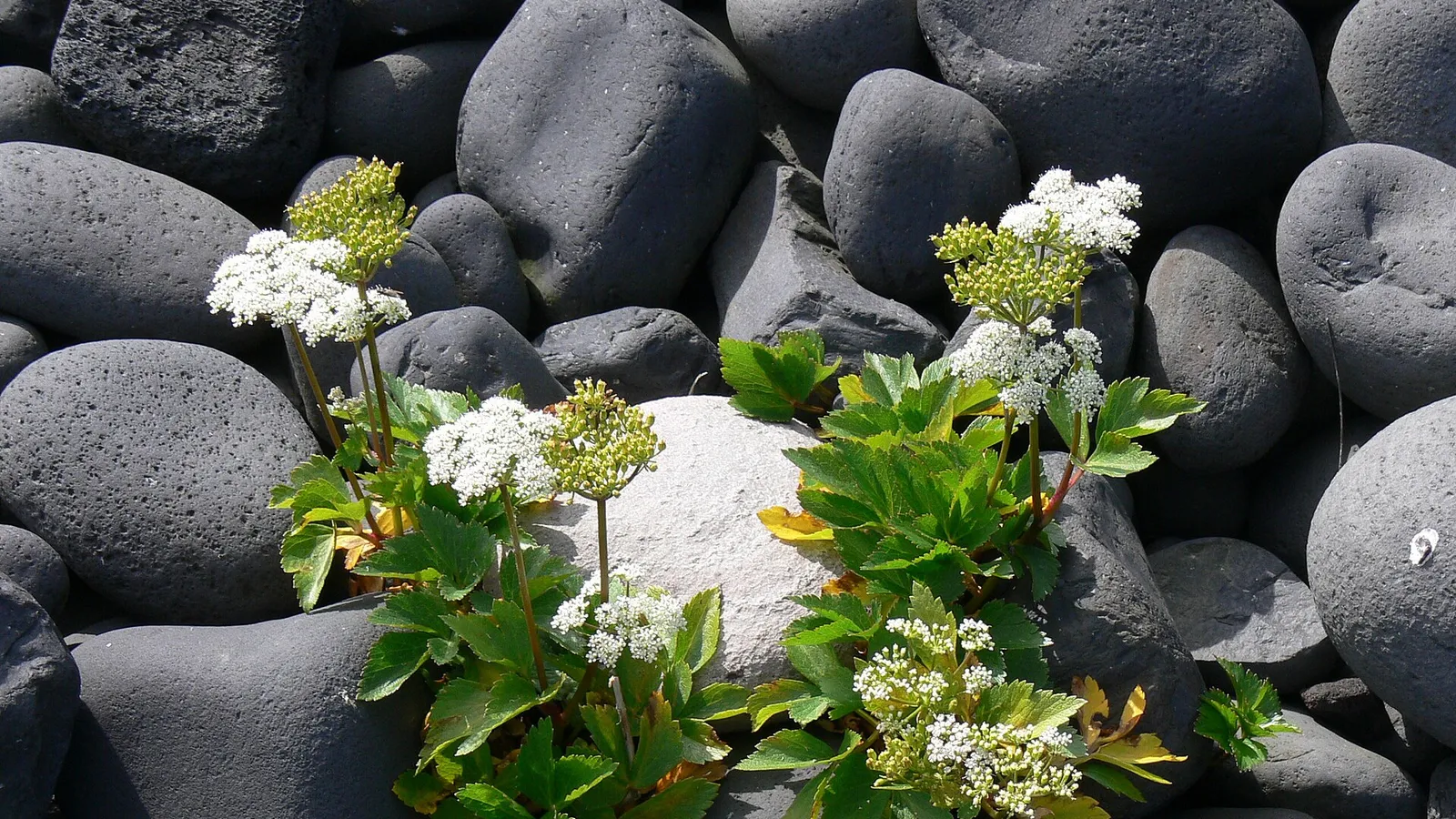

Scots Lovage (Ligusticum scoticum)
Contents
TL;DR
- established Within the British Isles, Scots lovage only survives where the mean July temperature remains below 15°C, a precise documented climatic constraint that confines the species to the more northerly shores of Britain, with its southernmost occurrence recorded at Ballyhalbert in Northern Ireland — a specific, quantified habitat limit this article states directly rather than a vague claim that the plant "prefers cooler climates."
- established Scots lovage was formerly widely eaten across western Britain, valued both for nutrition and specifically to combat scurvy, with its vitamin A- and C-rich leaves and stalks eaten raw or cooked like celery, young shoots sometimes candied, and leaves brewed as tea — a specific, documented historical dietary and anti-scurvy use this article names directly rather than a vague reference to the plant's "traditional uses."
- established The species occupies a genuinely disjunct Arctic range, found from northern Norway to the more northerly shores of the British Isles, and separately from western Greenland to New England, a specific, documented distribution pattern this article states directly rather than a vague claim that the plant is "found in cold northern regions."
- established Scots lovage can colonise bare fissures in coastal rock, sometimes as the only vascular plant able to establish there, and also grows in cliff-top grassland dominated by red fescue and sea plantain, tolerating salt spray and even responding positively to dilute seawater exposure — a specific, documented ecological tolerance this article names directly rather than a vague claim that the plant is "coastal."
- established The species' very name carries a documented spelling quirk from its original scientific description: Linnaeus first used the epithet "scothicum" in 1753, a spelling North American botanists retained while European botanists later amended it to the now-standard "scoticum" — a specific, documented point of taxonomic history this article states directly rather than presenting the plant's scientific name as having a single, uncomplicated origin.
Key Facts
- Scientific name
- Ligusticum scoticum
- Category
- Flora
- Plant family
- Apiaceae (celery family)
- Growth height
- 15–60cm
- UK climatic limit
- Mean July temperature below 15°C
- Southernmost UK/Ireland site
- Ballyhalbert, Northern Ireland
- Historical use
- Food and anti-scurvy source, western Britain
- Key habitat
- Coastal rock fissures, cliff-top grassland
Scottish Impact Index (SI Score)
- Scottish Significance
- 8/10
- Ecological Persistence
- 6/10
- Ecological Importance
- 6/10
- Botanical Distinctiveness
- 9/10
- Conservation Significance
- 9/10
- Recognition
- 5/10
43/60
Ranked =39th of 45 in Flora
A Note on Claims and Evidence
Biology, taxonomic naming history, Arctic distribution, UK climatic limit, habitat ecology, and historical scurvy-related dietary use are drawn from the species' Wikipedia-summarised research record. Additional culinary and medicinal traditional-use details are drawn from the Plants For A Future database.
Timeline
Carl Linnaeus first formally describes the species in Species Plantarum, using the epithet "scothicum," a spelling later retained by North American botanists while European botanists amend it to the now-standard "scoticum."
Scots lovage establishes itself across a genuinely disjunct Arctic range, from northern Norway to the more northerly shores of the British Isles, and separately from western Greenland to New England, colonising bare coastal rock fissures and cliff-top grassland and tolerating salt spray exposure.
The plant is formerly widely eaten across western Britain, valued both for nutrition and specifically to combat scurvy, with leaves and stalks eaten raw or cooked like celery, young shoots sometimes candied, roots eaten fresh or cooked, and seeds ground as a pepper substitute; the root is also used in traditional remedies for digestive complaints, and seeds are valued for their carminative properties.
Scots lovage's role as a cultivated pot herb largely declines as it is supplanted by celery, though the species continues to grow wild along its northern coastal range.
Within the British Isles, the species survives specifically where the mean July temperature remains below 15°C, a precise climatic constraint confining it to the more northerly shores, with its southernmost known occurrence at Ballyhalbert in Northern Ireland.
Scots lovage remains a characteristic plant of Scotland's rocky northern coasts, persisting both as a genuine wild survivor of a once-wider culinary tradition and as a species whose documented climatic tolerance closely tracks the cooler edge of Britain's coastline.
Details
A climatic limit stated with its real documented precision
This article names Scots lovage's British distribution boundary with real specificity rather than a vague claim that the plant "prefers cooler climates": within the British Isles, it survives only where the mean July temperature remains below 15°C, confining it to the more northerly shores, with its southernmost occurrence recorded at Ballyhalbert in Northern Ireland. This article states this precise temperature threshold because it represents a genuinely quantified climatic constraint, not a general impression of northern hardiness.
A historical dietary use named with its real documented purpose
This article states Scots lovage's historical culinary significance directly rather than a vague reference to the plant's "traditional uses": formerly widely eaten across western Britain both for nutrition and specifically to combat scurvy, with its vitamin-rich leaves and stalks eaten raw or cooked like celery. This article names this specific anti-scurvy use because it demonstrates a genuine, documented nutritional necessity behind the plant's historical consumption, not an incidental or purely culinary tradition.
A disjunct Arctic range stated with its real geographic structure
This article names Scots lovage's distribution pattern precisely rather than a vague claim that the plant is "found in cold northern regions": a genuinely disjunct range extending from northern Norway to the more northerly shores of the British Isles, and separately from western Greenland to New England. This article states this specific, split geographic structure because it reflects a real, documented biogeographic pattern, not a single continuous range.
An ecological tolerance named through its real documented extremes
This article states Scots lovage's habitat tolerance with real specificity rather than a vague claim that the plant is "coastal": it can colonise bare fissures in coastal rock, sometimes as the only vascular plant able to establish there, and also grows in cliff-top grassland, tolerating salt spray and responding positively to dilute seawater. This article names these specific conditions because they demonstrate a genuinely extreme ecological tolerance, not a general preference for seaside habitat.
A naming history acknowledged rather than simplified
This article names the documented spelling history behind Scots lovage's scientific epithet directly rather than presenting the plant's name as having a single, uncomplicated origin: Linnaeus's original 1753 spelling, "scothicum," was retained by North American botanists while European botanists later amended it to "scoticum." This article states this detail because it reflects genuine, documented taxonomic history, not a simplification of how the species came to be named.
Scots lovage in Flora Britannica
established Richard Mabey's Flora Britannica (1996) gives Scots lovage only a brief entry, as a native of rocky places by the sea in Scotland. It is more useful for a distinction. Garden lovage, Levisticum officinale, is a different plant: a tall culinary herb originally from Iran (Mabey's attribution) that occasionally survives in dry places as a relic of old gardens. Recipes and herbals that simply say "lovage" usually mean the garden plant, so they are not evidence for the wild Scottish one.
established Peter Marren's appendix on Scottish vernacular plant names in the same book records that where the wild plant is known, it is usually called just lovage, not "Scottish lovage", and occasionally sea parsley. "Scots lovage" is in practice a book name used to separate it from the garden herb.
Did You Know?
- Within the British Isles, Scots lovage survives only where the mean July temperature stays below 15°C.
- Its southernmost UK/Ireland site is Ballyhalbert, Northern Ireland.
- The plant was formerly widely eaten across western Britain, specifically to help combat scurvy.
- Its leaves and stalks taste similar to celery, while its seeds taste more like fenugreek or cumin.
- Scots lovage can grow in bare coastal rock fissures where it's sometimes the only vascular plant present.
- The species has a genuinely split, disjunct range — from Norway to northern Britain, and separately from Greenland to New England.
- Linnaeus originally spelled the species name "scothicum" in 1753; European botanists later amended it to "scoticum."
- People who know the wild plant in Scotland usually just call it lovage, and occasionally sea parsley.
- Garden lovage is a different plant, Levisticum officinale, which only turns up wild as a garden relic.
FAQ
1Why does Scots lovage only grow in Scotland's north and not further south in Britain?
Because within the British Isles it only survives where the mean July temperature stays below 15°C, a precise documented climatic limit.
2Was Scots lovage eaten historically?
Yes — it was formerly widely eaten across western Britain, valued for nutrition and specifically to help prevent scurvy, with leaves eaten like celery and seeds used as a pepper substitute.
3Where does Scots lovage grow globally?
It has a disjunct Arctic range — from northern Norway to northern Britain, and separately from Greenland to New England.
4What kind of coastal habitat does it tolerate?
Extreme conditions — it can grow in bare rock fissures, sometimes the only vascular plant able to establish there, and tolerates salt spray and dilute seawater exposure.
5Why does the scientific name have two different spellings historically?
Linnaeus originally spelled it "scothicum" in 1753; North American botanists kept this spelling, while European botanists later amended it to "scoticum," the now-standard form.
6What does Scots lovage taste like?
Its leaves taste similar to celery or parsley, while its seeds taste more like fenugreek or cumin.
7Is Scots lovage still eaten today?
Rarely as a cultivated crop — it was largely supplanted by celery — though it remains a wild coastal plant across its northern range.
8Is Scots lovage the same as the lovage sold as a herb?
No. Garden lovage is Levisticum officinale, a taller culinary plant. Richard Mabey's Flora Britannica (1996) notes that it only occasionally persists in the wild as a relic of cultivation.
9What do Scots call it?
Peter Marren's appendix to Flora Britannica records that it is usually just "lovage", not "Scottish lovage", and occasionally "sea parsley".
Sources and Further Reading
Primary/Institutional
- Ligusticum scoticum — Wikipedia
- British Wild Plant: Ligusticum scoticum Scots Lovage — UK Wildflowers
Scholarly/Critical
- Ligusticum scoticum Scottish Lovage — Plants For A Future database
- Ligusticum scoticum Scots Lovage — Northern Ireland's Priority Species
- Richard Mabey, Flora Britannica (Sinclair-Stevenson, 1996), including Peter Marren's appendix on Scottish vernacular plant names.
General
Caveats: Myths and Disputed Claims
- Clarification: This article does not treat the spelling "scoticum" as the plant's only historically used scientific epithet; Linnaeus's original 1753 spelling was "scothicum," still used by North American botanists.
- Note: This article does not describe Scots lovage as simply "cold-tolerant"; its British distribution follows a specific, documented climatic threshold — a mean July temperature below 15°C.
- Do not use recipes or herbal entries for plain "lovage" as evidence about Scots lovage; they usually mean garden lovage, Levisticum officinale.
- Do not read the traditional food and remedy uses above as advice to forage or self-treat. Scots lovage is a member of the carrot family, which includes poisonous look-alikes.
Card 030 · Flora