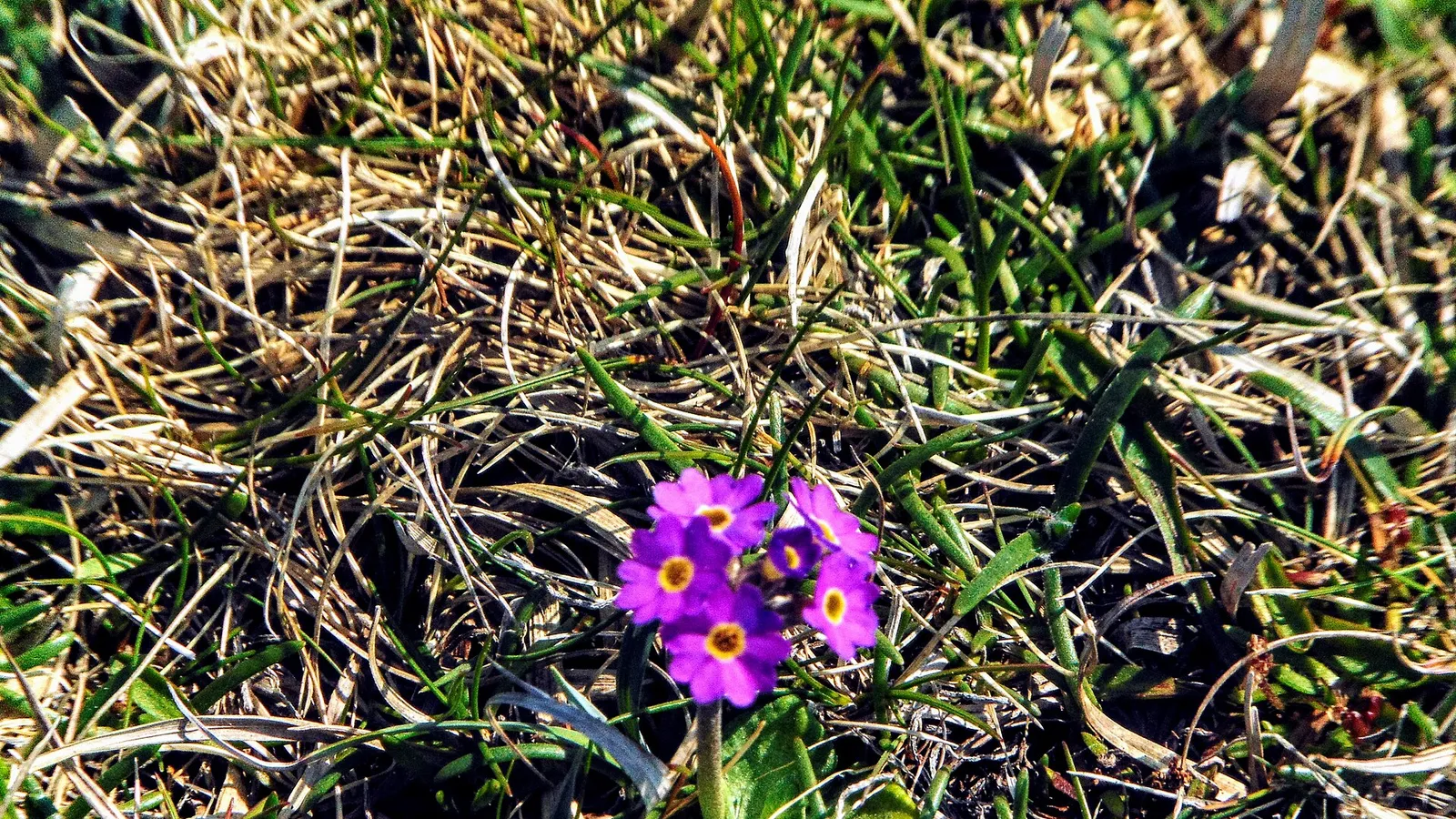

Scottish Primrose (Primula scotica)
Contents
TL;DR
- established The Scottish primrose grows naturally nowhere else on Earth, confined entirely to a narrow coastal strip of Caithness, Sutherland, and Orkney — a specific, documented global endemism this article states directly rather than a vague claim of rarity.
- established The species flowers twice each year, with a first bloom in early spring and a second in summer, though not every individual plant flowers in both periods — a specific, documented reproductive pattern this article names directly rather than describing a single generic flowering season.
- established The Scottish primrose has notably low genetic diversity and reproduces primarily through self-fertilisation, though cross-pollination by insects, when it occurs, produces longer-lived, more vigorous plants — a specific, documented reproductive biology this article states directly because it is relevant to the species' resilience under environmental pressure.
- disputed A 2009 survey found 194 populations and recorded that 75 populations present in earlier surveys had been lost, while separately finding that 95% of surveyed sites showed unchanged or increased plant numbers compared with 1985 figures — this article states both findings directly rather than resolving them into one simple trend, since the loss of entire populations and the stability or growth of plant numbers at surviving sites are different measures that can genuinely diverge.
- established The Scottish primrose served as the original emblem of the Scottish Wildlife Trust and is the designated county flower of Caithness — a specific, documented cultural significance this article names directly, reflecting the plant's status as a genuine symbol of Scottish nature conservation itself.
Key Facts
- Scientific name
- Primula scotica
- Category
- Endemics
- Global range
- Caithness, Sutherland, Orkney — nowhere else on Earth
- Flowering pattern
- Twice yearly: early spring and summer
- Populations recorded (2009 survey)
- 194
- Population size range
- Under 100 to ~100,000 plants per site
- Cultural status
- Original Scottish Wildlife Trust emblem; county flower of Caithness
Scottish Impact Index (SI Score)
- Scottish Significance
- 10/10
- Ecological Persistence
- 7/10
- Ecological Importance
- 6/10
- Botanical Distinctiveness
- 10/10
- Conservation Significance
- 10/10
- Recognition
- 8/10
51/60
Ranked =9th of 45 in Flora
A Note on Claims and Evidence
Distribution, habitat, flowering pattern, and genetic diversity details are drawn from NatureScot's and the Scottish Wildlife Trust's published assessments. Population survey figures, including the apparent tension between population loss and site-level stability, are drawn directly from the Scottish Wildlife Trust's published 2009 survey summary, which itself reports both findings without fully reconciling them.
Timeline
The Scottish primrose establishes itself as part of an Arctic-alpine polyploid complex, with research pointing to a reticulate (hybrid-involving) evolutionary origin rather than simple single-lineage descent.
The species becomes established exclusively along the northern coasts of Caithness and Sutherland and across Orkney, nowhere else in the world, favouring windswept cliff-top and short-turf coastal habitats where strong winds and grazing suppress taller competing vegetation.
A national survey establishes a population baseline against which later surveys are measured.
A follow-up survey records 194 populations spanning from Durness in Sutherland to Dunbeath in northeastern Caithness, finding that 75 populations recorded in earlier surveys had been lost, while separately finding that 95% of surveyed sites held unchanged or increased plant numbers compared with the 1985 baseline.
Conservation management, including winter-month grazing to maintain short vegetation while excluding livestock during the summer flowering period, is applied at key sites such as the Hill of White Hamars reserve, supported by Plantlife Scotland's Important Plant Area designation and funding through the Scottish Rural Development Programme.
The Scottish primrose remains legally protected, confined entirely to its historic northern Scottish range, with its overall population considered relatively stable since the 1960s despite documented site-level losses and significant local variation.
Details
A global endemism stated with its real geographic precision
This article names the Scottish primrose's range with real specificity rather than a vague claim of rarity: found naturally nowhere else on Earth, confined entirely to the coasts of Caithness, Sutherland, and Orkney. This article states this directly because it represents a genuine, complete global endemism, not simply a Scottish speciality found more thinly elsewhere.
A flowering pattern named with its real mechanism
This article states the species' reproductive timing precisely rather than describing a single flowering season: a first bloom in early spring and a second in summer, though not every individual plant flowers in both periods. This article names this twice-yearly pattern directly because it is a specific, documented biological trait distinguishing the species from most other primroses.
A reproductive biology relevant to the species' resilience
This article names the Scottish primrose's genetic and reproductive profile with real specificity: notably low genetic diversity, reproduction primarily through self-fertilisation, with insect cross-pollination, when it occurs, producing longer-lived, more vigorous plants. This article states this mechanism directly because it clarifies a genuine vulnerability — a genetically narrow, largely self-fertilising species may have less capacity to adapt to changing conditions than a more genetically diverse one.
A genuine tension between two measures of population status
This article treats directly, rather than resolving into a single trend, a real discrepancy in the 2009 survey's own findings: 75 populations recorded in earlier surveys were found to have been lost, while separately, 95% of surveyed sites held unchanged or increased plant numbers compared with the 1985 baseline. This article states both findings because they measure genuinely different things — the number of distinct populations occupying the landscape, and the number of plants at populations that have survived — and a reader could reasonably draw either a concerning or a reassuring impression depending on which figure they focus on; this article presents both rather than selecting the more convenient one.
How Flora Britannica placed it
established Richard Mabey, in Flora Britannica (1996), gives the Scottish primrose only a few lines, inside his long account of the primrose family. He describes it as "like a smaller bird's-eye primrose", one of Britain's few endemic species, confined to damp grassy places near the sea in northern Scotland. That matches the range given above. The comparison is useful. Bird's-eye primrose (Primula farinosa) is its nearest British relative, a plant of lime-rich flushes in the northern Pennines and Lake District, and the two share the same mealy leaves and small pink-purple flowers. The Scottish plant is smaller, and its flowers are a deeper purple.
established The book records no local name, custom or use for the plant. That is notable because Flora Britannica was built from thousands of contributions from the public, and its section on Scottish vernacular names, compiled by Peter Marren, lists many names still in use in Orkney and Caithness for other plants. The Scottish primrose's fame is botanical and modern, a matter of endemism and conservation, rather than of folk tradition.
A cultural status stated with its real specificity
This article names the Scottish primrose's documented cultural significance directly: it served as the original emblem of the Scottish Wildlife Trust and is the designated county flower of Caithness. This article states this because it reflects the plant's genuine status as a symbol of Scottish nature conservation itself, not an incidental botanical fact.
Did You Know?
- The Scottish primrose grows naturally nowhere else on Earth except Caithness, Sutherland, and Orkney.
- It flowers twice a year — once in early spring and again in summer.
- The species has notably low genetic diversity and mostly self-fertilises, though insect-pollinated plants live longer and grow more vigorously.
- A 2009 survey found 194 populations, but also recorded that 75 populations known from earlier surveys had been lost.
- Despite this, 95% of surveyed sites held the same or more plants than in 1985 — a genuine tension between two measures of the species' status.
- Population sizes at individual sites range enormously, from under 100 plants to as many as 100,000.
- The flower was the original emblem of the Scottish Wildlife Trust and is the county flower of Caithness.
- Richard Mabey's Flora Britannica (1996), built from thousands of public contributions, recorded no folk name or custom for it.
FAQ
1Is the Scottish primrose found anywhere outside Scotland?
No — it grows naturally nowhere else on Earth, confined to Caithness, Sutherland, and Orkney.
2How often does it flower?
Twice a year — a first bloom in early spring and a second in summer, though not every plant flowers both times.
3Is the species genetically diverse?
No — it has notably low genetic diversity and reproduces mostly through self-fertilisation, though insect-pollinated plants are more vigorous.
4Is the Scottish primrose declining?
This depends on the measure — a 2009 survey found 75 populations had been lost since earlier surveys, but also found 95% of surviving sites held stable or increasing plant numbers.
5What threats does it face?
Inappropriate grazing (both too much and too little), agricultural intensification, land development, and sensitivity to severe winters, particularly affecting young seedlings.
6How is it being conserved?
Through targeted management such as winter-only grazing to keep vegetation short while protecting the plants during summer flowering, supported by designated Important Plant Area status and government funding.
7Why is grazing both a threat and a conservation tool?
Too little grazing allows taller, more vigorous plants to outcompete the primrose, while grazing at the wrong time of year can damage flowering plants directly — the timing of grazing, not grazing itself, is what matters.
8What is its connection to the Scottish Wildlife Trust?
It was the Trust's original emblem and remains the county flower of Caithness.
9What is its closest British relative?
Bird's-eye primrose, Primula farinosa, of the northern Pennines and Lake District. Richard Mabey's Flora Britannica (1996) describes the Scottish primrose as a smaller version of it.
Sources and Further Reading
Primary/Institutional
Scholarly/Critical
- Low genetic diversity in the Scottish endemic Primula scotica — New Phytologist (Wiley)
- Primula scotica — Wikipedia
- Richard Mabey, Flora Britannica (Sinclair-Stevenson, 1996).
General
Caveats: Myths and Disputed Claims
- Clarification: This article does not resolve the apparent tension between the documented loss of 75 populations and the finding that 95% of surviving sites held stable or increasing plant numbers; both are stated directly as genuine, differently-measured findings from the same survey.
- Note: This article does not treat grazing as simply good or bad for the species; its effect depends specifically on timing and intensity, with both too much and too little grazing identified as documented threats.
Card 001 · Flora