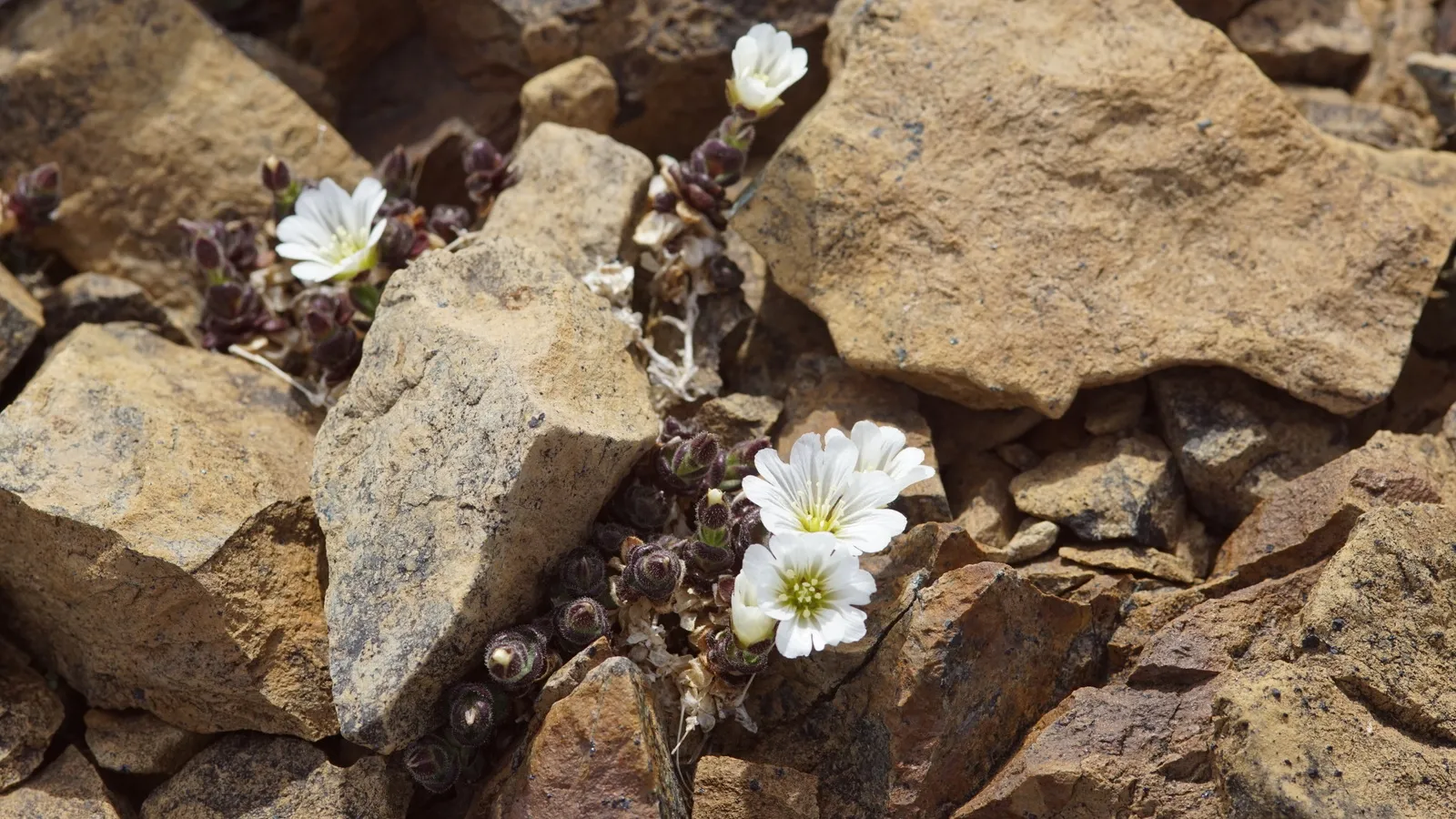

Shetland Mouse-ear (Cerastium nigrescens var. nigrescens)
Contents
TL;DR
- established The Shetland mouse-ear was first recorded in 1837 by Thomas Edmondston, a botanist then aged just 12, and has since contracted from several documented 19th-century sites to just two serpentine hills on the island of Unst — a specific, documented range contraction this article states directly rather than treating the plant's extreme rarity as always having been this narrow.
- established The species is restricted to serpentine, or ultramafic, substrate — a distinctive, chromium metal-rich soil type found at its core site, the Keen of Hamar National Nature Reserve — a specific, documented ecological dependency this article names directly rather than a vague reference to "unusual ground."
- established Plant form varies dramatically across individuals, from single shoots bearing a single flower to cushion-like formations producing around 40 flowers, which appear disproportionately large relative to the plant's overall size — a specific, documented physical trait this article states directly rather than a vague description of a small flower.
- established Population numbers fluctuate substantially from year to year, most likely reflecting varying rates of seedling germination and survival, yet the underlying long-term trend has been assessed as stable with no further range contraction observed in recent survey periods — this article states both the volatility and the underlying stability directly because treating the year-to-year fluctuation alone as evidence of decline would misrepresent what longer-term monitoring actually shows.
- established The Keen of Hamar holds dual statutory protection, both as a Site of Special Scientific Interest and, since 2005, as a Special Area of Conservation — a specific, documented legal protection regime this article names directly, reflecting the exceptional international rarity of the serpentine plant community it supports.
Key Facts
- Scientific name
- Cerastium nigrescens var. nigrescens
- Category
- Endemics
- Global range
- Two serpentine hills on Unst, Shetland — nowhere else on Earth
- First recorded
- 1837, by Thomas Edmondston, aged 12
- Core habitat
- Keen of Hamar National Nature Reserve (serpentine/chromium-rich soil)
- Flower count per plant
- 1 to ~40, depending on plant form
- Legal protection
- SSSI; Special Area of Conservation (since 2005)
Scottish Impact Index (SI Score)
- Scottish Significance
- 10/10
- Ecological Persistence
- 5/10
- Ecological Importance
- 5/10
- Botanical Distinctiveness
- 10/10
- Conservation Significance
- 10/10
- Recognition
- 5/10
45/60
Ranked =29th of 45 in Flora
A Note on Claims and Evidence
Discovery history, distribution, physical variation, and population dynamics details are drawn from published botanical sources, including the species' Wikipedia-summarised research record. Geological and statutory protection details for the Keen of Hamar are drawn from published reserve and conservation designation sources.
Timeline
Thomas Edmondston, a botanist then aged 12, makes the first recorded observation of the Shetland mouse-ear.
The plant is documented from several additional sites beyond its present range.
The species' recorded range contracts significantly, eventually confined to just two serpentine hills on Unst, centred on the Keen of Hamar.
The Keen of Hamar is formally designated a Special Area of Conservation, adding to its existing Site of Special Scientific Interest status.
Population surveys record substantial year-to-year fluctuation in plant numbers, attributed most likely to varying rates of seedling germination and survival, while the underlying long-term population trend and range are assessed as stable.
The Shetland mouse-ear remains confined entirely to its serpentine stronghold on Unst, protected under dual statutory designations reflecting its status as one of Britain's rarest native plants.
Details
A discovery credited to its real, specific origin
This article names the Shetland mouse-ear's discovery history directly: first recorded in 1837 by Thomas Edmondston, a botanist then aged just 12. This article states this specific detail because it is a genuine, documented part of the species' scientific record, not an incidental footnote.
A range contraction stated honestly, not assumed static
This article states plainly that the species' current extreme restriction — just two serpentine hills on Unst — was not always its full historical range: it was documented from several additional sites during the 19th century before contracting to its present extent. This article names this contraction directly because treating the plant's rarity as an unchanging, timeless fact would misrepresent a genuine, documented historical range loss.
A specific soil dependency, not a vague habitat preference
This article names the Shetland mouse-ear's ecological requirement precisely rather than vaguely: serpentine, or ultramafic, substrate, a distinctive chromium metal-rich soil type found at the Keen of Hamar. This article states this specific geological dependency because it explains directly why the species cannot simply be found or introduced elsewhere — its survival is tied to an unusual soil chemistry occurring at very few locations on Earth.
A striking physical variation, named with its real range
This article presents the species' documented physical variability with real specificity: individual plants range from single shoots bearing a single flower to cushion-like formations producing around 40 flowers, disproportionately large relative to the plant's size. This article states this range directly because it is a genuine, documented botanical characteristic rather than an incidental detail.
Year-to-year volatility distinguished honestly from long-term trend
This article treats directly, rather than conflating, two different findings about the species' population: substantial year-to-year fluctuation in plant numbers, most likely driven by variable seedling germination and survival, alongside an underlying long-term trend assessed as stable with no further range contraction observed. This article states both because a single low-count year, read in isolation, could misleadingly suggest decline, when longer-term monitoring points to stability.
Did You Know?
- The Shetland mouse-ear was first recorded in 1837 by a 12-year-old botanist, Thomas Edmondston.
- It is now found nowhere on Earth except two serpentine hills on the island of Unst, Shetland.
- The species depends on a specific, chromium metal-rich soil type found at the Keen of Hamar.
- Individual plants vary enormously, from a single flower on a single shoot to cushion-like clusters of around 40 flowers.
- Population numbers fluctuate significantly year to year, but the long-term trend is assessed as stable.
- The Keen of Hamar holds dual legal protection as both a Site of Special Scientific Interest and a Special Area of Conservation.
- The species was documented from additional sites in the 19th century before its range contracted to its present extent.
FAQ
1Where is the Shetland mouse-ear found?
Nowhere else on Earth except two serpentine hills on the island of Unst, Shetland.
2Who first recorded the species?
Thomas Edmondston, a botanist then aged just 12, in 1837.
3Why is it restricted to such a small area?
It depends on serpentine, chromium-rich soil, a distinctive geological substrate found at very few locations worldwide.
4Was its range always this small?
No — it was documented from additional sites in the 19th century before contracting to its present two-hill range.
5Is the population declining?
Year-to-year numbers fluctuate substantially, but the underlying long-term trend is assessed as stable, with no further range contraction observed.
6Is the species legally protected?
Yes — the Keen of Hamar holds dual protection as a Site of Special Scientific Interest and, since 2005, a Special Area of Conservation.
7How much does an individual plant vary?
Dramatically — from a single shoot with one flower to a cushion-like plant with around 40 flowers.
8What causes the year-to-year population fluctuation?
It's most likely driven by varying rates of seedling germination and survival rather than any underlying decline.
Sources and Further Reading
Primary/Institutional
Scholarly/Critical
- Population dynamics of two Scottish Ultramafic (serpentine) rarities with contrasting life histories — Botanical Journal of Scotland (Taylor & Francis)
- Cerastium nigrescens — Wikipedia
General
Caveats: Myths and Disputed Claims
- Clarification: This article does not treat the species' present two-hill range as having always been its full extent; 19th-century records document additional sites now lost.
- Note: This article does not treat significant year-to-year fluctuation in plant counts as evidence of ongoing decline; longer-term monitoring assesses the underlying population trend as stable.
Card 002 · Flora