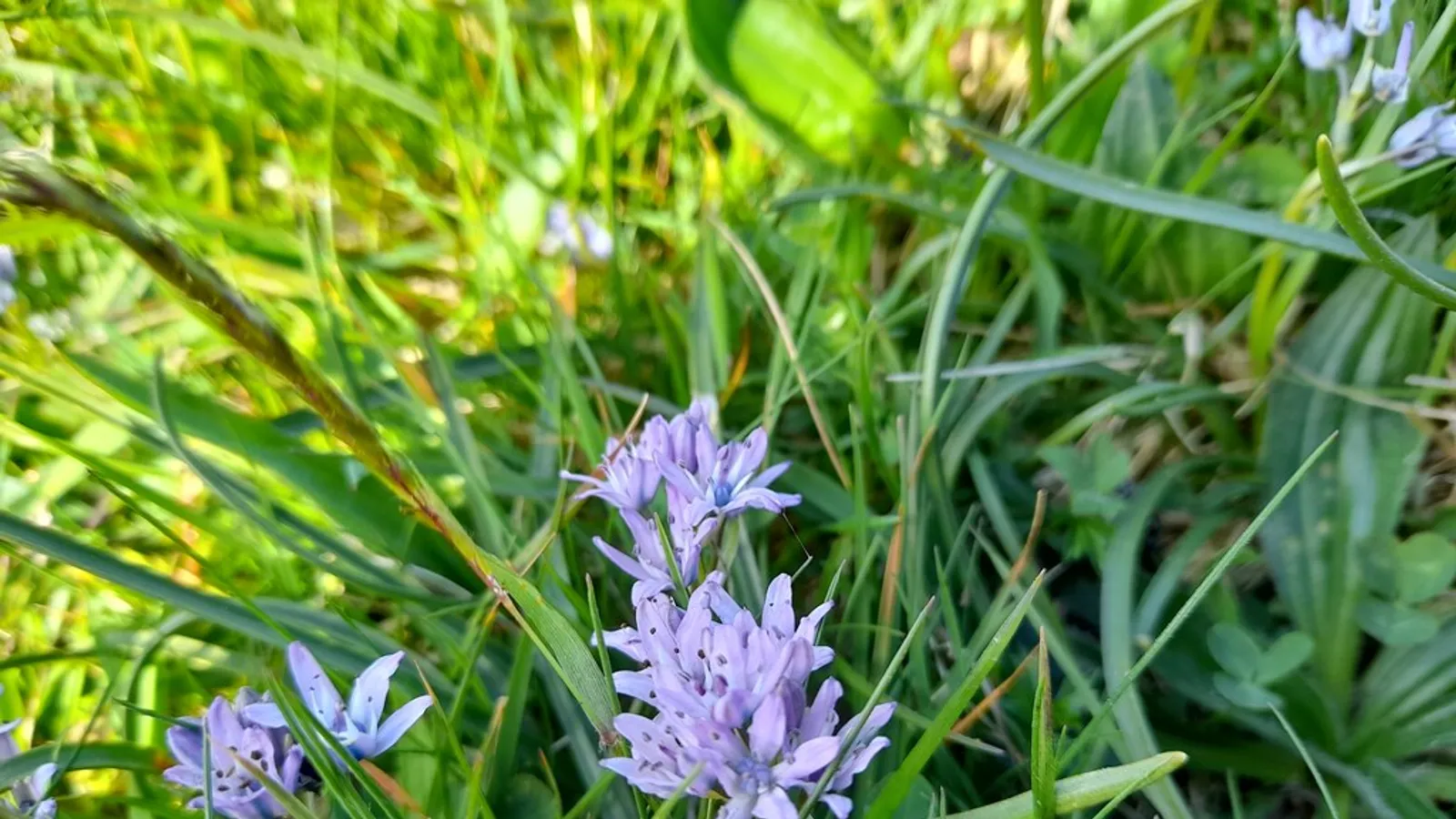

Spring Squill (Scilla verna)
Contents
TL;DR
- established Spring squill was long classified within the lily family, but DNA analysis has since reclassified it within the asparagus family, a genuine, documented taxonomic correction this article states directly rather than presenting the plant's family classification as settled and unchanging.
- established Spring squill thrives specifically on short-sward coastal grassland that has escaped cultivation and artificial fertiliser, with the species tending to grow most prolifically on ground well trodden by sheep — a specific, documented ecological relationship between grazing pressure and habitat suitability this article names directly rather than a vague claim that the plant "likes coastal grassland."
- established Within the UK, spring squill shows a markedly western and northern distribution, with strong populations recorded in Shetland, Orkney, and along the west coast of Scotland, alongside other western strongholds including the Isles of Scilly, Cornwall, Pembrokeshire, Anglesey, and the Isle of Man — a specific, documented geographic pattern this article states directly rather than a vague reference to the plant being "found around Britain's coasts."
- established Each spring squill flower is marked by a distinctive dark purple bract positioned directly beneath the bloom, a specific, documented physical feature this article names because it is a genuinely useful identifying detail distinguishing the species from similar small blue coastal flowers, not an incidental cosmetic trait.
- established Spring squill is low-growing and genuinely tolerant of salt spray, an adaptation that allows it to flourish on exposed maritime cliff-top and coastal path grassland where many other flowering plants cannot survive regular exposure to salt-laden wind and sea spray — a specific, documented physiological tolerance this article states directly rather than a vague claim that the plant is simply "coastal."
Key Facts
- Scientific name
- Scilla verna
- Category
- Flora
- Plant family
- Asparagaceae (reclassified from Liliaceae via DNA analysis)
- Growth height
- 10–15cm
- Flowers per spike
- 6–10, sky blue, star-shaped, 1–1.5cm
- Key UK strongholds
- Shetland, Orkney, west coast Scotland, Isles of Scilly, Pembrokeshire
- Flowering period
- March–August, best April–May (later in the north)
- Key habitat dependency
- Short-sward grassland maintained by sheep grazing
Scottish Impact Index (SI Score)
- Scottish Significance
- 8/10
- Ecological Persistence
- 8/10
- Ecological Importance
- 6/10
- Botanical Distinctiveness
- 8/10
- Conservation Significance
- 7/10
- Recognition
- 6/10
43/60
Ranked =39th of 45 in Flora
A Note on Claims and Evidence
Biology, flower structure, taxonomic reclassification, and grazing-dependent habitat details are drawn from First Nature's published species account. UK distribution and additional habitat and physical description details are drawn from the Wildlife Trusts' published species account.
Timeline
Spring squill establishes itself along Britain's western and northern coastlines, favouring short-sward coastal grassland shaped by grazing pressure, with notable strongholds developing in Shetland, Orkney, and along the west coast of Scotland, alongside further populations in Cornwall, Pembrokeshire, Anglesey, and the Isle of Man.
Sheep grazing on coastal grassland maintains the short, open sward spring squill depends on, with the species tending to grow most prolifically on ground well trodden by livestock, a documented ecological relationship between traditional land use and the plant's continued abundance.
DNA analysis reclassifies spring squill from the lily family into the asparagus family, correcting its long-standing historical classification.
Spring squill flowers from March through August, typically at its best in April and May, with later flowering recorded in northern populations, producing spikes of 6–10 sky-blue, star-shaped flowers, each marked by a distinctive dark purple bract beneath the bloom.
Spring squill remains a characteristic species of short-sward coastal grassland across its western and northern British strongholds, its low-growing, salt-tolerant form continuing to flourish on exposed cliff-top and coastal path ground that few other flowering plants can survive.
Details
A taxonomic correction stated as genuine and documented
This article names spring squill's reclassification directly rather than presenting its family classification as fixed: long placed within the lily family, DNA analysis has since reclassified the species within the asparagus family. This article states this correction because it reflects a genuine, documented revision in botanical understanding, not a trivial relabelling exercise.
A habitat dependency explained through its real grazing relationship
This article names the specific relationship between spring squill's habitat and grazing pressure rather than a vague claim that the plant "likes coastal grassland": it thrives on short-sward coastal grassland free of cultivation and artificial fertiliser, tending to grow most prolifically on ground well trodden by sheep. This article states this documented grazing relationship because it clarifies that the plant's abundance is tied to a specific traditional land-use pattern, not an assumed general preference for coastal turf.
A UK distribution stated with its real geographic specificity
This article names spring squill's British range precisely rather than a vague reference to the plant being "found around Britain's coasts": strong populations occur specifically in Shetland, Orkney, and along the west coast of Scotland, alongside other western strongholds including the Isles of Scilly, Cornwall, Pembrokeshire, Anglesey, and the Isle of Man. This article states this specific, markedly western and northern pattern because it demonstrates a genuinely uneven national distribution, not a species evenly spread around the entire coastline.
An identifying feature named for its real practical value
This article names the dark purple bract beneath each spring squill flower directly, because it is a genuinely useful identifying detail distinguishing the species from similar small blue coastal flowers, not an incidental cosmetic trait. This article states this specific feature because precise identification matters for a species whose flowers might otherwise be confused with related coastal wildflowers.
Part of the spring cliff display
established Richard Mabey, in Flora Britannica (1996), describes spring squill as a small native bulb with violet-blue flowers, often growing in great abundance on west-coast cliffs in company with thrift and sea campion. In his entry for sea campion he lists squill, thrift and early-purple orchid together as the spectacular spring display that adorns many sea-cliffs, especially on the western seaboard. That is the scene on many Scottish headlands in May, in Orkney and Shetland and down the west coast. The squill is rarely seen alone; it is one colour in a mixed sward.
shared Accounts differ on the colour. The modern sources above call the flowers sky blue, while Mabey calls them violet-blue. Both are fair. The shade varies between plants and in different light, and photographs tend to exaggerate the violet.
established Britain has a second native squill, autumn squill (Scilla autumnalis), which flowers in late summer and autumn. Mabey places it more or less in Devon and Cornwall only. Any small wild squill on a Scottish cliff in spring is therefore spring squill.
A salt tolerance stated with its real ecological consequence
This article names spring squill's genuine tolerance of salt spray directly rather than a vague claim that the plant is simply "coastal": this low-growing tolerance allows it to flourish on exposed maritime cliff-top and coastal path grassland where many other flowering plants cannot survive regular exposure to salt-laden wind and sea spray. This article states this specific physiological tolerance because it is the real mechanism explaining the plant's success in a habitat that excludes many competing species.
Did You Know?
- Spring squill was long classified in the lily family, but DNA analysis has since placed it in the asparagus family instead.
- It thrives specifically on short-sward coastal grassland maintained by sheep grazing, tending to grow most prolifically on well-trodden ground.
- Its UK range is markedly western and northern, with strong populations in Shetland, Orkney, and along Scotland's west coast.
- Each flower has a distinctive dark purple bract directly beneath the bloom, a useful identifying feature.
- The plant is genuinely tolerant of salt spray, letting it thrive on exposed cliff-top grassland few other flowers can survive.
- It flowers from March through August, typically peaking in April and May, with later blooming recorded in northern populations.
- Richard Mabey's Flora Britannica (1996) counts spring squill, thrift, sea campion and early-purple orchid as the classic spring display of western sea-cliffs.
- Britain's other native squill, autumn squill, is more or less confined to Devon and Cornwall.
FAQ
1What plant family does spring squill belong to?
The asparagus family — DNA analysis reclassified it there from its long-standing historical placement in the lily family.
2Why does spring squill favour grazed grassland?
It thrives specifically on short-sward coastal grassland free of cultivation and fertiliser, and tends to grow most prolifically on ground well trodden by sheep, which keeps the turf short and open.
3Where in Scotland is spring squill most common?
Shetland, Orkney, and the west coast of Scotland hold particularly strong populations.
4How can you identify spring squill?
By its sky-blue, star-shaped flowers arranged in spikes of 6–10 blooms, each marked by a distinctive dark purple bract directly beneath the flower.
5Why can spring squill grow right at the coast where other plants can't?
It's genuinely tolerant of salt spray, an adaptation that lets it thrive on exposed cliff-top and coastal path grassland.
6When does spring squill flower?
From March through August, usually peaking in April and May, with later flowering in northern populations.
7How tall does spring squill grow?
Typically 10–15cm.
8What does it grow with?
Thrift and sea campion above all, and often early-purple orchid, as Richard Mabey's Flora Britannica (1996) records for western sea-cliffs.
9Could a squill in Scotland be the autumn species?
Very unlikely. Mabey places autumn squill more or less in Devon and Cornwall only, and it flowers late in the year.
Sources and Further Reading
Primary/Institutional
- Scilla verna, Spring Squill: identification, distribution, habitat — First Nature
- Spring squill — The Wildlife Trusts
Scholarly/Critical
- British Wild Plant: Scilla verna Spring Squill — UK Wildflowers
- Scilla verna Huds. — Plants of the World Online, Kew
- Richard Mabey, Flora Britannica (Sinclair-Stevenson, 1996).
General
Caveats: Myths and Disputed Claims
- Clarification: This article does not present spring squill's lily-family classification as current; DNA analysis has reclassified the species within the asparagus family.
- Note: This article does not describe spring squill as evenly distributed around Britain's coastline; its range is markedly western and northern, with particular strongholds in Shetland, Orkney, and Scotland's west coast.
Card 028 · Flora