
The Caledonian Forest
Contents
TL;DR
- established At its maximum extent, around 5000 BCE, the Caledonian Forest covered an estimated 15,000 square kilometres (roughly 1.5 million hectares) of Scotland; today, documented remnants total only around 180 square kilometres, approximately 1.2% of the forest's original coverage — a specific, documented scale of loss this article states directly rather than a vague claim that Scotland's ancient forest has "shrunk."
- disputed The precise cause of the Caledonian Forest's historical decline remains a genuinely unresolved question among scholars: climate change around 2000 BCE, making Scotland's climate wetter and windier, played a documented role, but the relative contribution of subsequent human activity, including grazing by sheep and deer and historical felling for tanning, building, and urban development, remains actively debated, with some popularly repeated claims, such as large-scale English exploitation for charcoal or Napoleonic-era timber demand, lacking strong supporting evidence — this article presents this disagreement directly rather than assigning a single, settled cause.
- established Most of the forest's surviving fragments persist today specifically because the land they occupy was too steep, too rocky, or too remote to be agriculturally useful, meaning the Caledonian Forest's remnants exist largely as an accident of terrain rather than as a result of deliberate historical preservation — a specific, documented reason for survival this article states directly rather than presenting the surviving fragments as having been protected by design.
- established Recent survey work covering 71 of the 84 officially designated Caledonian Pinewood Inventory sites found that most remaining pinewoods lack key characteristics of health and resilience, with 23% now classified as critically threatened, and identified artificially large deer populations, driven by a lack of natural predators, as the single main barrier to the forest's natural recovery — a specific, documented current threat assessment this article names directly rather than treating the forest's survival as currently secure.
- established The Caledonian Forest remains the only British breeding habitat for several bird species, including the capercaillie, Scottish crossbill, crested tit, and parrot crossbill, while also supporting the Scottish wood ant, a species nearly exclusive to this forest type, even as other species once native to the forest, including brown bear, Eurasian lynx, grey wolf, and aurochs, are now extinct in Scotland — this article states both the forest's remaining unique significance and its documented historical losses together, rather than presenting only one side.
Key Facts
- Category
- Ecosystem
- Peak historical extent
- ~15,000 km² (~5000 BCE)
- Current remaining extent
- ~180 km² (~1.2% of original)
- Officially designated sites
- 84 (Scottish Government, 2019)
- Major surviving fragments
- Glen Affric, Abernethy, Glen Feshie, Rothiemurchus, Black Wood of Rannoch, Ballochbuie
- Main current barrier to recovery
- Artificially large deer populations
- Sites critically threatened
- 23% (of surveyed sites)
- UK-exclusive breeding birds
- Capercaillie, Scottish crossbill, crested tit, parrot crossbill
Scottish Impact Index (SI Score)
- Scottish Significance
- 10/10
- Ecological Persistence
- 8/10
- Ecological Importance
- 10/10
- Botanical Distinctiveness
- 10/10
- Conservation Significance
- 10/10
- Recognition
- 10/10
58/60
Ranked #3 of 45 in Flora
A Note on Claims and Evidence
Historical extent, the genuinely disputed causes of decline, current fragment extent and distribution, designated site figures, characteristic and extinct species, and the restoration/reintroduction record are drawn from Wikipedia's published research record. Current threat assessment, survey coverage, deer-population impact, and restoration approach are drawn from Trees for Life's published Caledonian Pinewood Recovery Project assessment.
Timeline
Scots pine arrives in Scotland following the Late Glacial period, beginning the establishment of what will become the Caledonian Forest.
The forest reaches its maximum historical extent, an estimated 15,000 square kilometres of Scots pine, birch, rowan, aspen, juniper, oak, and other hardy species.
Scotland's climate becomes wetter and windier, significantly reducing the forest's extent; from this point onward, grazing by sheep and deer combined with further climate shifts and historical felling continue to reduce the forest, with the precise balance of these causes remaining genuinely debated among scholars.
The forest's extent remains relatively stable at a much-reduced scale, its surviving fragments persisting largely on land too steep, rocky, or remote to be agriculturally useful.
Reindeer are reintroduced to Scotland, an early step in the wider modern effort to restore elements of the forest's historical ecosystem.
Little more than 25,000 acres of native pinewood is estimated to remain, as later reported by Richard Mabey.
A review documents extensive damage to remaining Caledonian pinewood from felling, fire, and grazing, recording approximately 12,000 hectares remaining at the time.
A Forestry Commission survey suggests a larger area of natural pinewood than earlier estimates, though it includes woods self-sown from nineteenth-century plantations.
Richard Mabey's Flora Britannica records the Scots pine as having "barely a vestige" of surviving folklore in Scotland.
Restoration accelerates, including the reintroduction of Eurasian beaver to Knapdale, Argyll, alongside wider efforts including deer-exclusion fencing and reintroduction of native flora and mycorrhizal fungi to regenerate soil, led in large part by Trees for Life.
The Scottish Government officially designates 84 Caledonian pinewood sites as part of the Caledonian Pinewood Inventory.
Documented remnants total around 180 square kilometres, approximately 1.2% of the forest's original extent, with recent survey work finding that most remaining pinewoods lack key characteristics of health and resilience and 23% are now critically threatened, artificially large deer populations identified as the main current barrier to natural recovery.
Details
A scale of loss stated with its real documented figures
This article names the Caledonian Forest's historical decline with real specificity rather than a vague claim that Scotland's ancient forest has "shrunk": from an estimated 15,000 square kilometres at its peak around 5000 BCE to around 180 square kilometres today, approximately 1.2% of the original extent. This article states these specific figures because they represent the real, documented scale of loss, not a general impression of historical deforestation.
A genuinely disputed cause, presented without resolving it
This article presents the cause of the Caledonian Forest's decline as a real, unresolved scholarly question rather than assigning a single settled cause: documented climate change around 2000 BCE played a role, but the relative contribution of subsequent human grazing and felling remains actively debated, with some popularly repeated claims about historical exploitation lacking strong supporting evidence. This article states this disagreement directly because current scholarship genuinely holds this question open, and assigning a single tidy cause would misrepresent an active historical debate.
A survival explained honestly as accident of terrain, not design
This article states plainly that most surviving Caledonian Forest fragments persist specifically because their land was too steep, rocky, or remote to be agriculturally useful, rather than presenting the surviving fragments as having been deliberately protected. This article names this reason because it is the real, documented explanation for which fragments survived, correcting any assumption that today's remaining pinewoods represent a history of intentional historical conservation.
A current threat assessment named without minimising it
This article names the Caledonian Forest's current documented vulnerability directly rather than treating its survival as secure: recent survey work found most remaining pinewoods lack key characteristics of health and resilience, with 23% critically threatened, and identified artificially large deer populations as the main barrier to natural recovery. This article states this assessment because it reflects the real, current state of the forest's remnants, not an assumption that past decline is now resolved.
A unique significance and a real historical loss, stated together
This article names the Caledonian Forest's remaining unique ecological significance, as the only British breeding habitat for species including the capercaillie, Scottish crossbill, and parrot crossbill, directly alongside its documented historical losses, including the extinction in Scotland of brown bear, Eurasian lynx, grey wolf, and aurochs. This article states both together because presenting only the forest's remaining significance would understate what has already been lost, while presenting only the losses would understate what genuinely remains.
How long did deforestation take? The environmental historian's view
The popular story blames the loss of the Caledonian Forest on a single villain: English warships, Jacobite-era iron-masters or Victorian sheep. Environmental historian T. C. Smout argues the timescale was far longer. Deforestation "is now seen to have been a very long drawn-out process, starting as early as the Neolithic and partly climatic in origin". It was substantially complete before 1500, and by 1750 less than a tenth of Scotland was woodland, much of that open wood pasture and montane scrub rather than closed forest.
Smout also qualifies Frank Fraser Darling's famous description of the Highlands as a "wet desert", stripped of nutrients by axe, fire and grazing. James Fenton has interpreted the bogs and flows of the north and west as the normal climax vegetation under the wetter climate of the last four thousand years, not as damaged former forest. And some of the industries usually cast as destroyers helped conserve woodland. The iron-masters of Argyll looked after the oak woods that fuelled their furnaces, and those who cut oak for tanbark from Dunbartonshire to Perthshire, or worked the Scots pine of Strathspey and Deeside, "contributed to their long-run conservation by taking good care of a profitable resource".
What kept the forest from coming back was grazing and burning. Smout notes that if stock is taken off and no fire is used, drier heaths revert quickly to birch, willow and sometimes Scots pine. Moor-burning was ancient, but after 1800 it was used increasingly to favour large Cheviot and blackface sheep flocks and, in Victorian times, grouse and deer. From early in the nineteenth century red deer were numerous enough to hinder natural regeneration of pine on Deeside and elsewhere.
How the 'great Caledonian forest' entered the national story
The image of one vast ancient forest is itself partly an eighteenth-century creation. Fredrik Albritton Jonsson argues that the Linnaean naturalists who toured the Highlands from the 1760s, such as James Robertson and John Walker, helped launch "the national myth of a prehistoric Caledonian forest". Improvers then used it to argue for replanting. The Rev. John Smith of Campbeltown told the Highland Society that a "great Caledonian forest" had once "covered almost the whole of the highest, and bleakest parts" of Scotland, pointing to pine and oak stumps in the peat. The Rev. James Robertson of Callander went further. He claimed that early clearance of the hill forests had made the climate colder and that it would never again be as warm. These were arguments for planting, not careful reconstructions. Modern pollen studies and T. C. Smout's work give a far patchier and longer history.
The forest in Flora Britannica (1996): the popular account in print
shared Mabey's version of the story. Richard Mabey, in Flora Britannica (1996), gives a clear example of the popular narrative that Smout questions. He describes a medieval forest of pine and birch stretching across most of the Highlands "from Perth to Ullapool", ransacked from the late seventeenth century for charcoal for lowland iron foundries and then for timber during the Napoleonic Wars, with regeneration blocked by sheep after the Clearances and later by deer. He lays the destruction of "the Old Wood of Caledon" chiefly at the door of English exploitation. The later stages of this account, grazing, burning and deer preventing regrowth, fit Smout's view. The claim that a near-continuous medieval forest survived until the seventeenth century does not: Smout finds most of the loss complete before 1500. Mabey's book is a botanical and cultural survey, not a work of environmental history, and on this point it repeats the received story of its day.
established A cultural loss. Mabey's more distinctive point is cultural. He found that Scots pine, for all its status as a Scottish emblem, had "barely a vestige" of surviving folklore in Scotland, while planted pines in England carried a rich store of stories. Whatever the timing of the forest's decline, the tree had largely dropped out of everyday Highland life by the time folklorists came to record it.
established Figures from the 1990s. Mabey reports that by the 1970s little more than 25,000 acres (about 100 km²) of native pinewood was estimated to remain, much of it in small clumps, and that the 1994 Forestry Commission survey suggested more, though it included woods self-sown from nineteenth-century plantations. These are dated figures; the current extent is given above.
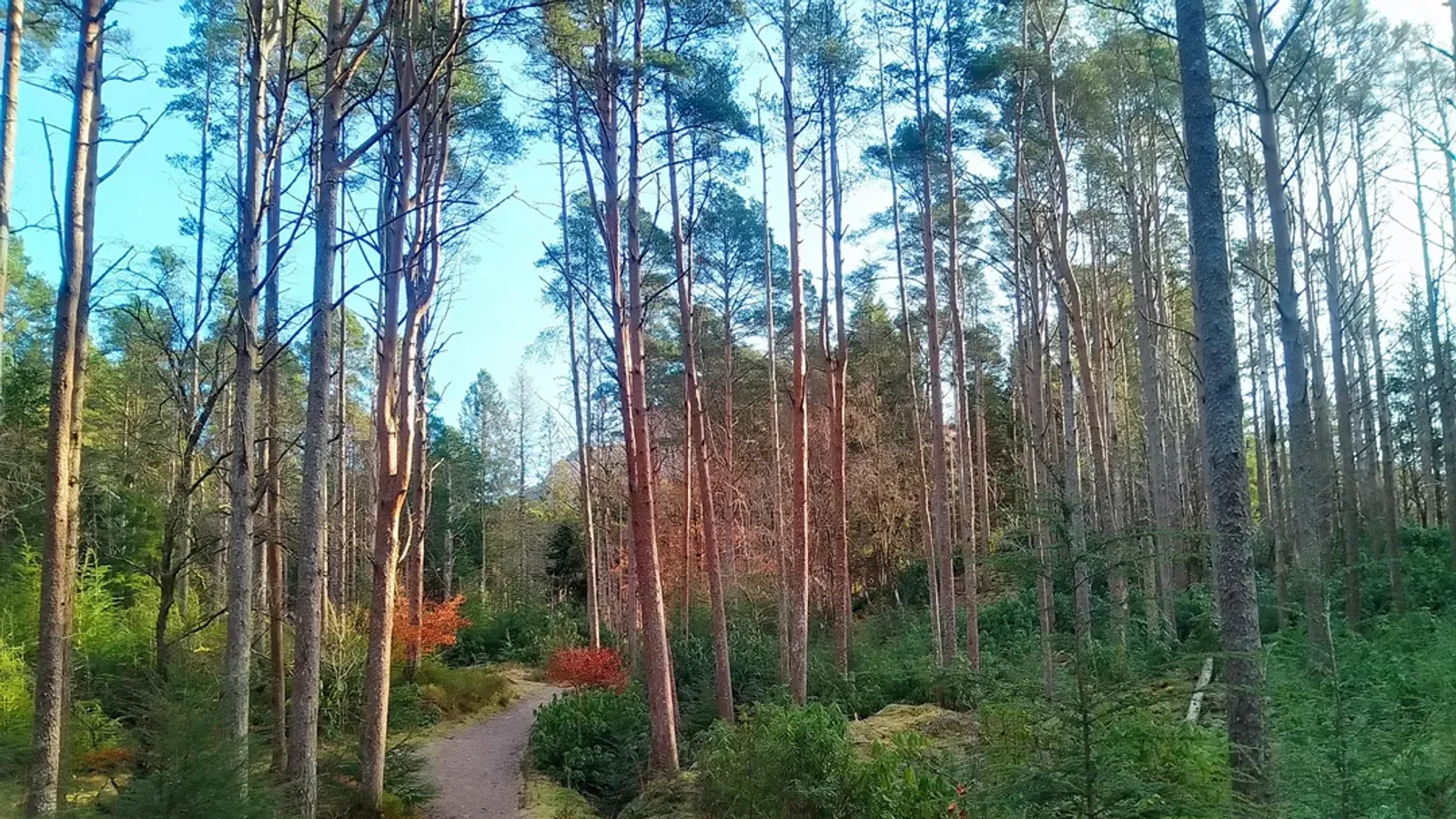
established What the old forest feels like. In fenced areas free of deer, Mabey wrote, something close to boreal pine forest can be glimpsed: standing dead trunks, self-sown saplings, a dense understorey of bilberry and heather, and the scent of pine resin and juniper. His illustrations are a massive dead pine in Glen Strathfarrar and native pines on Beinn Eighe, and he describes the Highland birchwoods, also well seen in Glen Strathfarrar, as one of Scotland's "signature" plant communities.
Did You Know?
- Richard Mabey's Flora Britannica (1996) repeated the popular story of a Highland forest destroyed by English exploitation, the Napoleonic Wars and the Clearances, a version environmental historians now heavily qualify.
- In the 1970s, native pinewood was estimated at little more than 25,000 acres, according to Flora Britannica.
- By 1750, according to environmental historian T. C. Smout, less than a tenth of Scotland was woodland, and most of the loss had happened before 1500.
- At its peak around 5000 BCE, the Caledonian Forest covered an estimated 15,000 square kilometres; today only about 1.2% of that remains.
- Scholars still genuinely debate how much of the forest's historical decline was caused by climate change versus human grazing and felling.
- Most surviving fragments exist today simply because their land was too steep, rocky, or remote to farm — not because they were deliberately protected.
- A recent survey found that 23% of remaining Caledonian pinewood sites are now critically threatened.
- Artificially large deer populations, with no natural predators, are identified as the single main barrier to the forest's natural recovery.
- The forest remains the only British breeding habitat for the capercaillie, Scottish crossbill, crested tit, and parrot crossbill.
- Species once native to the forest, including brown bear, lynx, wolf, and aurochs, are now extinct in Scotland.
- Eurasian beavers were reintroduced to Knapdale, Argyll, in the 2000s as part of wider restoration efforts.
FAQ
1How much of the original Caledonian Forest is left?
Around 180 square kilometres, roughly 1.2% of its estimated 15,000-square-kilometre peak extent around 5000 BCE.
2What caused the forest to decline?
It's genuinely debated — documented climate change around 2000 BCE played a role, but how much subsequent human grazing and felling contributed remains an active scholarly question.
3Why did some fragments of the forest survive?
Mostly because their land was too steep, rocky, or remote to be agriculturally useful, not because of deliberate historical protection.
4Is the remaining Caledonian Forest currently safe?
No — recent surveys found most remaining pinewoods lack key health and resilience characteristics, with 23% critically threatened, largely due to artificially large deer populations.
5What species can only be found breeding in the Caledonian Forest in Britain?
The capercaillie, Scottish crossbill, crested tit, and parrot crossbill.
6What animals that once lived in the forest are now extinct in Scotland?
Brown bear, Eurasian lynx, grey wolf, aurochs, and others.
7Didn't the English cut down the Caledonian Forest?
That is the popular story, repeated as recently as Richard Mabey's Flora Britannica (1996). Environmental historians such as T. C. Smout argue that most of the loss happened much earlier, before 1500, and that later industries affected only what remained.
8Why is there so little Scots pine folklore in Scotland?
Mabey found "barely a vestige" of it in 1996, and linked this to the long decline of the pinewoods, which removed the tree from everyday Highland life.
9What does a recovering pinewood look like?
Inside deer fences, Mabey described standing dead trunks, self-sown saplings and a dense understorey of bilberry and heather, close to the character of the northern boreal forests.
10What's being done to restore the forest?
Efforts including deer-exclusion fencing, native flora and fungi reintroduction, and species reintroductions such as the Eurasian beaver, led largely by organisations including Trees for Life.
Sources and Further Reading
Primary/Institutional
Scholarly/Critical
- Fredrik Albritton Jonsson, Enlightenment's Frontier: The Scottish Highlands and the Origins of Environmentalism (Yale University Press, 2013)
- T. C. Smout, "Land and Sea: The Environment", in T. M. Devine and Jenny Wormald (eds), The Oxford Handbook of Modern Scottish History (Oxford University Press, 2012)
- Richard Mabey, Flora Britannica (Sinclair-Stevenson, 1996).
- Pinewood Landscapes — Trees for Life
- Dundreggan Rewilding Project — Rewilding Britain
General
Caveats: Myths and Disputed Claims
-
The idea that the Caledonian Forest was felled mainly in recent centuries (by English shipbuilders, iron-masters or Clearance-era sheep farmers) is not supported by environmental historians. T. C. Smout describes deforestation as a long process beginning in the Neolithic, partly climatic, and substantially complete before 1500. Later industries affected what remained, and some (the Argyll iron-masters, the tanbark trade) helped conserve woods they depended on.
-
Do not cite Flora Britannica (1996) as evidence that a near-continuous Highland forest survived until the seventeenth century; on this point it repeats the popular account, which environmental historians have revised.
-
disputed This article does not assign the Caledonian Forest's historical decline to a single settled cause; the relative contribution of climate change versus human grazing and felling remains an active, unresolved scholarly question.
-
Clarification: This article does not present the forest's surviving fragments as the result of deliberate historical protection; most persist simply because their land was unsuitable for agriculture.
Card 050 · Flora