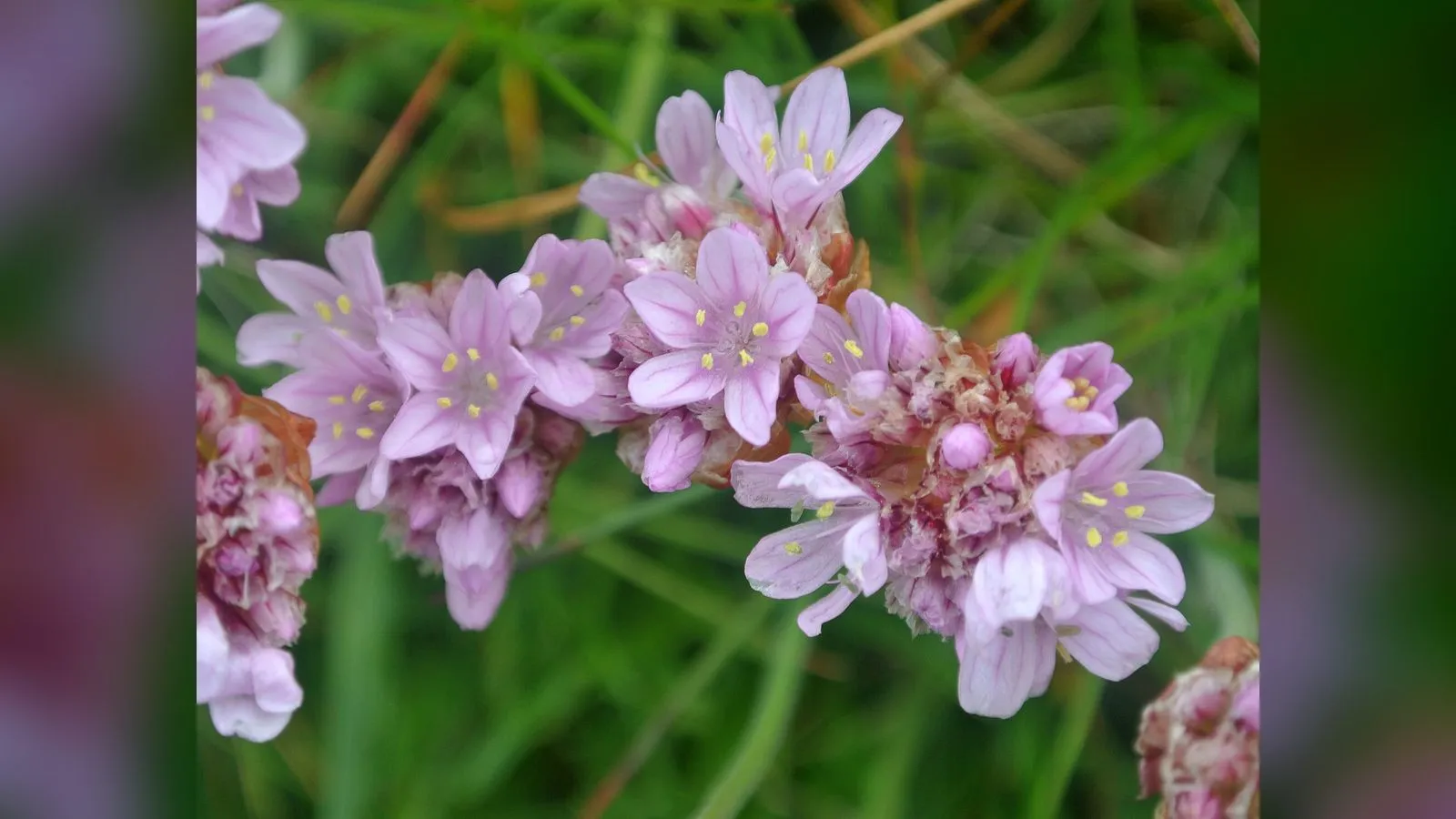

Thrift (Armeria maritima)
Contents
TL;DR
- established Thrift appeared on the reverse of the British threepenny coin between 1937 and 1952, a deliberate pun by designer Frances Madge Kitchener connecting the plant's common name directly to the economic virtue of "thrift," chosen specifically because saving, making, and mending were part of everyday British life during that period — a specific, documented piece of numismatic and social history this article states directly rather than a vague claim that the plant appeared "on old coins."
- established Thrift can tolerate remarkably high soil copper concentrations, documented at up to 6,400mg per kilogram, with research proposing that the plant achieves this by limiting copper transport into its shoots and excreting excess copper through its decaying leaves — a specific, documented physiological mechanism this article names directly rather than a vague claim that the plant is "tolerant of poor soil."
- established Thrift grows across a genuinely wide range of contrasting habitats, from coastal cliffs, grassland, and salt marshes to salted roadsides and, separately, inland on exposed mountain rock — a specific, documented dual coastal-and-montane distribution this article states directly rather than treating the plant as purely a seaside species.
- established The species has a circumpolar distribution across wild coastal regions of the Northern Hemisphere, and within Britain it remains common overall, though one specific subspecies, Tall Thrift (Armeria maritima subsp. elongata), found in England, holds formal conservation significance as a species of principal importance for biodiversity conservation under the 2006 NERC Act — a specific, documented distinction between the common form and a vulnerable subspecies this article states directly rather than presenting thrift's conservation status as uniform across all its populations.
- established Thrift flowers over an unusually long season, from April through October, relying on a range of insect pollinators including bees and moths and butterflies, giving it a genuinely extended role as a nectar source across much of the growing year compared with many shorter-flowering coastal and montane species — a specific, documented flowering duration this article states directly rather than a vague reference to the plant "flowering in summer."
Key Facts
- Scientific name
- Armeria maritima
- Category
- Flora
- Flowering period
- April–October
- Key habitat range
- Coastal cliffs, salt marsh, salted roadsides, inland mountain rock
- Copper tolerance
- Up to 6,400mg/kg soil copper concentration
- Historical coin appearance
- British threepence, 1937–1952
- Vulnerable subspecies
- Tall Thrift (A. m. subsp. elongata), England
- Distribution
- Circumpolar, Northern Hemisphere coastal regions
Scottish Impact Index (SI Score)
- Scottish Significance
- 9/10
- Ecological Persistence
- 9/10
- Ecological Importance
- 7/10
- Botanical Distinctiveness
- 8/10
- Conservation Significance
- 7/10
- Recognition
- 9/10
49/60
Ranked =19th of 45 in Flora
A Note on Claims and Evidence
Biology, heavy-metal tolerance mechanism, habitat range, distribution, and conservation status details are drawn from the species' Wikipedia-summarised research record. The threepenny coin history and the specific reasoning behind choosing thrift as its design are drawn from published numismatic history reporting.
Timeline
Thrift establishes itself with a circumpolar distribution across wild coastal regions of the Northern Hemisphere, adapting to dry, sandy, saline conditions on coastal cliffs, grassland, and salt marshes, while separately colonising exposed mountain rock inland, including sites with naturally or historically elevated soil copper concentrations that the species can tolerate through its own documented physiological mechanism.
Thrift appears on the reverse of the British threepenny coin, designed by Frances Madge Kitchener, chosen as a deliberate pun connecting the plant's common name to the economic virtue of thrift, reflecting a period when saving, making, and mending were part of everyday British life. Kitchener's design was modified by Percy Metcalfe before issue; no threepences were struck in 1947, and in 1953 the new Elizabeth II coin replaced thrift with a Tudor portcullis by William Gardner.
The species flowers over an unusually long season, from April through October, relying on bees, moths, and butterflies for pollination across much of the growing year.
Tall Thrift, a specific English subspecies, is formally recognised as a species of principal importance for biodiversity conservation under the NERC Act, establishing a documented distinction in conservation status between this vulnerable subspecies and the common form of thrift found more widely across Britain.
Thrift remains common across much of Britain, including Scotland's coasts and inland mountain habitats, while its specific English subspecies retains formal conservation significance, and the plant's genuine copper tolerance continues to make it ecologically notable on soils many other species cannot colonise.
Details
A coin history stated with its real specific reasoning
This article names thrift's appearance on the British threepenny coin with real specificity rather than a vague claim that the plant appeared "on old coins": it featured on the coin's reverse between 1937 and 1952, designed by Frances Madge Kitchener, chosen as a deliberate pun connecting the plant's name directly to the economic virtue of thrift, reflecting a period when saving, making, and mending were part of everyday British life. This article states this specific reasoning because it represents a genuine, documented piece of design history, not an incidental fact about an old coin's imagery.
A heavy-metal tolerance explained through its real physiological mechanism
This article names the specific mechanism behind thrift's remarkable copper tolerance rather than a vague claim that the plant is "tolerant of poor soil": documented to withstand soil copper concentrations of up to 6,400mg per kilogram, research proposes that the plant limits copper transport into its shoots and excretes excess copper through its decaying leaves. This article states this specific figure and proposed mechanism because they represent genuinely exceptional, measured tolerance, not a general impression of coastal plant hardiness.
A dual habitat range stated honestly, beyond the coast alone
This article names thrift's full habitat range directly rather than treating the plant as purely a seaside species: coastal cliffs, grassland, salt marshes, and salted roadsides, but also, separately, inland on exposed mountain rock. This article states this dual range because it demonstrates genuine ecological flexibility across two very different kinds of harsh, exposed environment, not a single coastal niche.
A conservation status distinguished by subspecies, not treated as uniform
This article names the specific distinction between thrift's common status across Britain and the vulnerable conservation status of its English Tall Thrift subspecies directly, rather than presenting the species' conservation standing as uniform. This article states this distinction because formal conservation significance under the NERC Act applies specifically to this subspecies, not to thrift as a whole across its wider British range.
A flowering season named with its real documented length
This article states thrift's flowering period precisely rather than a vague reference to the plant "flowering in summer": April through October, relying on bees, moths, and butterflies for pollination. This article names this specific, unusually long duration because it demonstrates a genuinely extended ecological role as a nectar source across much of the growing year, not a brief seasonal bloom.
Thrift in Flora Britannica
established Richard Mabey, in Flora Britannica (1996), lists thrift's vernacular names as sea-pink, cliff clover, ladies' cushions and heugh daisy. He describes heugh daisy as a very local Scots and northern name, from "heugh", a cliff or ravine. Peter Marren's appendix on Scottish vernacular plant names in the same book adds gressie-spink and sea-daisy. Marren explains "spink" as a general Scots name for bright, pretty flowers.
shared Mabey calls the origin of the name "thrift" obscure. It may come from "thriving", in the sense of evergreen, or, as he thinks more likely, from the tight, economical tufting of the leaves, which conserves water in salt winds. He confirms the threepenny-bit pun described above, calling the coin the twelve-sided threepenny bit, and notes that in the 1990s thrift was also the emblem of a building society.
established The book reproduces Charles Rennie Mackintosh's watercolour of thrift, or sea-pink, painted on Holy Island in 1901.
established Mabey records thrift as a garden plant since at least the sixteenth century, when John Gerard recommended it for edging beds. He also notes inland forms on mountains and river shingle, which he reads as relics of the open landscape after the last glaciation, and a taste for lead-rich soils that brings thrift onto old mine-spoil. A contributor from Wensleydale told him of a fine display 40 miles from the sea, beside a stream draining old lead-mines. The family name Plumbaginaceae comes from an ancient belief that these plants could cure lead poisoning; that is a historical belief, not a treatment. This lead tolerance sits alongside the copper tolerance described above.
Did You Know?
- Thrift appeared on the British threepenny coin between 1937 and 1952, a deliberate pun on the plant's name and the virtue of financial thrift.
- It can tolerate soil copper concentrations of up to 6,400mg per kilogram, among the highest documented heavy-metal tolerances of any British wildflower.
- It grows in two very different habitat types: coastal cliffs and salt marshes, and separately, inland on exposed mountain rock.
- One English subspecies, Tall Thrift, holds formal conservation significance, even though thrift overall remains common across Britain.
- Thrift flowers from April through October, an unusually long season for a coastal or montane wildflower.
- The species has a circumpolar distribution, found across wild coastal regions throughout the Northern Hemisphere.
- Charles Rennie Mackintosh painted a watercolour of thrift on Holy Island in 1901.
- In Scots, thrift has been called heugh daisy (a heugh is a cliff or ravine), gressie-spink and sea-daisy.
- Thrift often grows on old lead-mine spoil, sometimes many miles from the sea.
FAQ
1Why was thrift chosen for the old threepenny coin?
As a deliberate pun — designer Frances Madge Kitchener chose the plant specifically to connect its name to the economic virtue of thrift, reflecting the saving and making-do culture of the 1930s–1950s.
2How tolerant is thrift of contaminated or metal-rich soil?
Remarkably so — it's documented tolerating soil copper concentrations of up to 6,400mg per kilogram, likely by limiting copper transport into its shoots and excreting excess through decaying leaves.
3Does thrift only grow by the coast?
No — while it's common on coastal cliffs and salt marshes, it also grows inland on exposed mountain rock.
4Is thrift a rare or endangered plant?
Not generally — it remains common across much of Britain, though one specific English subspecies, Tall Thrift, holds formal conservation significance.
5How long does thrift flower for?
From April through October, an unusually long season relying on bees, moths, and butterflies for pollination.
6Where is thrift found globally?
It has a circumpolar distribution, occurring across wild coastal regions throughout the Northern Hemisphere.
7What are thrift's Scots names?
Richard Mabey's Flora Britannica (1996) records heugh daisy, from "heugh", a cliff or ravine. Peter Marren's appendix in the same book adds gressie-spink and sea-daisy.
8Why is it called thrift?
Nobody is sure. Mabey suggests it may come from "thriving", or more likely from the tight, economical tufts of leaves that save water in salt winds.
9Did a Scottish artist paint thrift?
Yes. Charles Rennie Mackintosh painted a watercolour of thrift, or sea-pink, on Holy Island in 1901.
Sources and Further Reading
Primary/Institutional
Scholarly/Critical
- Armeria maritima, Thrift or Sea Pink: identification, distribution, habitat — First Nature
- Blooming gorgeous: thrift — National Trust for Scotland
- Richard Mabey, Flora Britannica (Sinclair-Stevenson, 1996), including Peter Marren's appendix on Scottish vernacular plant names.
General
- "Brass threepence", Wikipedia (en.wikipedia.org/wiki/Brass_threepence), for the coin's dates and designers
- Thrift on old three pence coin — Theresa Green's nature blog
Caveats: Myths and Disputed Claims
- Clarification: This article does not treat thrift's conservation status as uniform; the species is common overall across Britain, while its specific Tall Thrift subspecies in England holds separate, formal conservation significance.
- Note: This article does not describe thrift as a purely coastal species; it also grows inland on exposed mountain rock, a genuinely separate habitat type from its better-known coastal cliffs and salt marshes.
- Do not state the origin of the name "thrift" as settled; Mabey calls it obscure.
- Do not present the old belief that the thrift family cures lead poisoning as medicine. It explains the family name, nothing more.
Card 027 · Flora