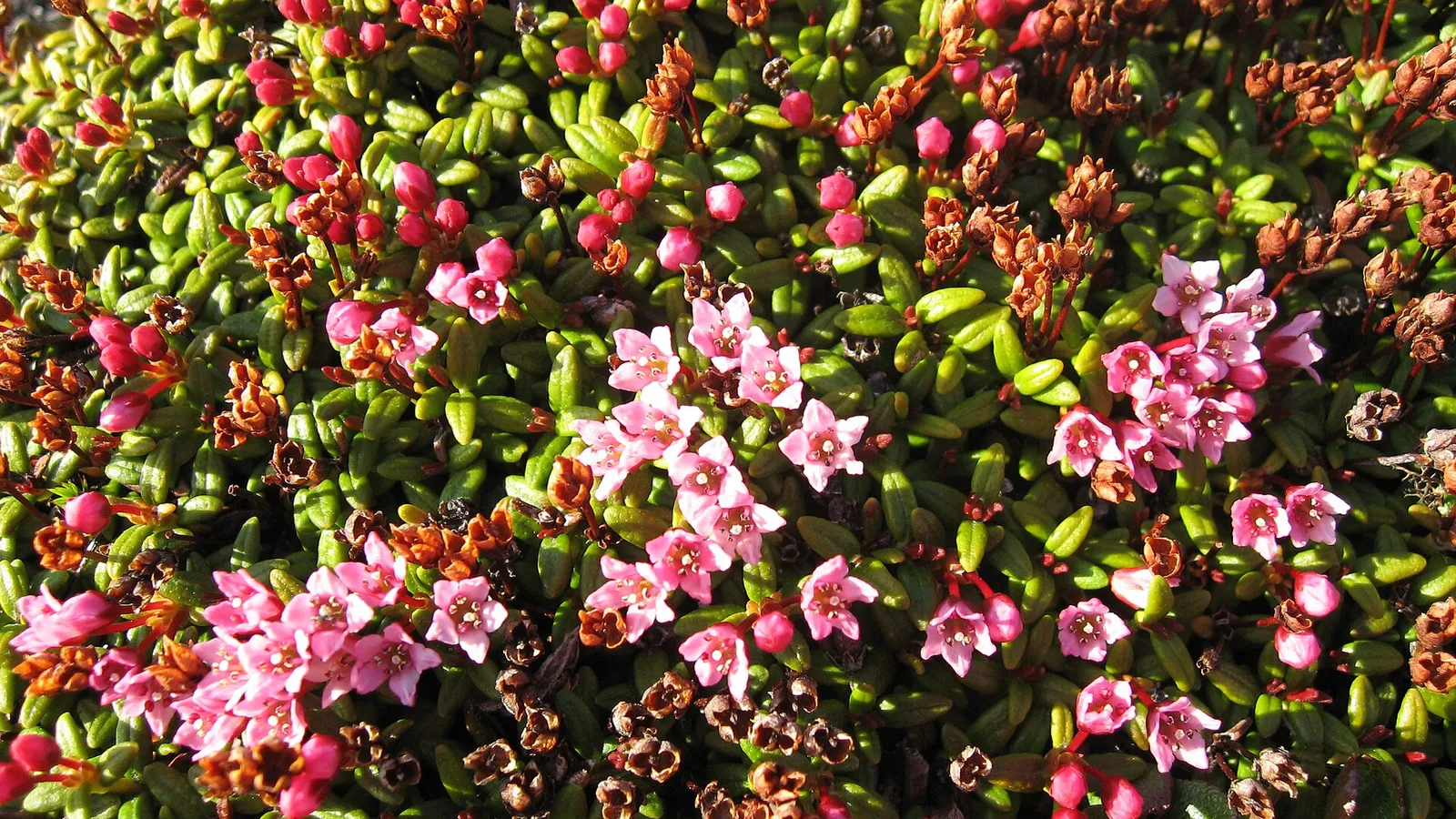

Trailing Azalea (Kalmia procumbens)
Contents
TL;DR
- established Within the UK, trailing azalea grows exclusively in Scotland, found only on bare mountain summits and ridges, with no occurrence anywhere else in Britain — a specific, documented distribution this article states directly rather than a vague claim that the species is "a mountain plant."
- established Trailing azalea is one of the smallest woody shrubs on Scotland's mountains, typically growing no more than 10cm tall as a hairless, mat-forming, prostrate undershrub, favouring the most exposed, windswept, bare summit ground available — a specific, documented growth form this article states directly rather than a vague reference to the plant being "low-growing."
- established The species carries two scientific names in current use, Kalmia procumbens and the long-familiar Loiseleuria procumbens, reflecting a genuine, documented taxonomic reclassification that places the plant within the genus Kalmia rather than its own separate genus — a specific, recent change this article names directly rather than treating the plant's scientific name as settled and unchanging.
- established Trailing azalea's leaves are specifically adapted for its exposed habitat: evergreen, leathery, with rolled-under edges and undersides covered in dense short white hairs, a structure that reduces water loss and wind damage in one of the harshest growing environments available to any Scottish shrub — a specific, documented physical adaptation this article names directly rather than a vague claim that the plant is "well adapted to the cold."
- established Trailing azalea grows on Scottish mountains from about 400m (around 1,300 feet) to over 1,000m, most abundantly on exposed ridges and summits in the montane zone above the treeline, alongside other mountain-heath specialists such as alpine lady's-mantle — a specific, documented elevation range this article states directly rather than a vague claim that the plant grows "high up."
Key Facts
- Scientific name
- Kalmia procumbens (syn. Loiseleuria procumbens)
- Category
- Flora
- Growth height
- Typically under 10cm
- UK distribution
- Scotland only — no occurrence elsewhere in the UK
- Growth form
- Hairless, mat-forming, prostrate undershrub
- Recorded elevation range
- About 400m (1,300 ft) to over 1,000m
- Flowers
- 2–5 per cluster, rose-pink, bell-shaped
- Conservation status
- Uncommon; native to the UK
Scottish Impact Index (SI Score)
- Scottish Significance
- 8/10
- Ecological Persistence
- 6/10
- Ecological Importance
- 6/10
- Botanical Distinctiveness
- 9/10
- Conservation Significance
- 9/10
- Recognition
- 6/10
44/60
Ranked =33rd of 45 in Flora
A Note on Claims and Evidence
Biology, taxonomy, leaf structure, and wider Northern Hemisphere distribution details are drawn from the species' Wikipedia-summarised research record. Scottish/UK distribution, specific elevation records, and habitat detail are drawn from the Wild Flower Finder published species account.
Timeline
Trailing azalea establishes itself across subarctic and high mountain regions of the Northern Hemisphere, favouring alpine and subalpine, rocky, exposed habitat above the treeline; within the UK, the species becomes restricted entirely to Scotland, found only on bare mountain summits and ridges.
Linnaeus originally names the species Azalea procumbens, establishing its earliest scientific classification.
The species is later reclassified under the genus Loiseleuria, honouring French botanist L.L.A. Loiseleur-Deslongchamps, becoming widely known as Loiseleuria procumbens for an extended period.
Further reclassification places the species within the genus Kalmia, as Kalmia procumbens, with both this name and the long-familiar Loiseleuria procumbens remaining in current use.
The plant produces two to five rose-pink, bell-shaped flowers in late spring and summer, its evergreen, leathery, white-haired-underside leaves persisting year-round to withstand the extreme wind exposure and cold of its exposed summit habitat.
Trailing azalea remains an uncommon but established native presence on Scotland's bare mountain summits, recorded at elevations from about 400m to over 1,000m, growing alongside other true montane specialists in one of the most exposed plant habitats found anywhere in Britain.
Details
A UK distribution stated with its real geographic exclusivity
This article names trailing azalea's British range with real specificity rather than a vague claim that it is "a mountain plant": within the UK, it grows exclusively in Scotland, found only on bare mountain summits and ridges, with no occurrence anywhere else in Britain. This article states this exclusivity directly because it represents a genuinely narrow, documented distribution, not a general impression of upland rarity shared with many other mountain species.
A growth form explained through its real structural logic
This article names trailing azalea's physical form precisely rather than a vague reference to the plant being "low-growing": it typically grows no more than 10cm tall as a hairless, mat-forming, prostrate undershrub, favouring the most exposed, windswept, bare summit ground available. This article states this specific growth form because it represents a genuine structural strategy for surviving extreme wind exposure, not an incidental feature of the species' size.
A taxonomic history named rather than treated as settled
This article states directly that trailing azalea carries two scientific names currently in use, Kalmia procumbens and the long-familiar Loiseleuria procumbens, reflecting a real, documented reclassification placing the species within the genus Kalmia. This article names this history because treating the plant's scientific name as permanently fixed would misrepresent ongoing taxonomic revision, not because the older name is now incorrect to use.
A leaf structure matched directly to its extreme habitat
This article names the specific physical features of trailing azalea's leaves rather than a vague claim that the plant is "well adapted to the cold": evergreen, leathery, with rolled-under edges and undersides covered in dense short white hairs, a structure that reduces water loss and wind damage. This article states these specific features because they represent the real, documented mechanism behind the plant's survival in one of the harshest growing environments available to any Scottish shrub.
An elevation range stated with its real documented precision
This article names trailing azalea's recorded elevation range directly rather than a vague claim that it grows "high up": it grows on Scottish mountains from about 400m to over 1,000m, and is at its most characteristic in the true montane zone above the treeline, growing alongside other mountain-heath specialists such as alpine lady's-mantle. This article states this specific range because it situates the species precisely within Scotland's most extreme upland plant communities, not a loosely defined "mountain habitat."
Correction. An earlier figure here gave the lower limit as 925m. That is far too high. Richard Mabey, in Flora Britannica (1996), places trailing azalea in rocky places "above 1,300 feet", about 400m, in the Scottish Highlands, and the UK Wildflowers species account likewise says it is not usually found below 1,200 feet. The 925m figure appears to describe particular summit records, not the bottom of the plant's range.
Britain's only truly native azalea
established Mabey calls trailing azalea "our only truly native 'azalea'". The many rhododendrons and garden azaleas found in British woods and parks were all introduced. He describes it as a domed shrub with small pink flowers, confined to the Scottish Highlands. That makes it one of the few wild relatives of a familiar garden group that is Scottish rather than British in general. Its absence from the high ground of Snowdonia and the Lake District is a reminder of how far north and west its British range is drawn.
established Flora Britannica records no Gaelic or Scots name, use or custom for the plant. Given how small and remote it is, that is not surprising.
Did You Know?
- Within the UK, trailing azalea grows only in Scotland, exclusively on bare mountain summits.
- It's one of Scotland's smallest woody shrubs, typically under 10cm tall.
- The species has been reclassified scientifically more than once — it's now known as Kalmia procumbens, though the older name Loiseleuria procumbens remains widely used.
- Its leaves have rolled-under edges and dense white hairs underneath, reducing water loss and wind damage in its extreme habitat.
- It grows on Scottish mountains from about 400m (1,300 feet) to over 1,000m.
- Richard Mabey's Flora Britannica (1996) calls it Britain's only truly native azalea.
- The plant produces two to five small rose-pink, bell-shaped flowers in late spring and summer.
- Linnaeus originally classified the species as Azalea procumbens in the 18th century.
FAQ
1Is trailing azalea found anywhere else in the UK besides Scotland?
No — within the UK, it grows exclusively on bare mountain summits in Scotland.
2How big does trailing azalea get?
It's one of Scotland's smallest woody shrubs, typically growing no more than 10cm tall as a mat-forming, prostrate undershrub.
3Why does the species have two different scientific names?
Because of a real, documented taxonomic reclassification — it was long known as Loiseleuria procumbens and is now also classified as Kalmia procumbens, with both names currently in use.
4How does trailing azalea survive such exposed conditions?
Its evergreen, leathery leaves have rolled-under edges and dense white hairs on the underside, reducing water loss and wind damage.
5At what elevation does trailing azalea grow?
From about 400m (1,300 feet) to over 1,000m, most characteristically on exposed ground in the montane zone above the treeline.
6When does trailing azalea flower?
In late spring and summer, producing small clusters of two to five rose-pink, bell-shaped flowers.
7Is trailing azalea rare?
It's classified as uncommon and native to the UK, restricted to Scotland's most exposed mountain summit habitats.
8Is it a real azalea?
Yes, in the broad sense. Richard Mabey's Flora Britannica (1996) calls it "our only truly native 'azalea'"; the garden azaleas and rhododendrons in British woods were introduced.
Sources and Further Reading
Primary/Institutional
Scholarly/Critical
- Alpide dwarf ericoid wind heaths — EUNIS habitat classification
- 4060 Alpine and Boreal heaths — JNCC Special Areas of Conservation
- Richard Mabey, Flora Britannica (Sinclair-Stevenson, 1996).
- Loiseleuria procumbens, Trailing Azalea — UK Wildflowers
General
Caveats: Myths and Disputed Claims
- Clarification: This article does not treat the older name Loiseleuria procumbens as incorrect; both it and the current Kalmia procumbens remain in documented use, reflecting ongoing taxonomic revision rather than a simple correction.
- Note: This article does not describe trailing azalea as found broadly across UK uplands; within Britain it is restricted entirely to bare mountain summits in Scotland.
- Do not give 925m as its lower limit; it grows from about 400m (1,300 feet).
Card 024 · Flora