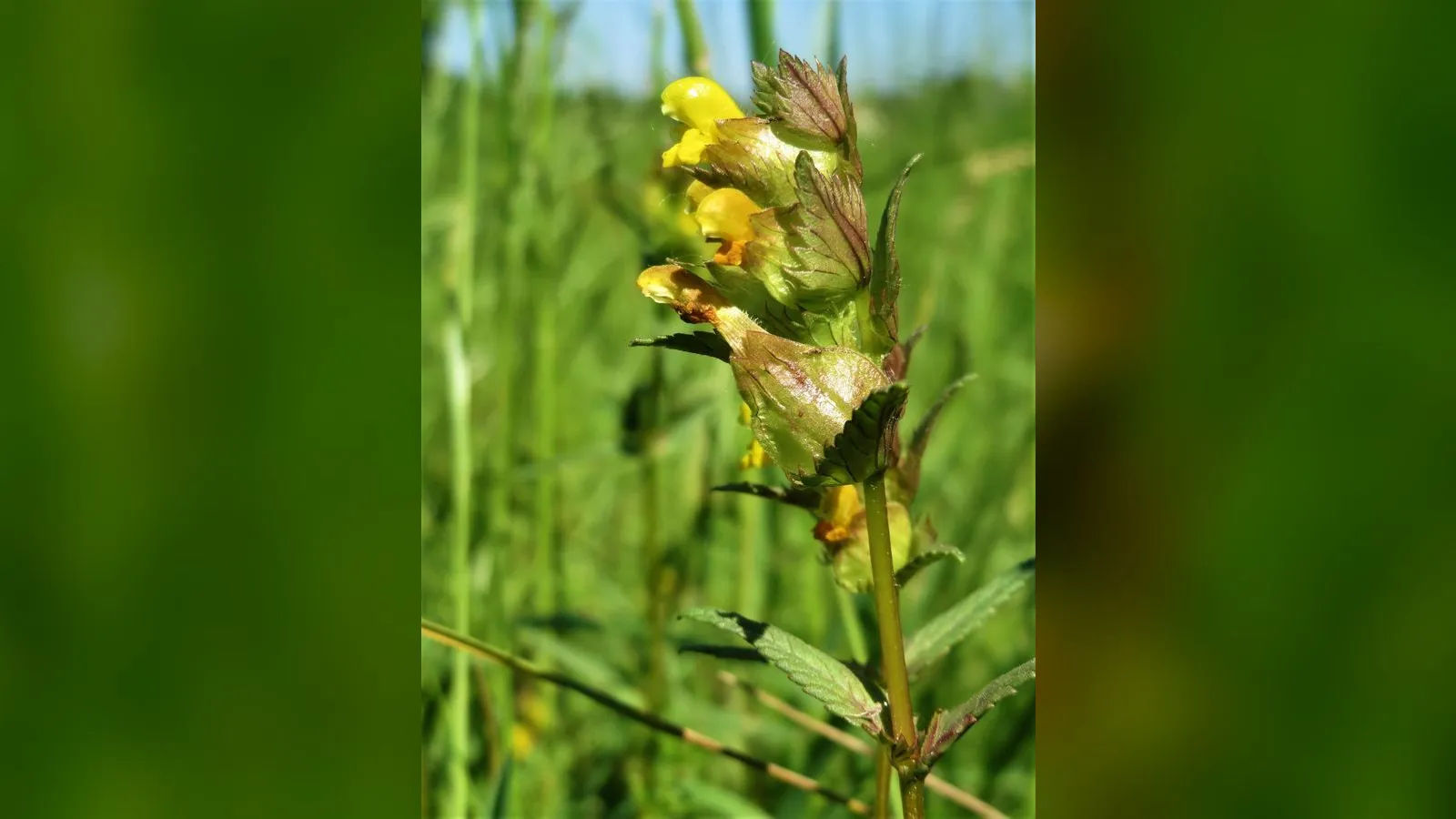

Yellow Rattle (Rhinanthus minor)
Contents
TL;DR
- established Yellow rattle is hemiparasitic, meaning its roots actively locate and attach to the roots of nearby plants, particularly vigorous grasses, extracting water and nutrients from them and weakening their growth — a specific, documented biological mechanism this article states directly rather than a vague claim that the plant "helps meadows."
- established By weakening dominant grasses, yellow rattle creates real ecological space for less competitive wildflowers, including oxeye daisy, knapweeds, and vetches, and in successfully managed meadows can ultimately enable orchids to establish once grass cover is sufficiently thinned, making the species a working tool in modern meadow restoration, earning it the nickname "meadow maker" — a specific, documented ecological cascade this article names directly rather than a vague reference to the plant "supporting biodiversity."
- established Yellow rattle's common name comes from its distinctive seed pods: after flowering, the calyx behind each flower swells into a silvery sphere in which the seeds ripen and audibly rattle, a specific, documented physical mechanism behind the plant's name this article states directly rather than treating the name as unexplained.
- established Historically, yellow rattle served as a practical farming signal: when the plant came into flower, farmers took this as an indication that the hay was ready for cutting, a specific, documented traditional use this article names directly rather than a vague reference to the plant's "folklore."
- established Yellow rattle underwent a marked, documented decline across Britain throughout the 20th century, attributed to changes in farming practices, even though the species is currently classified as Least Concern — this article states both the historical decline and the current conservation status plainly rather than presenting only one without the other.
Key Facts
- Scientific name
- Rhinanthus minor
- Category
- Flora
- Plant type
- Hemiparasitic annual
- Flowering period
- May–July
- Key habitat
- Nutrient-poor grassland, hay meadows, pastures, dunes
- Ecological role
- Suppresses dominant grasses, enabling wildflower diversity
- Nickname
- "The meadow maker"
- Conservation status
- Least Concern (following 20th-century decline)
A Note on Claims and Evidence
Biology, the hemiparasitic root-attachment mechanism, meadow-restoration role, name origin, haymaking folklore, and the documented 20th-century decline and current conservation status are drawn from Plantlife's published species and meadow-restoration guidance.
Timeline
Yellow rattle establishes itself across nutrient-poor British grassland, including hay meadows, pastures, and dunes, its hemiparasitic roots attaching to nearby grasses to extract water and nutrients, weakening grass vigour and creating ecological space for wildflowers including oxeye daisy, knapweeds, and vetches; farmers come to recognise the plant's flowering as a practical signal that hay is ready for cutting.
Yellow rattle undergoes a marked, documented decline across Britain, attributed to changes in farming practices affecting the traditional hay meadows the species depends on.
Ecologists and land managers deliberately sow yellow rattle as a working tool in meadow restoration, using its grass-suppressing mechanism to thin dominant grass cover and enable wildflower diversity to re-establish, with some successfully managed meadows ultimately supporting orchids once grass cover is sufficiently reduced.
Yellow rattle is currently classified as Least Concern, its documented ecological mechanism now actively applied in meadow restoration work across Scotland and the wider UK, even as the farming-practice changes behind its earlier 20th-century decline remain part of its historical record.
Details
A hemiparasitic mechanism explained through its real biological process
This article names the mechanism behind yellow rattle's effect on grassland precisely rather than a vague claim that the plant "helps meadows": its roots actively locate and attach to the roots of nearby plants, particularly vigorous grasses, extracting water and nutrients from them and weakening their growth. This article states this specific mechanism because it is the real, documented biological process behind the plant's ecological significance, not an assumed general benefit.
A restoration role traced as a real, working ecological cascade
This article names yellow rattle's role in meadow restoration with real specificity rather than a vague reference to the plant "supporting biodiversity": by weakening dominant grasses, it creates ecological space for wildflowers including oxeye daisy, knapweeds, and vetches, and in successfully managed meadows can ultimately enable orchids to establish once grass cover is sufficiently thinned. This article states this specific cascade because it represents a genuine, documented ecological process actively used as a tool in meadow restoration today, not a general impression of the plant's usefulness.
A name explained through its real physical mechanism
This article states directly that yellow rattle's common name comes from its seed pods: after flowering, the calyx behind each flower swells into a silvery sphere in which the seeds ripen and audibly rattle. This article names this specific mechanism because it is the real, documented physical process behind the plant's name, not an unexplained historical label.
A traditional farming signal named with its real practical function
This article names yellow rattle's historical role as a haymaking indicator directly rather than a vague reference to the plant's "folklore": when the plant came into flower, farmers took this as a practical signal that the hay was ready for cutting. This article states this specific traditional use because it represents a genuine, documented practical application of the plant's flowering cycle, not an arbitrary or superstitious belief.
A decline and recovery stated together, not selectively
This article states directly that yellow rattle underwent a marked, documented decline across Britain throughout the 20th century, attributed to changes in farming practices, while also naming its current Least Concern conservation status. This article states both facts together because presenting only the current status would omit the real, documented historical pressure the species faced, while presenting only the decline would misrepresent its present-day standing.
Yellow rattle in Flora Britannica
shared Richard Mabey, in Flora Britannica (1996), describes yellow rattle as a semi-parasitic annual of grassy meadows and pastures throughout Britain, sometimes growing in large colonies. He describes the ripe calyces as brown and inflated, "in the shape of little purses or seashells", with the seeds rattling inside. That confirms the origin of the name given above; the pods are green at first and papery brown when the seeds are ripe. Mabey's note that it grows chiefly on well-drained calcareous soils is a 1996 generalisation; the plant also grows on many other unimproved grasslands, including in Scotland.
shared The English vernacular names Mabey lists, hay-rattle, rattlebaskets, pots and pans and tiddibottles, all come from the rattling pods, and "hay-rattle" ties the plant to the hay meadow. He does not record its use as a sign that the hay was ready, so the haymaking-signal tradition above rests on the other sources cited.
established Peter Marren's appendix on Scottish vernacular plant names in the same book records yellow rattle as gowk's shillins, from the flat, round seeds. A gowk is a cuckoo, and by extension a fool; Marren groups the name with gowk's thimmles (harebell) and gowk's clover (wood-sorrel) as names for things "only a fool would mistake" for the real thing.
established Mabey adds that lousewort, Pedicularis sylvatica, another semi-parasite, takes the same place on acid grassland, damp heaths and moors, and that marsh lousewort or red-rattle is mainly northern and western. Marren also lists red-rattle among the plants called deid man's bellows in Scotland, so older "rattle" records should be checked for which plant is meant.
Did You Know?
- Yellow rattle is hemiparasitic: its roots actually attach to nearby grass roots and drain them of water and nutrients.
- By weakening dominant grasses, it makes room for wildflowers like oxeye daisy, knapweeds, and vetches — and eventually even orchids in well-managed meadows.
- Its nickname is "the meadow maker," reflecting its active, working role in meadow restoration today.
- The plant's name comes from its seed pods: after flowering, each calyx swells into a silvery sphere where the seeds ripen and rattle.
- Farmers historically used the plant's flowering as a natural signal that hay was ready for cutting.
- Yellow rattle underwent a marked decline across Britain in the 20th century, linked to changes in farming practices.
- Despite that historical decline, it's currently classified as Least Concern.
- In Scots, yellow rattle has been called gowk's shillins, "cuckoo's shillings", from its flat, round seeds.
- English country names include hay-rattle, rattlebaskets, pots and pans and tiddibottles.
FAQ
1How does yellow rattle actually help wildflower meadows?
Its roots attach to nearby grass roots and drain them of water and nutrients, weakening grass growth and creating space for wildflowers to establish.
2Why is yellow rattle called "the meadow maker"?
Because it's actively used as a working tool in meadow restoration, suppressing dominant grasses to allow wildflower diversity, and sometimes orchids, to re-establish.
3Where does the name "yellow rattle" come from?
From its seed pods — after flowering, each calyx swells into a silvery sphere where the ripening seeds audibly rattle.
4Did farmers use yellow rattle for anything practical?
Yes — its flowering traditionally signalled that hay was ready for cutting.
5Has yellow rattle always been common?
No — it underwent a marked decline across Britain in the 20th century due to changes in farming practices, though it's currently classified as Least Concern.
6What plants does yellow rattle help to grow?
By suppressing grass vigour, it creates space for wildflowers including oxeye daisy, knapweeds, and vetches, and can eventually support orchids in well-managed meadows.
7When does yellow rattle flower?
May to July.
8What is yellow rattle called in Scots?
Peter Marren's appendix to Richard Mabey's Flora Britannica (1996) records gowk's shillins, from the seeds. A gowk is a cuckoo or a fool: the "shillings" are not real money.
9Is there a Scottish relative that does a similar job?
Mabey notes that lousewort, another semi-parasite, occupies the same niche on acid grassland, heaths and moors, and that marsh lousewort, or red-rattle, is mainly northern and western.
Sources and Further Reading
Primary/Institutional
Scholarly/Critical
- Facilitating grassland diversification using the hemiparasitic plant Rhinanthus minor — ResearchGate
- Sow seeds of parasitic species (e.g. yellow rattle) — Conservation Evidence
- Richard Mabey, Flora Britannica (Sinclair-Stevenson, 1996), including Peter Marren's appendix on Scottish vernacular plant names.
General
Caveats: Myths and Disputed Claims
- Clarification: This article does not describe yellow rattle's meadow benefits in vague terms; it is specifically hemiparasitic, actively attaching to and draining nearby grass roots, a real documented biological mechanism rather than a passive or incidental effect.
- Note: This article does not present yellow rattle's current Least Concern status as meaning it has always been common; the species underwent a marked, documented decline across Britain in the 20th century.
- Do not confuse yellow rattle with red-rattle (marsh lousewort), a different semi-parasite of wet northern and western ground.
Card 046 · Flora