
Kate Crackernuts
Contents
Legend/Myth
Stepsister tales usually cast the stepmother's own daughter as a rival or villain. Kate Crackernuts inverts that expectation from its first scene: the enchantment is aimed at the stepmother's own daughter Anne, not at Kate, and it is Kate — the stepsister with no blood stake in Anne's beauty — who spends the whole story risking herself to save her. That reversal of the usual stepsister dynamic is the tale's real distinguishing feature, more than its two more commonly discussed fairy-tale ingredients (a disenchantment quest and a dancing prince).
TL;DR
- established — Kate Crackernuts was collected from Orkney tradition and first published by the folklorist and writer Andrew Lang in Longman's Magazine in 1889, giving the tale a securely dated, named point of entry into the written record, because a named collector publishing in a dated periodical is exactly the kind of documentary trace that distinguishes genuine folklore collection from undated, untraceable retelling.
- established — Joseph Jacobs reprinted and edited Lang's collected text in his 1890 collection English Fairy Tales, giving the tale a second independent nineteenth-century publication and wider circulation beyond its original Orkney source, because having two separate editors handle and publish the same core material within a year of each other confirms it as a recognised piece of the period's folklore record rather than a single writer's invention.
- established — The tale combines two internationally recognised and separately catalogued tale types — Aarne-Thompson-Uther 306, "The Danced-Out Shoes" (the type behind "The Twelve Dancing Princesses"), and ATU 711, "The Beautiful and the Ugly Twin" (the type behind tales like "Tatterhood") — because this kind of comparative tale-type classification is only possible for a story with a recognisable, analysable plot structure, not for a bare motif.
- established — The tale is specifically located in Orkney tradition, with its fairy hill, nut-gathering device, and dancing-prince sequence recorded as belonging to that regional source rather than to a generalised, unlocated "Scottish fairy tale," because Lang's original collection explicitly identifies the Orkney source of the material.
- disputed — Whether the moderately differing versions sometimes described as circulating in Orkney versus the Scottish mainland (including occasional attribution to Moray) represent genuinely distinct regional traditions or simply reflect the normal minor variation expected of any orally collected tale retold and re-edited across several nineteenth-century publications is not fully resolved, because the clearest documented source for the tale remains Lang's Orkney collection, and the degree of independent corroboration for a separate, distinct Moray strand is thinner by comparison.
Key Facts
- Type of Being/Legend
- Wonder tale (fairy tale): a loyal stepsister, a fairy-hill enchantment, and a disenchantment quest
- Region
- Orkney (primary documented source); also associated in some retellings with Moray
- First Attested
- Collected from Orkney tradition and published by Andrew Lang in Longman's Magazine, 1889
- Category
- Ballad and Romance
- SI Score
- 38/60
- Status Note
- Kept; no replacement. Valued in this series for its distinctive loyal-stepsister structure and its well-documented, specifically Orkney fairy-hill setting.
A Note on Claims and Evidence
This article relies on Andrew Lang's original 1889 published text, collected from Orkney tradition, and on Joseph Jacobs's 1890 reprinting and editing of that same material, as the core documentary sources for the tale. Its international classification under Aarne-Thompson-Uther types 306 and 711 is drawn from standard comparative folklore scholarship, including analysis by scholars such as Maria Tatar. Where later popular retellings attribute the tale to Moray rather than Orkney, or add detail not present in Lang's original text, this is identified as a later variation rather than part of the earliest documented version.
Timeline
The tale circulates in Orkney oral tradition for an unknown period before being collected and written down.
Andrew Lang publishes the collected Orkney text in Longman's Magazine, the earliest secure documentary attestation of the tale.
Joseph Jacobs reprints and edits the tale in English Fairy Tales, giving it a second independent nineteenth-century publication and a wider popular readership.
The tale is subsequently anthologised in various collections of British and Scottish fairy tales, sometimes with minor variation in detail or attributed setting.
Folklore scholars, including Maria Tatar, analyse the tale's unusual stepsister-solidarity structure and its combination of two distinct international tale types within comparative fairy-tale scholarship.
Details
The core tale
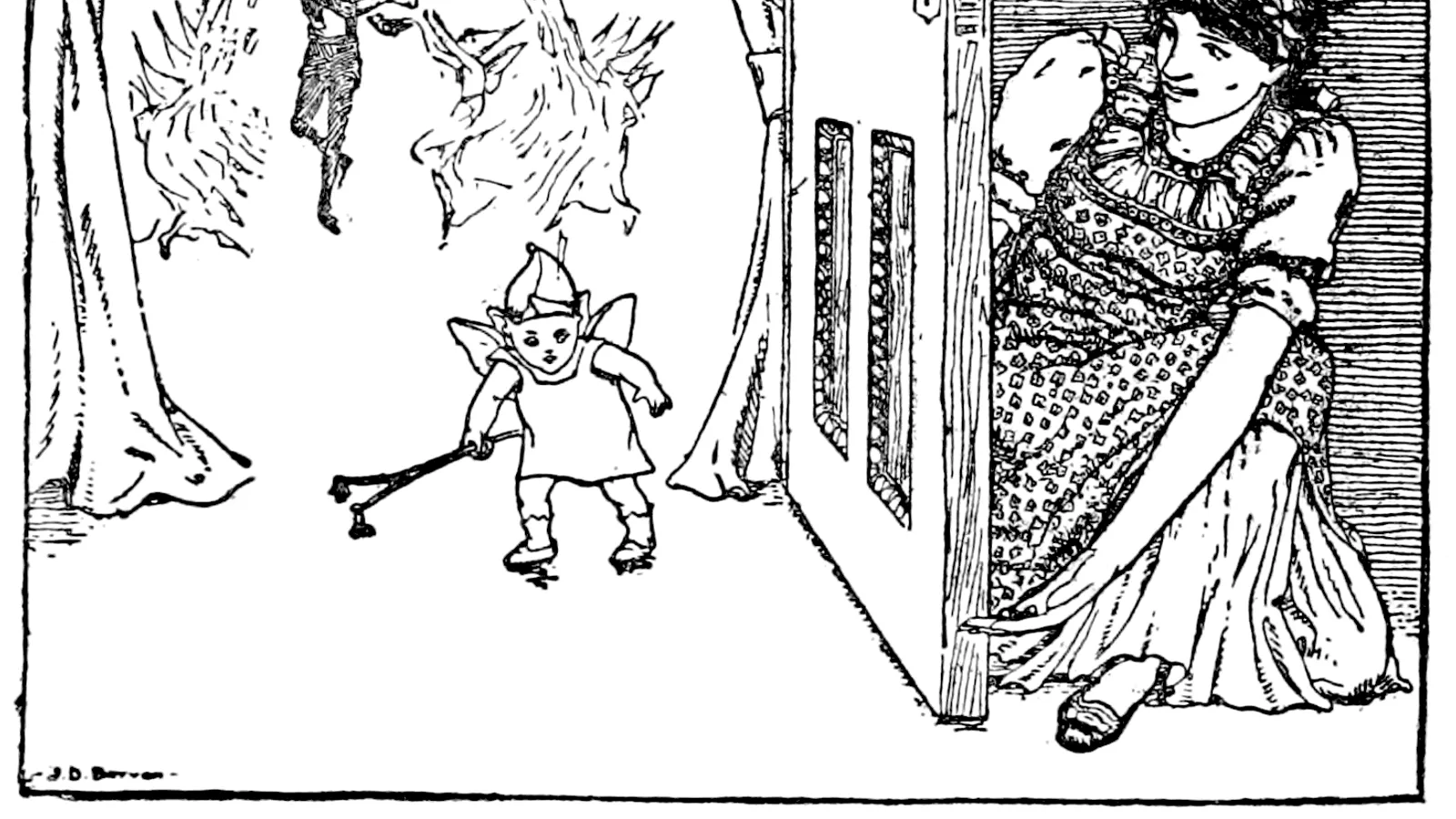
Kate's stepmother, jealous of her own daughter Anne's beauty, arranges for a hen-wife to curse Anne, causing her head to be replaced with a sheep's head. Kate, loyal to her disfigured stepsister despite having no part in the plot against her, wraps Anne's head in a cloth and sets out with her to seek their fortune. They come to a king's castle, where one of two ailing princes is said to fall mysteriously ill or vanish each night; Kate volunteers to sit up and watch, and discovers that the prince is compelled, by a company of fairies, to rise each night and dance himself to exhaustion inside a fairy hill that opens to receive him. Over successive nights, Kate uses a device of cracking and eating nuts to distract a fairy child into revealing first the whereabouts of a wand that can restore Anne's true head, and then a magical bird whose flesh can cure the dancing prince's exhaustion and illness. Having secured both cures, Kate restores Anne's beauty and nurses the prince back to health, and the tale ends with a double marriage: the recovered prince marries Anne, and his brother marries Kate.
Structure and tale-type classification
Folklorists classify Kate Crackernuts as a combination of two separately recognised international tale types: ATU 306, "The Danced-Out Shoes" (the pattern underlying tales such as "The Twelve Dancing Princesses," in which a nightly compelled dance must be discovered and ended), and ATU 711, "The Beautiful and the Ugly Twin" (the pattern underlying tales such as the Norwegian "Tatterhood," featuring a plain or disfigured sister whose true worth is eventually revealed or restored). The tale's distinguishing and most frequently remarked feature, noted by scholars including Maria Tatar, is that it compresses the usual cruel-stepmother framework unusually quickly and redirects its emotional weight almost entirely onto the loyalty between the two girls, rather than lingering on stepmother villainy for its own sake.
Regional setting and the fairy hill
The tale is explicitly located, in its earliest documented form, in Orkney, and its central supernatural device — a green hill that opens at night to admit the dancing prince and his fairy captors — belongs to the same broader Scottish "fairy hill" (sìthean) tradition treated more fully elsewhere in this series, though Kate Crackernuts gives that tradition a specifically Orcadian, narratively developed setting rather than treating the hill as a general place-belief. Some later popular retellings place the story in Moray instead of, or alongside, Orkney; the clearest and earliest documented source, however, remains Lang's Orkney collection.
Significance and relationship to neighbouring cards
Within the Ballad and Romance group, Kate Crackernuts sits closest in kind to the Black Bull of Norroway as a prose wonder tale rather than sung balladry, and both share the pattern of a resourceful heroine undertaking a sustained personal quest to disenchant someone she loves. It also connects to the fairy-hill tradition treated on its own dedicated card, giving that otherwise place-focused belief a fully worked narrative example of what is supposed to happen to someone taken inside one.
Did You Know?
- The tale was collected from Orkney tradition and first published by Andrew Lang in Longman's Magazine in 1889.
- Unlike most "wicked stepmother" tales, the enchantment here is aimed at the stepmother's own daughter, not at the stepsister telling the story.
- Kate uses cracked nuts to distract a fairy child into giving up two separate secrets — a wand to cure Anne, and a magical bird to cure the prince — which is likely the source of her name.
- The tale combines two separately catalogued international fairy-tale types: the "danced-out shoes" pattern (as in "The Twelve Dancing Princesses") and the "beautiful and ugly twin" pattern (as in "Tatterhood").
- Joseph Jacobs reprinted the tale in his 1890 collection English Fairy Tales, just a year after Lang's original publication.
- The story ends with a double wedding: the cured prince marries the restored Anne, while his brother marries Kate.
- The fairy hill that opens nightly to admit the dancing prince belongs to the same broader Scottish "fairy hill" tradition explored on its own dedicated card in this series.
- Some later retellings set the tale in Moray rather than Orkney, though the earliest documented source is specifically Orcadian.
FAQ
1What is Kate Crackernuts about?
An Orkney fairy tale about a loyal stepsister who undertakes a quest inside a fairy hill to cure both her enchanted stepsister and a fairy-cursed prince.
2Where was the tale first collected?
From Orkney tradition, published by Andrew Lang in Longman's Magazine in 1889.
3Why is Kate's name "Crackernuts"?
Because her method for distracting the fairy child whose secrets she needs involves cracking and eating nuts, a detail central to the tale's climax.
4Is this a typical "wicked stepmother" story?
Not quite — the curse is aimed at the stepmother's own daughter rather than at the stepsister narrator, which reverses the usual stepsister rivalry found in most comparable tales.
5What tale types does Kate Crackernuts combine?
ATU 306 ("The Danced-Out Shoes," as in "The Twelve Dancing Princesses") and ATU 711 ("The Beautiful and the Ugly Twin," as in "Tatterhood").
6What happens to Anne, the enchanted stepsister?
A hen-wife's curse replaces her head with a sheep's head; Kate later recovers a magical wand from a fairy child that restores Anne's true appearance.
7Why does the prince dance himself ill every night?
A company of fairies compels him to rise and dance inside a fairy hill each night, leaving him exhausted and unwell by day.
8How does the tale end?
With a double marriage: the cured prince marries the restored Anne, and his brother marries Kate.
9Is the tale set in Orkney or Moray?
The earliest and most clearly documented version is specifically Orcadian; some later retellings place it in Moray instead, but this is a later variation rather than the original documented setting.
10Who else published or edited the tale in the 19th century?
Joseph Jacobs reprinted and edited Lang's collected text in his 1890 collection English Fairy Tales.
11How does Kate Crackernuts connect to other cards in this series?
Its fairy hill links to the dedicated Fairy Hills and the Sìthean card, and its structure as a prose wonder tale connects it most closely to the Black Bull of Norroway within the Ballad and Romance group.
12What is the tale's modern cultural legacy?
It remains a frequently anthologised but comparatively less widely recognised Scottish fairy tale, valued by folklorists especially for its unusual stepsister-loyalty structure.
Sources and Further Reading
Primary/Institutional
- Andrew Lang, collected Orkney text, published in Longman's Magazine (1889)
- Joseph Jacobs, English Fairy Tales (1890)
Scholarly/Critical
- Maria Tatar, The Annotated Classic Fairy Tales, commentary on Kate Crackernuts and its tale-type structure
- Comparative Aarne-Thompson-Uther classification (ATU 306 and ATU 711)
General
Caveats: Myths and Disputed Claims
Popular retellings that relocate the tale to Moray, or that add embellishment not present in Lang's original 1889 Orkney text, should not be presented as part of the earliest documented tradition; the clearest, earliest source remains specifically Orcadian. The tale's combination of two distinct tale types (ATU 306 and 711) is a modern comparative-scholarship classification useful for placing the story within wider fairy-tale studies — it is not itself part of the original nineteenth-century collected text, which simply tells the story without reference to any typology.
Card 029 · Folklore