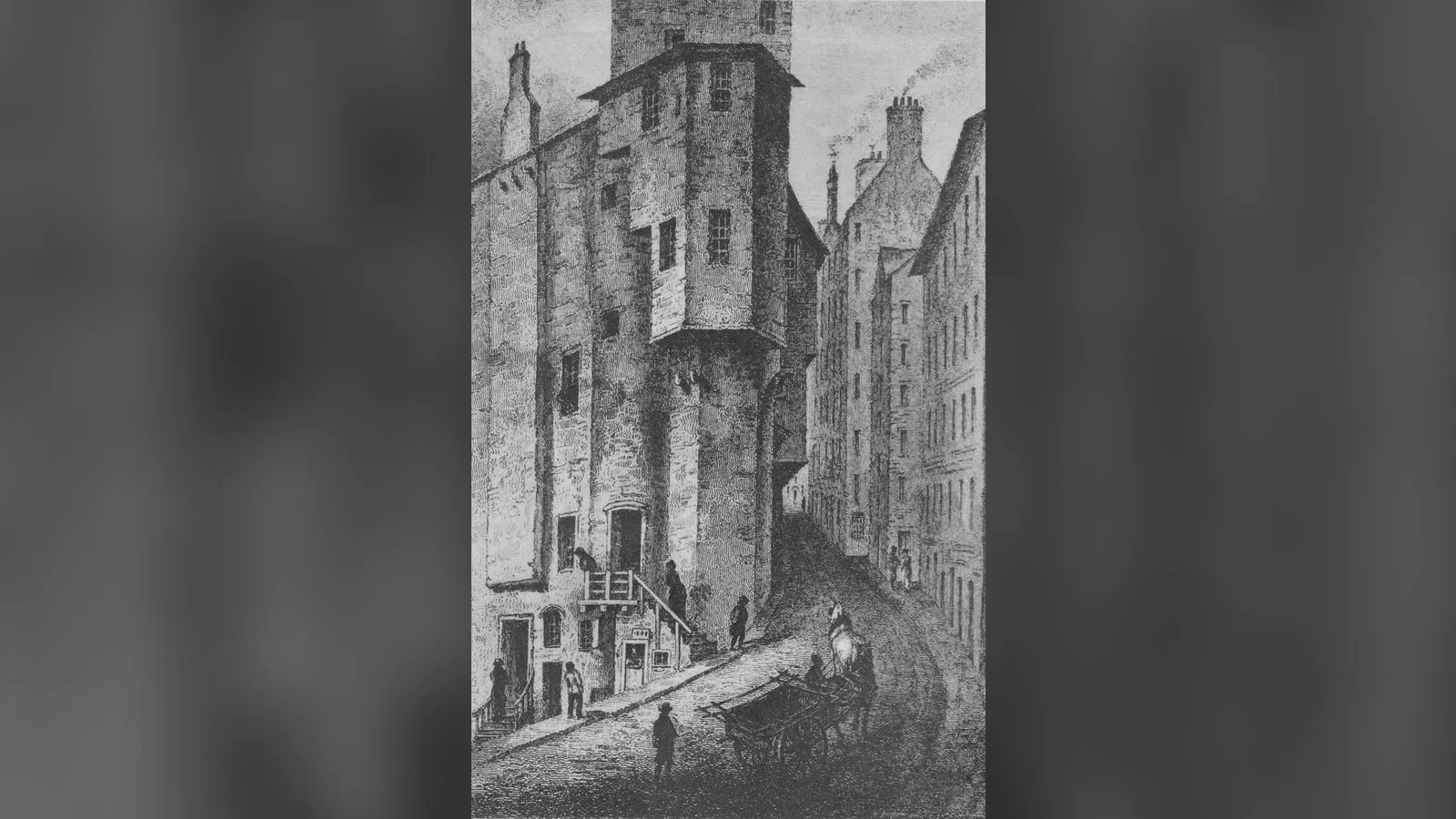

Major Weir, the Wizard of the West Bow
Contents
Legend/Myth
Major Weir is often filed alongside Scotland's lurid "witch" legends as if he were an invented bogeyman like Sawney Bean. He wasn't. Weir was a real, named, socially prominent Edinburgh Covenanter whose 1670 self-confession to witchcraft, incest, and bestiality is a matter of surviving court record, not chapbook invention — the haunting that followed is folklore, but the man and his trial are history.
TL;DR
- established — Major Thomas Weir (c.1599–1670) was a real Covenanting soldier and respected Edinburgh citizen, commander of the City Guard, because his military career, civic offices, and April 1670 trial are documented in contemporary legal and ecclesiastical records, not retrospective legend.
- established — Weir confessed, apparently voluntarily and while assessed as mentally sound, to incest with his sister Jean, adultery, and bestiality, and was executed (garroted and burned) on 11 April 1670, because the confession, trial proceedings, and sentence survive in the historical record independent of any supernatural claim.
- disputed — Weir's own claims of meeting the Devil in a fiery coach and his sister's claims of witchcraft and a magical flight to Musselburgh are his and Jean's own testimony, not corroborated events, because 17th-century courts and chroniclers recorded what the accused said, not what can be shown to have happened.
- disputed — The belief that Weir's carved thornwood staff possessed independent supernatural power, and that it resisted burning at his execution, is a popular embellishment layered onto the case in the decades after 1670, because it appears in later retellings rather than in the trial record itself.
- established — Weir's former house on the West Bow was reputed haunted and stood empty for over a century afterward, a reputation that persists in guided tours of the site today, because 18th- and 19th-century Edinburgh residents' accounts of the empty, shunned building are independently attested across multiple sources.
Key Facts
- Type of Being/Legend/Figure
- Historical figure turned haunted-site legend
- Region
- Edinburgh (West Bow, Old Town)
- First Attested
- 1670 (trial record); haunting reputation attested from the 1670s–1700s onward
- Category
- Witchcraft and Judicial Legend
- SI Score
- 42/60
- Status note
- Replacement card — replaces "Sawney Bean" (see Caveats)
A Note on Claims and Evidence
Major Weir's case sits unusually close to documented history for a "legend" card: his military career, civic rank, trial date, and sentence are matters of record, not retrospective myth. The supernatural content — the Devil's coach, the possessed staff, the haunted house — belongs to a separate, softer tier of 17th- and 18th-century report and oral tradition, and this article treats the two tiers distinctly throughout.
Timeline
Thomas Weir born, traditionally in Carluke, Lanarkshire.
Serves as a Covenanting officer during campaigns connected to the Irish Rebellion.
Commands Edinburgh's Town Guard; present in connection with the execution of the Marquess of Montrose.
Lives on the West Bow with his sister Jean; gains a reputation as a devout, eloquent Presbyterian "saint."
Trial opens after Weir's unsolicited confession; he and Jean are formally charged.
Weir is garroted and burned at Gallowlee; his body is gibbeted.
Jean Weir is hanged at the Grassmarket.
The vacated West Bow house gains a reputation for phantom lights, music, and a spectral coach; it stands empty for over a century.
The case becomes a fixture of Edinburgh ghost tours and witchcraft histories; the site is later associated with the present-day Quaker Meeting House on Victoria Street.
Details
The man before the confession
Thomas Weir cut an unlikely figure for a "wizard." Born around 1599, probably in Carluke, Lanarkshire, he served as a Covenanting officer during the 1641 Irish campaigns and rose by mid-century to command Edinburgh's Town Guard — a position of real civic trust. He was a signatory of the Solemn League and Covenant and was known across the city for his gift of extempore prayer, delivered with such fervour that neighbours gathered on the West Bow to hear him. By every outward measure, Weir was a pillar of strict Presbyterian respectability, not a fringe figure.
The confession
In 1670, in failing health and around seventy years old, Weir abruptly confessed — apparently unprompted — to a catalogue of offences: long-standing incest with his sister Jean, adultery, and bestiality. He also described meeting the Devil at Dalkeith and travelling in a fiery coach drawn by six horses. City authorities initially suspected senile delirium, but physicians who examined him found him lucid. Jean, questioned separately, corroborated much of his account and added her own: that their mother had been a witch, and that she herself had once been carried supernaturally to Musselburgh. The pair were tried on 9 April 1670. Notably, Weir was formally charged with incest, adultery, and bestiality — not witchcraft — while Jean faced the witchcraft charge. Both pleaded guilty. Weir was executed by garroting and burning at Gallowlee on 11 April; Jean was hanged at the Grassmarket the following day.
The staff and the house
Popular tradition added a supernatural prop to the human horror of the case: Weir's carved thornwood walking stick, nicknamed "the Lilyroot" and said to bear carved satyr heads, was credited with moving independently, lighting his way like a lantern, and resisting the flames at his execution. None of this appears in the surviving trial record; it belongs to the embellishment that accumulated around the Weirs in the years after their deaths. What is independently attested is the fate of the house itself: it stood vacant on the West Bow for more than a century, with generations of Edinburgh residents reporting phantom lights, music, and a ghostly coach thundering past at night. An occupant who dared move in around 1780 is said to have fled after encountering a spectral calf. The association persists into the present day, with some commentators connecting surviving structural fabric to the building now occupied by Edinburgh's Quaker Meeting House on Victoria Street.
Why Weir, not Sawney Bean
This card exists specifically to replace "Sawney Bean," the legendary clan of cannibal outlaws said to have preyed on travellers in Ayrshire. The curatorial judgment behind that substitution is explained fully in Caveats below, but the short version is this: Weir gives the series a genuinely attested case of a real, named person whose documented confession and trial produced a lasting folk-haunting, which is a structurally richer and more honest example of "Scottish witchcraft legend" than an invented cannibal clan with no supporting historical record.
Did You Know?
- The Weir story circulated for a century in print: an Edinburgh edition of George Sinclair's Satan's Invisible World Discovered (1769) advertised on its title page "that marvellous History of Major Weir and his sister".
- Weir was formally charged with incest, adultery, and bestiality — witchcraft was the charge laid against his sister Jean, not against him.
- Physicians examined Weir after his confession specifically to rule out that he was simply delirious with age; they judged him sound of mind.
- His final recorded words were reportedly: "Let me alone. I have lived as a beast, and I must die as a beast."
- Weir had commanded Edinburgh's Town Guard and was present in connection with the execution of the Marquess of Montrose two decades before his own trial.
- His house stood empty on the West Bow for more than a hundred years — an extraordinarily long "haunted" vacancy by the standards of Edinburgh property history.
- The carved staff legend gave Weir a signature prop in later retellings, much as a sword or ring might mark a hero; here it marks a villain.
- Some researchers argue Weir's crimes, stripped of the supernatural framing, were real and his confession substantially accurate — making this less a ghost story and more a documented case of serious abuse later mythologised.
- The site's modern association with a Quaker Meeting House gives the legend an unusually traceable physical throughline from the 1670s to today.
FAQ
1Was Major Weir a real person?
Yes. He is documented in Edinburgh's civic and legal records as a real soldier, Town Guard commander, and Covenanter, tried and executed in April 1670.
2Did he actually confess to witchcraft?
He confessed to incest, adultery, and bestiality, and described meeting the Devil; the formal witchcraft charge was laid against his sister Jean, not against Weir himself.
3Why did he confess, if the charges were never put to him first?
By most accounts the confession was unprompted, made in old age and failing health; physicians who examined him found him lucid rather than delirious, though the question of his state of mind has never been fully settled.
4What happened to Jean Weir?
She was tried alongside her brother, corroborated much of his account, and was hanged at the Grassmarket on 12 April 1670, the day after his execution.
5Is the story of his magical walking stick true?
No surviving trial record supports it; the staff's supposed supernatural powers are a later embellishment that became attached to the case.
6What happened to his house?
It stood empty on the West Bow for more than a century, with generations of residents reporting lights, music, and a phantom coach, before being occupied again; some structural fabric is thought to survive within a building on Victoria Street.
7Why does this card replace Sawney Bean?
Sawney Bean has no real historical basis and is treated by the curatorial team as 18th-century chapbook fiction rather than genuine folk belief; Weir offers a documented historical case with an attested afterlife as folklore, which better fits a series grounded in real tradition. See Caveats.
8Is this card about witchcraft in general, or about Weir specifically?
Specifically Weir and Jean's case; broader Scottish witch-trial history is covered elsewhere in the collection.
9Was Weir executed for witchcraft?
No — he was executed for incest, adultery, and bestiality. Witchcraft was Jean's charge.
10Does the haunting legend have any independent corroboration?
The reports of the house standing empty and reputedly haunted come from multiple independent 18th- and 19th-century sources, which is more corroboration than most haunted-house legends receive, even though no single account can be verified as literally true.
11Is Weir connected to other witchcraft cases in Scottish history?
He is often cited as one of the most striking individual cases because of the social respectability he held beforehand, but this card treats his case on its own terms rather than as representative of the wider witch trials.
12How reliable are the supernatural details compared to the trial facts?
The trial facts (dates, charges, sentence) are solid historical record; the supernatural details (the coach, the staff, the apparitions) rest on report and tradition and are flagged as such throughout this article.
Sources and Further Reading
Primary/Institutional
- Surviving Edinburgh trial and civic records referencing the 1670 case of Thomas and Jean Weir.
Scholarly/Critical
- Historical accounts of 17th-century Scottish witchcraft and criminal prosecution referencing the Weir case as an atypical example of a confessed, rather than accused, offender.
General
- The Wizard of West Bow — Spooky Isles
- Major Thomas Weir: The Wizard of the West Bow — Spooky Scotland
- Witchcraft on Edinburgh's West Bow — Edinburgh Expert
- George Sinclair, Satan's Invisible World Discovered (first published 1685; Edinburgh edition of 1769 with "that marvellous History of Major Weir and his sister"), as cited in Milne (ed.), Boswell: Journals 1766–1769, p. 59 n.
Caveats: Myths and Disputed Claims
- This card deliberately replaces "Sawney Bean," the legend of a cannibal clan said to have terrorised Ayrshire travellers from a coastal cave. The curatorial judgment is explicit: Sawney Bean is chapbook fiction manufactured for 18th-century popular print, with no supporting historical record of the clan, the cave, or the killings — it is the kind of lurid pseudo-"Scottish legend" this series is built to exclude, precisely because it was never folk belief, only commercial invention dressed as one. It is mentioned here only to draw that contrast with Weir, whose documented reality anchors this card.
- The supernatural elements of Weir's own case — the Devil's coach, the possessed staff, the demonic visitations — rest entirely on his and his sister's own testimony and on later retelling, not on independent corroboration. This article treats them as attested belief and tradition, not as established fact.
- Some modern historians suggest Weir's underlying crimes may have been real abuses that he and his sister later reframed in supernatural language consistent with the religious culture of the time; this reading is plausible but not provable from the surviving record.
- The claim that the staff resisted burning, moved on its own, or carried a lantern appears only in retrospective accounts and should not be read as part of the 1670 trial record.
Card 042 · Folklore