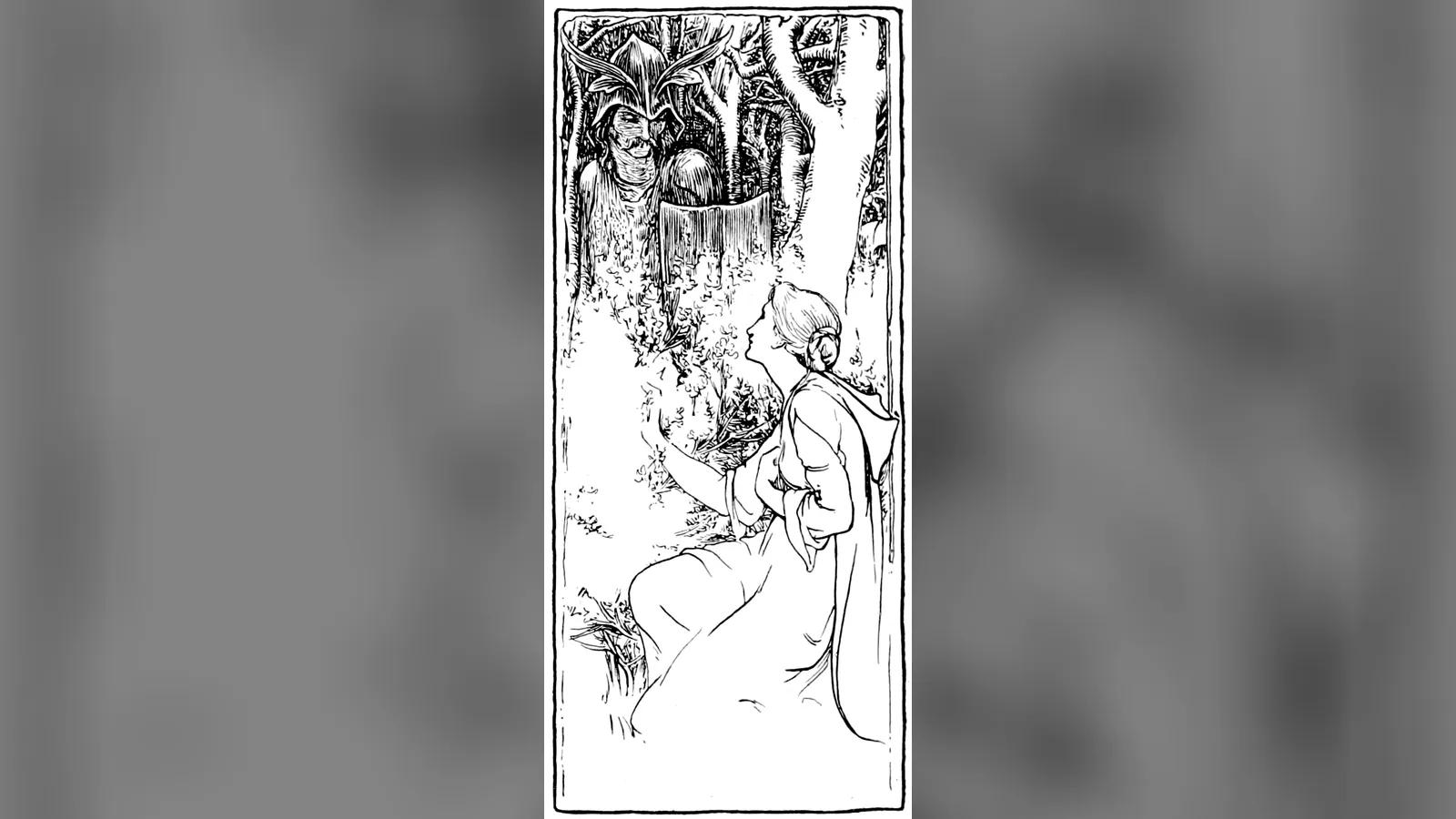

Tam Lin
Contents
Legend/Myth
Tam Lin is sometimes presented as a straightforward fairy romance — a handsome young man enchanted by the fairy queen, won back by a loyal sweetheart, happily ever after. The ballad tradition itself is considerably darker and stranger than that summary allows: Tam Lin is a mortal held captive and facing a literal tithe to hell, Janet's "rescue" requires her to physically wrestle a shapeshifting, transforming body through a sequence of terrifying forms without letting go, and the whole encounter takes place within one of the most structurally important and widely collected ballads in the entire English and Scottish tradition. This is not a soft fairy tale; it is one of the great set-pieces of the Border ballad corpus.
TL;DR
- established Tam Lin is catalogued by the great nineteenth-century ballad scholar Francis James Child as Ballad 39 in his monumental collection The English and Scottish Popular Ballads (1882–1898), which gives it one of the strongest, most formally recognised positions of any piece in this entire card series, because Child's numbering is the standard scholarly reference point used across ballad studies to this day.
- established The earliest printed text of the ballad appears in James Johnson's Scots Musical Museum (1792), communicated by Robert Burns, and Child subsequently collected more than a dozen distinct versions (labelled A through at least O) from manuscript and oral sources across Scotland, because having multiple independently collected versions, rather than a single fixed text, is exactly the kind of evidence folklorists rely on to establish genuine, long-circulating oral tradition rather than a single author's invention.
- established The ballad is explicitly and consistently located at Carterhaugh, a real place near Selkirk in the Scottish Borders where the Ettrick and Yarrow rivers meet, across its many collected versions, because a specific, named, geographically real setting repeated across independently collected texts is a strong marker of a rooted local tradition rather than a free-floating literary motif.
- established The ballad's central rescue sequence — Janet pulling Tam Lin from the fairy court's Halloween procession (the fairy rade, treated on its own card in this series) and holding him through a series of shapeshifting transformations until he returns to human form — recurs with only minor variation across the many collected versions, because this consistency across independently recorded tellings is what allows folklorists to treat it as the ballad's stable traditional core rather than one teller's embellishment.
- disputed The precise age of the underlying story predating its earliest print appearance in 1792 cannot be fixed with certainty, because oral ballads of this kind typically circulate for generations before anyone writes them down, and scholars can say the tradition is demonstrably old and widely rooted without being able to assign it a precise date of origin.
Key Facts
- Type of Being/Legend
- Ballad romance: a mortal man held captive by the fairy queen, rescued by a mortal woman
- Region
- Scottish Borders, specifically Carterhaugh near Selkirk (confluence of the Ettrick and Yarrow Water)
- First Attested
- Printed 1792 in James Johnson's Scots Musical Museum (text communicated by Robert Burns); catalogued as Child Ballad 39 by Francis James Child (1882–1898)
- Category
- Ballad and Romance
- SI Score
- 55/60 — the single highest-scored card in this series
- Status Note
- Kept; no replacement. Anchor/flagship card of the Legends & Folklore series — the deepest, most widely collected, most culturally durable item in the entire set.
A Note on Claims and Evidence
This article is built primarily on the ballad tradition itself as collected and catalogued by Francis James Child, cross-checked against Robert Burns's earlier communicated text in the Scots Musical Museum and against Sir Walter Scott's discussion of Border ballad material in Minstrelsy of the Scottish Border. Because Tam Lin survives in many independently collected versions rather than a single authoritative text, this article treats the recurring core elements — Carterhaugh, the fairy queen's claim on Tam Lin, the Halloween rescue, the tithe to hell — as the established traditional backbone, while noting that individual wording, verse order, and some narrative detail vary from version to version, as is normal for orally transmitted balladry.
Timeline
The ballad circulates in oral tradition in the Scottish Borders for an unknown but evidently substantial period before its first print appearance; its deep rootedness at Carterhaugh and its wide later collection both point to a long prior history.
The earliest printed text appears in James Johnson's Scots Musical Museum, communicated by the poet Robert Burns, giving the ballad its first firmly dated textual anchor.
Sir Walter Scott discusses and collects Border ballad material, including matter related to Tam Lin, in his influential Minstrelsy of the Scottish Border, helping to bring the ballad to a wider literary readership.
Francis James Child publishes his landmark The English and Scottish Popular Ballads, formally cataloguing the ballad as Child 39 and recording multiple distinct versions collected from manuscript and oral sources.
The ballad becomes a touchstone of the British folk-revival movement, recorded by major folk performers and groups and widely anthologised; it also inspires prose retellings and novels.
Tam Lin's rescue-from-the-fairy-court narrative continues to influence modern fantasy fiction and music, cited as a key source for the "mortal held captive by the fairy court" story pattern used across the genre.
Details
The core tradition
Janet, daughter of a local landowner, is warned not to go to Carterhaugh, where young women who pick roses risk encountering Tam Lin, a young man said to belong to the fairy queen. Janet goes anyway, picks a rose, and summons Tam Lin, who reveals he was once a mortal man — in most versions, a human child taken by the fairy queen after a fall from his horse — now held in the fairy court. He explains that every seven years the fairy court must pay a tithe to hell, and he fears that this time he, being mortal flesh, will be the one paid over. Janet, now pregnant by him, learns from Tam Lin exactly what she must do to win him back: she must go to Miles Cross (or a similar named crossing, depending on the version) on Halloween night, let the first two companies of riders in the fairy procession — on black and brown horses — pass by untouched, and pull the rider of the white horse down from his mount. Having seized him, she must hold on no matter what, as the fairy queen causes him to transform in her arms through a sequence of frightening shapes — commonly an adder or snake, a bear, a lion, and finally a glowing bar of red-hot iron — before he reverts to his own naked human form, at which point Janet must wrap him in her green mantle to complete and secure the rescue.
Regional and textual variants
Francis James Child's collection preserves well over a dozen distinct versions of the ballad, drawn from both manuscript sources and living oral tradition across Scotland, and the ballad continued to be collected into the twentieth century from singers who had learned it orally rather than from print. Variation between versions is normal and expected in oral balladry: some versions name the crossing differently, some adjust the exact sequence or number of Tam Lin's transformations, and some include or omit particular stanzas of dialogue between Janet and Tam Lin — but the core architecture (Carterhaugh, the fairy queen's claim, the Halloween rescue at the crossing, the sequence of transformations, the final covering in green) recurs with striking consistency, which is precisely why folklorists treat this as one of the best-attested and most structurally stable items in the entire Scottish ballad corpus.
The tithe to hell
The detail that gives the ballad its sharpest edge is Tam Lin's fear that he, specifically, may be the fairy court's payment to hell at the end of the current seven-year cycle. This motif — fairies as themselves subject to a higher, darker power, required periodically to render up one of their own captives — recurs elsewhere in British and Irish fairy belief and gives otherwise whimsical-seeming fairy abduction tales genuine stakes: the fairy queen in this ballad is not simply a jealous captor but an intermediary bound by rules Tam Lin, and by extension Janet, must work urgently around.
Significance and relationship to neighbouring cards
Tam Lin anchors the Ballad and Romance group of this series and sits in direct structural relationship with the Fairy Rade (the Halloween procession Janet must intercept, treated fully on its own card) and with Thomas the Rhymer (another Border ballad narrative built around a mortal's extended encounter with the fairy queen, though with a very different outcome and historical anchor). Where Thomas the Rhymer is framed around a documented historical figure who became the subject of legend, Tam Lin has no comparable historical anchor and is best understood purely as ballad tradition — its strength lies not in any claim to have happened to a real, named person, but in the sheer depth, consistency, and distribution of its collected textual record, which is why it scores highest of any card in this series.
Did You Know?
- Carterhaugh, the ballad's setting, is a real place in the Scottish Borders at the meeting of the Ettrick and Yarrow Water, near Selkirk.
- The earliest printed text of Tam Lin appeared in 1792 in a collection communicated by the poet Robert Burns.
- Francis James Child catalogued more than a dozen distinct collected versions of the ballad under Child 39, an unusually large number reflecting its wide oral circulation.
- Tam Lin fears he may be the fairy court's periodic tithe payment to hell — a detail that makes the fairies themselves subordinate to a darker power.
- To win Tam Lin back, Janet must hold onto him while he transforms in her arms through several frightening shapes, including, in most versions, a red-hot bar of iron.
- The rescue takes place specifically during the fairy rade, the fairy court's Halloween procession — treated on its own card in this series.
- Tam Lin became a touchstone of the twentieth-century British folk revival and has been recorded by numerous major folk musicians and groups.
- The ballad's "mortal captive of the fairy court, rescued at great personal risk" story pattern is widely cited as an influence on modern fantasy fiction.
FAQ
1What is Tam Lin about?
A ballad about a young man held captive by the fairy queen at Carterhaugh in the Scottish Borders, and his rescue by Janet, who intercepts the fairy court's Halloween procession and holds onto him through a series of frightening transformations.
2Is Tam Lin based on a real person?
No — unlike Thomas the Rhymer, Tam Lin has no identified historical figure behind him. The ballad is a piece of oral tradition, not a legend attached to a documented individual.
3What is Child Ballad 39?
The classification given to Tam Lin by Francis James Child in his landmark collection The English and Scottish Popular Ballads (1882–1898), the standard scholarly reference system for English and Scottish ballads.
4When was Tam Lin first printed?
In 1792, in James Johnson's Scots Musical Museum, in a text communicated by the poet Robert Burns.
5Where is Carterhaugh?
A real location in the Scottish Borders, at the meeting of the Ettrick and Yarrow Water near Selkirk — the ballad's consistently named setting across its many collected versions.
6Why does Tam Lin fear the Halloween tithe?
Fairy tradition in the ballad holds that the fairy court must periodically pay a tithe to hell, and Tam Lin, being a mortal man rather than a fairy, fears he may be the one paid over at the next such reckoning.
7What must Janet do to rescue Tam Lin?
Wait at a named crossing on Halloween night, let two companies of fairy riders pass, pull the rider of the white horse (Tam Lin) down, and hold onto him through a series of transformations until he returns to human form, then cover him in her green mantle.
8What does Tam Lin turn into during the rescue?
Versions vary slightly, but commonly an adder or snake, a bear, a lion, and finally a glowing bar of red-hot iron, before reverting to his own human shape.
9How is Tam Lin connected to the Fairy Rade card in this series?
The rescue takes place specifically during the fairy rade, the fairy court's seasonal procession, which is treated in full detail on its own separate card.
10Why does this card score the highest of any in the Legends & Folklore series?
Because it combines deep, widely collected oral tradition (many independent versions under Child 39), a real, specific, consistently named Scottish setting, strong imaginative force, and a substantial, ongoing modern cultural afterlife in folk music and fantasy fiction.
11Is Tam Lin still performed or adapted today?
Yes — it remains a staple of the British folk-music revival tradition and continues to inspire novels, songs, and other retellings.
12Is there only one version of the ballad?
No — Child collected more than a dozen distinct versions, and additional versions have been collected from oral tradition since, with normal variation in wording and detail typical of orally transmitted balladry.
Sources and Further Reading
Primary/Institutional
- Francis James Child, The English and Scottish Popular Ballads, Ballad 39 (1882–1898)
- James Johnson, Scots Musical Museum (1792), text communicated by Robert Burns
- Sir Walter Scott, Minstrelsy of the Scottish Border (1802–03)
Scholarly/Critical
- Ballad scholarship cataloguing and comparing the various collected versions (A–O and later-collected texts) of Child 39
General
Caveats: Myths and Disputed Claims
Popular retellings sometimes soften Tam Lin into a conventional fairy-tale romance; the ballad tradition itself is considerably sharper, hinging on a literal threatened human sacrifice and a physically harrowing rescue, and editorial treatments should resist smoothing that out. The ballad has no identified historical figure behind it, unlike Thomas the Rhymer, and should not be presented as based on a real person or real recorded event — its authority rests on the depth and consistency of its oral-collection record, not on any claim to historicity. The exact age of the story prior to its first 1792 print appearance cannot be fixed, and any specific earlier date offered for its origin should be treated as speculative rather than established.
Card 026 · Folklore