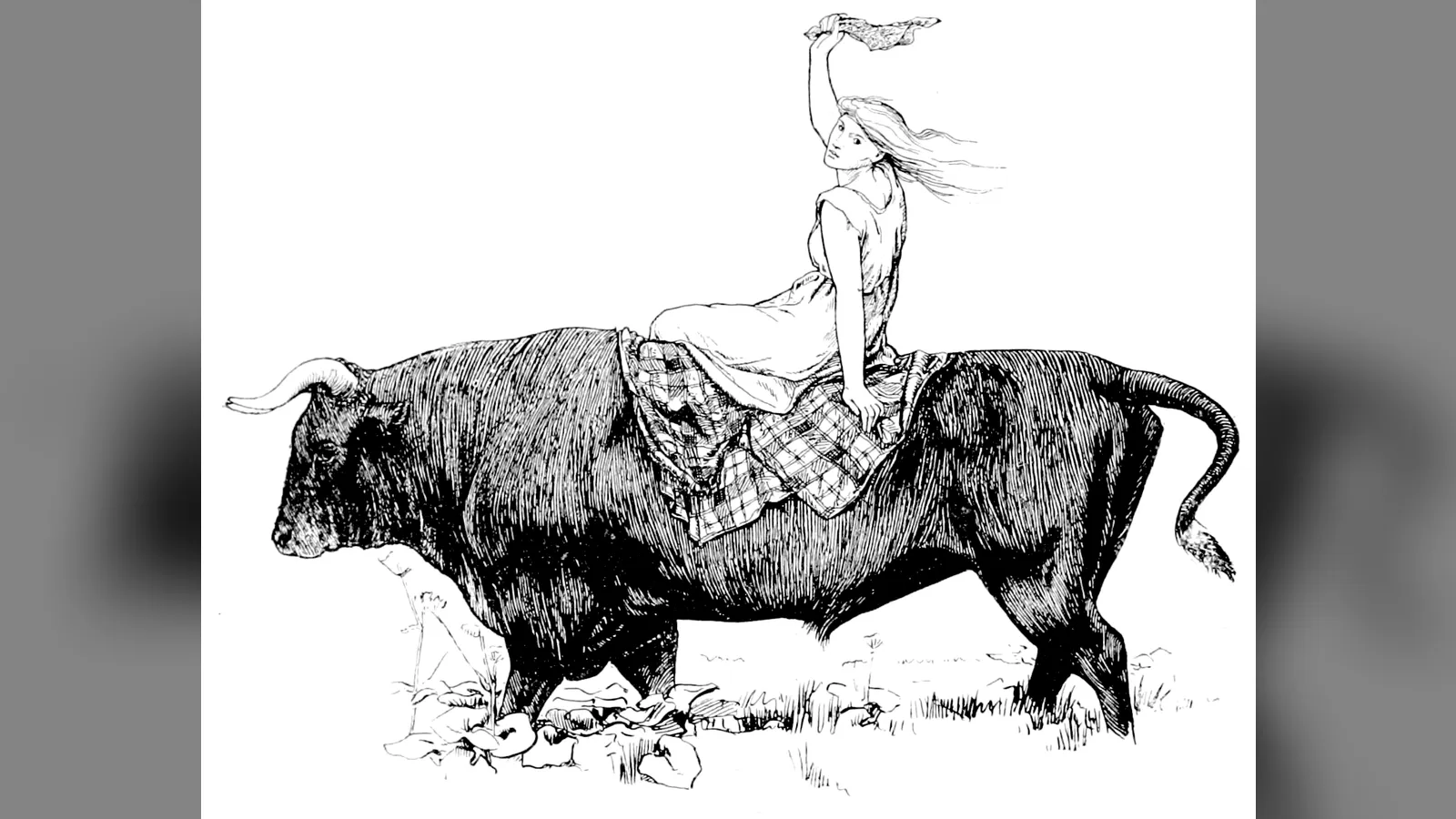

The Black Bull of Norroway
Contents
Legend/Myth
A card like this invites a fair question: why include a wonder tale about an enchanted bull rather than one of the many strange, half-remembered creature-names scattered through nineteenth-century Highland folklore collection? The answer is the whole editorial point of this card. The Black Bull of Norroway is a genuine, fully told story — with a beginning, middle, and end, a heroine who makes choices, and a shape recognisable across more than a thousand collected international variants — rather than a bare "motif" (a single strange name or image mentioned once or twice in passing, with no surrounding narrative). This card replaces an earlier candidate, the Fachan, precisely because the Fachan survives only as a rare descriptive mention in J. F. Campbell's Highland collecting, not as a story anyone can actually tell start to finish.
TL;DR
- established — The Black Bull of Norroway is recorded in print in the Scottish Borders as early as 1548, referenced in The Complaynt of Scotland, and again in Philip Sidney's Arcadia, giving it one of the longer continuous print histories of any wonder tale in Scottish tradition, because these are independent sixteenth-century literary references to an already-known tale title, not a story invented for nineteenth-century collection.
- established — Robert Chambers published a full version of the tale (under the title "The Red Bull of Norroway") in his 1842 Popular Rhymes, Fireside Stories, and Amusements of Scotland, with a further version appearing in a later edition of his Popular Rhymes of Scotland, giving the tale a securely dated, named, nineteenth-century collector and publication, because Chambers's named, printed collection is exactly the kind of documentary trace that distinguishes a genuinely told story from a scholarly reconstruction.
- established — The tale is internationally classified as Aarne-Thompson-Uther type 425A, "The Animal (Monster) as Bridegroom," placing it within a very large, well-studied international tale-type family that includes "East of the Sun, West of the Moon" and well over a thousand collected variants studied by folklorists including Jan-Öjvind Swahn, because this kind of comparative classification is only possible for tales with enough narrative substance and enough collected variants to compare — exactly what distinguishes a told story from a thin motif.
- established — Joseph Jacobs adapted and republished a version of the tale in his 1894 collection More English Fairy Tales, and it was further anthologised by Andrew Lang, showing the story circulating actively across multiple independent nineteenth-century folklore collectors and editors, not surviving through a single source.
- disputed — Scholars disagree on the precise geographic origin point of the "enchanted bull" branch of this very widely distributed international tale type, with some comparative folklorists suggesting an Irish or British origin for this particular animal-bridegroom variant specifically, because the tale type as a whole is found across Europe and parts of Asia and tracing any single branch's point of origin within such a widely distributed family is inherently difficult.
Key Facts
- Type of Being/Legend
- Wonder tale (fairy tale) of the animal-bridegroom type: an enchanted prince in bull form, and the heroine who frees him
- Region
- Scotland generally, collected and published in the Scottish Lowlands tradition
- First Attested
- Referenced by title in print from 1548 (The Complaynt of Scotland); full told version published by Robert Chambers, 1842
- Category
- Ballad and Romance
- SI Score
- 40/60
- Status Note
- Replacement for the Fachan, which the curator judged to be a rare descriptive motif recorded by J. F. Campbell, not a living, fully told story — this card was chosen specifically because it is a genuine told tale.
A Note on Claims and Evidence
This article relies on Robert Chambers's nineteenth-century published text (under the title "The Red Bull of Norroway" in his 1842 collection, later reprinted within editions of Popular Rhymes of Scotland) as the core told version, cross-referenced against the sixteenth-century title references in The Complaynt of Scotland and Sidney's Arcadia, and against the tale's international Aarne-Thompson-Uther classification (type 425A) established through comparative folklore scholarship, notably Jan-Öjvind Swahn's large-scale study of the wider animal-bridegroom tale family. Where a detail comes specifically from Chambers's text rather than from the wider international tale type, it is identified as such.
Timeline
The Complaynt of Scotland references the tale by title, the earliest known print mention, confirming the story was already a recognised piece of Scottish popular culture by the mid-sixteenth century.
Philip Sidney references the tale title in his Arcadia, a second independent literary mention confirming the story's circulation beyond Scotland's own borders in educated English literary culture.
Robert Chambers publishes a full told version, titled "The Red Bull of Norroway," in Popular Rhymes, Fireside Stories, and Amusements of Scotland, the earliest full surviving text of the story as actually told.
A further edition of Chambers's Popular Rhymes of Scotland includes another collected version of the tale.
Joseph Jacobs adapts and republishes a version in More English Fairy Tales, under the now-standard title "The Black Bull of Norroway."
Andrew Lang anthologises the tale for a wider popular audience, and comparative folklorists begin classifying it within the international "animal bridegroom" tale-type family.
Jan-Öjvind Swahn's major comparative study of the Cupid-and-Psyche/animal-bridegroom tale family (ATU 425 and its sub-types) places the Black Bull of Norroway within a documented international context of well over a thousand collected variants.
Details
The core tale
A washerwoman's youngest daughter sets out with a mysterious black bull, who carries her on a long journey through increasingly strange and threatening lands, promising her safety so long as she does not break his trust. Eventually the bull is lost to her — in the fullest versions, after she disobeys an instruction and he vanishes into a glass valley or similar otherworldly barrier — and she must then undertake a long, difficult quest of her own to win him back: years of labour in service to a smith in exchange for a pair of iron shoes needed to cross the glass mountain, and finally the use of three magical gifts (traditionally an apple, a pear, and a plum, each containing some wonder) to buy, night by night, access to the enchanted man the bull truly is, until on the third night he wakes, recognises her, and the enchantment is broken.
Relationship to the wider international tale family
The Black Bull of Norroway belongs to the same broad international story family as "East of the Sun, West of the Moon" (a Norwegian tale) and, more distantly, to the classical "Cupid and Psyche" pattern: a heroine bound to an enchanted or hidden bridegroom, a betrayal or broken condition that separates them, and a hard quest — buying access across several nights, in this tale type's specific pattern — to win him back. Comparative folklorists classify this group as Aarne-Thompson-Uther type 425A, and large-scale studies (notably Jan-Öjvind Swahn's) have traced well over a thousand collected variants of the wider family across Europe and parts of Asia, which gives scholars real comparative material against which to read the specifically Scottish details of the Norroway telling — its washerwoman's daughter, its named fruit gifts, its glass valley.
Why this card replaces the Fachan
The curatorial decision behind this card is itself worth recording as part of its editorial story. An earlier candidate for this slot, the Fachan — a strange one-legged, one-armed, one-eyed Highland creature mentioned in J. F. Campbell's nineteenth-century collecting — was judged too thin to anchor a card: it survives as a rare descriptive image or motif, not as a story with a plot anyone tells start to finish. The Black Bull of Norroway was chosen specifically because it clears that bar comfortably: a full narrative arc, a named nineteenth-century collector and publication, sixteenth-century title references confirming a long prior history, and a secure place within a well-studied international comparative tale-type family.
Significance and relationship to neighbouring cards
Within the Ballad and Romance group, the Black Bull of Norroway sits alongside Tam Lin, Thomas the Rhymer, and Kate Crackernuts as Scotland's strongest wonder-tale and ballad-romance material, though it differs from the first two in having no ballad verse form and no fairy-court setting; it is prose wonder tale rather than sung balladry, closer in kind and structure to Kate Crackernuts than to the Carterhaugh or Erceldoune material.
Did You Know?
- The tale is referenced by title as early as 1548, in The Complaynt of Scotland — one of the longest print histories of any Scottish wonder tale.
- Sir Philip Sidney also references the tale's title in his Arcadia, showing it was known in educated English literary circles well before any folklore collector wrote it down in full.
- Robert Chambers's original 1842 published title for the tale was "The Red Bull of Norroway," not "Black" — the now-standard title became fixed through later editions and Joseph Jacobs's 1894 retelling.
- The heroine must win three nights of access to the enchanted man using magical fruit gifts — traditionally an apple, a pear, and a plum.
- The tale belongs to the same international story family as the Norwegian tale "East of the Sun, West of the Moon."
- Folklorist Jan-Öjvind Swahn's major comparative study traced well over a thousand collected variants of this wider "animal bridegroom" tale family across Europe and parts of Asia.
- This card replaces an earlier candidate, the Fachan, a rare Highland creature-motif judged too thin — a bare mention rather than a told story — to anchor a card on its own.
- "Norroway" in the title is an older Scots form referring to Norway, though the tale itself is set in an otherworldly, fairy-tale landscape rather than a geographically real Scandinavia.
FAQ
1What is the Black Bull of Norroway?
A Scottish wonder tale about a washerwoman's daughter who travels with an enchanted black bull — really a transformed prince — and must undertake a long quest to free him after he is lost to her.
2Is this a real, traditionally told Scottish story, or a scholarly reconstruction?
A genuinely told story, with a full plot and a securely documented nineteenth-century publication by Robert Chambers, as well as sixteenth-century title references confirming it was known long before that.
3When was the tale first mentioned in print?
In 1548, in The Complaynt of Scotland, and again later in the sixteenth century in Philip Sidney's Arcadia.
4Who first published a full version of the tale?
Robert Chambers, in 1842, under the title "The Red Bull of Norroway," in Popular Rhymes, Fireside Stories, and Amusements of Scotland.
5Why is it now usually called the "Black" Bull rather than the "Red" Bull?
Later editions and retellings, including Joseph Jacobs's 1894 version, fixed "Black Bull of Norroway" as the standard modern title, even though Chambers's original 1842 title used "Red."
6What tale type does this story belong to?
Aarne-Thompson-Uther type 425A, "The Animal (Monster) as Bridegroom," an international tale family that also includes "East of the Sun, West of the Moon."
7What must the heroine do to free the bull-prince?
Work for years to earn iron shoes, use them to cross a glass mountain or valley, and then use three magical fruit gifts to buy three nights of access to him until he wakes and recognises her.
8Why does this card replace the Fachan?
Because the Fachan survives only as a rare, thin descriptive motif in Highland folklore collection, not as a full told story, while the Black Bull of Norroway has a complete narrative, a named collector, and a long print history.
9Is the Black Bull of Norroway connected to other cards in this series?
It sits in the same Ballad and Romance group as Tam Lin, Thomas the Rhymer, and Kate Crackernuts, though it is a prose wonder tale rather than sung balladry.
10Is "Norroway" a real place in the story?
It is an older Scots form of "Norway," but the tale's setting is an otherworldly fairy-tale landscape rather than a literal geography.
11Who else collected or retold this tale?
Joseph Jacobs republished a version in More English Fairy Tales (1894), and Andrew Lang later anthologised it for a wider popular readership.
12What is the Black Bull of Norroway's modern cultural legacy?
It remains a staple of Scottish fairy-tale anthologies and continues to be cited by folklorists as a strong Scottish example of the widely distributed "animal bridegroom" tale type.
Sources and Further Reading
Primary/Institutional
- Robert Chambers, Popular Rhymes, Fireside Stories, and Amusements of Scotland (1842; "The Red Bull of Norroway"), and later editions of Popular Rhymes of Scotland (1870)
- The Complaynt of Scotland (1548)
- Joseph Jacobs, More English Fairy Tales (1894)
Scholarly/Critical
- Jan-Öjvind Swahn, comparative study of the Cupid-and-Psyche/animal-bridegroom tale family (ATU 425 and sub-types)
- Hans-Jörg Uther, The Types of International Folktales (ATU classification)
General
Caveats: Myths and Disputed Claims
The tale's original 1842 published title, Chambers's "The Red Bull of Norroway," is sometimes forgotten in favour of the now-standard "Black Bull" title fixed by later retellings; both refer to the same story, and the colour change is an editorial and publishing-history detail, not evidence of two separate tales. The precise geographic point of origin for this specific "enchanted bull" branch of the much larger international animal-bridegroom tale family remains debated among comparative folklorists and should not be stated as settled. This card's replacement of the Fachan should not be read as a judgement that the Fachan is not genuine Highland folklore at all — only that it survives as a thin descriptive motif rather than a full told story, which made it a weaker anchor for a card in this particular series.
Card 028 · Folklore