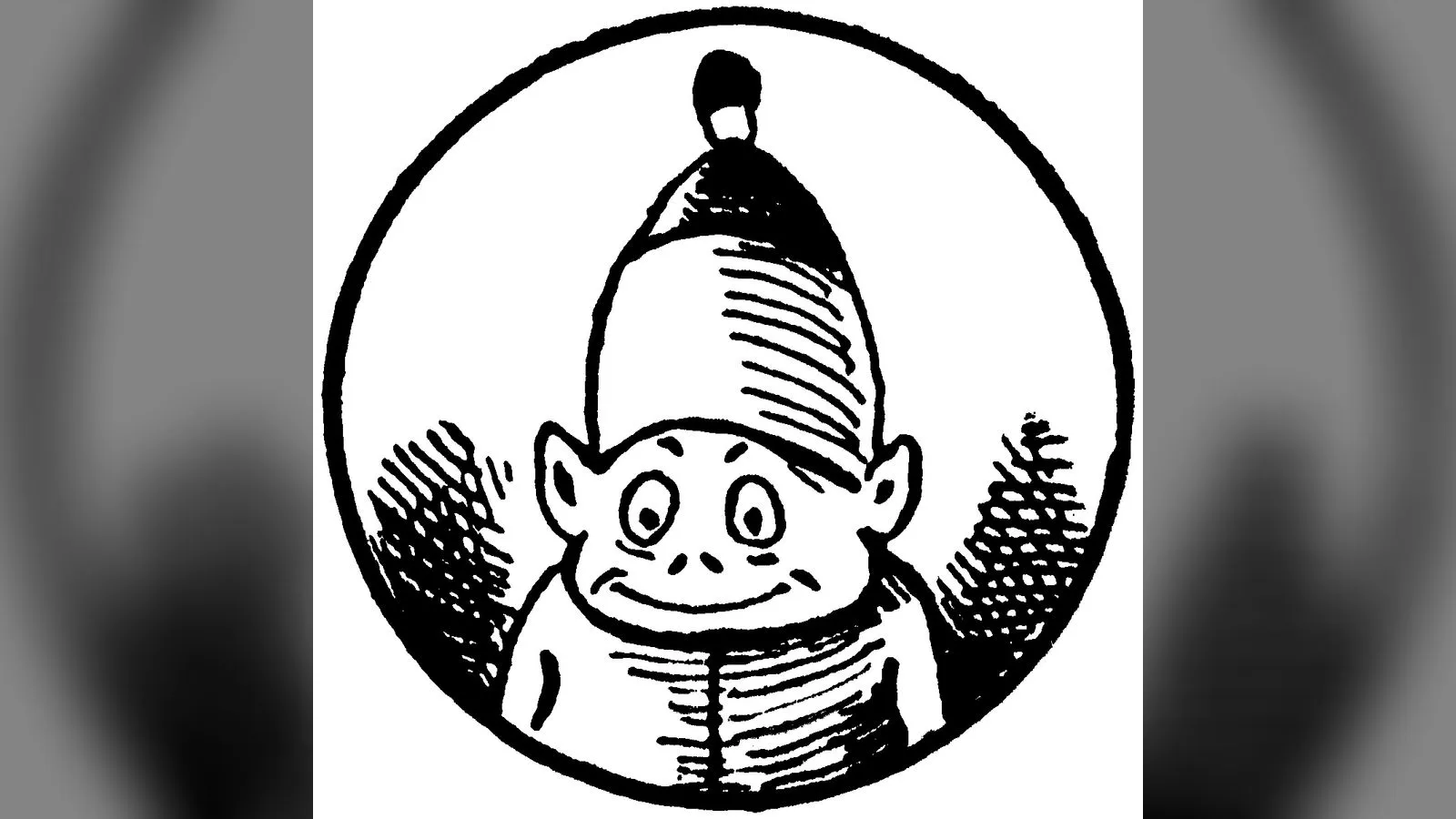

The Brownie
Contents
Legend/Myth
The brownie is often mistaken for a generically "Celtic" or purely literary invention — a cute fireside sprite dreamed up for children's books. In fact the belief is a genuine, widely attested piece of Lowland and Highland Scottish domestic tradition stretching back at least to the sixteenth century, and it long predates the "brownie-mania" character merchandise of the 1890s and the house-elves of modern fantasy fiction that borrowed its shape.
TL;DR
- established The brownie is attested in print from the late sixteenth century, including in King James VI's 1597 Daemonologie, which treats brownies as a recognised class of household spirit — this is a documented textual attestation, not folklore reconstructed after the fact.
- established The core belief — a solitary, hairy, brown-skinned spirit that does unseen farm and house work overnight in exchange for cream or milk left at the hearth, and who is driven off forever by the gift of clothing or by being named — is consistent across collections from the Scottish Lowlands, Highlands, Shetland and the English Borders, which is why folklorists treat it as a stable, widely collected motif rather than a one-off tale.
- established Sir Walter Scott recorded and discussed brownie belief in Minstrelsy of the Scottish Border, and John Brand documented Shetland brownie-offering customs as early as 1703 — naming specific named collectors and dates is what allows this to be called "documented" rather than merely "traditional."
- disputed Whether the brownie is best understood as a distinct Scottish/Border tradition or as one regional face of a much older, pan-European house-spirit belief (compared by some scholars to the Roman Lares, and cousin to the Welsh bwbach, Manx fenodyree, and English hob) is not settled, because the historical relationship between these regional figures cannot be traced through unbroken written record.
- disputed The exact line between the "brownie" and the outdoor water-and-hill spirit the Highlands call the ùruisg (urisk) is blurred in some older sources and sharpened in others; John Gregorson Campbell's own distinction between an indoor English/Lowland brownie and an outdoor Highland ùruisg is a scholarly tidying of material that was not always kept so clean by the people who told the stories.
Key Facts
- Type of Being/Legend
- Solitary household/tutelary spirit
- Region
- Scottish Lowlands and Highlands, Shetland, Scottish Borders (cognates across England, Wales, Isle of Man)
- First Attested
- 1584 (Reginald Scot, The Discoverie of Witchcraft, England); 1597 (King James VI, Daemonologie, Scotland)
- Category
- Household Spirits
- SI Score
- 47/60
- Status Note
- Kept; no replacement. Anchor card for the Household Spirits group — the baseline domestic "good" spirit against which the Gruagach, Glaistig and Urisk are distinguished in their own cards.
A Note on Claims and Evidence
This article draws on early textual witnesses (King James VI's Daemonologie, 1597; Reginald Scot, 1584), early folklore recorders (John Brand's Shetland material, 1703; Sir Walter Scott's Minstrelsy of the Scottish Border), and the systematic nineteenth-century Highland collecting of John Gregorson Campbell, read alongside Katharine Briggs's twentieth-century synthesis in works such as An Encyclopedia of Fairies. Where regional custom (a Shetland offering practice, a Border tale) is cited, it is attributed to its named source rather than presented as a single undifferentiated "Scottish belief."
Timeline
Reginald Scot's The Discoverie of Witchcraft records the English form of the belief, including the detail that a brownie vanishes forever once given clothing.
King James VI names and classifies the brownie as a species of demon/spirit in Daemonologie, the earliest clear Scottish textual attestation.
John Brand documents Shetland households' brownie-offering customs.
Sir Walter Scott discusses brownie belief in Minstrelsy of the Scottish Border, describing it as distinct in temperament from "freakish and mischievous elves"; John Gregorson Campbell collects Highland material and draws his brownie/ùruisg distinction.
Palmer Cox publishes The Brownies: Their Book in the USA, launching a commercial "brownie" character craze unconnected to the original belief in any functional sense beyond the borrowed name.
Katharine Briggs's folklore scholarship (An Encyclopedia of Fairies and related work) consolidates and cross-references brownie material with cognate traditions.
The house-elf of the Harry Potter novels and figures such as Thimbletack in The Spiderwick Chronicles popularise a recognisably brownie-shaped character for new audiences.
Details
The core tradition
The brownie is imagined as a small, hairy, brown-skinned, solitary male spirit attached to a particular house or farm rather than to a family that might move house. By night, while the household sleeps, he performs unseen labour — threshing grain, churning butter, sweeping, tending livestock — and in return expects a small offering, typically cream or the "brownie's bowl" of milk left by the hearth or dairy. He is quick to take offence: too much praise, too much curiosity about his appearance, or any attempt to pay him in clothing rather than food will drive him away for good, sometimes with a parting curse on the house that failed to understand the etiquette of the relationship.
Regional variants
Belief in named local brownies — tied to a specific farm, mill or great house rather than a generic type — is recorded across the Lowlands and Borders, and the figure is, by Campbell's own account, more commonly told of in the Lowlands and in England than in the Gaelic-speaking Highlands, where the outdoor ùruisg tends to take an equivalent role. Shetland tradition (via Brand) describes household offerings that are functionally identical to Lowland custom despite the geographic distance, which folklorists take as evidence of a genuinely widespread shared belief rather than a single local legend that happened to travel.
What it was believed to explain or warn against
The brownie belief does double duty as a piece of practical household etiquette: it explains unaccountable overnight tidiness or farm productivity, and it encodes a warning about the social obligations of hospitality and gratitude — treat your unseen helper (and, by extension, your own servants) shabbily, with excess familiarity, or with misplaced charity, and the help will vanish.
Relationship to neighbouring beings
Within this card series, the brownie is the baseline, indoor, broadly benevolent domestic spirit. It should not be conflated with the Gruagach (a distinctively Highland, long-haired guardian specifically of cattle and the dairy, with its own stone-libation custom), the Urisk/ùruisg (an outdoor, solitary Highland spirit of pools and waterfalls rather than the house), or the Glaistig (a shape-shifting green fairy woman whose nature swings between cattle-guardian and dangerous seductress). The brownie is also cousin to — but not identical with — England's hobgoblin/hob, Wales's bwbach, and the Isle of Man's fenodyree; these are best treated as parallel regional traditions rather than one creature under different names.
Scholarly significance
The brownie is one of the best-documented figures in British household folklore precisely because belief in it was mainstream and openly discussed by serious writers (a king, a border antiquarian, an eighteenth-century minister) rather than surviving only in oral collection taken down after the fact. That gives scholars an unusually long and continuous written record to work with, making the brownie a useful anchor point for dating and tracing the wider "house spirit" tradition across the British Isles.
"A Brownie in business"
By the mid-eighteenth century the brownie had become a figure of speech for the educated as well as a belief of the countryside. On 16 January 1768 James Boswell watched Alexander Lockhart, Dean of the Faculty of Advocates and one of the busiest lawyers in Scotland, work through a mountain of cases in the Court of Session without ever seeming hurried. Boswell wrote in his journal:
I told him he was just a Brownie in business. In a few hours the work of a dozen of men is performed by him.
Lockhart, Boswell noted, "said he wondered how the story of Brownies came ever to be believed". That exchange neatly captures the brownie's place in Enlightenment Edinburgh: everyone knew what a brownie was, the tireless unseen worker who did a household's jobs by night, and the city's lawyers were already asking how anyone could have believed in one.
Did You Know?
- In 1768 James Boswell called the advocate Alexander Lockhart "a Brownie in business" for doing the work of a dozen men without complaint.
- King James VI, later James I of England, discussed brownies as a real category of spirit in his 1597 book on witchcraft and demonology, Daemonologie.
- A brownie who is given clothing as a reward is traditionally insulted by the gift and leaves the house forever — the opposite of what a human servant would want.
- Shetland households recorded as early as 1703 left regular milk offerings for their household brownie.
- John Gregorson Campbell treated the Highland ùruisg (Urisk) as essentially the outdoor, Gaelic-speaking counterpart of the brownie — same job, different habitat.
- The 1890s "Brownie" camera, Brownie Scout troops, and Palmer Cox's bestselling children's books all borrowed the name and general shape of the folklore figure for entirely commercial purposes.
- Harry Potter's house-elves and Enid Blyton's Noddy-universe brownies both draw, at a distance, on this same underlying folk figure.
- Brownies are almost always described as solitary — unlike fairy "hosts," a brownie does not travel or act in groups.
- The worst insult you can offer a brownie, by tradition, is excessive gratitude or fuss over the work it has done; silence and a steady small offering is the correct etiquette.
FAQ
1Is the brownie a real Scottish folk belief, or a modern invention?
It is a genuine, long-attested folk belief, recorded in print from the late sixteenth century onward, well before any commercial "brownie" character existed.
2What does a brownie look like?
Traditionally small, brown-skinned or brown-haired, hairy, and ragged — deliberately unglamorous, in contrast to the beautiful fairy folk of other tales.
3What does a brownie want in payment?
Food, not money or clothing — classically cream, milk, or a bit of bread left out overnight, given without comment.
4Why does giving a brownie clothes drive it away?
Clothing is read by the brownie as a judgement that its current state is shameful, or as a formal discharge from service (the same motif appears with other British household spirits); either way, it ends the relationship.
5Is the brownie the same as a hobgoblin?
Related but not identical — "hobgoblin" and "hob" are the English equivalents, and while they share the core behaviour, they are treated by collectors as parallel regional traditions rather than one figure under two names.
6Is the brownie the same as the Urisk in this collection?
No. The brownie is indoor and domestic; the Urisk (ùruisg) is its outdoor Highland counterpart, associated with pools, waterfalls and farm boundaries rather than the hearth.
7Did real households actually believe in brownies, or was it just a story told to children?
Adult, documented custom — the Shetland offering practice recorded by Brand in 1703 and the household etiquette Scott describes were treated as genuine practical precautions, not bedtime stories.
8Where was brownie belief strongest?
By Campbell's own account, more commonly told in the Lowlands, the Borders, and in England than in the Gaelic Highlands.
9What happens if a brownie is insulted?
It traditionally leaves the house for good, sometimes pronouncing a curse on the family's future luck.
10Are there female brownies?
The tradition overwhelmingly describes the brownie as male; female household-spirit figures in Scottish tradition more often appear as separate figures such as the Glaistig.
11Is the brownie connected to witchcraft trials?
Indirectly — King James VI's discussion of the brownie sits within a broader demonological text written during a period of intense Scottish witch persecution, which shaped how such spirits were officially classified.
12What is the brownie's modern cultural legacy?
Beyond the nineteenth-century commercial "Brownie" craze, the figure's basic shape recurs in fantasy fiction's house-elves and similar domestic spirits.
Sources and Further Reading
Primary/Institutional
- King James VI, Daemonologie (1597)
- Reginald Scot, The Discoverie of Witchcraft (1584)
- Sir Walter Scott, Minstrelsy of the Scottish Border
- John Gregorson Campbell, collected Highland folklore (19th century)
Scholarly/Critical
- Katharine Briggs, An Encyclopedia of Fairies (1976)
- John Brand, Shetland folklore records (1703)
General
- Brownie (folklore) — Wikipedia
- Hugh M. Milne (ed.), James Boswell: The Journals in Scotland, England and Ireland, 1766–1769 (Edinburgh University Press, 2023), entry for 16 January 1768.
Caveats: Myths and Disputed Claims
The sharp textbook distinction between "indoor brownie" and "outdoor ùruisg" is a tidier line than the oral record actually supports in every region — some tellers used the names more loosely or interchangeably. The commercial "Brownie" character of the 1890s onward (Palmer Cox's books, the Brownie camera, Brownie Guides) is not evidence of continuous folk belief; it is a separate, deliberately marketed reuse of the name and is not itself part of the traditional record. Claims connecting the brownie directly and unbroken to the Roman Lares are a comparative scholarly suggestion about shared human patterns of belief, not a demonstrated historical lineage.
Card 011 · Folklore