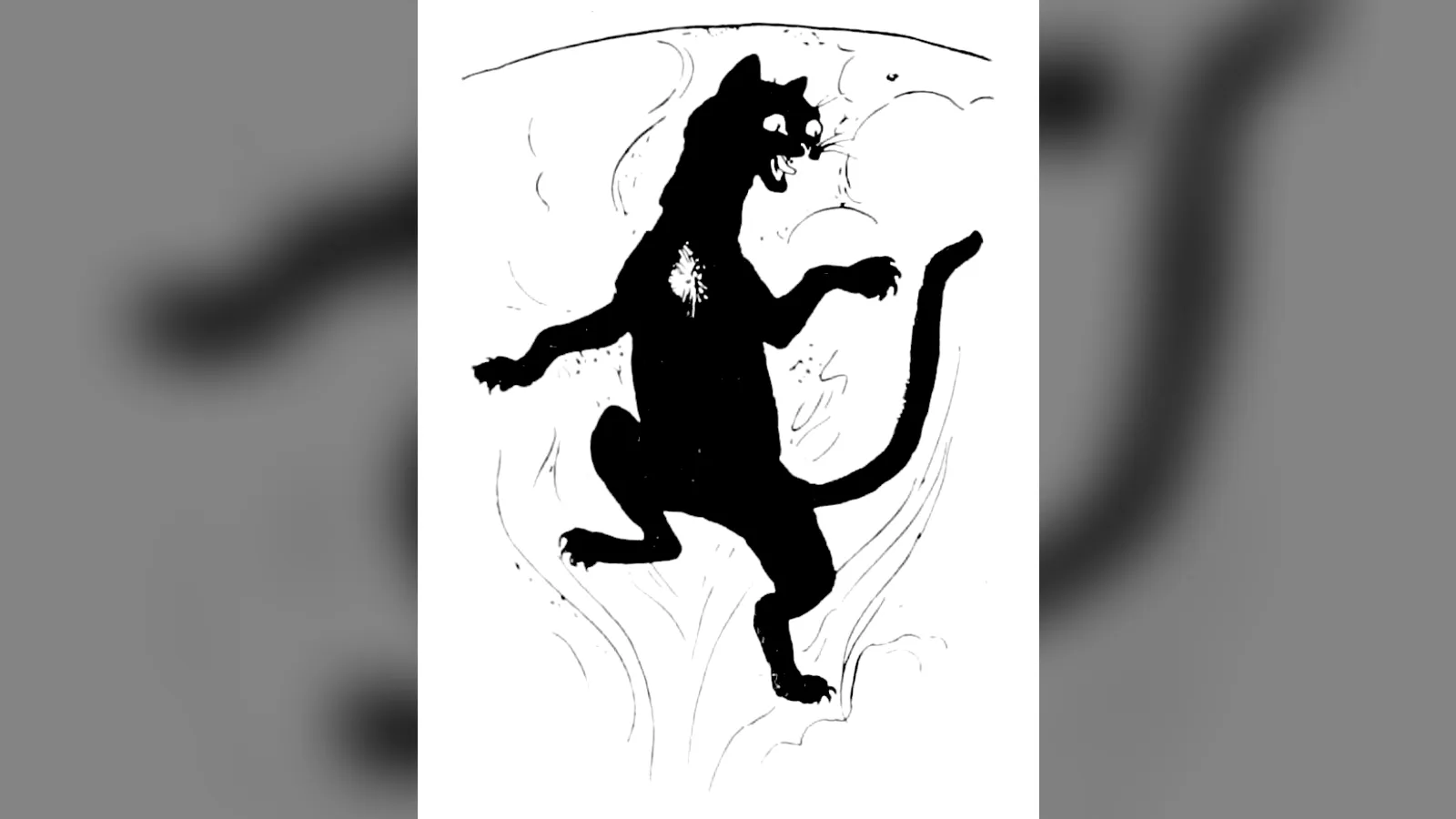

The Cat-Sìth
Contents
Legend or Myth?
Modern retellings frequently reduce the cat-sìth to a simple just-so story: "this is where the idea of cats having nine lives comes from." That gets the emphasis backwards. The core, best-attested Highland belief is not about lives at all — it is about a very specific danger at a wake, where a black fairy cat might cross over a corpse before burial and steal the unclaimed soul. The nine-lives/witch-transformation idea is a secondary, loosely attached theory recorded alongside the main tradition, not its foundation.
TL;DR
- established The cat-sìth ("fairy cat") is recorded in Highland tradition as a large black cat with a single white spot on its chest, capable of walking upright on its hind legs, because this specific, consistent physical description recurs across the Highland sources rather than varying randomly from account to account.
- established The central belief attached to it is that it might steal the soul of a person recently dead but not yet buried, by passing over or near the body before burial, because this is the specific danger the community-organised wake-watching custom was designed to prevent, not an incidental detail.
- established Highland communities held wake-watches, sometimes called the fèill fhadalach ("late wake"), to guard an unburied body — using distraction such as music, games, riddles, and catnip, and deliberately avoiding lighting fires near the corpse since the cat-sìth was believed drawn to warmth — because this specific protective custom, including the no-fire detail, is recorded as the practical, communal response to the belief rather than a modern invention.
- disputed Whether the cat-sìth was believed to be literally a shape-shifted witch (limited, in this theory, to nine transformations before becoming permanently trapped as a cat) or simply a distinct fairy-animal in its own right is not settled, because both explanations are recorded in the folklore literature without one clearly displacing the other.
- established Separately from the folklore, Scotland is the last British home of the wildcat, Felis silvestris, called cat-fiadhaich in Gaelic. The Handbook of British Mammals (1991) records that melanistic (black) cats had been reported from Scotland, but that whether they were wildcats, domestic cats or hybrids remained in doubt.
- disputed The popular claim that the cat-sìth tradition is the direct origin of the general Western saying that cats have nine lives is treated by folklorists as a plausible but unproven connection, because the "nine lives" saying has its own separate and wider history across European folklore, independent of any specifically Highland source.
Key Facts
- Type of Being/Legend
- Fairy cat; believed capable of stealing a soul from an unburied corpse
- Region
- Scottish Highlands and Islands, with a closely related Irish cat sí tradition
- First Attested
- 19th–20th-century Highland oral collection and comparative folklore literature (consistent with the general period of Highland fairy-cat and wake-custom recording; cross-referenced with the Irish King o' the Cats tale type recorded by Joseph Jacobs, 1894)
- Category
- Death and the Host
- SI Score
- 42/60 (Narrative Reach 7, Depth of Tradition 7, Scottish Distinctiveness 9, Imaginative Force 8, Cultural Afterlife 5, Recognition 6)
- Real-world cat (natural history)
- Scottish wildcat, Felis silvestris (Gaelic cat-fiadhaich); range at its lowest about 1914, recovering after the First World War
- Black wild-living cats
- Melanistic cats reported from Scotland; wildcat, domestic or hybrid status unresolved in 1991 (Handbook)
- Status Note
- Kept as its own card. Distinguished within this collection from the Cù-Sìth (a fairy hound whose danger is an approaching death rather than a threat to the newly dead) and from the general Irish cat sí tradition, which this card treats as a close cognate rather than claiming as identical.
A Note on Claims and Evidence
The cat-sìth is known chiefly through Highland oral tradition concerning the wake-watching custom and the soul-stealing belief attached to an unburied corpse, together with the closely related Irish "King o' the Cats" tale type recorded by Joseph Jacobs in 1894 and a specific witch-cat variant recorded from County Kerry by Margaret Doyle in 1937. Because the cat-sìth sits at the intersection of genuine wake-custom folklore and a looser, more speculative witch-transformation theory, this article treats the wake-watching material as the firmer, practice-grounded tradition and the nine-lives/witch theory as a secondary explanatory layer rather than collapsing the two into a single settled account.
The section "The real cats" is natural history, drawn mainly from The Handbook of British Mammals, 3rd edition (1991). It describes the wild and feral cats of the Highlands. It is not offered as the source or explanation of the belief, and the 1991 picture of the wildcat has since been overtaken by newer research.
Timeline
Oral tradition of a dangerous fairy cat and the practice of guarding an unburied corpse circulates across the Highlands and Islands, with no surviving earlier written record under this specific name.
Highland communities practise the fèill fhadalach ("late wake"), a watch over the unburied dead that includes deliberately avoiding fires and using games, music, and catnip as distraction, recorded as a living custom tied directly to the soul-stealing belief.
Joseph Jacobs publishes "The King o' the Cats" in his collection of English/Irish fairy tales, a closely related tale type about a household cat who is secretly fairy-royalty.
The wildcat is lost from northern England and Wales, and is last heard of in southern Scotland at about the same time (natural history).
The Scottish wildcat is described as Felis grampia from a specimen from Invermoriston, Inverness-shire.
The wildcat reaches its lowest ebb, confined to Inverness-shire, parts of Argyll, Ross-shire and Sutherland; it spreads again after the First World War.
Margaret Doyle collects a County Kerry story of two witch-transformed cats at Ballymalis Castle, illustrating the witch-cat theory current in the wider Gaelic-speaking world.
Katharine Briggs's An Encyclopedia of Fairies synthesises Highland cat-sìth material within the wider British and Irish fairy-animal literature.
The wildcat receives full legal protection under Schedule 5 of the Wildlife and Countryside Act.
The cat-sìth persists chiefly through folklore writing, cat-themed popular culture pieces, and the enduring "nine lives" saying, more often cited loosely than retold as a full wake narrative.
Details
The core tradition
The cat-sìth is described as an entirely black cat but for one small white spot on its chest, notably larger than an ordinary domestic cat — closer to the size of a dog — with an arched back and bristled fur when encountered, and the unsettling ability to walk upright on its hind legs. Its central danger in Highland belief concerned the recently dead: before a body was buried, a cat-sìth might pass directly over or near the corpse and, in doing so, steal the soul before it could be properly claimed and pass on. This was a serious enough fear that it shaped funerary practice directly rather than remaining a passing superstition.
The wake-watching custom
To prevent this, Highland communities organised a watch over an unburied body, sometimes called the fèill fhadalach, or "late wake." Those keeping the vigil used active distraction — riddles, games, music, and catnip — to keep any cat-sìth drawn to the house occupied and away from the corpse, and, crucially, avoided lighting fires anywhere near the body, since the creature was believed to be drawn specifically to warmth. The custom combined genuine communal mourning and companionship through a difficult night with a specific, practical set of protective rules built directly around the creature's described habits and preferences.
Regional variants and the witch theory
Running alongside the wake-custom tradition is a separate, more speculative explanation: that cat-sìth were in fact witches who had taken feline form, limited to nine transformations in total, after which the ninth and final shift into cat shape became permanent and irreversible. This theory is popularly cited as the direct origin of the general saying that cats have nine lives, though folklorists treat this connection as plausible rather than proven, since the nine-lives saying has its own broader and older history across European folklore independent of any specifically Highland source. A closely related Irish tradition, the cat sí, and the English/Irish "King o' the Cats" tale type recorded by Joseph Jacobs (1894) — in which a household cat, Old Tom, learns of the death of "the King o' the Cats" and promptly reveals himself as the heir, vanishing up the chimney to claim his throne — belong to the same wider Gaelic and British fairy-cat belief family, though they are a related tale type rather than a direct retelling of the Highland wake-danger tradition.
What it was believed to warn against
The cat-sìth tradition reinforced the genuine seriousness with which an unburied body needed to be watched and protected, giving a diffuse cultural anxiety about the vulnerable period between death and burial a specific, nameable danger and a correspondingly specific, actionable set of protective customs. The deliberate avoidance of fire near a corpse, in particular, married an ordinary household practicality (keeping a cooling body undisturbed) to supernatural caution, reinforcing careful, attentive behaviour during the mourning period.
Relationship to neighbouring beings
Within this collection's Death and the Host group, the cat-sìth is closest in function to the Cù-Sìth: both are animal fairy-beings bound up with death, but where the cù-sìth's three-barks motif warns the living of a death still to come, the cat-sìth's danger targets the newly dead directly, threatening to steal a soul before it has properly departed. The cat-sìth is also closely related to the Irish cat sí tradition and to the broader "King o' the Cats" tale type found in English and Irish collections, which this card treats as cognate rather than identical material specific to the Scottish Highlands.
Scholarly significance
The cat-sìth is a useful case for showing how a single genuine, practice-grounded Highland custom (the wake-watch, with its fire-avoidance rule) can become entangled, in later retelling, with a looser and more speculative folk-etymology (the witch/nine-lives theory) until the two are treated as equally solid in popular writing. Folklorists use it to illustrate the value of separating the firmly attested, custom-grounded layer of a tradition from the secondary explanatory layer attached to it afterward.
The real cats: natural-history grounding
This section is natural history, kept separate from the folklore. It describes the wild-living cats of the Highlands as recorded in The Handbook of British Mammals (1991), in accounts by N. Easterbee (wildcat) and D. W. Macdonald (feral cat).
established The Scottish wildcat. The wildcat, Felis silvestris, is Britain's only surviving native wild cat, and in 1991 the Handbook gave its British range as central and northern Scotland only, absent from the Scottish islands. Its Gaelic name is cat-fiadhaich. Scottish wildcats were described as a separate subspecies, Felis grampia, by Miller in 1907 from a specimen from Invermoriston, though the Handbook doubted that the distinction from continental wildcats was justified.
established What a wildcat looks like. The wildcat resembles a large, robust tabby. It has seven to 11 dark body stripes and a thick, club-like tail with three to five separate black rings and a blunt black tip. It has no substantial areas of white or ginger, though small white patches can occur on the chest and throat. Wildcats are solitary, mostly active at dusk and by night, and usually silent, although they have been heard to scream in the mating season.
established Black cats in the wild. The Handbook records that melanistic, or all-black, forms "have been reported from Scotland", but that whether they were wildcats, domestic cats or hybrids "remains in doubt". Wildcats and domestic cats interbreed and produce fertile young. Hybrids can look very like wildcats, though their tails tend to be tapered and less clearly ringed. Black coat colour is common among feral domestic cats, which the Handbook defines as domestic cats living at least partly independently of people.
established Persecution and retreat. The wildcat once lived throughout mainland Britain. The Handbook traces a steady loss of range from the Middle Ages through hunting and habitat destruction: it disappeared from southern England probably in the sixteenth century, and from northern England and Wales by 1880, when it was also last heard of in southern Scotland. Around 1914 it was confined to Inverness-shire, parts of Argyll, Ross-shire and Sutherland. Freedom from persecution during the First World War, lighter persecution afterwards and the spread of conifer plantations let it recover ground. In 1991 the central belt appeared to block any spread southwards.
established Threats. In 1991 persecution was still a major cause of death in many areas, as gamekeeping interests regarded the wildcat as vermin. The Handbook warned that the species' survival in Britain "may be threatened by hybridisation" with domestic cats. It had been fully protected under Schedule 5 of the Wildlife and Countryside Act 1981. Later genetic studies have found hybridisation to be far more widespread than was clear in 1991, and captive-bred wildcats have been released in the Cairngorms National Park under the Saving Wildcats project since 2023.
Did You Know?
- The cat-sìth is described as entirely black except for a single white spot on its chest.
- It is said to be able to walk upright on its hind legs — one of its most unsettling described traits.
- Its main danger was to the newly dead: it might steal an unburied person's soul by passing over the corpse before burial.
- The fèill fhadalach, or "late wake," was a community watch over an unburied body specifically meant to keep the cat-sìth away.
- Fires were deliberately kept unlit near a corpse during the wake, because the creature was believed to be drawn to warmth.
- One popular theory holds that cat-sìth were witches limited to nine transformations into cat form, the last one permanent — a theory often, but not conclusively, linked to the wider saying that cats have nine lives.
- The closely related "King o' the Cats" tale type, recorded in English and Irish collections, tells of a household cat who turns out to be fairy-royalty in disguise.
- The Scottish wildcat's Gaelic name is cat-fiadhaich, a different word from the fairy cat-sìth.
- In 1991 the Handbook recorded black wild-living cats in Scotland but could not say whether they were wildcats, domestic cats or hybrids.
- Despite its fearsome reputation, the cat-sìth is sometimes treated with wary respect rather than pure hostility in Highland tradition, reflecting the general Highland practice of trying to appease rather than simply fight supernatural beings.
FAQ
1What does "cat-sìth" mean?
Scottish Gaelic for "fairy cat."
2What does it look like?
A large black cat, roughly the size of a dog, with a single white spot on its chest, and the unsettling ability to walk upright on its hind legs.
3What was its main danger?
Stealing the soul of a person who had died but was not yet buried, by passing over or near the corpse.
4What is the fèill fhadalach?
The Highland "late wake" — a community watch kept over an unburied body, using games, music, riddles, and catnip to distract any cat-sìth, and deliberately keeping fires unlit nearby.
5Why avoid lighting fires near the body?
Because the cat-sìth was believed to be drawn to warmth, so an unlit room was thought to make the house less inviting to it.
6Is the nine-lives saying really about the cat-sìth?
It is popularly linked to a theory that cat-sìth were witches limited to nine transformations into cat form, but folklorists treat the connection as plausible rather than proven, since the nine-lives saying has its own separate, wider history in European folklore.
7Is the cat-sìth the same as the Irish cat sí?
Closely related — both are part of the same wider Gaelic fairy-cat tradition — but this card treats them as cognate rather than strictly identical, since the Highland wake-custom material is specifically Scottish.
8What is the "King o' the Cats" story?
A related English/Irish tale type, recorded by Joseph Jacobs in 1894, in which a household cat learns of the death of the fairy cat-king and reveals itself as the heir before vanishing up the chimney.
9Is the cat-sìth the same as the cù-sìth?
No, though both appear in this collection's Death and the Host group — the cù-sìth is a giant hound whose barking warns of a death still to come, while the cat-sìth threatens a soul that has already died but not yet been buried.
10Could a cat-sìth be a transformed witch?
That is one theory recorded in the tradition, limited to nine transformations before the final, permanent shift into cat form — but it exists alongside, not clearly above, the simpler idea that the cat-sìth is its own distinct fairy being.
11Where does this tradition come from?
The Scottish Highlands and Islands, with closely related material from Ireland.
12Is the cat-sìth still part of living Highland belief?
It survives chiefly through folklore writing and the enduring, if loosely connected, "nine lives" saying, rather than as an active contemporary wake-custom.
13Are there black wildcats in Scotland?
Black wild-living cats have been reported from Scotland. In 1991 The Handbook of British Mammals said their status as wildcats, domestic cats or hybrids remained in doubt.
14How do you tell a wildcat from a tabby?
Mainly by the tail: a wildcat's is thick and blunt, with three to five separate black rings and a black tip. Domestic tabbies' tails taper and their rings are less distinct. Hybrids can be very hard to tell apart.
15Where do Scottish wildcats live?
In 1991, in central and northern Scotland only, in upland woods, forestry plantations, moorland and hill ground, and not on the islands.
Sources and Further Reading
Primary/Institutional
- Joseph Jacobs, "The King o' the Cats," in More English Fairy Tales (1894)
- Margaret Doyle, County Kerry witch-cat narrative (collected 1937)
Scholarly/Critical
- Katharine Briggs, An Encyclopedia of Fairies: Hobgoblins, Brownies, Bogies, and Other Supernatural Creatures (1976)
- G. B. Corbet and S. Harris (eds), The Handbook of British Mammals, 3rd edn (Blackwell Scientific, 1991), accounts of the wildcat by N. Easterbee and of the feral cat by D. W. Macdonald
General
- Comparative folklore writing on the Irish cat sí tradition and on the general European "nine lives" saying
Caveats: Myths and Disputed Claims
The cat-sìth's wake-custom tradition is well attested, but several popularly repeated claims deserve caution. First, the confident modern assertion that "this is where the nine lives saying comes from" overstates a connection folklorists treat as plausible at best; the nine-lives idea has its own separate and older history in wider European folklore, and no direct documented chain connects it exclusively to the Highland cat-sìth. Second, the witch-transformation theory and the simpler "distinct fairy animal" explanation are both recorded in the literature without one clearly superseding the other, and this card presents them as two coexisting strands of belief rather than resolving which is "correct." Third, the cat-sìth is sometimes loosely equated with the Irish cat sí or folded into the "King o' the Cats" tale type as though they were a single tradition; they are closely related but distinct bodies of material, and this card's claims are scoped to the specifically Highland wake-danger tradition.
- Do not present the wildcat, black hybrid cats or any other animal as the proven origin of the cat-sìth; the natural-history section describes real cats, not the source of the belief.
- Do not treat the Handbook's 1991 account of the wildcat as its current status; hybridisation science and conservation work have moved on considerably.
Card 019 · Folklore