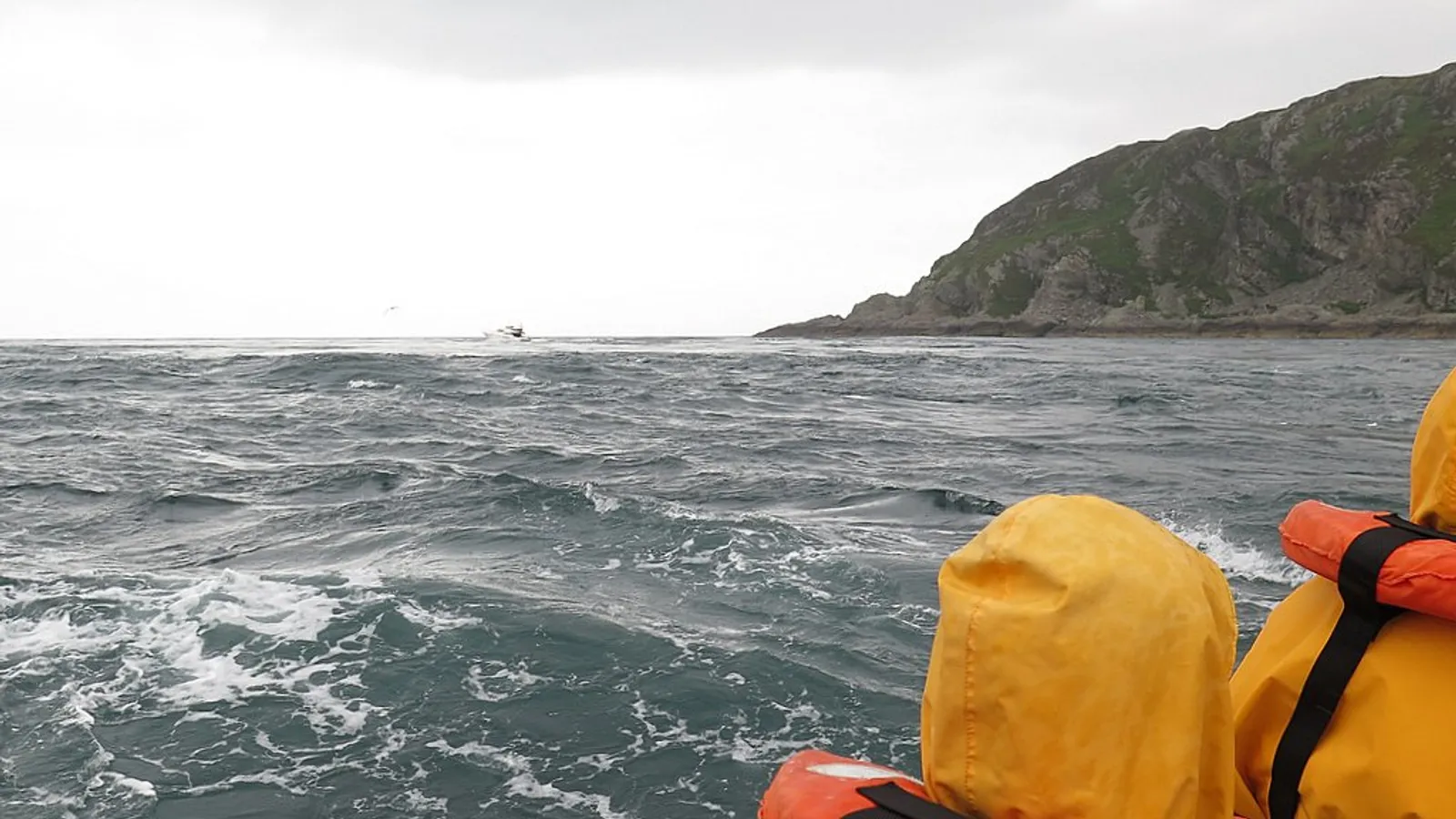

The Corryvreckan
Contents
Legend or Myth?
The Gulf of Corryvreckan is often introduced purely as a navigational hazard — "the world's third-largest whirlpool" — with its folklore treated as decorative colour rather than substantive tradition. In fact the whirlpool carries two distinct, named legendary explanations that have circulated for centuries: one ties it to the Cailleach, the great winter hag-goddess of Highland tradition (covered by her own card elsewhere in this collection), who is said to use the gulf as her washtub each year to herald winter's onset; the other ties it to a Norse-descended prince, Breacan (or Brecan), drowned there after mooring across the strait. This card treats both traditions as genuine, long-attested legendary material rather than modern tourist embellishment, while being clear about which claims rest on solid early documentation and which are later elaboration.
TL;DR
- established The Gulf of Corryvreckan is documented by name in written sources as early as the 7th century, when the monk Adamnan refers to it as "Charybdis Brecani" in his life of St Columba, because this is a securely dated, named textual reference that predates all later folkloric elaboration by many centuries.
- established The whirlpool's danger to shipping was recorded in detail by Dean Donald Monro in 1549, describing it as a stream "above the power of all sailing and rowing, with infinit dangers," because this is a specific, dated, named administrative-ecclesiastical source rather than a later retrospective folk account.
- established The Cailleach's washtub legend — in which she washes her great plaid in the gulf to mark winter's arrival, the roar of the resulting tempest audible for many miles over several days — is a well-attested strand of wider Highland Cailleach tradition, because it is consistently recorded as part of the Cailleach's broader seasonal mythology (she is a recognised figure across Gaelic Scotland, documented in her own right) rather than being invented specifically for Corryvreckan.
- disputed The precise relationship between the name "Corryvreckan" and the figure of Breacan/Brecan is not settled, because scholars note the etymology could run either way — the strait's name may have generated a legendary prince to explain it, or a genuinely remembered figure named Breacan may have given the strait its name — and the surviving evidence cannot fully resolve the direction of borrowing.
- established The gulf's real danger is well documented in the modern era, notably George Orwell's near-fatal 1947 boating accident there, because this is a specifically dated, independently corroborated historical event rather than legendary material.
Key Facts
- Type of Being/Legend
- Place-legend (whirlpool associated with two distinct mythic explanations)
- Region
- The Gulf of Corryvreckan, between the islands of Jura and Scarba, Argyll and Bute, west coast of Scotland
- First Attested
- Named as "Charybdis Brecani" by Adamnan in his 7th-century life of St Columba; described in detail by Dean Donald Monro, 1549
- Category
- Place Legends
- SI Score
- 45/60 (Narrative Reach 7, Depth of Tradition 7, Scottish Distinctiveness 9, Imaginative Force 9, Cultural Afterlife 6, Recognition 7)
- Status Note
- Kept as its own card. Cross-references the Cailleach, who holds a separate card elsewhere in this collection; her wider seasonal mythology is not duplicated here, only her specific connection to this place.
A Note on Claims and Evidence
The Corryvreckan has an unusually long documentary trail by the standards of this series: Adamnan's 7th-century reference and Dean Monro's 1549 description are both securely dated named texts, giving the place itself a far older attested history than most Northern Isles beings in this collection. The legendary material proper — the Cailleach's washtub, Breacan's drowning — is harder to date precisely, since it circulates through oral Highland tradition and later folklore writing rather than a single named 19th-century collector's text. This article treats the gulf's real, continuously documented danger as established fact, and treats the two legendary explanations as genuine, long-circulating folk tradition whose exact age and historical "originality" (which came first, the name or the story) cannot be fixed with precision.
Timeline
Adamnan, in his life of St Columba, refers to the strait as "Charybdis Brecani," the earliest known written reference, already associating it with a named figure, Brecan.
Dean Donald Monro's Description of the Western Isles of Scotland describes the strait in detail as an extraordinarily dangerous stream "above the power of all sailing and rowing."
The Cailleach's washtub legend and the fuller Breacan drowning narrative circulate and are elaborated within Gaelic oral storytelling, with specific details (the princess, the escaping-father variant, the faithful dog) recorded in various later folklore retellings.
George Orwell nearly drowns in the gulf after his boat's engine is torn off by the whirlpool; he and his party are rescued by passing lobstermen after reaching a rocky outcrop, and he completes the first draft of Nineteen Eighty-Four within months of the incident.
The Corryvreckan becomes a recognised feature of Scottish tourism, environmental writing, and folklore media, with ongoing scientific interest in its tidal mechanics (a pyramid-shaped basalt pinnacle rising from around 70 metres to 29 metres depth drives much of its extreme tidal behaviour) alongside its continued legendary reputation.
Details
The core tradition
Two distinct legendary explanations are attached to the Corryvreckan's violence. In the first, the Cailleach — the great winter hag-goddess of Highland and wider Gaelic tradition — is said to use the gulf as her washtub (or to wash her great plaid there) each year as winter approaches. The resulting tempest is said to be audible up to twenty miles away and to rage for three days; when she is finished, her cloth, now pure white, becomes the snow that blankets the land, marking winter's formal onset. In the second, a Norse-descended prince named Breacan (or Brecan) moors his ship in or near the strait — in one version to prove his love by anchoring there for three days and nights to impress a princess, in another to escape a pursuing father — and is drowned when the whirlpool overwhelms his vessel; his faithful dog is sometimes said to retrieve his body afterward. The two legends are not presented in the tradition as rivals explaining the same event so much as layered explanations: a seasonal, cosmic one (the Cailleach) and a tragic, human-scaled one (Breacan), both accounting for the same terrifyingly real natural phenomenon.
What it explained and warned against
Both legends function, at bottom, as explanations for a genuinely extreme and dangerous natural phenomenon — one of the largest whirlpools in the world, created by a dramatic underwater basalt pinnacle and powerful tidal currents between Jura and Scarba. Dean Monro's 1549 description makes clear that the gulf's real danger to shipping was common knowledge centuries before any Victorian folklore collector wrote it down as a legend. The Cailleach's washtub story gives this danger a seasonal, calendrical logic, tying it to the turn of the year; the Breacan story gives it a human, cautionary edge, warning against hubris and against underestimating the strait regardless of one's skill or status.
Relationship to neighbouring beings
The Corryvreckan's Cailleach connection directly ties this card to the Cailleach's own entry elsewhere in this collection, where her broader seasonal mythology — her role in bringing winter, her association with mountains, storms, and the turning of the year across the Highlands — is covered in full. This card is deliberately scoped to her specific, local association with Corryvreckan (the washtub legend) rather than duplicating her wider profile. The gulf's name's possible connection to Breacan also places it within the wider Scottish and Hebridean tradition of place-legends explaining dangerous natural features through a named human (or semi-legendary) figure's fate, a pattern echoed elsewhere in Highland and Island folklore.
Scholarly significance
The Corryvreckan is notable among Scottish place-legends for having both an unusually early securely dated textual attestation (Adamnan, 7th century) and an ongoing, continuously renewed legendary and real-world reputation into the present day (Orwell's 1947 near-drowning; modern tidal science). This makes it a useful case study in how a genuinely extreme natural feature can accumulate layered legendary explanation across more than a millennium without any single explanation displacing the others — the Cailleach and Breacan traditions coexist rather than compete.
Did You Know?
- The Corryvreckan is considered the third-largest whirlpool in the world.
- The earliest known written reference to the strait, by the monk Adamnan in the 7th century, already associates it with a named figure, Brecan.
- The Cailleach's washtub tempest is said to be audible up to twenty miles away and to last three days.
- Dean Donald Monro described the strait in 1549 as a stream "above the power of all sailing and rowing, with infinit dangers."
- A dramatic underwater basalt pinnacle, rising from around 70 metres to just 29 metres below the surface, drives much of the whirlpool's extreme tidal behaviour.
- George Orwell nearly drowned in the Corryvreckan in August 1947 after his boat's engine was torn off by the current.
- Orwell completed the first draft of Nineteen Eighty-Four within months of his near-fatal Corryvreckan accident.
- Scholars are not certain whether the name "Corryvreckan" produced the legend of Prince Breacan, or whether a remembered figure of that name gave the strait its name.
FAQ
1What is the Corryvreckan?
A famously dangerous whirlpool in the strait between the islands of Jura and Scarba on Scotland's west coast, associated with two distinct legends.
2What is the Cailleach's connection to Corryvreckan?
Tradition holds that the Cailleach, the Highland winter hag-goddess, uses the gulf as her washtub each year, and that the resulting tempest marks the start of winter.
3Who was Breacan?
A Norse-descended prince said in tradition to have drowned in the strait after mooring his ship there, in some versions to prove his love for a princess, in others to escape his father.
4When was the Corryvreckan first recorded in writing?
As early as the 7th century, when the monk Adamnan referred to it as "Charybdis Brecani" in his life of St Columba.
5Is the Corryvreckan really dangerous?
Yes — it is one of the largest whirlpools in the world, driven by a dramatic underwater rock pinnacle and powerful tidal currents, and has caused real, documented near-disasters, including George Orwell's 1947 accident.
6Did George Orwell really nearly drown there?
Yes — in August 1947, his boat's engine was torn off by the whirlpool, and he and his party were stranded until rescued by passing lobstermen.
7Is the Cailleach covered elsewhere in this collection?
Yes — she has her own dedicated card covering her wider seasonal mythology; this card focuses specifically on her connection to Corryvreckan.
8Does the name Corryvreckan come from Breacan?
Possibly, but the direction of borrowing is uncertain — the name may have generated the legend, or a real or legendary figure may have given the strait its name.
9Is the whirlpool legend still told today?
Yes, actively — it remains a well-known feature of Scottish tourism, environmental writing, and folklore media, alongside ongoing genuine scientific interest in its tidal mechanics.
10Can the Corryvreckan be safely crossed today?
It is navigable under the right tidal conditions by experienced sailors, but remains genuinely hazardous and is treated with serious caution by mariners.
11Are there other legendary explanations for the whirlpool besides the Cailleach and Breacan?
These two are the dominant and most consistently recorded traditions; other local variations exist but are less widely attested.
12Is this a myth invented for tourism?
No — the strait's reputation for danger is independently documented from the 7th century onward, well before any modern tourism industry existed.
Sources and Further Reading
Primary/Institutional
- Adamnan, Life of St Columba (7th century), reference to "Charybdis Brecani"
- Dean Donald Monro, Description of the Western Isles of Scotland (1549)
Scholarly/Critical
- Royal Scottish Geographical Society, material on the Gulf of Corryvreckan's folklore and tidal mechanics
- Historic Environment Scotland, blog material on the Cailleach in Scottish tradition
General
- Whirlpool-scotland.co.uk, local heritage and legend material on the Gulf of Corryvreckan
- Accounts of George Orwell's 1947 Corryvreckan boating accident
Caveats: Myths and Disputed Claims
The Corryvreckan's real, documented danger (attested from the 7th century onward) should not be confused with the precise age or "original" form of its legendary explanations, which circulate through oral Highland tradition and later folklore writing rather than a single dateable text. The claim that the strait's name derives directly from Prince Breacan — or, conversely, that Breacan was invented to explain an existing name — cannot be resolved from the surviving evidence; readers should treat either direction as a plausible but unproven hypothesis rather than settled fact. Similarly, while the Cailleach's washtub legend is a genuine and long-attested part of wider Highland tradition, the specific details given in popular retellings (the exact duration and audible range of the tempest) should be read as traditional storytelling detail rather than literally measured claims.
Card 009 · Folklore