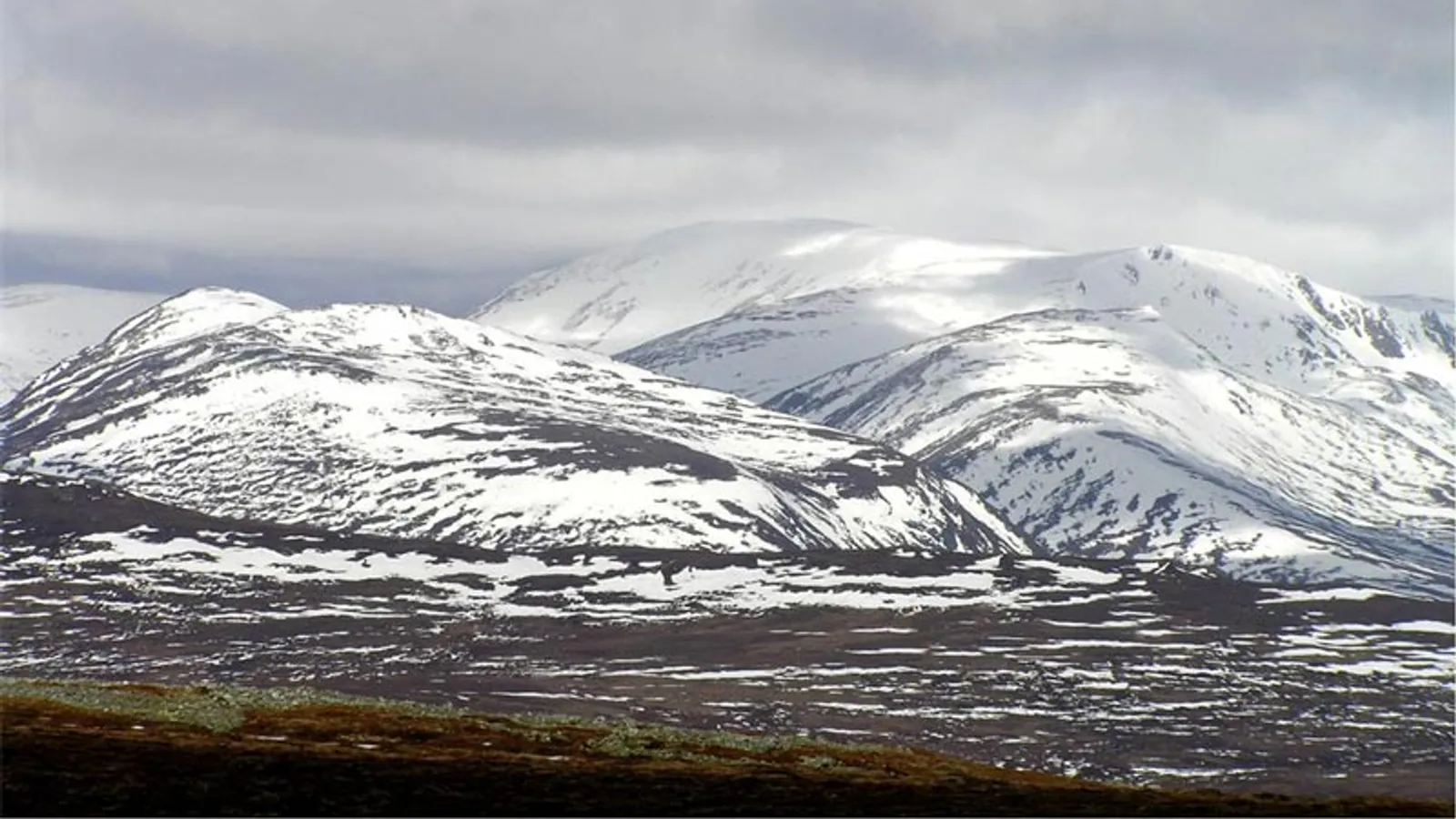

The Grey Man of Ben Macdui
Contents
Legend/Myth
The Grey Man is often presented as ancient Highland lore on a par with kelpies or the Cailleach. It isn't. This is a twentieth-century mountaineering phenomenon with a specific, named starting point — and this card is honest about that from the outset.
TL;DR
- established — The Grey Man of Ben Macdui (Am Fear Liath Mòr) entered recorded tradition in 1925, when the respected mountaineer and Royal Geographical Society member J. Norman Collie publicly described an unsettling experience on the mountain, because his account is the first documented report and is independently dated to that year.
- disputed — Collie's own experience, which he dated to around 1891, involved hearing crunching footsteps behind him spaced further apart than a human stride, not seeing any figure, because what is established is that he reported this sensation — not that an actual entity caused it.
- established — Multiple other named climbers (including Hugh D. Welsh, Alexander Tewnion, and Richard Frere) reported similar sensed-presence experiences on Ben Macdui across the 20th century, because these are separately documented personal testimonies spanning several decades.
- disputed — Whether these experiences share a single cause, whether natural (infrasound, the Brocken spectre, exhaustion-induced hallucination) or otherwise, remains unresolved, because no single explanation accounts for every reported detail across every account.
- disputed — The legend is sometimes described as ancient Highland folklore, when in fact it is scored by this collection's own curatorial team as a modern phenomenon with low depth of tradition, because its earliest attested instance (Collie, 1925) is barely a century old, not a tradition passed down across centuries.
Key Facts
- Type of Being/Legend/Figure
- Modern uncanny phenomenon / sensed-presence legend
- Region
- Ben Macdui, Cairngorms
- First Attested
- 1925 (J. Norman Collie's account, describing an 1891 experience)
- Category
- Modern Uncanny
- SI Score
- 40/60 (Depth of Tradition scored lowest at 4/10)
- Status note
- Explicitly scored as modern — not inherited ancient folk belief
A Note on Claims and Evidence
Unlike most entries in this series, the Grey Man's documentary trail is short and recent rather than deep and ancient. This article treats 1925 as a firm starting point rather than a convenient marker for a much older oral tradition, because no earlier attestation has been found despite the mountain's long use by travellers, drovers, and hillwalkers before that date.
Timeline
J. Norman Collie later says he experienced the unsettling footsteps-and-presence phenomenon on Ben Macdui during this period, though he does not speak of it publicly for over three decades.
Hugh D. Welsh reports a related experience on the mountain.
Collie publicly recounts his 1891 experience at a meeting of the Cairngorm Club, giving the phenomenon its first documented public airing.
Alexander Tewnion reports an encounter, including firing a shot at a shape he believed he saw.
Pete Densham reports a related experience.
Richard Frere documents another account.
The phenomenon becomes a fixture of Scottish mountaineering folklore, discussed in hillwalking literature and later popular media.
Am Fear Liath Mòr remains one of the most cited "modern" Scottish legends, frequently presented (misleadingly) alongside much older creature lore.
Details
Collie's account
The phenomenon's documented history begins with John Norman Collie, a highly respected mountaineer, chemist, and Royal Geographical Society member — not a figure given to idle sensationalism. Collie described, in a 1925 account, an experience he placed around 1891: descending Ben Macdui in mist, he heard "a crunch, and then another crunch, as if someone was walking after me but taking steps three or four times the length of my own." Unnerved, he fled the mountain and stated plainly that he would not go back alone. The gap of over three decades between the experience and his public account is itself notable — Collie was by all accounts reluctant to discuss it, which has lent the story unusual credibility among those inclined to take it seriously.
Other witnesses
Collie's account was followed, across the ensuing decades, by a string of similarly framed reports from other named climbers: Hugh D. Welsh in 1904, Alexander Tewnion in 1943 (who claimed to have fired a shot at an indistinct shape), Pete Densham in 1945, and Richard Frere in 1948, among others. Descriptions vary but recur around a small set of sensations: slurring or crunching footsteps on gravel or scree, an overwhelming and specific sense of dread or "a Presence, utterly abstract but intensely real," and in some accounts an eerie high singing or humming note. Visual sightings are rare and usually indistinct — a large, dark silhouetted figure glimpsed at a distance, never a clear form.
Proposed explanations
Several naturalistic explanations have been proposed. The Brocken spectre — a climber's own shadow, projected and magnified onto a bank of mist or cloud below — can produce an unnervingly large, distorted humanoid figure under the right lighting conditions, and the Cairngorms' weather makes this a genuine possibility on many days. Infrasound generated by wind passing over the mountain's terrain has also been proposed as a cause of unexplained unease, dread, or auditory hallucination, a mechanism documented in other contexts of reported "haunted" locations. Simple exhaustion, altitude, isolation, and the psychological effects of poor visibility are also cited. None of these explanations has been definitively matched to any single documented account, and the phenomenon remains, by its nature, resistant to controlled investigation.
Why this is scored as modern, not ancient
This card's curatorial scoring is explicit and should not be read past: Depth of Tradition is the lowest of the Grey Man's sub-scores, reflecting that this is not an inherited piece of old Highland oral tradition comparable to, say, the Cailleach or the kelpie. Its earliest attested instance is Collie's 1925 account of an 1891 experience — a documentable, dateable, twentieth-century starting point, not folklore stretching back through unrecorded centuries. That it has nonetheless become deeply embedded in the popular image of Highland mystery, in barely a hundred years, is itself part of what makes it worth including in this series — a demonstration of how quickly a "legend" can form around a real mountain given the right ingredients of isolation, weather, and a credible first witness.
Did You Know?
- J. Norman Collie did not speak publicly about his 1891 experience for more than thirty years, only recounting it in 1925.
- Collie was a serious, credentialed figure — a chemist and mountaineer with genuine scientific standing — which is part of why his account was taken seriously rather than dismissed outright.
- Alexander Tewnion claimed in 1943 to have fired a revolver shot at an indistinct shape he believed was approaching him on the mountain.
- Most reported encounters involve sound and sensation (footsteps, dread, a humming note) rather than a clear visual sighting of any figure.
- Ben Macdui is the second-highest peak in Britain and the highest in the Cairngorms, a setting whose isolation and weather conditions are frequently cited in explanations of the phenomenon.
- The Brocken spectre phenomenon — a magnified, distorted shadow cast onto mist — is named after a German mountain where the same optical effect was first widely documented.
- Despite being barely a century old, the Grey Man is now routinely discussed alongside far older Scottish creature legends, illustrating how quickly modern "folklore" can form.
- No visual photograph or physical evidence of any kind has ever been produced in connection with the phenomenon.
FAQ
1What is the Grey Man of Ben Macdui?
Am Fear Liath Mòr is a reported uncanny presence on Ben Macdui in the Cairngorms, associated with unexplained footsteps, a sense of dread, and occasional indistinct sightings, first documented in 1925.
2Is this ancient Highland folklore?
No — it is explicitly scored by this collection as a modern phenomenon, with its earliest attested account dating only to 1925 (describing an experience from 1891), not an inherited old tradition.
3Who first reported it?
J. Norman Collie, a respected mountaineer and scientist, who described his own unsettling experience on the mountain at a 1925 meeting of the Cairngorm Club.
4Did Collie actually see anything?
No — he reported hearing crunching footsteps spaced further apart than a human stride, which drove him to leave the mountain, but he did not claim to see a figure.
5Have other people reported similar experiences?
Yes, a number of named climbers across the 20th century — including Hugh D. Welsh, Alexander Tewnion, Pete Densham, and Richard Frere — reported broadly similar sensed-presence experiences on the same mountain.
6Is there a scientific explanation?
Several have been proposed, including the Brocken spectre (a magnified shadow on mist), infrasound-induced unease, and exhaustion or altitude effects, but no single explanation has been conclusively matched to all reported accounts.
7Has anyone photographed or recorded physical evidence of the Grey Man?
No photograph or physical evidence has ever been produced.
8Why did Collie wait so long to tell anyone?
He reportedly did not want to be thought foolish or sensationalist; the delay has, if anything, added to the account's perceived credibility among those who take it seriously.
9Is the Grey Man related to other "big hairy humanoid" legends internationally?
Popular media sometimes draws comparisons to Yeti or Bigfoot-type legends, but the Scottish phenomenon is distinctively about a sensed presence and sound rather than a cryptozoological creature with a described physical form.
10Why is this card scored lower on "Depth of Tradition" than most others in the series?
Because its documented history only extends back to the 1920s, in sharp contrast to figures and legends with centuries of attested oral tradition behind them.
11Does this mean the Grey Man isn't a "real" piece of Scottish folklore?
It is real as a documented, century-long pattern of reported experience and as a genuine piece of 20th-century Highland culture — this card simply insists on being accurate about when that tradition began.
12Why is it included in a "Legends & Folklore" series if it's modern?
Because it has become one of the most recognisable pieces of uncanny Highland lore in its own right, and the series groups it honestly under "Modern Uncanny" rather than misrepresenting its age.
Sources and Further Reading
Primary/Institutional
- J. Norman Collie's 1925 account as recorded in Cairngorm Club proceedings and subsequent mountaineering literature.
Scholarly/Critical
- Accounts collecting and comparing multiple 20th-century witness reports (Welsh, Tewnion, Densham, Frere) alongside proposed naturalistic explanations.
General
Caveats: Myths and Disputed Claims
- This legend is frequently misrepresented in popular culture as ancient Highland folklore; its own curatorial scoring in this collection explicitly flags it as modern, with the lowest Depth of Tradition sub-score of any card in this run, because its documented origin dates only to 1925.
- No report in this chain constitutes physical evidence of any entity; all accounts are personal testimony, mostly of sound and sensation rather than sight.
- Proposed naturalistic explanations (Brocken spectre, infrasound, exhaustion) are plausible but unproven for any individual account, and no single explanation has been shown to cover every reported detail.
- The gap of over three decades between Collie's reported experience (1891) and his public account (1925) means the earliest telling already relies on long personal recollection rather than a contemporaneous record.
Card 045 · Folklore