
The North Berwick Witches
Contents
TL;DR
- established The North Berwick witch trials of 1590–1591 involved King James VI personally and directly, following accusations that a group of witches had conspired, using magic, to sink the ship bringing his bride, Anne of Denmark, across the North Sea — because James's involvement, his presence at interrogations, and his personal belief that he was a target are recorded in the surviving contemporary pamphlet and court material.
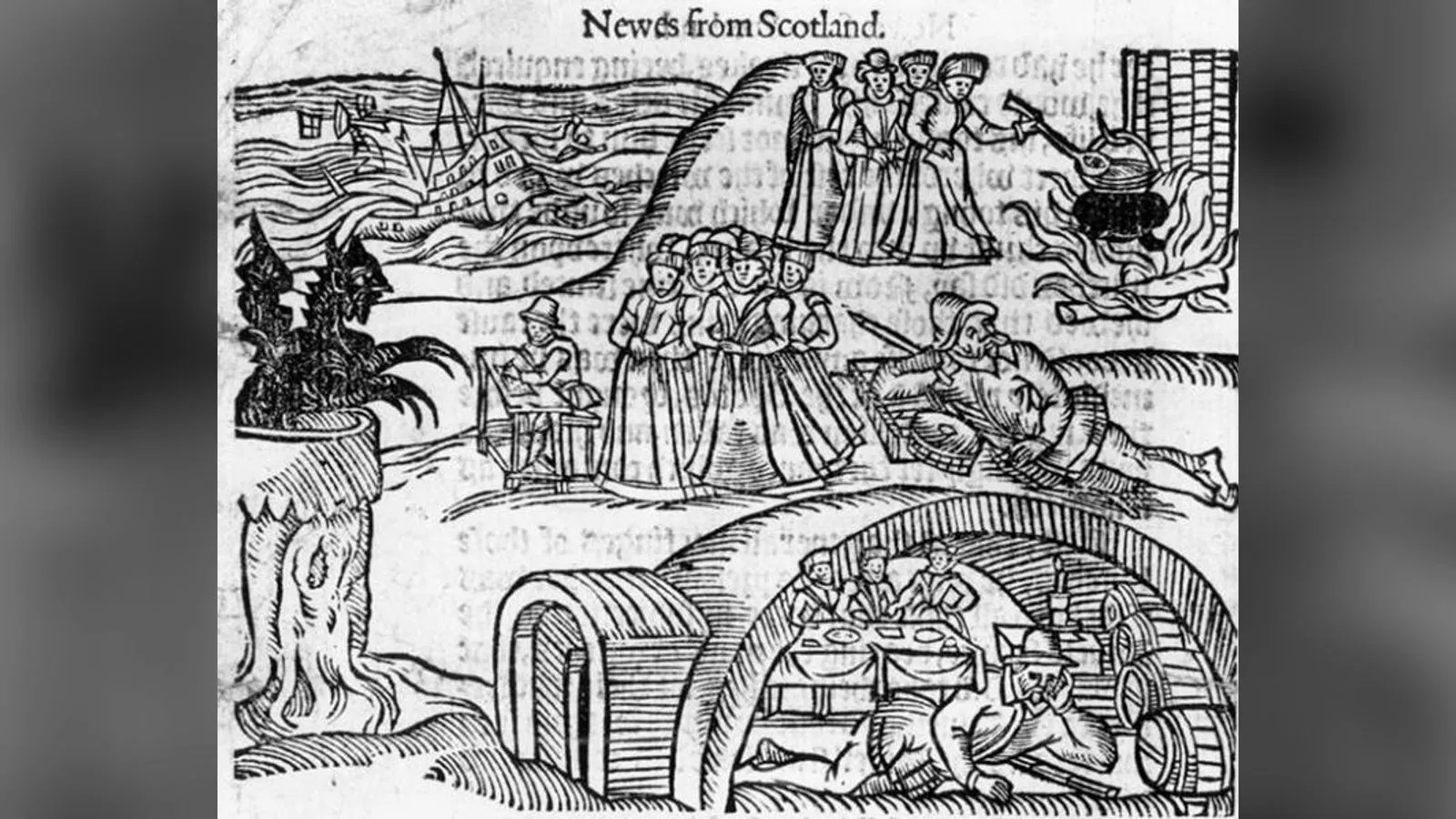
- established The pamphlet Newes from Scotland, published in London in 1591, is a key contemporary printed source documenting the trials, including detailed (and almost certainly partly embellished) accounts of confessions, and is considered one of the earliest substantial Scottish witchcraft publications — because the pamphlet survives and its publication and content are well attested bibliographically.
- established Agnes Sampson, one of the central accused, was tortured and her resulting confession — including an account said to reveal private details of the King's wedding night — was treated by James as confirmation that a real conspiracy existed against him — because this episode is recorded in the trial material and is widely cited as the turning point in James's engagement with the case.
- established The North Berwick episode directly shaped James VI's own treatise Daemonologie, published in 1597, and his subsequent tightening of witchcraft law after he became James I of England in 1603 — because this causal chain, from personal experience of the trials to his later writing and legislative action, is documented across his own published work and the Witchcraft Acts of the period.
- disputed The specific confessed details of the witches' meeting — roughly 200 witches gathering at North Berwick kirk, a storm summoned by throwing a dead cat into the sea, direct speech attributed to the Devil calling James "the greatest enemy he hath in the world" — should be read as confessions extracted substantially under torture and shaped by interrogators' expectations, not as a reliable factual account of an actual gathering — because torture-extracted testimony of this kind is now understood by historians to reflect coercion and leading questioning far more than independent, voluntary recollection.
Key Facts
- Type of Being/Legend/Figure
- Documented witch panic/trial (state-driven, not a mythological being)
- Region
- North Berwick, East Lothian
- First Attested
- 1590–1591 trials; Newes from Scotland pamphlet, 1591
- Category
- Witchcraft
- SI Score
- 45/60
- Status Note
- Among the best-documented Scottish witch panics; confession content should be understood as coerced testimony, not literal fact
A Note on Claims and Evidence
The North Berwick trials are unusually well documented by the standards of early modern Scottish witchcraft cases, thanks to direct royal involvement and a printed contemporary pamphlet. That documentation records what was said and done during the trials with reasonable confidence; it does not establish that the confessed events — a mass gathering of 200 witches, a storm-summoning ritual, direct dialogue with the Devil — actually occurred as described. Torture was used to extract key testimony, and this card treats the trial's existence, its political consequences, and its documentary record as established fact, while treating the confession content itself as coerced and shaped testimony rather than a reliable description of real events.
Timeline
James VI travels to Denmark to collect his bride, Anne of Denmark; the couple's return voyage across the North Sea is beset by storms.
Accusations begin to surface in Scotland that witches, through magical conspiracy, had caused the storms that endangered the King's ship.
A series of trials takes place, centred on alleged gatherings at North Berwick kirk; numerous individuals are accused, interrogated, and in several cases executed.
Agnes Sampson is tortured and gives a detailed confession, including claims said to have revealed private knowledge of the King's wedding night, which James takes as confirmation of a real plot against him.
The pamphlet Newes from Scotland is published in London, documenting the trials and their confessions for a wider English and Scottish readership.
James VI publishes Daemonologie, a treatise on witchcraft directly informed by his personal experience of the North Berwick case.
James VI becomes James I of England following the Union of the Crowns.
English witchcraft law is tightened under James, with penalties for confessed or proven witchcraft strengthened, extending the influence of his Scottish experience into his reign as King of England.
Details
The storm and the accusation
The North Berwick panic began with an entirely real and dangerous event: storms battered the ship bringing James VI's new bride, Anne of Denmark, back to Scotland in 1589–90. In an era where sudden, severe weather was readily attributed to malevolent supernatural causes, suspicion turned toward witchcraft as an explanation, and accusations soon focused on an alleged gathering of witches at North Berwick kirk in East Lothian. According to the confessions later extracted, the accused had met with the Devil, received instructions to use spells, and thrown a dead cat into the sea specifically to raise a storm targeting the King's ship — the Devil reportedly declaring that James was "the greatest enemy he hath in the world."
James VI's personal involvement
What distinguishes North Berwick from most Scottish witch trials is the King's own direct, personal engagement. Initially sceptical — James is recorded dismissing the accused as "all extreme liars" — his position shifted dramatically after the interrogation of Agnes Sampson. Sampson, having been tortured, reportedly revealed knowledge of private conversation between James and his bride on their wedding night, details James apparently believed could not have reached her by ordinary means. This single episode appears to have converted the King from sceptic to believer that a genuine magical conspiracy had been mounted against his life, and he thereafter took an active, personal role in the proceedings.
Newes from Scotland
The pamphlet Newes from Scotland, published in London in 1591, is the principal surviving contemporary printed account of the trials. It is considered one of the earliest substantial Scottish witchcraft publications, including woodcut illustrations and detailed renderings of confessions, and was produced and circulated while a number of the accused were still imprisoned. As a polemical and sensational publication aimed at a popular London readership, it should be read as a contemporary artifact of how the case was publicised and understood at the time, rather than as a neutral court transcript — though it remains an invaluable primary source for the episode's documented outline and public reception.
From trial to treatise: Daemonologie
James VI's direct experience of the North Berwick case fed into his own writing on the subject. In 1597 he published Daemonologie, a treatise addressing witchcraft, demonic pacts, and related supernatural threats, explicitly shaped by his conviction — formed through the North Berwick investigation — that witchcraft posed a genuine and personal danger to him. This is one of the clearest documented cases in Scottish history of a specific witch trial directly producing a monarch's own theoretical and legal position on witchcraft, rather than the trial simply applying pre-existing doctrine.
Consequences after 1603
The North Berwick case's influence did not end with James's Scottish reign. After the 1603 Union of the Crowns made him James I of England, his conviction that witchcraft was a serious and personal threat carried over into English law and practice, contributing to a tightening of the English Witchcraft Act and to greater royal engagement with witch-hunting during his reign as King of England — meaning a trial that began as a local East Lothian panic ultimately shaped witchcraft policy well beyond Scotland's borders.
Reading the confessions critically
The vivid specific details attributed to the North Berwick confessions — the approximate figure of 200 witches, the dead-cat storm ritual, the Devil's reported taunt about James — were extracted under conditions that, by modern historical consensus, make them unreliable as literal fact. Torture and the leading expectations of interrogators steeped in contemporary demonological belief are now understood to shape confession content substantially; this is a general feature of early modern witch-trial testimony, not unique to North Berwick, and applies equally to other cases in this series such as Isobel Gowdie's, though Gowdie's case is notable for the apparent absence of recorded torture, unlike Sampson's.
Relationship to neighbouring cards
The North Berwick Witches card documents a large, state-driven, politically consequential panic with direct royal involvement, in clear contrast to Isobel Gowdie's case elsewhere in this series' Witchcraft group, which appears more individually centred and local in character, however extraordinary its own confession content. Together, the two cards illustrate the considerable range within Scottish witch-trial history, from royal political crisis to local interrogation. This card does not duplicate coverage of Daemonologie itself beyond its direct relevance to the North Berwick case.
Did You Know?
- The North Berwick trials are considered one of the best-documented Scottish witch panics, partly because King James VI took a direct personal role in the investigation.
- James was initially sceptical of the accusations, reportedly dismissing the accused as "all extreme liars," before a confession he found personally convincing changed his mind.
- Newes from Scotland (1591) is one of the earliest substantial printed Scottish witchcraft publications and remains a key primary source for the episode.
- The confessions describe an alleged gathering of roughly 200 witches at North Berwick kirk — a figure historians treat with considerable scepticism.
- James VI's personal experience of the trials directly shaped his own 1597 treatise, Daemonologie.
- After becoming King of England in 1603, James's conviction about witchcraft's danger contributed to stricter English witchcraft legislation.
- Agnes Sampson was tortured before giving the confession that reportedly convinced James a real plot existed against him.
- The storm said to have endangered Anne of Denmark's ship was real; it was the explanation for the storm — a magical conspiracy — that was never independently verified.
FAQ
1What triggered the North Berwick witch trials?
Storms that endangered the ship bringing James VI's bride, Anne of Denmark, to Scotland in 1589–90, which were blamed on an alleged witches' conspiracy.
2Was King James VI really involved personally?
Yes — he took a direct, personal role in the investigation, particularly after Agnes Sampson's confession convinced him a real plot existed against him.
3What is Newes from Scotland?
A 1591 London-published pamphlet documenting the trials and their confessions, considered one of the earliest substantial Scottish witchcraft publications.
4Did 200 witches really meet at North Berwick kirk?
This figure comes from torture-extracted confessions and should be treated with scepticism rather than as a reliable historical count.
5How does this connect to Daemonologie?
James VI's personal experience of the North Berwick case directly informed his 1597 treatise on witchcraft, Daemonologie.
6Did this affect England as well as Scotland?
Yes — after James became King of England in 1603, his conviction about witchcraft's danger contributed to tighter English witchcraft legislation during his reign.
7Were the confessions reliable?
No — key testimony, including Agnes Sampson's, was extracted under torture, and historians treat the specific narrative details as shaped by coercion and interrogator expectation rather than literal fact.
8How is this different from Isobel Gowdie's case?
North Berwick was a large, state-driven panic with direct royal involvement; Gowdie's case, elsewhere in this series, appears more local and individually focused, and notably lacks any recorded use of torture.
9What happened to those accused?
Several of the accused were executed, in keeping with the standard legal consequence for a witchcraft conviction in this period.
10Why did James VI believe Agnes Sampson's confession?
She reportedly revealed knowledge of private details from his wedding night that he believed she could not have obtained by ordinary means.
11Is Daemonologie covered on its own card?
This card covers Daemonologie only in direct relation to the North Berwick case; it is referenced as a consequence of the trials, not given independent full treatment here.
12Why is this trial considered so historically significant?
Because it combines unusually strong documentation, direct royal involvement, and demonstrable influence on both Scottish and later English witchcraft law and policy.
Sources and Further Reading
Primary/Institutional
- Newes from Scotland (London, 1591), the principal contemporary printed account of the trials.
- James VI, Daemonologie (1597), the King's own treatise shaped directly by the North Berwick case.
Scholarly/Critical
- Historical scholarship on early modern Scottish witch trials, torture-extracted confession, and the North Berwick case's influence on Scottish and English witchcraft law.
General
- General-audience Scottish history writing on the North Berwick witch trials and James VI's involvement.
Caveats: Myths and Disputed Claims
The trials' occurrence, James VI's personal involvement, the publication of Newes from Scotland, and the case's documented influence on Daemonologie and later witchcraft legislation are established history. The specific confessed details — the 200-strong gathering, the dead-cat storm ritual, reported direct speech from the Devil — were extracted substantially under torture and should be read as coerced, interrogator-shaped testimony, not as a factual record of events that actually took place at North Berwick kirk.
Card 040 · Folklore