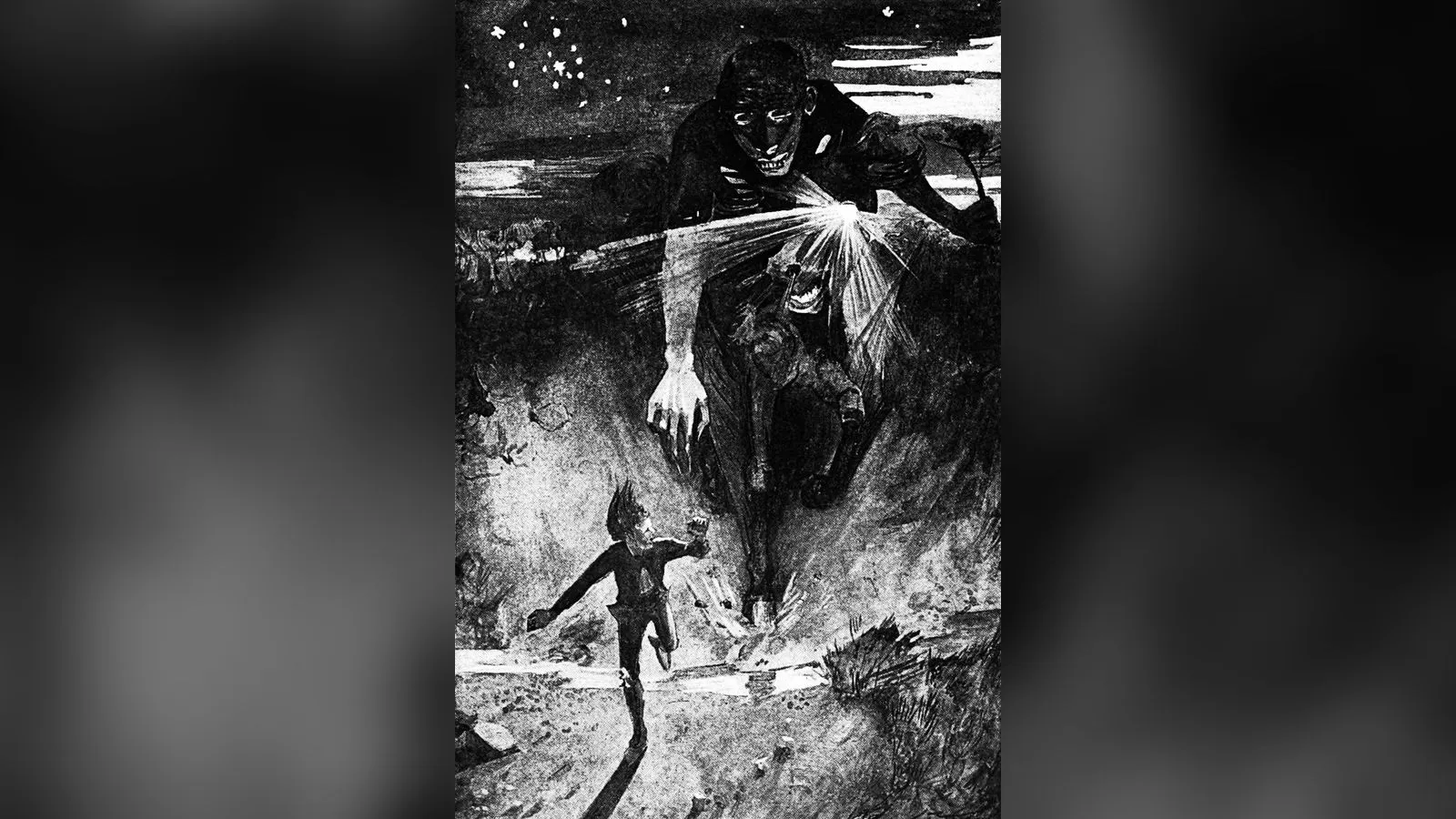

The Nuckelavee
Contents
Legend or Myth?
Popular retellings sometimes soften the Nuckelavee into "just another Scottish sea monster," comparable to a kelpie or each-uisge. Orcadian tradition is considerably more extreme: the Nuckelavee is recorded not merely as dangerous to individuals who stray too close to the water, but as a cause of plague, blight, drought, and livestock disease across entire islands — a being of "unmixed malignity" with no redeeming trickster streak or capacity for bargain. It is also, distinctively, skinless: its horror lies specifically in anatomical exposure — raw muscle, visible black veins, a single burning eye — rather than in any natural animal disguise. This card treats the Nuckelavee as the Northern Isles' most extreme single-monster figure, as flagged in the curator's note.
TL;DR
- established The Nuckelavee is first substantially recorded by the Orcadian folklorist Walter Traill Dennison, published in the journal The Scottish Antiquary in the early 1890s, because this is the earliest known detailed written description and the direct textual source for virtually all later accounts.
- established The being is consistently described across the primary record as a fused horse-and-rider form with no skin, visible muscle and black blood vessels, a disproportionately large head, and a single flaming eye, because this specific, consistent physical description appears in Dennison's named account rather than varying wildly between tellings.
- established Fresh running water is recorded as the Nuckelavee's one reliable weakness, with the creature unable to cross a loch, river, or stream, because this specific limitation is explicit in the primary folklore record and is used as the resolution device in the collected escape-narratives.
- disputed Whether the Nuckelavee represents a genuinely old, pre-Christian Orcadian belief-figure or a more recent 19th-century narrative elaboration (possibly influenced by Dennison's own storytelling style) is not settled, because — as with several other Orcadian beings in this collection — no earlier independent written witness survives against which to check Dennison's account.
- established The Nuckelavee is specifically credited in Orcadian tradition with causing a real, named outbreak of disease in horses (mortasheen) on the island of Stronsay, because this localised, specific attribution is recorded directly in the primary source rather than being a generic later embellishment.
Key Facts
- Type of Being/Legend
- Skinless sea-devil (malevolent hybrid horse-and-rider monster)
- Region
- Orkney, Scotland, with a specific named tradition on Stronsay
- First Attested
- Walter Traill Dennison, published in The Scottish Antiquary, early 1890s, collected from Orcadian oral informants
- Category
- Legendary Beasts
- SI Score
- 49/60 (Narrative Reach 8, Depth of Tradition 8, Scottish Distinctiveness 10, Imaginative Force 10, Cultural Afterlife 6, Recognition 7)
- Status Note
- Kept as its own card; the strongest single-monster visual in the Northern Isles group, per curatorial note.
A Note on Claims and Evidence
The Nuckelavee's documentary record, like that of several other Orcadian beings in this collection, rests principally on Walter Traill Dennison's account in The Scottish Antiquary in the early 1890s, drawn from named local informants (Dennison's material is understood to derive from oral testimony given to him directly). Ernest W. Marwick's The Folklore of Orkney and Shetland (1975) provides the standard later scholarly synthesis. Because the primary written record is narrow and concentrated in one collector's hand, this article treats claims about the being's exact antiquity and the historical reality of any specific disease outbreak attributed to it with appropriate caution, flagged directly in the Caveats section.
Timeline
Oral tradition concerning a malevolent, skinless sea-being circulates in Orkney, with Stronsay recorded as a locus of belief; no written record survives from this period.
Walter Traill Dennison publishes the foundational detailed written account of the Nuckelavee in The Scottish Antiquary, including its physical description, its weakness to fresh water, and its attributed role in the Stronsay horse-disease outbreak.
Ernest W. Marwick's The Folklore of Orkney and Shetland synthesises and contextualises the Nuckelavee within the wider Orcadian tradition of malevolent sea- and weather-beings, including its relationship to the Sea Mither and Teran.
The Nuckelavee becomes one of the most widely cited single "monsters" of Scottish folklore in popular writing, folklore podcasts, and bestiary-style web content, and features increasingly in illustrated and game-adjacent depictions, giving it a wider modern cultural afterlife than many other Orcadian beings.
Details
The core tradition
The Nuckelavee is described as a monstrous fusion of man and horse, but with no skin covering either part: raw red muscle is visible, black blood pulses visibly through exposed veins, and the horse-body's single eye burns like flame. The "rider" portion has a head grotesquely large relative to its body, with an enormous, gaping mouth. Its breath alone is poisonous, said to wither crops, sicken livestock, and spread disease and drought across the land it passes near. It is recorded in Dennison's account as the direct cause of a severe outbreak of the horse disease known as mortasheen on the island of Stronsay, after islanders burned seaweed (kelp) for industry, an act that enraged the creature. The Nuckelavee's one weakness is recorded consistently: it cannot cross fresh running water, so a loch, stream, or river is the only reliable means of escaping it, a device used directly in the collected folk-tales of narrow human escapes.
What it warned against
Like several other Orcadian coastal beings, the Nuckelavee functioned as an explanation for otherwise inexplicable, large-scale misfortune — livestock plague, crop blight, drought, and general ill fortune befalling a community — giving these events a legible supernatural cause rather than leaving them as unexplained natural disaster. Its specific attribution to a real, named disease outbreak on Stronsay shows the belief operating at a very concrete, local level, not merely as abstract cosmic menace. The fresh-water weakness also carried a practical, cautionary logic: it gave islanders a specific, actionable piece of safety lore (stay near running water, or cross it, if pursued) rather than leaving the threat entirely unmanageable.
Relationship to neighbouring beings
The Nuckelavee's confinement is directly tied to the Sea Mither, the benevolent summer sea-spirit covered elsewhere in this collection: in the same body of Orcadian tradition, she is credited with helping to restrain the Nuckelavee (alongside her more defining antagonist, Teran) during the warmer months, meaning the creature is at its most dangerous specifically in winter, when her power wanes. This gives the Northern Isles tradition a structural logic in which the Sea Mither functions as a seasonal check on two separate malevolent forces — Teran's storms and the Nuckelavee's plague-bringing — rather than the Nuckelavee being an entirely freestanding threat. The Nuckelavee is also sometimes loosely compared by popular writers to the each-uisge and kelpie of Highland and general Scottish tradition, since all are equine-associated water-threats, but the comparison is superficial: the Nuckelavee's defining horror (skinlessness, plague-breath, land-based ecological harm) and its specifically Orcadian, Dennison-recorded form set it clearly apart from the shapeshifting, drowning-focused each-uisge and kelpie tradition.
Scholarly significance
The Nuckelavee is frequently cited by folklorists and popular writers alike as one of the most vivid and extreme single figures in British folklore, notable for a level of described physical horror (visible muscle, exposed veins, a single flaming eye) that goes well beyond the more ambiguous or mischievous character given to many other water- and land-spirits in the Scottish tradition. Its concentrated association with one specific, named local disaster (the Stronsay mortasheen outbreak) also makes it a useful case study in how folk belief could assign a named supernatural cause to a real, locally remembered misfortune.
Did You Know?
- The Nuckelavee's name is thought to derive from the Orcadian term "knogkelvi," sometimes glossed as meaning roughly "devil of the sea."
- The creature is described as having no skin at all — its horror lies specifically in exposed muscle and visibly pulsing black veins.
- Its single eye is described as burning like fire.
- Burning seaweed (kelp) for industry is recorded as a specific act that enraged the Nuckelavee in Orcadian tradition.
- The Nuckelavee is directly blamed, in the primary folklore record, for an outbreak of a real horse disease (mortasheen) on the island of Stronsay.
- Fresh running water — a loch, stream, or river — is its one documented weakness; it cannot cross it.
- The Sea Mither, Orkney's benevolent summer sea-spirit, is credited with helping to confine the Nuckelavee during the warmer months.
- Despite its fearsome reputation, the Nuckelavee has a narrower documentary trail than some other Orcadian beings — its description rests almost entirely on one 19th-century collector's account.
FAQ
1What is the Nuckelavee?
A monstrous, skinless Orcadian sea-devil, part man and part horse, associated with plague, blight, and general malevolence.
2What does the Nuckelavee look like?
A horse-and-rider form fused together with no skin: visible raw muscle, pulsing black veins, a disproportionately large head, a wide mouth, and a single burning eye on the horse portion.
3Who first recorded the Nuckelavee?
Walter Traill Dennison, an Orcadian folklorist, who published a detailed account in The Scottish Antiquary in the early 1890s.
4What is the Nuckelavee's weakness?
Fresh running water — it cannot cross a loch, stream, or river, making water the standard means of escape in the collected tales.
5Did the Nuckelavee really cause a disease outbreak?
In Orcadian tradition, yes — it is specifically blamed for an outbreak of mortasheen, a horse disease, on the island of Stronsay, after islanders angered it by burning seaweed.
6How is the Nuckelavee related to the Sea Mither?
The Sea Mither is credited with helping to restrain the Nuckelavee during the warmer months, making it most dangerous in winter when her influence is weakest.
7Is the Nuckelavee the same as a kelpie or each-uisge?
No — despite a superficial equine association, the Nuckelavee is a distinct Orcadian figure defined by skinlessness and plague-bringing, not a shapeshifting drowning-spirit of the kelpie/each-uisge type.
8Why is the Nuckelavee considered so extreme compared to other Scottish water-beings?
Because the primary sources describe it with an unusually graphic level of physical horror and attribute to it large-scale harm (plague, blight, drought) rather than the more limited, individual danger typical of most water-spirits.
9Is the Nuckelavee still part of living Orcadian belief?
No longer as active belief; it survives today through folklore writing, heritage material, and popular bestiary-style retellings.
10How reliable is the historical record for the Nuckelavee?
It rests principally on Walter Traill Dennison's early-1890s account; no earlier independent written source survives to verify the details against.
11Does the Nuckelavee appear in modern popular culture?
It has become one of the more widely cited "classic monsters" of Scottish folklore in recent popular writing, podcasts, and illustrated bestiary content, giving it a wider modern profile than many comparably obscure Orcadian beings.
12Is there a specific place most associated with the Nuckelavee?
Stronsay is the most specifically named location in the primary tradition, tied to the recorded mortasheen outbreak.
Sources and Further Reading
Primary/Institutional
- Walter Traill Dennison, account of the Nuckelavee, The Scottish Antiquary, or Northern Notes and Queries (early 1890s)
Scholarly/Critical
- Ernest W. Marwick, The Folklore of Orkney and Shetland (London: Batsford, 1975; repr. Edinburgh: Birlinn, 2000)
General
- Orkneyjar (orkneyjar.com), Orkney heritage and folklore resource, entry on the Nuckelavee
- The Scottish Folklore Podcast, episode discussing the Sea Mither, the Vore Tullye, and the Nuckelavee
Caveats: Myths and Disputed Claims
As with several other Orcadian beings in this collection, the Nuckelavee's documented history is considerably shorter than its vivid detail might suggest: the earliest substantial source is Walter Traill Dennison's early-1890s account, and no earlier independent written witness survives to confirm how far back the belief extends in anything like its recorded form. Readers should be cautious of treating every graphic physical detail (the exact colour and texture of exposed veins, the precise size ratio of the oversized head) as fixed, universally agreed folklore rather than the specific phrasing of one collector's informants. The attribution of a real historical disease outbreak on Stronsay to the Nuckelavee should be understood as the tradition's own explanatory logic — a supernatural cause assigned to a real local misfortune — rather than as an endorsed claim that the Nuckelavee was the actual cause of that outbreak.
Card 006 · Folklore