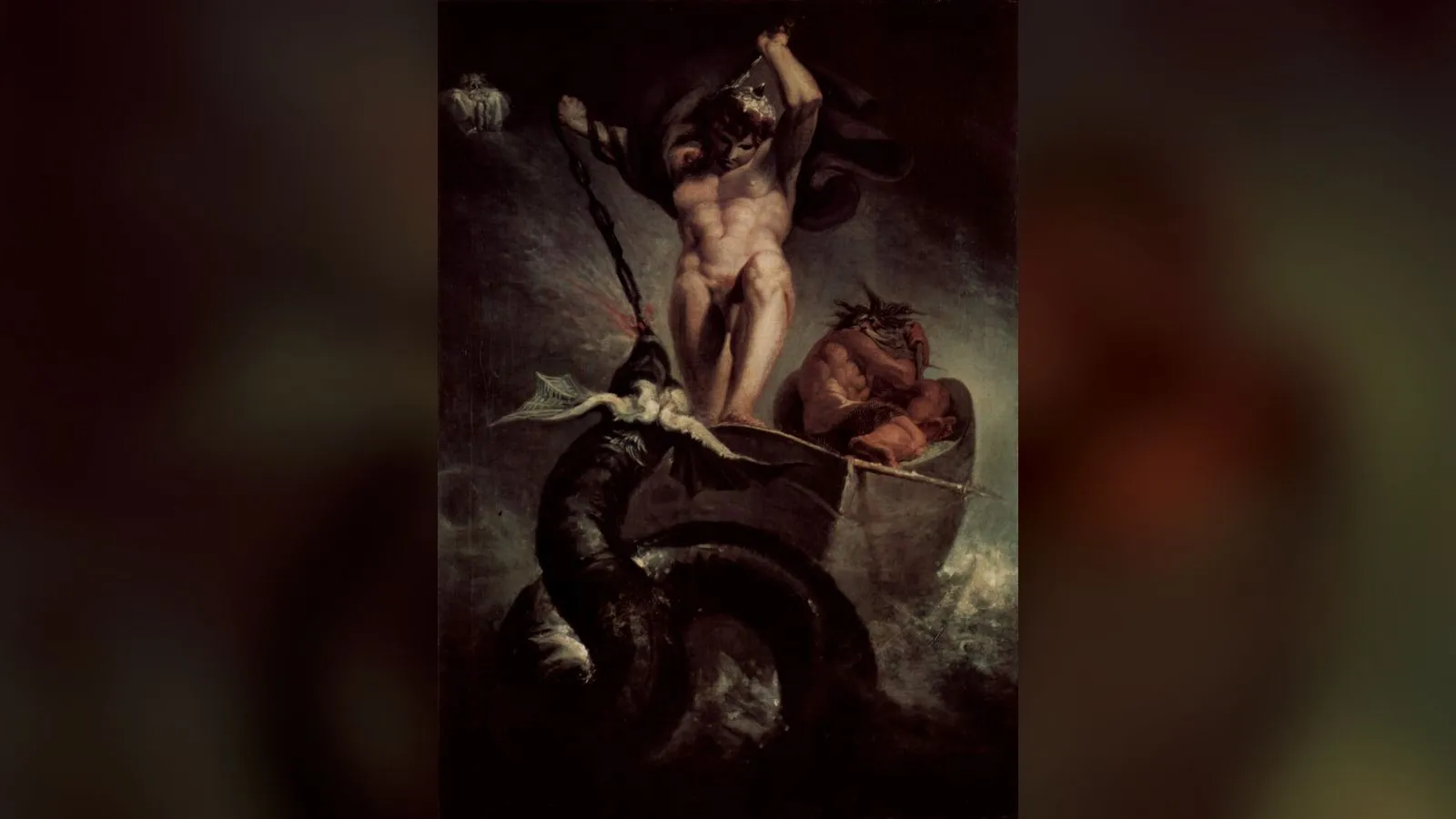

The Stoor Worm
Contents
Legend or Myth?
The Stoor Worm is sometimes retold as a simple "Orkney dragon" story, interchangeable with any generic sea-serpent tale. It is something more specific: a world-serpent narrative, closely paralleling the Norse Jörmungandr (the Midgard Serpent), in which the monster's death literally creates the geography of the North Atlantic — Orkney from its teeth, Shetland and the Faroes from its scattered fragments, Iceland from its curled body, the Baltic from its tongue. It is also, distinctively among Scottish folklore giants, a hero tale rather than a pure monster tale: the creature exists in the record chiefly as the thing that the farmer's despised youngest son, Assipattle, defeats. This card is scoped to the Stoor Worm itself — its nature, menace, and cosmogonic death — while the mechanics of Assipattle's cleverness belong to his own telling of the tale rather than to the monster's profile.
TL;DR
- established The Stoor Worm is first given full literary form by the Orcadian folklorist Walter Traill Dennison, who published it in the journal The Scottish Antiquary in 1891, because this is the earliest substantial printed text and the source every later retelling (including Jacobs's and Marwick's) derives from.
- established The tale is widely treated by folklorists as an Orkney localisation of the Norse Jörmungandr/Midgard Serpent myth, because the etymology of "stoor" (from Old Norse Storðar-gandr, a recorded alternative name for Jörmungandr) and the aetiological ending (the monster's remains forming real islands) both point directly at Norse cosmological material carried to Orkney by Norse settlement.
- established The story's structure — a king, a monster demanding tribute, a princess offered as reward, and an unlikely low-status hero who succeeds with cunning rather than strength — is recognised by comparative folklorists (notably E. Sidney Hartland) as a widespread international dragon-slayer tale-type, because near-identical structures recur in Greek myth (Herakles and Hesione) and biblical narrative (Jonah), suggesting a shared narrative template rather than an isolated Orcadian invention.
- disputed Whether the Stoor Worm preserves a genuine pre-literary Orcadian or Norse oral tradition, versus being substantially shaped — or even partly composed — by Dennison's own 19th-century literary hand, is not fully resolved, because Dennison worked from local oral material but also wrote in a self-consciously literary register, and no earlier independent written witness to the tale survives to check his version against.
- established The tale functioned, and is treated by folklorists such as Ernest Marwick as having functioned, as an explanation of real coastal geography (the shape of Orkney, Shetland, the Faroes, and Iceland), because this aetiological function is explicit in the text itself rather than a later interpretive overlay.
Key Facts
- Type of Being/Legend
- World-serpent / sea-dragon hero-tale (cosmogonic monster)
- Region
- Orkney, Scotland; narrative geography extends to Shetland, the Faroes, Iceland, and the Baltic
- First Attested
- Walter Traill Dennison, published in The Scottish Antiquary, 1891 (collected from Orcadian oral tradition); reprinted by Joseph Jacobs in More English Fairy Tales (1894)
- Category
- Legendary Beasts
- SI Score
- 43/60 (Narrative Reach 7, Depth of Tradition 7, Scottish Distinctiveness 9, Imaginative Force 9, Cultural Afterlife 5, Recognition 6)
- Status Note
- Kept as its own card, scoped to the monster. Assipattle's heroics are referenced only as necessary to establish how and why the Worm dies; a separate human-hero framing is not duplicated here.
A Note on Claims and Evidence
The Stoor Worm's documentary record rests almost entirely on one named 19th-century source: Walter Traill Dennison's text in The Scottish Antiquary (1891), itself drawn from Orcadian oral storytelling he collected directly. Joseph Jacobs reprinted a version in More English Fairy Tales (1894), and Ernest W. Marwick's The Folklore of Orkney and Shetland (1975) provides the standard modern scholarly synthesis, situating the tale within wider Norse-Orcadian tradition. Because no earlier independent manuscript or oral record survives, claims about the tale's age, its degree of Norse derivation, and the extent of Dennison's own literary shaping are treated here as informed inference rather than settled fact, and are flagged accordingly in the Caveats section below.
Timeline
Norse settlement and rule in Orkney establishes the Norse mythological substrate (including Jörmungandr, the Midgard Serpent) from which the Stoor Worm is widely believed to descend.
Walter Traill Dennison publishes the first substantial written version of the tale in The Scottish Antiquary, collected from Orcadian oral tradition.
Joseph Jacobs reprints a version as "Assipattle and the Stoor Worm" in More English Fairy Tales, bringing the story to a wider English-language readership.
Ernest W. Marwick's The Folklore of Orkney and Shetland gives the tale its standard modern scholarly treatment, comparing it with the wider Scandinavian and international dragon-slayer corpus.
The tale persists chiefly through children's retellings, Orkney tourism and heritage material, and occasional stage and illustrated adaptations, rather than major film treatment.
Details
The core tradition
In the tale, a monstrous sea-serpent — the Stoor Worm, from Old Norse stórr ("great") combined with a name recorded as an alternative for the Midgard Serpent itself — rises from the sea and threatens to devour the kingdom unless it is given a weekly sacrifice of seven virgins. A wise man (the spaeman) is consulted and eventually proposes a solution that will cost the king his own daughter, Gem-de-lovely. The king proclaims that whoever slays the Worm may have the princess's hand, half his kingdom, and his own magic sword, Sikkersnapper, said to have belonged to Odin. Assipattle — the youngest and most ridiculed son of a farmer, an "ash-raker" who lies idle by the fire while his brothers work — steals the sword and a burning peat, rows out in a stolen boat, and lets himself be swallowed by the Worm. Inside its body he reaches the liver and sets it alight; the dying creature's convulsions hurl its teeth out to sea, and in the final throes its vast body curls and settles to form the land itself.
What it explained
The Stoor Worm is explicitly aetiological: the tale accounts for the physical shape of the North Atlantic as islanders understood it. The creature's teeth, scattered as it thrashed in its death agony, become Orkney and Shetland; further teeth become the Faroe Islands; its curled, settled body becomes Iceland (whose volcanoes are explained, in some tellings, as the Worm's fire still burning within); and its tongue, flung out in a final convulsion, carves the gap that becomes the Baltic Sea. This is a creation myth wearing the shape of a monster story — a way of explaining the islands' existence and their relationship to one another through narrative rather than geology.
Relationship to neighbouring beings
The Stoor Worm belongs to a distinct category from the other Northern Isles beings in this collection: it is not a shapeshifting household or water spirit like the Njuggle or the Brownie, nor a seasonal nature-personification like the Sea Mither, but a singular cosmic monster, defeated once and permanently. Its closest kin are not Orcadian at all but Norse: the Jörmungandr/Midgard Serpent of Scandinavian mythology, which similarly encircles the world and is fated to die in a cataclysmic final battle. Folklorists also class it within the wider international "dragon-slayer" tale-type identified by Hartland and others, placing it alongside the Greek Herakles-and-Hesione narrative and the biblical Jonah story as a structurally similar tale of a monster demanding tribute, met by an unlikely rescuer.
Scholarly significance
The Stoor Worm is one of the clearest surviving examples in British folklore of a Norse mythological figure localised and domesticated into a specifically Orcadian landscape legend. Its value to folklorists lies less in debate over its authenticity as a "pure" belief-narrative — since it survives through one principal 19th-century literary transcription rather than multiple independently collected variants — and more in what it demonstrates about how large-scale Norse cosmology (a world-serpent fated to die at the end of the world) could be absorbed into local Orcadian storytelling as an explanation of real, nameable islands.
Did You Know?
- The Stoor Worm's name likely derives from Old Norse Storðar-gandr, which is itself a recorded alternative name for Jörmungandr, the Midgard Serpent of Norse mythology.
- In the tale, the monster's death throes are said to have created Orkney, Shetland, the Faroe Islands, Iceland, and the Baltic Sea.
- Iceland's volcanic activity is explained in some tellings as the residual fire of the Worm still burning beneath its settled, curled body.
- The sword used to kill the Worm, Sikkersnapper, is said to have once belonged to the Norse god Odin.
- Assipattle, the hero, is a classic "unlikely youngest son" figure — mocked for laziness before proving the cleverest of his brothers.
- The tale was first given substantial written form as late as 1891, by the Orcadian folklorist Walter Traill Dennison.
- Folklorist E. Sidney Hartland compared the tale's structure to the Greek myth of Herakles rescuing Hesione from a sea monster, and to the biblical story of Jonah.
- Unlike many Northern Isles beings, the Stoor Worm has no ongoing "current" presence in belief — it is a one-time, world-shaping monster permanently defeated within the story itself.
FAQ
1What is the Stoor Worm?
A monstrous world-serpent in Orcadian folklore, widely seen as a localised version of the Norse Jörmungandr (Midgard Serpent), slain by the hero Assipattle.
2Where does the name come from?
Most likely from Old Norse Storðar-gandr, an alternative name recorded for Jörmungandr, reflecting the tale's Norse mythological roots.
3Who first wrote the story down?
Walter Traill Dennison, an Orcadian folklorist, who published it in The Scottish Antiquary in 1891, drawing on Orcadian oral tradition.
4What geographical features does the legend explain?
The islands of Orkney, Shetland, and the Faroes (from the Worm's scattered teeth), Iceland (from its curled body), and the Baltic Sea (from its tongue).
5Who is Assipattle?
The despised, idle youngest son of a farmer who defeats the Worm through cunning rather than strength, by sailing into its mouth and burning its liver from within.
6Is the Stoor Worm connected to Norse mythology?
Yes — it is widely treated by folklorists as an Orcadian localisation of the Midgard Serpent myth, reflecting the centuries of Norse settlement and rule in Orkney.
7Is this a purely Orcadian invention?
Not entirely; the tale's structure (monster, tribute, unlikely hero, princess as reward) matches a widespread international dragon-slayer tale-type found well beyond Scotland and Scandinavia.
8How reliable is the written record of this tale?
It rests almost entirely on Dennison's 1891 text; no earlier independent written witness survives, so questions about how much is pre-existing oral tradition versus Dennison's own literary shaping cannot be fully resolved.
9Is the Stoor Worm still part of living Orcadian belief?
Not as an active belief; it survives today as cultural heritage, told through children's retellings, tourism material, and Orkney's broader folklore identity rather than as something anyone claims to fear.
10Does the Stoor Worm appear in other collections or retellings?
Yes — Joseph Jacobs reprinted a version as "Assipattle and the Stoor Worm" in his 1894 More English Fairy Tales, extending its reach well beyond Orkney.
11Is there a real place associated with the story?
No single site is tied to the tale the way some Orkney legends are pinned to specific lochs or hills; its "geography" is the North Atlantic islands themselves, explained as the monster's remains.
12Why is this card about the Worm and not about Assipattle?
Because the card is scoped to the monster itself — its nature, menace, and cosmogonic death — with Assipattle discussed only as far as needed to explain how and why the Worm dies.
Sources and Further Reading
Primary/Institutional
- Walter Traill Dennison, "The Stoor Worm," The Scottish Antiquary, or Northern Notes and Queries, vol. 5 (1891)
- Joseph Jacobs, "Assipattle and the Stoor Worm," in More English Fairy Tales (London: David Nutt, 1894)
Scholarly/Critical
- Ernest W. Marwick, The Folklore of Orkney and Shetland (London: Batsford, 1975; repr. Edinburgh: Birlinn, 2000)
- E. Sidney Hartland, The Legend of Perseus: A Study of Tradition in Story, Custom and Belief (1894–96), for comparative dragon-slayer tale-type analysis
General
- Orkneyjar (orkneyjar.com), Orkney heritage and folklore resource, entry on the Stoor Worm
- Historic Environment Scotland, Orkney folktales heritage blog material
Caveats: Myths and Disputed Claims
The Stoor Worm's written history is shorter than its apparent mythological depth might suggest: the earliest substantial text is Walter Traill Dennison's 1891 version, meaning the tale's documented age is under 150 years even though its content is widely believed to encode much older Norse mythological material. Readers should be cautious of any retelling that presents a single "original" or "authentic" version predating Dennison, since no earlier independent manuscript survives to compare against his text. Similarly, while the Jörmungandr/Midgard Serpent connection is well supported by etymology and comparative mythology, it remains an inferred relationship rather than a documented, unbroken chain of transmission from Norse mythological texts (such as the Prose Edda) to 19th-century Orcadian storytelling. Finally, claims that specific real-world geographical features (particular rock formations, specific islets) are "literally" the Worm's teeth should be read as the tale's own aetiological logic, not as a claim this article endorses as geological fact.
Card 004 · Folklore