
Thomas the Rhymer
Contents
Legend/Myth
Thomas the Rhymer is sometimes treated as a purely fictional, Merlin-like figure — a stock "wizard prophet" invented wholesale for ballad entertainment. In fact there really was a Thomas of Erceldoune, a landed figure in the Scottish Borders in the thirteenth century whose name survives on real legal documents. What this article is careful to separate is that solid historical core from the much larger legend built on top of it: the seven years in Elfland, the gift of a tongue that cannot lie, and the long chain of prophecies later attributed to him are folklore and literary tradition, not biography, however often popular writing blurs the two together.
TL;DR
- established A real historical Thomas of Erceldoune existed in the Scottish Borders in the thirteenth century, documented through surviving charters: one dated to the period 1260–1280 referring to him, and a later charter from 1294 that names "Thomas de Ercildounson, son and heir of Thome Rymour de Ercildoun" — this is documentary legal evidence, not folklore, which is why Thomas's basic historical existence is treated as reasonably well established rather than disputed.
- established The Thomas of Erceldoune romance survives in multiple independent medieval manuscripts, including the Lincoln Thornton manuscript (circa 1430–1440, the earliest complete surviving copy) and several further fifteenth- and sixteenth-century manuscripts, placing the written legend firmly within the late medieval period, because having several independently copied manuscripts is strong evidence the story was circulating and being actively copied well before any post-medieval retelling.
- established Thomas the Rhymer was collected and catalogued by Francis James Child as Ballad 37 in The English and Scottish Popular Ballads, and Sir Walter Scott published his own influential three-part version in Minstrelsy of the Scottish Border (1802–03), because both a formal scholarly catalogue number and an independently documented antiquarian collection confirm this is long-standing, widely circulated oral and literary tradition rather than a single writer's invention.
- disputed Whether the Elfland journey, the seven-year service to the Queen of Elfland, and the prophetic gift were genuinely believed folk tradition attached to the historical Thomas from an early date, or whether this supernatural frame developed and was elaborated considerably later and then retrospectively attached to a real local landowner's name, cannot be settled with certainty, because the earliest surviving manuscript evidence for the full legend postdates Thomas's own lifetime by more than a century.
- disputed The many specific prophecies popularly attributed to Thomas the Rhymer — concerning the death of Alexander III, the union of the Scottish and English crowns, and various other national events — are, for the most part, documented only from the fifteenth century onward or later, well after the events they supposedly predicted, which means most should be read as prophecies retrospectively credited to Thomas rather than contemporary thirteenth-century predictions.
Key Facts
- Type of Being/Legend
- A real historical figure (Thomas of Erceldoune, Borders laird) who became the subject of an extensive fairy-encounter and prophecy legend
- Region
- Scottish Borders, specifically Earlston (Erceldoune), Berwickshire, and the Eildon Hills
- First Attested
- Thomas historically documented via charters, circa 1260–1294; the literary/supernatural legend first survives in manuscript from circa 1430–1440 (Lincoln Thornton MS)
- Category
- Ballad and Romance
- SI Score
- 54/60
- Status Note
- Kept; no replacement. Framed carefully across the whole article: historical existence is reasonably established; the Elfland/prophecy legend attached to him is folklore, not biography.
A Note on Claims and Evidence
This article separates three distinct evidence tiers. First, the documentary record: surviving charters from circa 1260–1294 establish that a real Thomas of Erceldoune existed and held land in the Scottish Borders. Second, the medieval literary record: the Thomas of Erceldoune verse romance survives in several independent fifteenth- and sixteenth-century manuscripts, the earliest being the Lincoln Thornton manuscript of circa 1430–1440, establishing that a developed supernatural legend was already circulating in writing within roughly a century and a half of Thomas's own lifetime. Third, the later ballad and prophecy tradition, catalogued by Child as Ballad 37 and given fresh literary shape by Sir Walter Scott in 1802–03, through which most of the specific prophecies now popularly attributed to Thomas reached their familiar modern form. Nothing in the documentary record confirms the Elfland journey itself; that remains legend built around a documented man, not a documented event.
Timeline
The approximate lifespan of the historical Thomas of Erceldoune, a landowner in Earlston, Berwickshire, in the Scottish Borders.
A surviving charter refers to Thomas of Erceldoune, among the earliest documentary traces of his historical existence.
A further charter names "Thomas de Ercildounson, son and heir of Thome Rymour de Ercildoun," confirming Thomas's historical identity and that "Rymour" (Rhymer) was already attached to his name.
The Lincoln Thornton manuscript preserves the earliest surviving complete text of the Thomas of Erceldoune verse romance, describing his journey with the Queen of Elfland; several further manuscripts (including Cambridge MS Ff.5.48, Cotton Vitellius E.x, and later sixteenth-century copies) preserve related versions.
Sir Walter Scott publishes a three-part version of the ballad in Minstrelsy of the Scottish Border, adding an extended sequence of prophecies and Thomas's eventual return to Elfland.
Francis James Child catalogues the ballad as Child 37 in The English and Scottish Popular Ballads, formally fixing its place in the scholarly ballad canon.
Thomas the Rhymer's "mortal taken by the Queen of Elfland" narrative is widely cited as an influence on later literature, including John Keats's La Belle Dame Sans Merci and, more loosely, on Washington Irving's Rip Van Winkle-type "time passing differently in the otherworld" motif.
Details
The historical Thomas of Erceldoune
Thomas of Erceldoune is documented, however sparsely, as a real landholder in the Scottish Borders in the thirteenth century, based at Earlston (the modern form of "Erceldoune"), Berwickshire. Surviving charters from the 1260s–1280s and a further charter of 1294 — the latter naming his son and explicitly recording "Rymour" as part of the family's identifying name — confirm both his existence and that the nickname "Rhymer" was already attached to him or his household within his likely lifetime, consistent with a reputation as a poet, prophet, or both. Beyond these legal traces, no contemporary thirteenth-century account of his supposed fairy encounter or prophecies survives; everything beyond the bare charter evidence belongs to later legend.
The Elfland legend
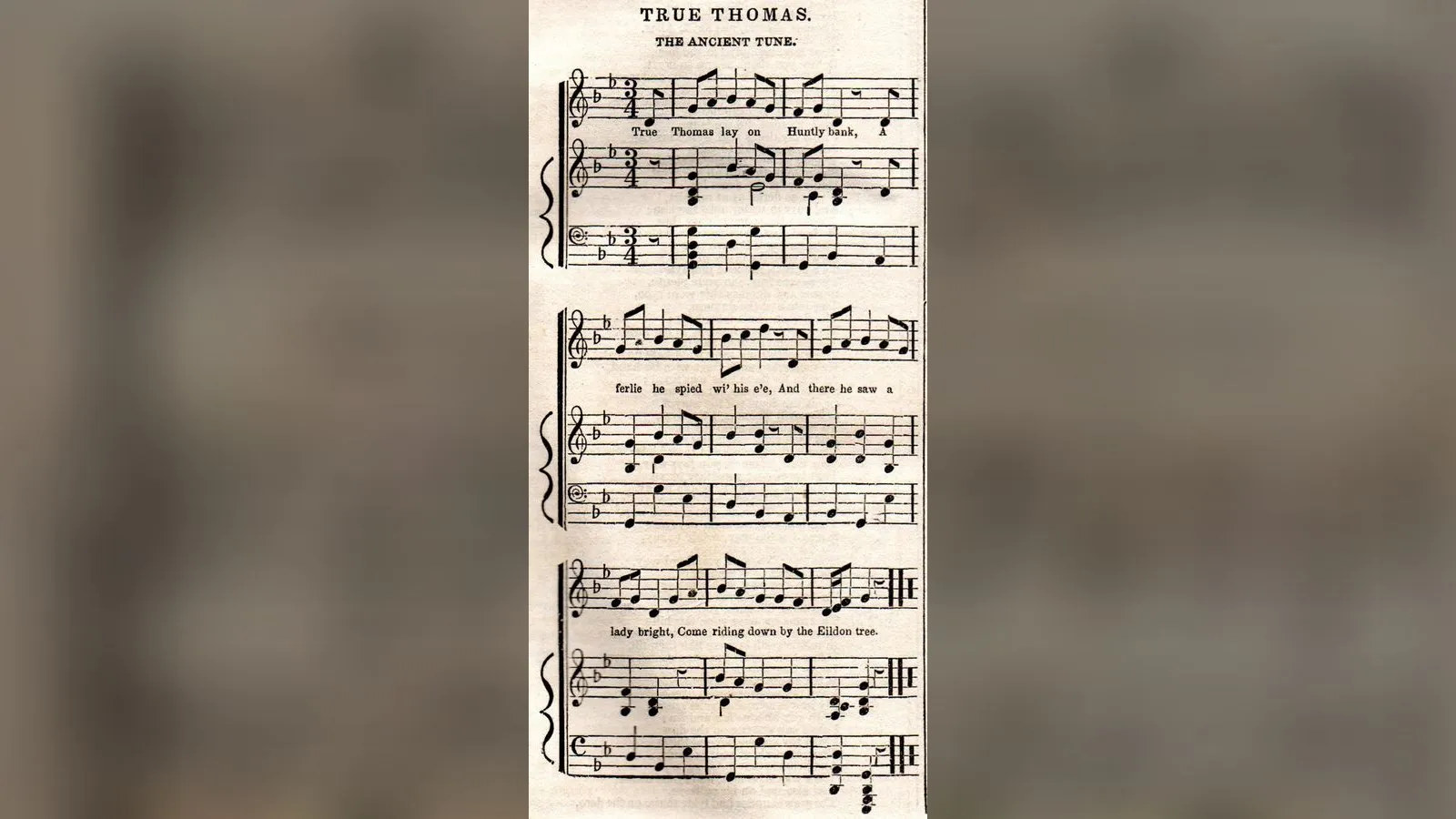
According to the romance and later ballad tradition, Thomas meets the Queen of Elfland beneath a tree at Huntly Bank, on the Eildon Hills near Earlston, and is persuaded to kiss her, at which point he is bound to accompany her into the otherworld. He travels with her — in different tellings for forty days and nights or for seven years — through a landscape where the roads to heaven, hell, and Elfland all meet, and serves in her court before being returned to the mortal world with the gift of prophecy and a "tongue that cannot lie." In the fullest literary version, Thomas eventually resists the burden of compelled truth-telling, and is ultimately called back to Elfland for good after a white hart and hind are seen walking the streets of Earlston — a sign, in the story, that the Queen has sent for him.
The prophecies
A long list of prophecies has, over the centuries, been attributed to Thomas the Rhymer, the best known concerning the death of King Alexander III in 1286 and, later, the union of the Scottish and English crowns under James VI and I. Close examination of when these prophecies are first recorded in writing shows that most survive only from the fifteenth century onward or later — in several cases, well after the events they claim to foretell — which means the great majority should be read as prophecies retrospectively attached to Thomas's reputation as a seer, rather than contemporary thirteenth-century predictions genuinely made by the historical man.
Significance and relationship to neighbouring cards
Thomas the Rhymer sits alongside Tam Lin in the Ballad and Romance group as the series' two major "mortal and the Queen of Elfland" narratives, but the two work in structurally different ways: Tam Lin has no historical anchor and draws its authority purely from the depth and consistency of its oral-ballad record, while Thomas the Rhymer is built around a documented real individual onto whom an extensive legend was subsequently attached. The Redcap card in this series notes a further, lighter connection: some tellings of the Lord Soulis/Robin Redcap legend credit Thomas with the trick that finally bound the sorcerous Border lord, a detail that belongs to that separate legend rather than to Thomas's own core story, but which illustrates how widely his reputation as a wise, otherworld-connected figure was drawn upon in other Border tales.
A north-east cousin: "Sir John Gordon"
In north-east Scotland a closely related ballad survived into the late nineteenth century. Dr Shearer, headmaster of the Gordon Schools in Huntly, noted down old ballads from local singers and reciters and printed them in The Huntly Express. One, "Sir John Gordon", tells of a Gordon knight who falls asleep under the "elfin-tree" while hunting. He wakes to find the Elfin Queen bending over him, mistakes her for the Virgin Mary, and kisses her. He is carried off through a landscape of "dead men's banes" and hags picking "the banes o' unchristened weans", and is warned that if he speaks a word in Elfland he will never see his own country again. He spends seven silent years there and returns "with a coat of the crimson cloth, and shoes of the velvet green". Those are the same unspeaking servitude, seven-year term and elfin clothing as in "Thomas the Rhymer".
The collector John Ord reprinted it in his Bothy Songs & Ballads (1930) and weighed up the possibilities. Either it was "a modern production evolved from 'Thomas the Rhymer' in The Border Minstrelsy", or "a genuine north-country version of that great ballad, which has been modernised by someone not long dead". His own view was that "Sir John Gordon" was "an old ballad which has been by some much injured modern 'improver'". He added that "Thomas the Rhymer" itself "was greatly benefited by the poetic skill of Sir Walter Scott, who may even have made interpolations of his own". He pointed to the famous "three roads" stanzas, to heaven, hell and "fair Elfland", as "almost too fine to be the composition of an 'auld makar'". This is Ord's opinion, not a proven fact, but it is a useful reminder of how far collectors shaped the texts we now treat as traditional.
Still a toast in 1767
Thomas remained part of polite Edinburgh's furniture of legend. On 20 February 1767, at a supper where each guest proposed a Scottish worthy as a toast, James Boswell recorded that the old Countess of Kellie gave "Thomas The Rhymer". The other toasts were the historians Pitscottie and Sir James Melville.
Did You Know?
- A north-east ballad, "Sir John Gordon", collected near Huntly in the late nineteenth century, tells almost the same story as "Thomas the Rhymer" with a Gordon knight in Thomas's place.
- In 1767 the Countess of Kellie proposed "Thomas The Rhymer" as a toast at an Edinburgh supper recorded by James Boswell.
- Surviving thirteenth-century charters prove a real Thomas of Erceldoune existed and that "Rymour" was already part of his family's recorded name.
- The earliest surviving complete manuscript of the Thomas of Erceldoune romance, the Lincoln Thornton manuscript, dates to around 1430–1440 — roughly a century and a half after Thomas's own lifetime.
- According to legend, Thomas met the Queen of Elfland at Huntly Bank on the Eildon Hills, near his home at Earlston.
- The "tongue that cannot lie" Thomas is said to have received from the Queen of Elfland was, in legend, initially a burden he tried to resist, not a welcome gift.
- Most of the specific prophecies popularly attributed to Thomas, including the one linked to the 1286 death of Alexander III, are first recorded in writing well after the events they claim to foretell.
- Legend holds that Thomas was finally called back to Elfland for good after a white hart and hind were seen walking the streets of Earlston.
- Sir Walter Scott's 1802–03 version in Minstrelsy of the Scottish Border is the source of much of the ballad's familiar modern shape, including its extended prophecy sequence.
- Some tellings of the unrelated Lord Soulis/Robin Redcap legend (treated on the Redcap card in this series) credit Thomas the Rhymer with the trick used to finally bind that Border sorcerer-lord.
FAQ
1Was Thomas the Rhymer a real person?
Yes — a real thirteenth-century landowner, Thomas of Erceldoune, is documented through surviving charters from the 1260s–1294, based at what is now Earlston in the Scottish Borders.
2Is the Elfland story true?
No — there is no contemporary thirteenth-century record of any fairy encounter. The Elfland journey is a later legend attached to Thomas's name, first surviving in manuscript from around 1430–1440.
3What is the earliest evidence for the legend?
The Lincoln Thornton manuscript, dated to roughly 1430–1440, preserves the earliest complete surviving text of the Thomas of Erceldoune verse romance.
4What is Child Ballad 37?
The scholarly catalogue number Francis James Child gave to the Thomas the Rhymer ballad tradition in his landmark collection, The English and Scottish Popular Ballads.
5What gift did Thomas receive from the Queen of Elfland?
According to legend, the gift — or burden — of a tongue that cannot lie, along with the power of prophecy.
6Did Thomas really predict the death of Alexander III?
The prophecy is popularly attached to his name, but it is first recorded in writing well after 1286, the year Alexander III died, so it should be read as a prophecy later credited to Thomas rather than a contemporary prediction.
7Where did Thomas supposedly meet the fairy queen?
At Huntly Bank, on the Eildon Hills near his home at Earlston (Erceldoune) in the Scottish Borders.
8How is Thomas the Rhymer connected to Tam Lin in this series?
Both are the series' major "mortal and the Queen of Elfland" ballad narratives, but Thomas is anchored to a documented real individual while Tam Lin has no identified historical figure behind him.
9Is Thomas the Rhymer connected to the Redcap legend in this series?
Loosely — some tellings of the separate Lord Soulis/Robin Redcap story credit Thomas with devising the trick that finally bound that sorcerous Border lord, though this belongs to that legend rather than to Thomas's own core story.
10How did Thomas's story end, according to legend?
He is said to have been called back to Elfland for good after a white hart and hind were seen in the streets of Earlston, a sign the Queen had sent for him.
11What is Thomas the Rhymer's modern literary legacy?
His "mortal taken by the fairy queen" narrative is widely cited as an influence on later literature, including Keats's La Belle Dame Sans Merci.
12Why does the TL;DR separate "historical" from "legendary" so carefully for Thomas?
Because, unlike most figures in this series, Thomas genuinely existed and left a documentary trace — so conflating his real biography with the Elfland legend built on top of it would misrepresent what is actually historically established.
Sources and Further Reading
Primary/Institutional
- Francis James Child, The English and Scottish Popular Ballads, Ballad 37 (1882–1898)
- Sir Walter Scott, Minstrelsy of the Scottish Border (1802–03)
- The Romance and Prophecies of Thomas of Erceldoune, ed. from the Lincoln Thornton MS and related manuscripts
Scholarly/Critical
- Scholarship on the dating and manuscript tradition of the Thomas of Erceldoune romance (Thornton, Cotton Vitellius E.x, Cambridge Ff.5.48 manuscripts)
- Charter evidence for the historical Thomas of Erceldoune (1260s–1294)
General
- Thomas the Rhymer — Wikipedia
- Thomas the Rhymer — Mysterious Britain & Ireland
- John Ord, Bothy Songs & Ballads of Aberdeen, Banff & Moray, Angus and the Mearns (Alexander Gardner, Paisley, 1930), "Sir John Gordon" and note (pp. 424–26).
- Hugh M. Milne (ed.), James Boswell: The Journals in Scotland, England and Ireland, 1766–1769 (Edinburgh University Press, 2023), entry for 20 February 1767.
Caveats: Myths and Disputed Claims
Thomas's historical existence should not be taken as evidence that any part of the Elfland journey itself actually happened; the charter record proves only that a real man named Thomas of Erceldoune lived and held land in the thirteenth-century Borders. Most of the specific prophecies popularly attributed to Thomas are first documented well after the events they supposedly predicted and should be presented as later attributions rather than genuine contemporary predictions. The romance's full supernatural narrative survives only from roughly a century and a half after Thomas's own probable lifetime, so claims that the fairy-encounter legend was already fixed and widely believed during his own lifetime go beyond what the surviving record can support.
Card 027 · Folklore