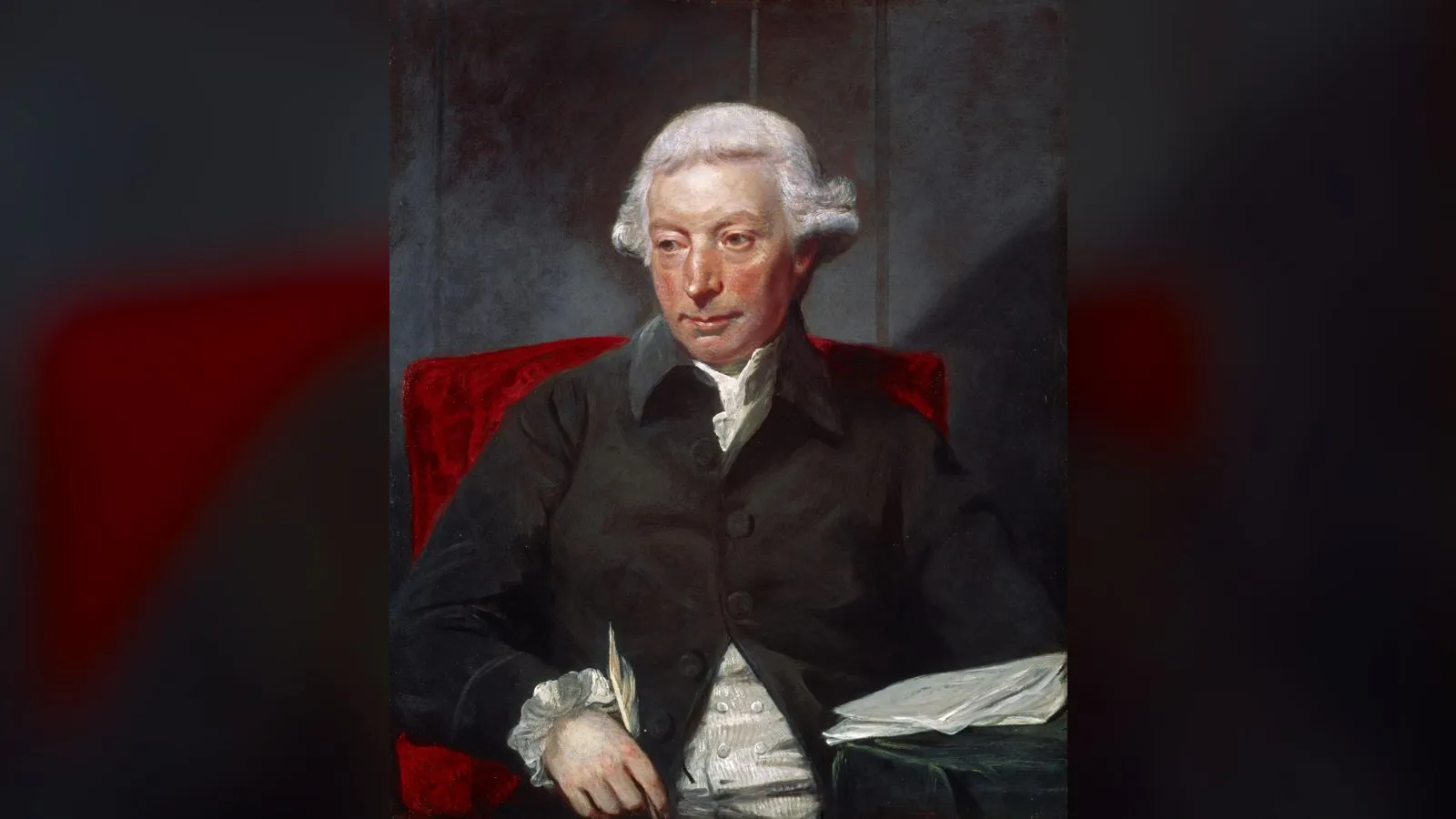

Adam Ferguson (1723–1816): Evidence-Tiered Research Dossier for the "Great Scots" Card Series
The most important correction for this card is that Adam Ferguson almost certainly did not fight at Fontenoy, and was probably not there at all. The battle was fought on 11 May 1745. The Presbytery of Dunkeld did not license and ordain him until 2 July 1745, and he joined the Black Watch in Flanders in September 1745.[1] Everything else about him is solidly documented and more interesting than the legend: he was a Gaelic-speaking Hanoverian chaplain, Hume's successor at the Advocates' Library, Edinburgh's moral philosophy professor from 1764 to 1785, the main organiser of the campaign for a Scottish militia, secretary to a failed peace mission to revolutionary America, and the author of An Essay on the History of Civil Society (1767). That book is one of the earliest critiques of commercial modernity. Calling him the "father of sociology" is a real scholarly tradition, but it was applied to him long after his death.
TL;DR
- established Born 20 June 1723 (Old Style) at Logierait, Perthshire, the youngest of nine children of the parish minister. Educated at Perth Grammar School and St Andrews (MA 1742), then studied divinity at Edinburgh. Chaplain to the Black Watch 1745–54. Professor at Edinburgh (natural philosophy 1759, moral philosophy 1764–85). Died at St Andrews on 22 February 1816, aged 92.
- [Legend/Myth] The Fontenoy broadsword story ("D—n my commission!") comes from Sir Walter Scott in 1827. The dates rule it out: the battle was on 11 May 1745, ordination on 2 July 1745, and arrival at the regiment in September 1745. Bruce Buchan's study concludes that "all the credible evidence indicates that he was not" present.[2]
- established His Essay on the History of Civil Society (1767) warned that commercial society, the division of labour and professional armies could erode civic virtue. That puts him at odds with the more optimistic Hume and Smith, and Hume tried to stop the book being published.
- [Shared/Traditional → Disputed] "Founding father of sociology" is a label that sociologists and historians have repeated since at least 1917. Modern specialists such as Brewer, Hill and Oz-Salzberger call him a "proto-sociologist" or forerunner whose thinking came from classical republican moral philosophy, not the "value-free" social science of later sociology.
- [Established / Disputed] He was a central figure in the campaign for a Scottish militia and a founder of the Poker Club (1762), named for "stirring" the militia question. Whether he or Hume wrote the militia satire Sister Peg (1761) is still openly disputed.
Key Facts
- Full name
- Adam Ferguson (father spelled it "Fergusson"); Gaelic Adhamh MacFhearghais; sometimes "Ferguson of Raith" | Established (name); Traditional (Raith epithet)
- Born
- 20 June 1723 (Old Style) = 1 July 1723 (New Style), Logierait, Perthshire | Established
- Parents
- Rev. Adam Fergusson (1672–1754), minister of Logierait; Mary Gordon (b. c.1680) | Established (ODNB)
- Education
- Logierait parish school; Perth Grammar School; St Andrews (MA 1742); divinity at St Andrews and Edinburgh | Established
- Military
- Deputy chaplain, 43rd (later 42nd) Highland Regiment (Black Watch), 1745; principal chaplain 1746; left active service 1754 | Established
- Fontenoy (11 May 1745)
- Not present; broadsword story is a later fiction | Legend/Myth
- Library post
- Keeper of the Advocates' Library, Jan 1757–early 1758, succeeding David Hume | Established
- Chairs (Edinburgh)
- Natural philosophy 1759–64; pneumatics and moral philosophy 1764–85 | Established
- Major works
- Reflections Previous to the Establishment of a Militia (1756); Essay on the History of Civil Society (1767); Institutes of Moral Philosophy (1769); History of the Progress and Termination of the Roman Republic (1783); Principles of Moral and Political Science (1792) | Established
- Politics
- Scottish militia campaigner; anti-Price pamphlet (1776); secretary, Carlisle Peace Commission (1778) | Established
- Married
- Katharine Burnett, niece of chemist Joseph Black (sources give 1765–67); seven children | Established (fact); date conflicting
- Died
- 22 February 1816, St Andrews, aged 92 | Established
- Buried
- St Andrews Cathedral churchyard, east wall; inscription by Sir Walter Scott | Established
Scottish Impact Index (SI Score)
- Global Influence
- 5/10
- Enduring Relevance
- 8/10
- Material Contribution
- 2/10
- Exceptional Achievement
- 7/10
- Lasting Legacy
- 6/10
- Recognition
- 2/10
30/60
Ranked =93rd of 200 in Great Scots
Claim Status
Every claim in this dossier carries one of four labels:
- Established/Documented: backed by primary records (presbytery minutes, Continental Congress journals, letters, published works) or agreed across authoritative scholarship (ODNB, the Cambridge Texts edition, the Stanford Encyclopedia of Philosophy).
- Shared/Traditional: reported by early biographers or memoirists (Alexander Carlyle, Walter Scott, John Small, the old DNB) and widely repeated, but without independent corroboration.
- disputed serious scholars actively disagree, for example over Sister Peg, the "father of sociology" label, and how much his Highland background shaped his ideas.
- Legend/Myth: contradicted by documentary evidence, above all the Fontenoy broadsword story.
A word on sources. The standard modern reference is Fania Oz-Salzberger's ODNB entry (doi:10.1093/ref:odnb/9315; 2004, revised 2009). It is paywalled, so this dossier relies on its public extract and on Oz-Salzberger's introduction and chronology in the Cambridge Texts edition of the Essay (1995). The fullest biographical account is Jane B. Fagg's "Biographical Introduction" to The Correspondence of Adam Ferguson, ed. Vincenzo Merolle (2 vols, William Pickering, 1995).[3] The old DNB (1885–1900) is useful for the history of the legends but is out of date on facts: it still places him at Fontenoy.
Timeline
Born in the manse at Logierait, Atholl, Perthshire — Established
St Andrews; MA 1742 (Oz-Salzberger gives 4 May, the old DNB 4 July) — Established (year); date conflicting
Divinity studies, first at St Andrews, then Edinburgh; friendships with William Robertson, John Home, Hugh Blair, Alexander Carlyle — Established
Battle of Fontenoy; Ferguson still a divinity student in Edinburgh — Established (absence)
General Assembly lets him proceed early to trials at Lord John Murray's request for a Gaelic-speaking chaplain — Established
Presbytery of Dunkeld examines, licenses and ordains him — Established
Joins the 43rd at Vilvoorden camp, Flanders — Established
Preaches Gaelic ("Ersh") sermon to the regiment at Camberwell; English translation published at the Dowager Duchess of Atholl's instance — Established
Commissioned principal chaplain — Established
Regimental service, including the attempt on Lorient (Brittany) and sojourns in Ireland; presence at Bergen-op-Zoom "reported" — Established / Traditional
Leaves active service in church and army after failing to obtain a Perthshire living from the Duke of Atholl — Established
Tutor in Groningen and Leipzig — Established
Reflections Previous to the Establishment of a Militia — Established
Succeeds Hume as Keeper of the Advocates' Library — Established
The Morality of Stage Plays Seriously Considered (defending Home's Douglas); resigns military commission (October) — Established
Tutor to the Earl of Bute's sons — Established
Chair of natural philosophy, Edinburgh — Established
Sister Peg published anonymously (authorship disputed) — Disputed
Poker Club founded — Established
Chair of pneumatics and moral philosophy — Established
An Essay on the History of Civil Society; honorary LL.D (Edinburgh) — Established
Institutes of Moral Philosophy — Established
Entertains Benjamin Franklin in Edinburgh — Established
Essay printed at Philadelphia — Established
Tutor to the young Earl of Chesterfield on tour; visits Voltaire at Ferney — Established
Remarks on a Pamphlet lately Published by Dr. Price (against the American rebels) — Established
Secretary to the Carlisle Peace Commission; refused a passport by Washington (9 June); Dugald Stewart teaches his class 1778–79 — Established
Paralytic attack; recovers, becomes vegetarian and teetotal; writes "History" article for Encyclopaedia Britannica 2nd ed. — Established
History of the Progress and Termination of the Roman Republic; founding fellow, Royal Society of Edinburgh — Established
Resigns chair; Dugald Stewart succeeds; Ferguson nominally holds the mathematics chair jointly with John Playfair — Established
Burns and the young Walter Scott meet at his house, Sciennes Hill House — Established
Principles of Moral and Political Science — Established
European tour to Rome; elected to the Royal Prussian Academy (September) — Established
Death of wife Katharine — Established
Lives at Neidpath Castle, then Hallyards, Manor Water (Peeblesshire) — Established
Moves to St Andrews — Established
Dies at St Andrews, aged 92 — Established
Details
1. Birth, family and the "Highland" question
established Ferguson "was born on 20 June 1723 in the village of Logierait, Perthshire, the youngest of nine children born to Adam Fergusson (1672–1754), the parish minister, and his wife, Mary... daughter of Patrick Gordon" (ODNB, Oz-Salzberger).[4] The Cambridge edition introduction describes Logierait as "on the border between the Scottish lowlands and highlands", and notes that his mother was a distant relation of the dukes of Argyll.[5] He went to the parish school, then Perth Grammar School.[6] At sixteen he went up to St Andrews and graduated MA in 1742.[5] The old DNB records "a reputation for proficiency in classics, mathematics, and metaphysics". He started divinity at St Andrews and then moved to Edinburgh,[7] where he joined the circle of young Moderate clergy (Robertson, Blair, Home, Carlyle) who would later form the core of the Edinburgh Enlightenment.[5]
Gaelic fluency: Established, with important nuance. He certainly spoke Gaelic, which was the stated qualification for his chaplaincy. Lord John Murray asked the General Assembly for "a chaplain of the communion of this church, having the Irish language".[1] Ferguson preached a published sermon in Gaelic ("Ersh") in December 1745.[5][8] But John D. Brewer ("Putting Adam Ferguson in his place", British Journal of Sociology, 2007), drawing on Fagg, shows that the household was far from a Gaelic cultural hearth:
- The Logierait school taught in English.[9]
- His father backed the SSPCK schools, which were meant to replace Gaelic, and complained of "the ignorance and barbarity that rages in this country".[9]
- His father was a firm Hanoverian who advised the government on whom to hang after the '45.[9]
Ferguson himself, giving evidence on Ossian to the Highland Society in 1798, played down his authority. He wrote that his birthplace was "barely within the limits at which Gaelic begins to be vulgar tongue", and that Gaelic "was a language spoken in the cottage but not in the parlour or at the table of gentlemen". In another letter he called himself a "bastard Gaelic man".[9]
Influence on his social theory: Disputed. Oz-Salzberger argues that "what made him an unusual Enlightenment thinker was his acquaintance with the Gaelic-speaking society of the highlands". She adds that his experience suggested "the rude clans had effectively preserved values which modern society had, to its detriment, lost".[5] Forbes, MacRae, Hill and David Allan (Adam Ferguson, 2006) take similar lines. Brewer disagrees. He argues that "there is nothing in the Essay to suggest his Highland origins", that Ferguson "never mentions his Highland roots in the Essay", and that the Highlander-to-sociologist story "reproduces the social construction of space in Scottish society".[9] Editorial position: the card can say his Gaelic-speaking border upbringing probably sharpened his interest in "rude" societies. It should not present the Essay as a Highlander's autobiography. Ferguson's own sources were mainly classical authors and French and Jesuit ethnographers such as Lafitau and Charlevoix.[5]
2. Black Watch chaplaincy and the Fontenoy legend
Established: the appointment. The Dowager Duchess of Atholl wanted a steadying clerical presence beside her son Lord John Murray, the regiment's young colonel.[7] Murray requested a Gaelic-speaking chaplain, and Ferguson, "student in Divinity, son to the minister of Logierat", was chosen (Morren, Annals of the General Assembly).[1] He had completed only three of the six years of divinity study then required. The General Assembly let him proceed early. The Presbytery of Dunkeld began his trials on 4 June 1745, finished them on 2 July, licensed him unanimously and ordained him at once "since Ferguson needed to leave Scotland to join the regiment in a few days" (Fagg). He arrived at the regiment's Vilvoorden camp in Flanders in September 1745.[3] He was commissioned principal chaplain on 30 April 1746[1] and served until 1754. His 1745 Gaelic sermon denounced the Pretender, popery and France.[7] Oz-Salzberger writes that "as some of his contemporaries testified, Ferguson felt more at home on the battlefield than in the pulpit", and that military valour became "a cornerstone of civic virtue" in his thought.[5]
Legend/Myth: the Fontenoy broadsword. The story comes from Sir Walter Scott's 1827 Quarterly Review essay on John Home. The old DNB suggests Scott "probably heard the story from his friend Adam, Ferguson's son".[7] In Scott's version:
"As the regiment advanced to the battle of Fontenoy, the commanding officer, Sir Robert Monro, was astonished to see the chaplain at the head of the column, with a broadsword drawn in his hand. He desired him to go to the rear with the surgeons, a proposal which Adam Ferguson spurned. Sir Robert at length told him that his commission did not entitle him to be present in the post which he had assumed.—'D—n my commission,' said the warlike chaplain, throwing it towards his colonel."[10]
A second, more restrained version appeared in David Stewart of Garth's Sketches of the Highlanders (1822).[2] There Ferguson fights in the ranks and refuses to leave the field when ordered.
The documentary chronology rules out both. Fagg writes that "the battle was waged on 11 May 1745 (30 April OS) while he was still a student of divinity in Edinburgh", and calls the story "tradition".[3] Bruce Buchan ("Adam Ferguson, the 43rd, and the Fictions of Fontenoy", in Heath & Merolle eds, Adam Ferguson: Philosophy, Politics and Society, Pickering & Chatto, 2008/9, pp. 25–43) is categorical:[2][11]
- "all the credible evidence indicates that he was not" present;
- "we can be sure that Ferguson did not participate in the battle of Fontenoy";
- it is a "plausible but certainly fictional tale".[2]
He calls Scott's version "frankly incredible". Stewart's he calls "more plausible, but still erroneous". Buchan suggests it may be veterans' blurred memories of Ferguson's conduct in the later Flanders campaigns of 1746–48. Michael Fry, in the same volume, says the story "appears to be apocryphal".[2] Brewer calls it simply "myth", noting it is "enthusiastically reiterated as proof of Highland martial values".[9] As early as the Victorian period, one Edinburgh writer asked whether "it was usual for chaplains to carry their commissions about their persons, ready to fling as missiles at their superior officers".[12] Oz-Salzberger's Cambridge introduction calls his participation "highly questionable".[5]
Why the myth persists. It fits the Romantic "fighting Highland parson" image that Scott did so much to create, and it seems to illustrate Ferguson's later praise of martial virtue. That is exactly the kind of patriotic embellishment the site's standard exists to correct. Popular and reference sources still state it as fact: Undiscovered Scotland, madeinperth.org, the Nuttall Encyclopaedia and the old DNB all do, Encyclopaedia Britannica's current entry says he "engaged in combat in Flanders" in 1745, and a Glasgow Life museums blog (9 December 2024) says he "witnessed war firsthand at the Battle of Fontenoy". Wikipedia calls it "a matter of debate". Editors should treat all of these as unreliable on this point. Ian McCulloch's regimental history "An Unbounded Ascendancy", by contrast, notes that "records clearly show that Ferguson … was only examined and ordained in Dunkeld on 2 July 1745."
Departure: Established. He left active service in 1754.[13] The old DNB says this was "partly out of disgust at the seventh Duke of Atholl's refusal to present him to a Perthshire living"[7] (the parish of Caputh is named in later accounts).[14] He kept his military commission until October 1757.[5] Fagg notes that he never formally renounced his ordination and served as a Kirk elder in the 1760s, even though he told Smith "I am a downright layman".[15]
3. Advocates' Library and the Edinburgh chairs
established Hume had used the Advocates' Library for his History of England and finished that research in 1757. He resigned by letter on 8 January 1757 ("I am very desirous to deliver over the charge of the library as soon as possible").[16] The Stanford Encyclopedia of Philosophy says Hume "quickly resigned to make the position available for Adam Ferguson".[17] The Cambridge edition notes that Hume "helped arrange Ferguson's succession". Ferguson held the post only from January 1757 to early 1758, then left to tutor the Earl of Bute's sons.[5] The old contrast between Hume the famous librarian and Ferguson the successor who barely stayed a year is accurate.
established Hume also lobbied for Ferguson's first chair. The Heath & Merolle introduction says Hume's efforts "finally succeeded on the third attempt, securing for him the chair in Natural Philosophy"[2] in July 1759.[18] This was an odd appointment for a classicist, and he reportedly had to cram the subject. In 1764 he moved to the chair of "pneumatics (philosophy of the mind) and moral philosophy", which Oz-Salzberger calls "a more suitable appointment",[5] succeeding James Balfour of Pilrig, who held it 1754–64. He taught there until 1785.[19] Dugald Stewart covered his class during the 1778–79 American mission.[20] In 1785 Ferguson retired and Stewart took the moral philosophy chair.[21] Ferguson in turn was nominally made joint professor of mathematics with John Playfair, a paper exchange that secured him an income.[5] Historic Environment Scotland's plaque entry notes that, having reached this prominent post, "he almost lost it due to prolonged absences in Italy and France where he mixed with leading thinkers of the day including Voltaire."
4. An Essay on the History of Civil Society (1767)
Established: the argument. Ferguson rejects the idea of a pre-social "state of nature" associated with Hobbes and Rousseau: "mankind are to be taken in groups, as they have always subsisted". The Essay's six parts move from human nature through "rude nations" and the rise of policy and arts to the "Consequences that result from the Advancement of Civil and Commercial Arts", "the Decline of Nations" and "Corruption and Political Slavery".[5] He uses a stadial scheme of "savage", "barbarian" and "polished" or commercial societies. Brewer argues that this typology is "qualitatively different" from Smith's and Millar's four-stage theory.[9] His most quoted line states the Scottish doctrine of unintended consequences: nations "stumble upon establishments, which are indeed the result of human action, but not the execution of any human design".[5]
Established: the critique of commercial modernity. This is what sets Ferguson apart. He was not against commerce. Oz-Salzberger stresses that he "made a point of conceding that luxury was in every epoch relative", and that "the real moral danger in modern times... was not wealth but political laziness". His fear was that specialisation, once it spread into government and defence and made statesmen and soldiers into professionals rather than citizens, would "break the bands of society".[5] The finished polity, he wrote, is "not divested of danger". The final two parts of the Essay are about how nations decline.[9] Compared with his friends: "David Hume, and more decisively Adam Smith, chose" to adapt civic values to commercial society, while "Adam Ferguson opted for" insisting that active citizenship remained indispensable (Oz-Salzberger). J. G. A. Pocock called him the "most Machiavellian" of the Scottish thinkers.[5] Brewer and Hill caution against reading him as nostalgic for clan society. Brewer argues that "anonymity was his target not modernity".[9]
Established: reception. The Essay was an immediate success. It went through seven editions in Ferguson's lifetime, with a German translation (Leipzig, 1768) and a French one (Paris, 1783). The ageing Voltaire congratulated him for "civilizing the Russians", since his works were used at Moscow University. Herder, Schiller, Jacobi and Novalis admired him. Hegel took up his "civil society", and Marx credited him on the division of labour.[5] Hume disliked it. Having read the manuscript, Hume wrote to Hugh Blair: "I do not think them fit to be given to the Public, neither on account of the Style nor the Reasoning; the Form nor the Matter," and offered to "concur in any Method to prevent or retard the Publication".[22] David Raynor attributes this to Hume's irritation at Ferguson's Stoicism, his praise of Sparta and other factors.[2][18]
Founder of sociology? Disputed / Shared-Traditional. The label has a long pedigree: H. E. Barnes, "Sociology Before Comte" (American Journal of Sociology, 1917); W. C. Lehmann, Adam Ferguson and the Beginnings of Modern Sociology (Columbia, 1930); Donald MacRae, in The Founding Fathers of Social Science (1969); and most recently Craig Smith, "Adam Ferguson as Founding Father of Sociology", in T. Demeter ed., The Sociological Heritage of the Scottish Enlightenment (Edinburgh UP, 2024).[9][23] Brewer observes wryly that "virtually every generation has someone declaring Ferguson as the discipline's founder".[9] The sober scholarly view is more qualified:
- Lisa Hill finds "clear anticipations of modern social science", including conflict theory, anomie and alienation, but insists his work "must be understood as classically and theologically inspired".[24]
- Brewer says his "anticipation of the discipline's core themes was constrained by the civic humanist concerns".[9]
- Oz-Salzberger calls the Essay's thesis "a moralizing thesis, far removed from the pretence to 'value-free' sociology". She notes that German readers (Marx, Sombart) valued the "sociology" while ignoring his civic virtue.[5]
- David Kettler's pioneering study (The Social and Political Thought of Adam Ferguson, Ohio State UP, 1965; revised as Adam Ferguson: His Social and Political Thought, Transaction, 2005) reads him mainly as a political thinker balancing liberalism and republicanism.[25]
Editorial position: "a pioneer and forerunner of sociology" is safe. "The father of sociology" should be marked as a retrospective, contested accolade. The word "sociology" was coined by Comte in the 1830s, after Ferguson's death, and Smith, Millar and Montesquieu are rival candidates for the title.
Disputed / sensitive: race. The University of Edinburgh's June 2025 report Decolonised Transformations: Confronting the University of Edinburgh's History and Legacies of Enslavement and Colonialism (Research and Engagement Working Group, co-chaired by Tommy Curry and Nicola Frith; appendix by Ian Stewart) states that "racial theories were taught across the various colleges at the University of Edinburgh from about the 1760s onwards", and that Ferguson incorporated racial theory, specifically Buffon's classification, into his moral philosophy lectures. The appendix calls this "the earliest surviving evidence" of racial theory in his teaching and says Stewart later expanded on it. A Glasgow Life Museums "Legacies of Slavery and Empire" blog post goes much further: Finn Jeffrey of the University of St Andrews, "Adam Ferguson, Walter Scott and White Supremacy" (9 December 2024), calls the Essay "a natural history of race" and claims Ferguson's theories "justified the ownership of enslaved people". That strong claim is not supported by the scholarly sources reviewed here and should be treated as disputed advocacy, not established fact. The same post also repeats the Fontenoy myth.
5. Friends, rivals and clubs
established
- Hume was a generous patron who secured Ferguson's library post and first chair, but he disliked the Essay.
- Smith and Ferguson were born the same year and are often called "the two Adams".[26] Alexander Carlyle recorded that when the Essay appeared, "Smith had been weak enough to accuse him of having borrowed some of his inventions without owning them. This Ferguson denied, but owned he derived many notions from a French author, and that Smith had been there before him." The dispute was probably over the division of labour, but that is inferred, not documented.[27] In 1776 Ferguson praised The Wealth of Nations but objected: "you have likewise provoked the militia, and there I must be against you". This was a reaction to Smith's view that a militia is inferior to a standing army.[2][28]
- William Robertson, Hugh Blair, John Home and Alexander Carlyle were his divinity-student circle and Moderate allies. Ferguson defended Home's Douglas in 1757 and took part in a scandalous amateur staging of it.[5]
- Joseph Black was his cousin, his doctor after the 1780 attack, and his wife's uncle.[29]
- Ossian: Ferguson was one of James Macpherson's key Edinburgh sponsors. His Gaelic background "lent credibility to the project", which later drew him into an awkward exchange with Thomas Percy (Oz-Salzberger).[5] The site should note this as a cautionary episode, since the Ossian "translations" were largely Macpherson's own inventions.
Select Society (1754): Established. Oz-Salzberger calls him "a central figure" in this debating club of noblemen and scholars, where the militia question was formally debated.[5][30]
Poker Club (1762): Established. Richard B. Sher's ODNB article dates the club to 1762–84. It was founded after the English Militia Act of 1757 and the parliamentary defeat of the first Scottish Militia Bill in April 1760. The name was "a cryptic 'Alusion to the use of that Instrument when fires like ours need to be Stirred', as Adam Ferguson wrote to Lord Shelburne on 3 February 1762".[31] Carlyle and the club's minutes credit Ferguson with the name, and Brewer and Fagg call him a founder.[9][32] For Ferguson and Carlyle it was a vehicle for militia agitation. For Hume it was mainly social ("I really wish often for the plain roughness of the Poker", he wrote from Fontainebleau).[31][32]
6. The Scottish Militia campaign
Established: the grievance. After the '45, suspicion of Jacobitism meant the Militia Acts of 1757, and later ones during the American war, left Scotland out. Scots saw this as a slur on their loyalty within the Union. Oz-Salzberger calls the militia "Ferguson's most cherished cause". His Reflections Previous to the Establishment of a Militia (1756) asked whether a nation could "mix military spirit and commercial policy". She concludes that the campaign "failed as a political cause; but, largely thanks to Ferguson's work, this was an exceptionally fruitful failure", because it fed straight into the Essay's themes.[5] A 1762 letter shows him playing a long game: "The next best thing to the procuring of Actual Political Establishments for this purpose is turning the Attentions & desires of men to such Establishments & to make them think & disspute about them."[32] The standard studies are John Robertson, The Scottish Enlightenment and the Militia Issue (1985), and Sher, "Adam Ferguson, Adam Smith, and the Problem of National Defense" (Journal of Modern History, 1989).[33]
Disputed: Sister Peg (1761). This allegorical satire in the style of Arbuthnot's John Bull was long attributed to Ferguson, following Carlyle's memoirs. David Raynor reattributed it to Hume in 1982, pointing out that Hume "openly admitted" writing it.[34] In 2021 Mark J. Hill and Mikko Tolonen ("A Computational Investigation into the Authorship of Sister Peg", Eighteenth-Century Studies 54:4, pp. 861–885) concluded from computational stylometry that "the work was not written solely by David Hume and, instead, Adam Ferguson is likely to be the sole author or there was a more complicated history of co-authorship." Sher's "Let Margaret Sleep" (History of European Ideas, 2021/23) argues for Ferguson using a newly found 1809 Ferguson letter, and Raynor replied in 2023. Label: Disputed, leaning Ferguson.
7. America, Rome and later life
Established: Carlisle Peace Commission (1778). After Saratoga, Lord North sent the Earl of Carlisle, William Eden and George Johnstone to offer the colonies self-rule short of independence.[35] Ferguson had already denounced the rebels in his Remarks on Richard Price (1776), published at government expense, where he warned that a "Continental Republic" was "probably laying the seeds of anarchy".[5] He sailed as the commission's secretary in April 1778. In June he rode from Philadelphia "with a Flag and a Trumpet" to take the commission's papers to Congress. Washington wrote to him on 9 June 1778 that "I can not grant the Passport requested... without the previous instructions of Congress".[36] The Continental Congress then "Resolved unanimously, that Congress approve the conduct of General Washington, in refusing a passport to Dr. Ferguson" (Journals of the Continental Congress, vol. 11).[37][38] Ferguson wrote or co-wrote the commission's "Manifesto and Proclamation", an appeal over the heads of Congress that "badly misfired" (Oz-Salzberger).[5] The commission left America at the end of 1778 having achieved nothing.[39] Assessment: Ferguson's role was clerical and propagandist, not that of a negotiator, and he came home more hostile to the rebels than before.[5]
Established: American readers before and after the war. The literary historian Andrew Hook, in Scotland and America: A Study of Cultural Relations, 1750–1835 (1975), traces Ferguson's American reception. Ferguson met Benjamin Franklin in Edinburgh in 1759 and gave a dinner for him in 1771 during Franklin's second visit. The Essay on the History of Civil Society was printed at Philadelphia in 1773; Hook finds that it and William Robertson's Charles V (Philadelphia, 1770) were the only major works of the Scottish Enlightenment published in America before the Revolution. In 1782 James Madison's list of books for the use of Congress included both the Essay and the Institutes of Moral Philosophy, and Thomas Jefferson owned the Essay. After the war the Essay was reprinted at Philadelphia in 1804 and 1819 and at Boston in 1809, and the Roman Republic at Philadelphia in 1805 and 1811.
Shared: the Charleston book-burning proposal. Hook reports that after Ferguson served the Carlisle Commission, the Library Society of Charleston, South Carolina, proposed that his Essay, by an author "of the kingdom of Scotland", be condemned to be burnt. Hook's source is a Port Folio item of 1824, nearly fifty years later, so the episode should be presented as reported, not as a documented resolution of the society. It fits the wider picture Hook draws of Scots as the most unpopular national group in revolutionary America.
Established: the Roman Republic (1783). Oz-Salzberger writes that his History of the Progress and Termination of the Roman Republic was his most successful book in Britain and America, admired by Gibbon and J. S. Mill. It also gave him the somewhat quaint image of the "Scottish Cato".[5] His military experience shows in the battle narratives.
Established: later life. In 1780 he suffered a paralytic attack. Under Joseph Black's care he recovered and stayed a vegetarian and total abstainer for the remaining 36 years of his life (Historic Environment Scotland).[7][29][40][41] He retired from teaching in 1785, published the Principles in 1792, toured Europe to Rome in 1793 and was elected to the Prussian Academy. He sympathised with the spirit of the French Revolution, if not its methods. His wife died in 1795.[5] He lived at Neidpath Castle and then Hallyards on Manor Water (1796–1809), where Scott and Mungo Park visited him.[6][32] Around 1809/10 he moved to St Andrews, reportedly because of failing eyesight and to be near friends.
8. Death and legacy
established He died at St Andrews on 22 February 1816, aged 92.[13][42] That was a remarkable age for the time; he outlived Hume by 40 years and Smith by 26. No specific cause beyond old age is recorded in the sources reviewed. His eldest son Adam, a friend of Scott, returned from French captivity shortly before his death.[5][43]
Shared/Traditional. His last words to his daughters are said to have been "There is another world" (Edinburgh Review, 1867, via the old DNB). Scott claimed that the news of Waterloo worked on the "aged patriot as a Nunc Dimittis".[7] Both are memoir-based and should be labelled as tradition.
Established: burial. He is buried against the east wall of St Andrews Cathedral churchyard under a large neoclassical mural monument with a marble profile portrait.[6][44] Scott wrote the inscription, which praises his "unostentatious works and steady perseverance in acquiring and diffusing knowledge and his practice of public and of domestic virtue".[45] Oddly, the inscription gives his birthplace as "Logiewald", which is worth a Did You Know.[42]
Reputation. His reputation dipped in 19th-century Britain but lasted longer in Germany.[5] It revived after Kettler (1965) and Duncan Forbes's 1966 edition of the Essay, then through the civil-society debates of the 1990s (Gellner, Keane, Dahrendorf) and Oz-Salzberger's Cambridge edition (1995).[9] Recent scholarship includes Iain McDaniel, Adam Ferguson in the Scottish Enlightenment: The Roman Past and Europe's Future (Harvard, 2013), and the Merolle-edited Correspondence and Manuscripts (Pickering, 1995; 2006).[46] Gordon Graham notes that Ferguson has still "received little of the renewed attention" given to Hume, Reid and Smith.[47]
Did You Know?
- The inscription on his St Andrews monument, written by Sir Walter Scott, gives his birthplace as "Logiewald", not Logierait.[42]
- The only meeting between Robert Burns and the 15-year-old Walter Scott took place at Ferguson's house, Sciennes Hill House, in the winter of 1786–87. His friends called the house "Kamtchatka" because it was so far from the city centre.[7][48][49]
- He was appointed to Edinburgh's chair of natural philosophy (physics) in 1759, although he was a classicist and moralist. Hume had lobbied for three attempts to get him a chair.[18]
- A paralytic attack in 1780 turned him into a teetotal vegetarian for the remaining 36 years of his life.[41]
- He wrote the 40-page "History" article for the second edition of Encyclopaedia Britannica (1780), replacing a one-paragraph entry.[13]
- George Washington personally refused him a passport in June 1778, and the Continental Congress unanimously approved the refusal.[36][37]
- He probably named the Poker Club, as an allusion to "stirring" the fire of the militia question.[5][31]
- His Essay contains one of the earliest recorded English uses of the word "civilization" in its opening passage (Oz-Salzberger).[5]
- The Essay on the History of Civil Society was printed at Philadelphia in 1773, three years before American independence, and James Madison put it on his 1782 list of books for Congress, even though its author had come to America in 1778 as secretary to a British peace mission.
FAQ
1
- Was Adam Ferguson really at the Battle of Fontenoy?
Almost certainly not. The battle was on 11 May 1745. He was ordained on 2 July 1745 and joined the regiment in September 1745. The broadsword story comes from Walter Scott (1827) and is classed here as Legend/Myth.
2
- Where does the "D—n my commission!" line come from?
From Scott's 1827 Quarterly Review essay on John Home. Scott probably had it from Ferguson's son Adam. No contemporary source records it.
3
- Did Ferguson speak Gaelic?
Yes. It was the reason he got the chaplaincy, and he preached a published Gaelic sermon in 1745. But he himself said his birthplace was "barely within the limits" of Gaelic-speaking country, and he was raised in an English-schooled, anti-Jacobite manse.[9]
4
- Was he a Highlander?
It depends how you define it. Logierait sits on the Highland–Lowland border. Scholars disagree about how "Highland" he was and how much it shaped his ideas (Oz-Salzberger versus Brewer).
5
- Did he succeed David Hume as librarian?
Yes. He became Keeper of the Advocates' Library in January 1757[13] after Hume resigned, partly to make room for him, and held it for about a year.[50][51]
6
- What chairs did he hold?
Natural philosophy at Edinburgh (1759–64), then pneumatics and moral philosophy (1764–85). His student Dugald Stewart succeeded him.[52][53]
7
- What is the Essay on the History of Civil Society about?
How societies develop from "rude" to "polished", and the danger that commercial wealth, specialisation and professional armies lead citizens to neglect public life and civic virtue.
8
- Is he really the "father of sociology"?
He is a widely recognised forerunner. Scholars have used the label since 1917 (Barnes) and 1930 (Lehmann). But it is retrospective: the word "sociology" did not exist in his lifetime, and he wrote as a moral philosopher in the classical republican tradition.
9
- How did he differ from Adam Smith?
Both analysed the division of labour, but Ferguson stressed its costs to citizenship more heavily. He defended militias against Smith's preference for standing armies. Smith once accused him of borrowing ideas without credit.[27][28]
10
- What was the Poker Club?
An Edinburgh club founded in 1762 to "stir up" support for a Scottish militia. Ferguson was a founder and probably named it.[5]
11
- What did he do in America?
He was secretary to the Carlisle Peace Commission in 1778.[13] Washington refused him a passport to reach Congress, and the mission failed.[5][13]
12
- When and where did he die?
At St Andrews on 22 February 1816, aged 92. He is buried in the cathedral churchyard.[42]
13
- Was Ferguson read in America?
Yes. The Essay was printed at Philadelphia in 1773 and again in 1804, 1809 and 1819, and the Roman Republic in 1805 and 1811. Madison listed the Essay and the Institutes among books for Congress in 1782. A later report says Charleston's Library Society proposed burning the Essay after his 1778 mission, but the evidence for that is late.
Sources
Primary / Institutional
- The Correspondence of Adam Ferguson, ed. Vincenzo Merolle, with Biographical Introduction by Jane B. Fagg, 2 vols (London: William Pickering, 1995).
- Adam Ferguson, An Essay on the History of Civil Society, ed. Fania Oz-Salzberger (Cambridge Texts in the History of Political Thought, Cambridge University Press, 1995), including its chronology; also Duncan Forbes, ed. (Edinburgh University Press, 1966).
- Journals of the Continental Congress, 1774–1789, vol. 11 (1778), Library of Congress: resolution approving Washington's refusal of a passport to Ferguson.
- George Washington to Adam Ferguson, 9 June 1778 (via Electronic Enlightenment / OUP blog).
- Presbytery of Dunkeld records, 1745 (National Library of Scotland), and Morren, Annals of the General Assembly (1840), as cited by Fagg and McCulloch.
- Oxford Dictionary of National Biography: Fania Oz-Salzberger, "Ferguson, Adam (1723–1816)", doi:10.1093/ref:odnb/9315; Richard B. Sher, "Poker Club (act. 1762–1784)", doi:10.1093/ref:odnb/73613.
- Historic Environment Scotland, commemorative plaque entry "Adam Ferguson" (Hallyards, 2014); Historic Environment Scotland listings LB50188 (Adam Ferguson Building) and LB30477 (Sciennes Hill House).
- University of Edinburgh, "Our History: George Square", and 2025 race and empire review appendix (Ian Stewart).
- National Trust for Scotland collections: engraving after C. M. Hardie, The Meeting of Burns and Scott in Sciennes House (1895).
Scholarly
- David Kettler, The Social and Political Thought of Adam Ferguson (Ohio State UP, 1965); Adam Ferguson: His Social and Political Thought (Transaction, 2005).
- Fania Oz-Salzberger, Translating the Enlightenment: Scottish Civic Discourse in Eighteenth-Century Germany (Clarendon, 1995).
- Eugene Heath & Vincenzo Merolle (eds), Adam Ferguson: Philosophy, Politics and Society (Pickering & Chatto, 2008/9), esp. Bruce Buchan, "Adam Ferguson, the 43rd, and the Fictions of Fontenoy"; Michael Fry, "Ferguson the Highlander"; David Raynor and Vincenzo Merolle on Hume's criticism of the Essay.
- John D. Brewer, "Putting Adam Ferguson in his place", British Journal of Sociology 58:1 (2007).
- Lisa Hill, "Anticipations of Nineteenth and Twentieth Century Social Thought in the Work of Adam Ferguson", European Journal of Sociology 37 (1996); "Adam Ferguson and the Paradox of Progress and Decline", History of Political Thought 18 (1997).
- Richard B. Sher, "Adam Ferguson, Adam Smith, and the Problem of National Defense", Journal of Modern History 61:2 (1989); Church and University in the Scottish Enlightenment (Princeton, 1985); "'Let Margaret Sleep'", History of European Ideas 49:2 (2023).
- David R. Raynor, ed., Sister Peg (Cambridge UP, 1982); "The authorship of Sister Peg", History of European Ideas (2023).
- John Robertson, The Scottish Enlightenment and the Militia Issue (John Donald, 1985).
- W. C. Lehmann, Adam Ferguson and the Beginnings of Modern Sociology (Columbia UP, 1930); H. E. Barnes, "Sociology Before Comte", American Journal of Sociology 23 (1917).
- Iain McDaniel, Adam Ferguson in the Scottish Enlightenment (Harvard UP, 2013); David Allan, Adam Ferguson (Edinburgh UP, 2006); Craig Smith, "Adam Ferguson as Founding Father of Sociology" (Edinburgh UP, 2024).
- Alexander Broadie, "Scottish Philosophy in the 18th Century", Stanford Encyclopedia of Philosophy.
General
- Dictionary of National Biography (1885–1900), "Ferguson, Adam": useful for the history of the legends, outdated on Fontenoy.
- Encyclopaedia Britannica, "Adam Ferguson"; Encyclopædia Britannica 11th ed. (1911).
- J. G. Lockhart, Memoirs of the Life of Sir Walter Scott (quoting Scott's Fontenoy anecdote).
- Curious Edinburgh, "Adam Ferguson's House (Sciennes Hill House)"; Walter Scott Club walking tour.
- Adam Smith Works, "The Two Adams of the Scottish Enlightenment" (Max Skjönsberg).
Scholarly/Critical
- Alexander Broadie, "The Rise (and Fall?) of the Scottish Enlightenment", in T. M. Devine and Jenny Wormald (eds), The Oxford Handbook of Modern Scottish History (Oxford University Press, 2012) — further reading on Ferguson and the Scottish Enlightenment
- Andrew Hook, Scotland and America: A Study of Cultural Relations, 1750–1835 (Blackie, 1975) — American editions and reception of Ferguson
Honest Caveats
- Fontenoy broadsword charge: Legend/Myth. It is contradicted by the ordination and arrival dates. Do not use it except as a debunked legend. Wikipedia's "matter of debate" and the old DNB's "was present" are out of date.
- "Father of sociology": Shared/Traditional, contested. Present it as a later accolade, not a contemporary role.
- Highland identity as the key to the Essay: Disputed. Oz-Salzberger and Allan emphasise it. Brewer calls it a stereotype.
- Authorship of Sister Peg: Disputed. Scholarship currently leans towards Ferguson, but it is not settled.
- Smith's plagiarism accusation: Shared/Traditional. It rests on Carlyle's memoir. That the division of labour was the issue is scholarly inference.[54]
- Ferguson "led" or "negotiated" the American peace effort: False as usually implied. He was secretary and courier, was refused access to Congress, and co-wrote a counterproductive manifesto.
- Race and slavery claims: Disputed. His teaching of Buffon's racial taxonomy is documented in the University of Edinburgh's June 2025 Decolonised Transformations report. Claims that he provided a theological basis for white supremacy (Finn Jeffrey's Glasgow Life blog post, 9 December 2024) go beyond the evidence reviewed.
- Date conflicts. Birth is 20 June (OS) or 1 July (NS) 1723, so use "20 June 1723 (Old Style)". MA date: 4 May (Oz-Salzberger) versus 4 July (old DNB). Marriage: sources give 1765, 1766 and 1767. Some Victorian sources give 1724 as his birth year,[13][14][29][55] and one gravestone transcription reads "1728", a transcription error.
- Death circumstances. His last words and the Waterloo "Nunc Dimittis" come from Scott and the 1867 Edinburgh Review. Label them Traditional.
- Coverage gaps. Jane Rendall's work (e.g. The Origins of the Scottish Enlightenment, 1978) and the full ODNB text were not consulted directly. The ODNB content here comes from its public extract and Oz-Salzberger's Cambridge edition.
- Charleston book-burning. The proposal by Charleston's Library Society to burn the Essay is reported only in a Port Folio note of 1824, quoted by Andrew Hook. Do not present it as a documented act. Some writers, including Hook in one passage, date the Essay to 1766; the first edition is 1767.
- Logierait. No dedicated Ferguson memorial at Logierait was confirmed in this research. The present parish church dates from the early 19th century, so it is not the church his father served.[56]
Sources
- An Unbounded Ascendancy
- Adam Ferguson: Philosophy, Politics and Society (The Enlightenment World: Political and Intellectual History of the Long Eighteenth Century) - SILO.PUB
- The correspondence of Adam Ferguson [1] 1851961410 - DOKUMEN.PUB
- Ferguson, Adam (1723–1816), philosopher and historian
- https://api.pageplace.de/preview/DT0400.9781107776609_A23755120/preview-9781107776609_A23755120.pdf
- Adam Ferguson
- Dictionary of National Biography, 1885-1900/Ferguson, Adam (1723-1816) - Wikisource, the free online library
- 1745
- Putting Adam Ferguson in his place1 John D. Brewer Abstract
- J. G. Lockhart: Life of Walter Scott
- Eugene Heath and Vincenzo Merolle (eds), Adam Ferguson: Philosophy, Politics and Society, London: Pickering and Chatto, 2008. 256pp, $99 hb. ISBN 9781851968657.
- CHAPTER V ADAM FERGUSON - DR. HUGH BLAIR
- Adam Ferguson
- Significant Scots - Dr Adam Ferguson
- (PDF) Adam Ferguson’s epistolary self
- The Project Gutenberg eBook of Life and Correspondence of David Hume, Volume II, by John Hill Burton.
- David Hume (Stanford Encyclopedia of Philosophy/Spring 2008 Edition)
- adam ferguson: philosophy, politics and society
- 1 Appendix
- 1911 Encyclopædia Britannica/Stewart, Dugald - Wikisource, the free online library
- John Playfair
- Hume as Critic of Ferguson's Essay (Chapter 4) - Adam Ferguson
- eprints.gla.ac.uk
- www.cambridge.org
- Adam Ferguson - New World Encyclopedia
- Essay on the History of Civil Society First Edition - Adam Ferguson - Bauman Rare Books
- Adam Smith and the Pin Factory
- The Two Adams of the Scottish Enlightenment and Political Economy
- Portrait Of Adam Ferguson (17...
- Project MUSE - <i>Sister Peg: A Pamphlet Hitherto Unknown by David Hume</i> (review)
- Poker Club (act. 1762–1784)
- ‘Let Margaret Sleep’: putting to bed the authorship controversy over Sister Peg: History of European Ideas: Vol 49 , No 2 - Get Access
- “Adam Ferguson, Adam Smith, and the Problem of National Defense” - Adam Smith
- A Computational Investigation into the Authorship of Sister Peg
- Definition of Carlisle Peace Commission in U.S. History.
- Who were the Carlisle Commissioners? Part one
- Response to British Peace Proposals - Teaching American History
- [Volume 11 (1778)] Journals of the Continental Congress, 1774-1789 - Volume 11 (1778)
- Peace Commission of Carlisle
- Adam Ferguson 1723-1816
- Adam Ferguson 1723-1816
- Adam Ferguson (1723-1816) - Find a Grave Memorial
- Adam Ferguson (British Army officer)
- Adam Ferguson, Walter Scott and White Supremacy - Glasgow Life
- Adam Ferguson: philosopher and historian
- Civil Society Theory: Ferguson
- Gordon Graham, Adam Ferguson as a Moral Philosopher - PhilPapers
- Adam Ferguson’s House (Sciennes Hill House) - Curious Edinburgh
- Sir Walter Scott
- David Hume (Stanford Encyclopedia of Philosophy/Spring 2004 Edition)
- Advocates Library
- Dugald Stewart - New World Encyclopedia
- Scottish Philosophy in the 18th Century (Stanford Encyclopedia of Philosophy)
- Adam Smith, Adam Ferguson, and the Division of Labour: Published Paper - Independent Institute
- Dr Adam Ferguson (1723–1816) • FamilySearch
- Logierait
- Framed engraving of 'The Meeting of Burns and Scott in Sciennes…
- 5 Sciennes House Place, Edinburgh, Edinburgh, Edinburgh
- A Sir Walter Scott Walking Tour: Sciennes Hill House (former site)
- Adam Ferguson (Block D), Arts Faculty, University Of Edinburgh, 36 George Square, Edinburgh, Edinburgh
- Category:29 Buccleuch Place - Wikimedia Commons
- Enlightenment Scotland: Advocates Library, Edinburgh
Card 023 · Great Scots