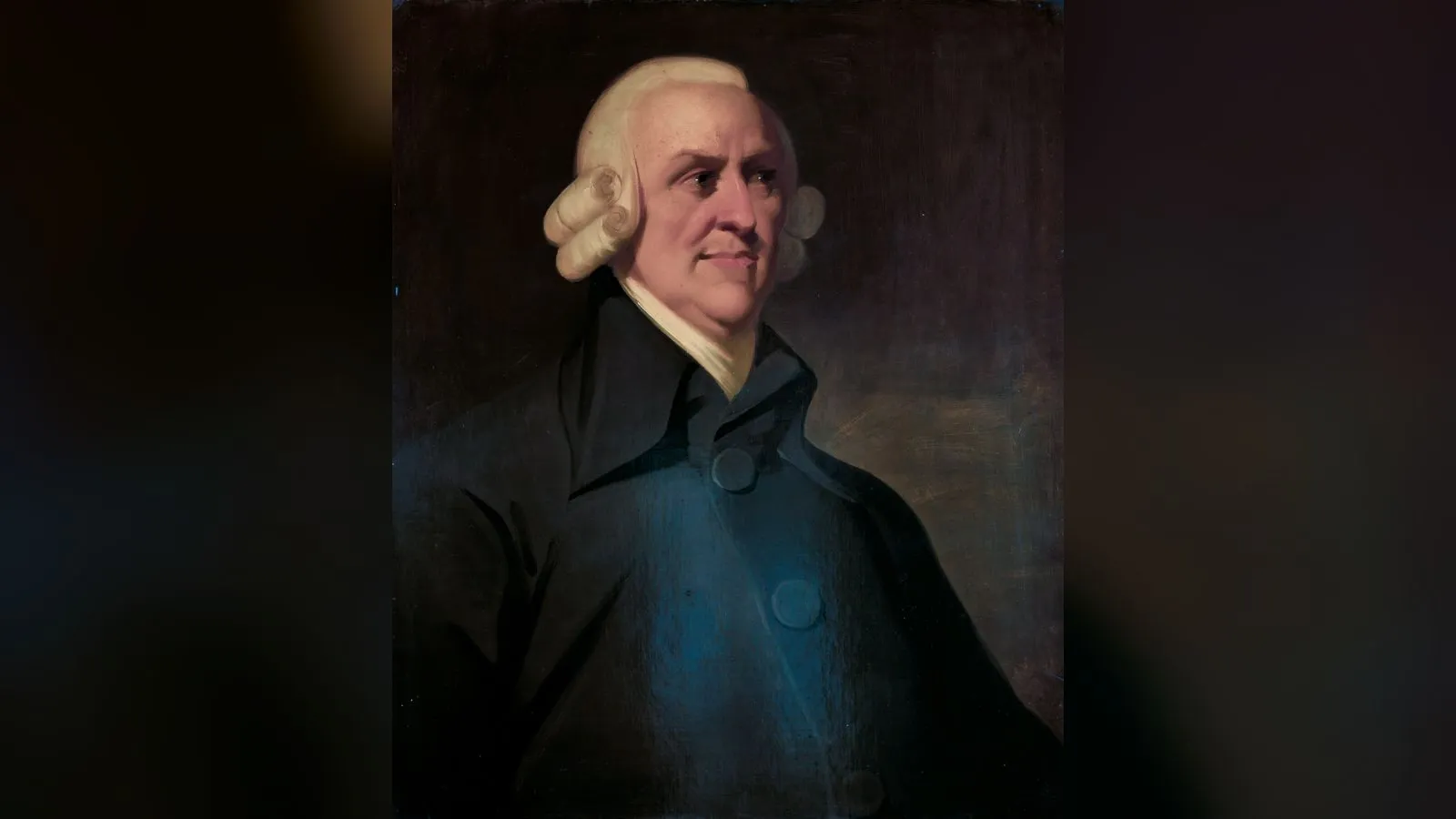

Adam Smith (1723–1790)
Contents
The Father of Economics — Who Was Not the Free-Market Ideologue He's Usually Made Out to Be
TL;DR
- established Adam Smith is the foundational figure of modern economics, whose An Inquiry into the Nature and Causes of the Wealth of Nations (1776) remains one of the most influential books in the history of the discipline — but his own view was that his earlier work, The Theory of Moral Sentiments (1759), was his real masterpiece, a moral philosophy of sympathy and conscience that he continued revising until his death.
- Established, and one of the most important corrections in this article: The popular image of Smith as a dogmatic free-market ideologue opposed to almost all government intervention is a significant distortion. He explicitly supported public funding of education, infrastructure the private sector wouldn't build, banking regulation, progressive taxation, and even limited protections for "infant industries" — and he repeatedly, sharply warned against merchants and manufacturers colluding against the public interest.
- established The "invisible hand," today treated as Smith's central doctrine, appears in his entire body of work only three times, used narrowly and specifically — not as a general claim that unregulated markets always produce good outcomes.
- established Smith opposed slavery on both economic and moral grounds, and was sharply critical of European colonialism and the East India Company's monopoly practices — a genuinely strong record on these questions, in real contrast to his close friend David Hume's much more compromised legacy on race, and worth stating factually rather than defensively.
- Disputed/uncertain: The famous childhood anecdote of the young Adam Smith being briefly kidnapped by Romani travellers appears in only one source — his first full biography, written in 1895, over a century after his death — and should be treated as unverified biographical tradition rather than established fact.
Key Facts
- Born
- Baptised 5 June 1723 (exact birth date unrecorded), Kirkcaldy, Fife
- Died
- 17 July 1790, Edinburgh, aged 67
- Education
- University of Glasgow (1737–1740), under Francis Hutcheson; Balliol College, Oxford (1740–1746)
- Major works
- The Theory of Moral Sentiments (1759); An Inquiry into the Nature and Causes of the Wealth of Nations (1776)
- Career
- Professor of Logic, then Moral Philosophy, University of Glasgow (1751–1764); tutor to the Duke of Buccleuch (1764–1766); Commissioner of Customs, Scotland (1778–1790)
- Key friendship
- David Hume — described as one of the closest personal and intellectual bonds of the Scottish Enlightenment
- Marital status
- Never married; lived with his mother, Margaret Douglas, for most of his life
- Burial
- Canongate Kirkyard, Edinburgh
- Modern commemoration
- Bank of England £20 note (2007–2020); statue on Edinburgh's Royal Mile (2008); Clydesdale Bank £50 note
Scottish Impact Index (SI Score)
- Global Influence
- 10/10
- Enduring Relevance
- 10/10
- Material Contribution
- 10/10
- Exceptional Achievement
- 10/10
- Lasting Legacy
- 10/10
- Recognition
- 8/10
58/60
Ranked =3rd of 200 in Great Scots
Claim-Status Note
Smith presents a particular editorial challenge, but a different one from many figures on this site: the risk isn't correcting an inflated legend, it's correcting a simplified one — a version of Smith reduced to a small set of slogans ("the invisible hand," "greed is good," "government bad, markets good") that his own writing does not actually support in the sweeping form popularly attributed to him. This distortion is not neutral or accidental; it has been actively shaped over more than a century by selective quotation, often for specific political purposes. This article uses a four-tier evidence framework — Established/Documented, Shared/Traditional, Disputed, Legend/Myth — and treats correcting the popular caricature as a central task, on equal footing with the biographical facts, since getting his actual arguments right matters more for Smith than for almost any other figure in this series.
Timeline
Born (baptised 5 June), Kirkcaldy, Fife; father, a customs official, died before his birth
Studies at the University of Glasgow under Francis Hutcheson
Attends Balliol College, Oxford, on a Snell Exhibition scholarship; later sharply critical of the quality of teaching there
Delivers well-received public lectures in Edinburgh
Appointed Professor of Logic, University of Glasgow
Becomes Professor of Moral Philosophy, University of Glasgow
Publishes The Theory of Moral Sentiments
Meets Benjamin Franklin during Franklin's tour of Edinburgh and Glasgow
Leaves Glasgow to tutor the young Duke of Buccleuch on a Grand Tour of France and Switzerland; meets Voltaire and the French Physiocrat economists (including Quesnay)
Publishes An Inquiry into the Nature and Causes of the Wealth of Nations — the same year as the American Declaration of Independence
Publishes a public letter describing David Hume's calm death, which caused some contemporary controversy
Appointed Commissioner of Customs for Scotland; moves to Panmure House, Edinburgh, with his mother
His mother, Margaret Douglas, dies
Serves as Lord Rector of the University of Glasgow
Dies at Panmure House, Edinburgh; instructs his executors to burn almost all his unpublished manuscripts
Featured on the Bank of England £20 note
Statue unveiled on Edinburgh's Royal Mile
The Details
Kirkcaldy, and an Unverified Childhood Legend
Adam Smith was baptised in June 1723 in Kirkcaldy, Fife (his exact birth date was never recorded); his father, a customs official, had died two months earlier, and Smith was raised by his mother, Margaret Douglas, to whom he remained close for his entire life. One frequently repeated childhood anecdote deserves particular caution: the story that the young Smith was briefly kidnapped by a band of travelling Romani people and rescued shortly afterward. This story originates from John Rae's 1895 biography of Smith — the first full-length biography, written over a century after Smith's death — and appears nowhere else in earlier sources or in Smith's own writing. Modern historians treat it as unverified biographical tradition rather than documented fact; it makes for a memorable opening anecdote in popular retellings, but should not be presented with more confidence than the single, late source actually supports. Disputed/uncertain — Legend/Myth in likely origin.
Glasgow and Oxford: A Formative Contrast
Smith entered the University of Glasgow at fourteen, studying under the philosopher Francis Hutcheson, whose ideas about natural justice, fair exchange and the moral dimensions of commerce would echo throughout Smith's later work. He then won a Snell Exhibition scholarship to Balliol College, Oxford (1740–1746) — an experience he found intellectually barren and later wrote about with real bitterness. In The Wealth of Nations, he stated plainly that "in the University of Oxford, the greater part of the public professors have, for these many years, given up altogether even the pretence of teaching," and reportedly had a copy of David Hume's Treatise of Human Nature confiscated and was punished for reading it. Smith later offered a structural explanation for Oxford's poor teaching quality that is itself a striking preview of his mature economic thinking: Oxford's wealthy college endowments made professors' income independent of whether they actually taught well, unlike the Scottish universities, where professorial income depended directly on attracting and keeping fee-paying students. This is a genuinely useful, concrete illustration of Smith reasoning from incentive structures decades before he wrote his famous economic works. established
Glasgow Professor, and a Close Friendship With Hume
Smith later described his thirteen years as a Glasgow professor (1751–1764) as "by far the most useful and therefore by far the happiest and most honourable period of my life." During this period he formed what became one of the closest personal and intellectual friendships of the Scottish Enlightenment, with David Hume — a relationship spanning philosophy, history, politics, religion and economics, and one that would later produce a notably public and controversial gesture of loyalty (see below). established
The Grand Tour: Physiocrats, Voltaire, and the Seeds of Wealth of Nations
Between 1763 and 1766, Smith left his Glasgow post to tutor the young Duke of Buccleuch on an extended Continental tour, for a salary roughly double his professor's income. In Toulouse — a stretch he found rather boring — he reportedly began drafting what would become The Wealth of Nations. In Geneva he met Voltaire; in Paris, more consequentially, he engaged directly with the French Physiocrat economists, notably François Quesnay, whose opposition to mercantilism and emphasis on natural economic order genuinely shaped Smith's own thinking, even as he remained critically independent of their specific theories, later describing their school as flawed but "perhaps the nearest approximation to the truth that has yet been published upon the subject of political economy." He had already met Benjamin Franklin years earlier, in Scotland: Franklin's 1759 tour took him to Smith's company both in Edinburgh and in Glasgow (Andrew Hook, Scotland and America, 1975, following J. Bennett Nolan). established
The Theory of Moral Sentiments (1759): Smith's Own Favourite
Smith's first major work set out his theory of moral judgment, built around the concept of the "impartial spectator" — the idea that individuals develop a conscience by imagining how a fair, disinterested observer would judge their conduct, with morality arising from a mutual, reciprocal sympathy between people rather than from a special innate moral sense (as earlier thinkers like Hutcheson had argued) or from calculations of utility (as Hume had argued). The book was well received and brought Smith enough renown that wealthy students travelled from abroad specifically to study under him at Glasgow. Notably, Smith continued revising the book across six editions throughout his life, right up to the year of his death — a sign of how central he considered it to his intellectual project, and there is reasonable evidence he privately regarded it as superior to his more famous economic work. established
The "Adam Smith Problem" — A Debate Modern Scholarship Has Largely Resolved
For much of the 19th century, particularly among German scholars, a supposed contradiction was identified between the sympathetic, other-regarding individual described in Moral Sentiments and the self-interested economic actor at the heart of The Wealth of Nations — the so-called "Adam Smith Problem." Since roughly the bicentennial of Wealth of Nations in 1976, this has been substantially reconsidered by most scholars, who now generally read the two works as complementary parts of a single, unified system rather than as contradictory: sympathy and conscience operate as the moral restraint on self-interest in personal and social life, while market competition performs an analogous restraining function specifically within economic exchange — different mechanisms suited to different domains of human behaviour, not two incompatible theories of human nature. established as the modern scholarly consensus, while noting the historical dispute genuinely existed and shaped 19th-century reception of Smith.
The Wealth of Nations (1776): What It Actually Argues
Published in 1776 — the same year as the American Declaration of Independence — The Wealth of Nations sold out its first edition within six months and was an immediate, substantial success, distinguishing it sharply from Hume's earlier Treatise (a useful point of contrast between the two close friends' respective publishing fortunes). Its central concerns include the division of labour and specialisation as drivers of productivity, a sustained critique of mercantilism (the belief that national wealth depends on accumulating gold and restricting trade), and an argument for the general benefits of open exchange. One frequently missed nuance: Smith's famous illustration of the division of labour using a pin factory did not originate with him — a very similar example already appeared in the French Encyclopédie — though Smith's development and integration of the idea into a full economic framework was original. established
The Invisible Hand: Rare, Specific, and Widely Overstated
This is one of the most consequential corrections to make about Smith, because it directly shapes how his entire body of thought gets popularly summarised. The phrase "invisible hand" — now treated in popular discourse as the defining, central concept of Smith's economics, shorthand for the claim that unregulated self-interested markets automatically produce good social outcomes — appears across Smith's entire surviving body of work only three times: once in an early essay on the history of astronomy (referring to "the invisible hand of Jupiter"), once in The Theory of Moral Sentiments, and once in The Wealth of Nations itself, in a specific passage about individuals preferring to invest domestically rather than abroad, incidentally contributing to national economic benefit as an unintended side effect of pursuing their own interest — not a general claim about markets always self-optimising. Modern economists, notably Paul Samuelson in his hugely influential 20th-century textbook, elevated the phrase into something close to Smith's central doctrine; classical scholars of Smith's actual texts regard this emphasis as substantially disproportionate to how the phrase actually functions in his writing. Some recent scholarship goes further, arguing the passage was originally more about restraining merchant monopoly behaviour than about celebrating unregulated markets generally. established — a genuinely important corrective, not a minor pedantic point.
Not a Laissez-Faire Ideologue: What Smith Actually Supported
This is arguably the single most important corrective this article can offer, because it runs directly against Smith's most common modern political usage. Smith was not a doctrinaire opponent of government intervention in the way he is frequently invoked to be. He explicitly supported: public funding of elementary education; state-funded infrastructure — roads, bridges, canals, harbours — specifically in cases where the necessary investment "could never repay the expense to any individual" and therefore wouldn't be built by private enterprise alone; banking regulation; enforcement of contracts and justice as a core government function; patent and copyright protections to encourage invention; and — significantly, given how often he is invoked against progressive taxation today — he explicitly wrote that "it is not very unreasonable that the rich should contribute to the public expense, not only in proportion to their revenue, but something more in that proportion," a plain statement in favour of proportionally heavier taxation on the wealthy. He also accepted the case for temporary protections for newly established "infant industries," while cautioning that such industries would likely resist ever giving up state support once granted it — itself a shrewd, non-doctrinaire piece of political-economy reasoning. established
Smith's Real Target: Merchants, Monopolies, and "Conspiracy Against the Public"
Where Smith was genuinely and consistently suspicious was not of government as such, but of the capture of government by commercial interests. His actual sharpest and most quotable warnings are directed at merchants and manufacturers, not at the state: "People of the same trade seldom meet together, even for merriment and diversion, but the conversation ends in a conspiracy against the public, or in some contrivance to raise prices." He argued that any proposed new trade regulation coming from merchants themselves "ought always to be listened to with great precaution, and ought never to be adopted till after having been long and carefully examined, not only with the most scrupulous, but with the most suspicious attention" — precisely because such proposals typically serve merchants' narrow interests against the broader public's. Read carefully, Smith's actual concern throughout The Wealth of Nations is less "government intervention is always bad" and more "beware government captured by, and acting on behalf of, concentrated commercial interests" — a considerably more specific and, in modern terms, considerably less politically convenient position than the version of Smith frequently invoked by advocates of minimal government today. established, and treated here as a necessary corrective to a widespread popular misreading, including by some organisations that invoke Smith's name and image in contemporary political debate.
Slavery and Colonialism: A Genuinely Strong Record
Here Smith offers a real and worthwhile point of contrast with his close friend David Hume, whose record on race and slavery — as this site's own article on Hume documents — is considerably more compromised. Smith argued against slavery on both economic grounds (he considered enslaved labour fundamentally less efficient and productive than free wage labour, since enslaved people had no personal incentive to work well) and on moral grounds. He was also sharply critical of European colonialism and, specifically, of the East India Company's monopoly trading practices, rejecting arguments that overseas colonies were economically essential to British prosperity, and explicitly rejecting the notion — common among his contemporaries — that China and India were culturally or developmentally inferior to Europe. Modern scholarship, particularly following renewed attention around the 1976 bicentennial of Wealth of Nations, has worked to recover and foreground this dimension of Smith's thought, which had previously been comparatively underemphasised relative to his purely economic arguments. established, and stated here plainly as a genuine point of comparative distinction rather than defensively.
Later Life: Commissioner of Customs — An Ironic Career Capstone
In 1778, Smith accepted appointment as Commissioner of Customs for Scotland, moving into Panmure House, Edinburgh, with his mother, who lived with him until her death in 1784. There's a genuine, worth-noting irony here: Smith's own father had been a customs official, and Smith himself, in The Wealth of Nations, had written at length critiquing exactly the kind of trade restrictions and tariff enforcement that customs administration existed to implement. This should be noted as an interesting biographical irony rather than evidence of hypocrisy — Smith's economic critique of mercantilist trade restriction was never a case against all government administration or revenue collection as such, consistent with the broader corrective above about his actual, more nuanced position on government's proper role. established
A Public Letter That Caused Controversy: Smith on Hume's Death
In 1777, following David Hume's death the previous year, Smith published a public letter describing his old friend's remarkable personal calm and good humour in the face of death — an account that caused real controversy at the time, since it was widely read as endorsing, or at least refusing to condemn, Hume's well-known irreligious scepticism in his final days. Smith's willingness to publish this account despite the controversy it invited is a notable, well-documented instance of personal loyalty to Hume's memory. established
Death and a Lost Archive
Smith died at Panmure House, Edinburgh, on 17 July 1790, aged 67, after a painful illness, reportedly expressing disappointment on his deathbed that he had not achieved more. Before his death, he gave explicit instructions that almost all his unpublished manuscripts and personal papers be destroyed — instructions honoured by his literary executors, the scientists Joseph Black and James Hutton. This was a genuinely significant loss for later scholarship: it means much of Smith's private thinking, including planned but never-completed major works on legal theory and on the arts and sciences, is permanently unrecoverable, and biographers have had to work with a much thinner personal archive than exists for many of his contemporaries. What did survive and was published posthumously includes Essays on Philosophical Subjects (1795) and, later, lecture notes recovered from student transcriptions (Lectures on Jurisprudence, not published until 1896). He is buried in Canongate Kirkyard, Edinburgh. established
Personal Life: Eccentric, By Most Accounts — But Some Stories Should Be Treated With Caution
Smith never married and lived with his mother for most of his adult life. He had a well-documented reputation for absent-mindedness and eccentric personal habits — talking to himself, stacking books and papers in precarious towers around his study, and reportedly deliberately avoiding showing off his knowledge in conversation, on the theory (relayed by his student James Boswell) that impressing people in person might reduce book sales. Some of the more colourful specific anecdotes commonly repeated about him — famously, that he once walked into a tanning pit while lost in conversation about free trade, or that he once put bread and butter into a teapot and drank the result, declaring it the worst cup of tea he'd ever had — lack solid primary documentation and should be treated as likely embellished biographical tradition rather than verified fact, in the same category of caution as the childhood kidnapping story. established general reputation for eccentricity; Shared/Traditional, bordering on Legend/Myth, for the more specific individual anecdotes.
Legacy
Smith is regarded as the founding figure of modern economics, and his influence extends through the entire subsequent history of the discipline. His image appeared on the Bank of England £20 note between 2007 and 2020 — the first Scotsman to feature on an English banknote — and continues to appear on Clydesdale Bank's Scottish £50 note. A ten-foot bronze statue by Alexander Stoddart was unveiled on Edinburgh's Royal Mile in 2008. His name has also been adopted by various modern political and economic institutions, most prominently the free-market-oriented Adam Smith Institute think tank — itself a notable, ongoing example of the selective, politically motivated invocation of Smith's name and image discussed above, worth flagging as part of his afterlife rather than as evidence of what Smith himself actually argued. established
Smith as a historian of society
The philosopher Alexander Broadie places Smith within the Scottish Enlightenment's habit of "conjectural history": reasoning from a scientific account of human nature about periods for which there is little or no direct evidence. Dugald Stewart gave Smith's account of the origin of language as a model example. Smith treated property law as a product of a society's stage of development and traced four stages, hunter-gatherer, herdsman, farmer and finally modern commercial society, both in his Glasgow lectures on jurisprudence and in The Wealth of Nations. His arguments for free trade were developed in terms of that last, commercial stage.
Smith's moral philosophy also grew out of his Glasgow teacher. He remembered "the never to be forgotten Hutcheson" and, although he did not share Hutcheson's view that morality rests on benevolence, called him "the soberest and most judicious" of all its defenders.
Smith and the Highlands: a telling silence
For all his interest in improvement, Smith said strikingly little about the Highlands. He seems to have crossed the Highland line only once, on a 1759 visit to the Duke of Argyll at Inveraray. His surviving letter about the trip complains only about an expensive inn. In The Wealth of Nations the region appears as a negative example: a "desert country" where every farmer "must be butcher, baker, and brewer for his own family", and where "a half starved Highland woman frequently bears more than twenty children". He made no recorded comment on the Highland famine of 1782.
When the British Fisheries Society sought his support in 1786–87, Smith praised its "public spirited intentions" but warned that its investors would "lose every shilling". Fredrik Albritton Jonsson argues that this silence was principled. Smith's model of growth assumed the mixed farming of the Lowlands and southern England, while improvers such as John Walker insisted that Highland conditions required local, expert management.
Smith and America
The literary historian Andrew Hook, in Scotland and America: A Study of Cultural Relations, 1750–1835 (1975), gathers the evidence for Smith's American connections and readership.
Franklin and the American students. established Smith met Benjamin Franklin in Edinburgh and again in Glasgow during Franklin's Scottish tour of 1759. Smith's Glasgow years coincided with the first wave of American students at Scottish universities: Hook counts about twenty Americans at Glasgow before the Revolution, against about a hundred at Edinburgh, most of them medical students.
On the American war. established Smith was one of several of Franklin's Scottish friends who opposed the government's handling of the colonies. In The Wealth of Nations (1776) he argued that the colonies should be represented in Parliament in proportion to their contribution to public revenue, and he expected that the seat of empire might in time move to America. That was a proposal for imperial union, not support for independence.
In the new republic. established In 1782 James Madison's list of books for the use of Congress included The Wealth of Nations; Thomas Jefferson owned a copy. American printers began to issue it once the war was over: Philadelphia in 1789, 1796 and 1816, and Hartford in 1804, 1811 and 1818. The Theory of Moral Sentiments followed at Philadelphia and Boston in 1817 and at New York in 1822. Examination papers set at the University of Virginia around 1828 expected students to discuss Smith alongside Thomas Brown, Hugh Blair and Dugald Stewart.
Reputation. shared By the 1820s American writers treated Smith as the master of political economy. In 1829 the Reverend Mitchell King, addressing the St Andrew's Society of Charleston, said Smith had "created a new science" (as quoted by Hook). Hook's own judgement is that American recognition of Smith "as the master economic thinker" was part of a wider respect for Scottish learning, and that Scottish thinkers stayed powerful in American thought for decades after 1800. This is Hook's assessment of the period up to 1835; the much larger later American debates over Smith, free trade and protection fall outside it.
Did You Know?
- In 1784 Smith took the visiting French geologist Barthélemy Faujas de Saint-Fond to the Highland Society of London's piping competition in Edinburgh, apparently curious to see his reaction. The visitor said the music reminded him of "a bear's dance" (Jonsson, 2013).
- Smith considered his first book, The Theory of Moral Sentiments, at least as important as The Wealth of Nations — and kept revising it right up until the year he died.
- He never invented the famous "pin factory" example of the division of labour — a very similar illustration already existed in the French Encyclopédie before he wrote The Wealth of Nations.
- The "invisible hand" — treated today as Smith's central idea — appears in his entire surviving body of work only three times, and never as a general claim that unregulated markets always produce good outcomes.
- Smith explicitly argued that the rich should pay proportionally more in tax than everyone else — a position rarely associated with his modern political reputation.
- His sharpest, most quotable warnings in The Wealth of Nations aren't aimed at government — they're aimed at merchants, whom he accused of routinely conspiring against the public interest.
- Smith opposed slavery on both economic and moral grounds, and rejected the idea that China and India were culturally inferior to Europe — a notably stronger record than his close friend David Hume's on questions of race.
- Smith's own father had also been a customs official — and Smith himself later spent the last twelve years of his career as a customs commissioner, enforcing exactly the kind of trade regulation his most famous book had spent hundreds of pages criticising.
- He instructed his executors to burn almost all his unpublished manuscripts before his death, permanently destroying much of the private record of how he actually thought.
- The first American edition of The Wealth of Nations was printed at Philadelphia in 1789, the year George Washington became president.
Frequently Asked Questions
1
- Was Adam Smith really the "father of capitalism"?
He's certainly the founding figure of modern economics, but the popular "father of pure free-market capitalism" label overstates and distorts his actual views. He explicitly supported public education, infrastructure spending, banking regulation, and progressive taxation, and reserved his sharpest criticism for merchants seeking to manipulate government to their own advantage.
2
- What is the "invisible hand," and is it really Smith's central idea?
It's a metaphor Smith used only three times across his entire body of work, in specific and limited contexts — not a general theory that unregulated markets always self-correct for the public good. Its status as Smith's supposed defining concept owes more to later economists (notably Paul Samuelson's influential 20th-century textbook) than to how the phrase actually functions in Smith's own writing.
3
- Did Adam Smith support any government regulation?
Yes, extensively — public funding for education and infrastructure the private sector wouldn't build, banking regulation, patent protection, and even temporary support for new "infant industries." His actual target was less government intervention as such and more government captured by merchant and manufacturer interests against the public good.
4
- What was Smith's actual relationship to David Hume?
Extremely close — one of the defining personal and intellectual friendships of the Scottish Enlightenment. Smith caused controversy in 1777 by publicly and warmly describing Hume's calm death despite Hume's well-known religious scepticism.
5
- Did Adam Smith support slavery?
No — he opposed it on both economic grounds (he considered enslaved labour less productive than free labour) and moral grounds, and was also sharply critical of European colonialism and monopoly trading companies like the East India Company.
6
- Is the story about Smith being kidnapped by Romani travellers as a child true?
It can't be verified. The story appears in only one source — a biography written in 1895, more than a century after Smith's death — and isn't corroborated anywhere else. Treat it as unverified biographical tradition, not established fact.
7
- Why did Smith write two very different-seeming books?
The Theory of Moral Sentiments (on sympathy and moral judgment) and The Wealth of Nations (on markets and self-interest) were once thought to contradict each other — the so-called "Adam Smith Problem." Most modern scholars now read them as complementary parts of a single system, addressing different aspects of human behaviour in different domains.
8
- Did Adam Smith invent the pin factory example?
No — a similar illustration of the division of labour already appeared in the French Encyclopédie before Smith wrote about it, though his development of the idea into a fuller economic argument was his own.
9
- What happened to Smith's private papers?
He ordered nearly all his unpublished manuscripts destroyed before his death, a request his executors honoured. This is a genuine, permanent loss for scholars trying to understand his private thinking and unfinished projects.
10
- Was Smith actually a good public speaker or a compelling conversationalist?
Accounts are mixed. He wasn't naturally gifted at public speaking but his lectures were nonetheless well received; in private conversation, he reportedly deliberately avoided showing off what he knew, on the theory that impressing people directly might reduce sales of his books.
11
- Is it true he once walked into a tanning pit while distracted?
This and several similarly colourful anecdotes about Smith's absent-mindedness are widely repeated but lack solid contemporary documentation. Treat them as likely embellished tradition rather than verified fact.
12
- Why is the Adam Smith Institute sometimes seen as controversial in how it uses his name?
Because it and similar organisations tend to invoke Smith specifically in support of minimal-government, free-market positions that, as this article details, only partially and selectively reflect his actual, considerably more nuanced published views on the proper role of government.
13
- When did Smith meet Benjamin Franklin?
In 1759, in Edinburgh and Glasgow, during Franklin's tour of Scotland, not on Smith's later continental tour.
14
- Was The Wealth of Nations read in early America?
Yes. It was on James Madison's 1782 list of books for Congress, and American editions appeared at Philadelphia from 1789 and at Hartford from 1804.
Sources and Further Reading
Primary/Institutional
- Adam Smith, The Theory of Moral Sentiments (1759); An Inquiry into the Nature and Causes of the Wealth of Nations (1776); Essays on Philosophical Subjects (1795, posthumous); Lectures on Jurisprudence (1896, posthumous, from student notes)
- Panmure House, Edinburgh — heritage and archival materials
- Bank of England — historical banknote series information
Scholarly
- Fredrik Albritton Jonsson, Enlightenment's Frontier: The Scottish Highlands and the Origins of Environmentalism (Yale University Press, 2013)
- Nicholas Phillipson, Adam Smith: An Enlightened Life
- Ian Simpson Ross, biography of Adam Smith
- John Rae, Life of Adam Smith (1895) — the earliest full biography; noted here as more anecdotal and less critically rigorous than modern scholarship, and the sole source of several unverified personal anecdotes
- Emma Rothschild, work on Smith's economic and political thought
- David Levy and Sandra Peart, on Smith's views on slavery, colonialism and racial equality
- Econ Journal Watch, "Adam Smith and the Invisible Hand: From Metaphor to Myth"
- Andrew Hook, Scotland and America: A Study of Cultural Relations, 1750–1835 (Blackie, 1975)
- J. Bennett Nolan, Benjamin Franklin in Scotland and Ireland, 1759 and 1771 (Philadelphia, 1938)
- Alexander Broadie, "The Rise (and Fall?) of the Scottish Enlightenment", in T. M. Devine and Jenny Wormald (eds), The Oxford Handbook of Modern Scottish History (Oxford University Press, 2012)
General
- Encyclopaedia Britannica, "Adam Smith"
- Internet Encyclopedia of Philosophy, "Adam Smith"
- Adam Smith Institute publications — useful as an example of contemporary political use of Smith's legacy, read alongside academic economic historians rather than as a neutral biographical source
Caveats: Myths and Disputed Claims
- Fredrik Albritton Jonsson (Enlightenment's Frontier, 2013) dates Faujas de Saint-Fond's visit to the Edinburgh piping competition to the autumn of 1782. The competition Faujas described was held in 1784, the year of his Scottish journey, so this card uses 1784.
- "Smith opposed almost all government intervention." A significant distortion — he explicitly supported public education funding, infrastructure spending, banking regulation, and progressive taxation. established correction.
- The "invisible hand" as Smith's central economic doctrine. Used only three times across his entire body of work, in specific and limited contexts, not as a sweeping general theory. established correction.
- The Romani-kidnapping childhood story. Appears in only one late source (1895) and is not independently corroborated. Disputed/Legend-Myth.
- Several colourful personal-eccentricity anecdotes (the tanning-pit incident, the teapot story) lack solid contemporary documentation. Shared/Traditional, treated with appropriate caution.
- "Smith invented the pin factory example." He did not — a similar illustration predates him in the French Encyclopédie. established correction.
- The "Adam Smith Problem" (a supposed contradiction between his two major works) is now largely regarded by scholars as resolved/overstated, though it was a genuine and influential 19th-century scholarly position in its own right. established as the modern consensus, with the historical dispute itself noted honestly.
- Do not say Smith first met Benjamin Franklin on his continental tour of 1763–66. They met in Scotland in 1759. established correction.
- Modern political organisations invoking Smith's name and image in support of minimal-government positions should be read critically against his actual, considerably more qualified published views. This article treats such usage as a notable feature of his afterlife, not as an authoritative account of his actual arguments.
Card 020 · Great Scots