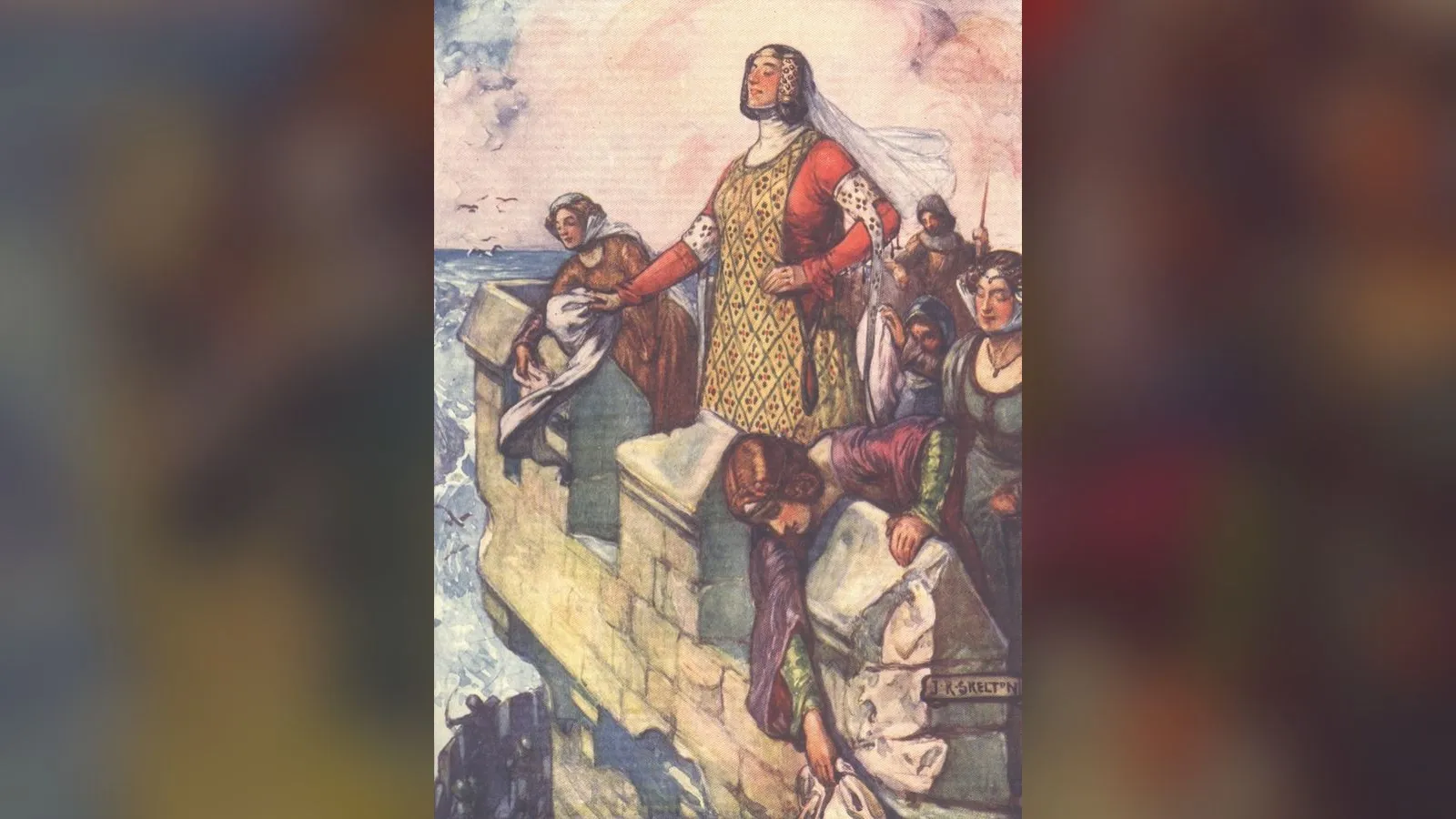

Agnes Randolph, "Black Agnes," Countess of Dunbar (c. 1312–1369)
Contents
TL;DR
- established Born into one of Scotland's most prominent noble families as daughter of Thomas Randolph, Earl of Moray and nephew of Robert the Bruce, Agnes Randolph successfully defended Dunbar Castle against a sustained English siege in 1338 while her husband was away, commanding the garrison herself for five months until the besiegers withdrew.
- established The siege itself, led by William Montagu, 1st Earl of Salisbury, is well documented: it began on 13 January 1338 and ended on 10 June 1338 after Salisbury, having spent nearly £6,000 and facing a successful Scottish relief effort, admitted defeat and withdrew his forces — a genuine military failure for a substantial English campaign, not an exaggerated or minor skirmish.
- Shared/Traditional. The siege's most famous individual anecdotes — having a servant dust the battlements with a kerchief after bombardment, mocking Salisbury's siege engine as a "sow" about to "cast her pigs," and nearly trapping Salisbury himself in an ambush at the gate — are preserved in historical chronicles and widely repeated, but this article states directly that historians cannot definitively verify which specific exchanges occurred as recorded versus which were later dramatised, and tiers them accordingly as traditional rather than strictly established fact.
- established When the English captured her brother John and threatened to hang him unless she surrendered the castle, Agnes reportedly responded that his death would only benefit her, as his heir — a genuinely harsh, documented reply this article reports directly without softening, rather than omitting an uncomfortable detail that complicates a simpler heroic portrait.
- established Agnes outlived her husband, had no surviving children of her own, and died in 1369; her successful defence of Dunbar nonetheless became one of the best-remembered episodes of medieval Scottish resistance, commemorated in contemporary ballad and enduring popular memory.
Key Facts
- Born
- c. 1312, Scotland
- Died
- 1369, Scotland, aged approximately 57
- Known for
- Successful defence of Dunbar Castle against English siege, 1338
- Father
- Thomas Randolph, 1st Earl of Moray
- Husband
- Patrick, 9th Earl of Dunbar and March
- Siege dates
- 13 January – 10 June 1338 (approximately five months)
- Opposing commander
- William Montagu, 1st Earl of Salisbury
Scottish Impact Index (SI Score)
- Global Influence
- 3/10
- Enduring Relevance
- 7/10
- Material Contribution
- 1/10
- Exceptional Achievement
- 4/10
- Lasting Legacy
- 3/10
- Recognition
- 3/10
21/60
Ranked =165th of 200 in Great Scots
A Note on Claims and Evidence
Agnes's family background, her marriage, and the broad facts of the 1338 siege of Dunbar Castle — its dates, its commanders, its cost to the English, and its ultimate failure — are well documented in contemporary chronicles and historical scholarship, and are treated as Established. The specific individual anecdotes most commonly associated with the siege are tiered as Shared/Traditional, since this article follows historians in noting that while these anecdotes are preserved in historical chronicles, their precise verbatim accuracy cannot be definitively confirmed against later dramatisation.
Timeline
Born to Thomas Randolph, Earl of Moray, and Isabel Stewart.
Marries Patrick, 9th Earl of Dunbar and March.
Her husband briefly defects to the English following the Scottish defeat at Halidon Hill, before returning to the Scottish side.
English forces under William Montagu, 1st Earl of Salisbury, besiege Dunbar Castle while Patrick is away.
Agnes commands the castle's defence herself, with the garrison and her own household.
Following a successful Scottish relief effort led by Sir Alexander Ramsay of Dalhousie, Salisbury abandons the siege after nearly five months.
Dies, aged approximately 57; buried near Mordington House, Berwickshire.
Details
A noblewoman from Scotland's highest ranks
Agnes Randolph was born around 1312 into deep proximity to Scotland's ruling circles: her father, Thomas Randolph, Earl of Moray, was a trusted companion and nephew of Robert the Bruce and served as regent of Scotland. She married Patrick, 9th Earl of Dunbar and March, in 1324, a union that placed her at Dunbar Castle, a strategically significant fortress on Scotland's eastern coast. This article notes directly that her husband's own wartime loyalties had been genuinely complicated — he briefly defected to the English following the 1333 Scottish defeat at Halidon Hill before returning to the Scottish side — a political volatility that forms part of the real context for the English assault on his castle five years later, when he himself was away.
Five months of defended siege
When English forces under William Montagu, 1st Earl of Salisbury, besieged Dunbar Castle beginning in January 1338, Agnes took direct command of its defence in her husband's absence — a role this article notes was, while historically significant, also a recognised and not wholly unprecedented responsibility for noblewomen of her era when their husbands were away. The siege itself is well documented as a genuine, substantial military campaign rather than a minor skirmish: it lasted approximately five months, until 10 June 1338, and ended only when Salisbury, having spent nearly £6,000 — a very substantial sum for the period — and facing a successful Scottish relief effort led by Sir Alexander Ramsay of Dalhousie, admitted defeat and withdrew his forces entirely. This article treats the siege's successful resistance as Agnes's genuine, documented military achievement, independent of the more colourful individual anecdotes that later became attached to it.
Famous anecdotes, honestly tiered
The individual episodes most commonly associated with Agnes's defiance — having a servant dust the battlements with a kerchief immediately after English bombardment, taunting Salisbury's siege engine as a "sow" soon to "cast her pigs" within the fortress before having it crushed by a dropped boulder, and nearly trapping Salisbury himself in an ambush at the castle gate — are vividly preserved in historical chronicles and remain the most memorable elements of her story. This article states directly, however, that historians cannot definitively verify the precise accuracy of these specific exchanges as recorded, as opposed to later dramatisation layered onto a genuinely remarkable core event, and tiers them accordingly as Shared/Traditional rather than strictly Established fact — a distinction this article maintains deliberately, since conflating vivid, memorable anecdote with verified historical record would understate the real uncertainty involved, even while the broader siege and its outcome remain solidly documented.
An uncomfortable detail, reported honestly
This article includes directly, rather than omitting in deference to a simpler heroic narrative, one of the siege's more genuinely harsh documented episodes: when the English captured Agnes's brother John and threatened to hang him unless she surrendered the castle, she reportedly replied that his death would in fact benefit her, as his heir to certain lands. This article presents this response as it is recorded, without attempting to soften or explain away its coldness, consistent with a full and accurate portrait of a figure operating under the genuine pressures of a prolonged siege rather than a simplified legend.
A legacy outlasting an uncertain personal record
Agnes and Patrick had no surviving children, and their estates ultimately passed to the children of Patrick's cousin and Agnes's own younger sister. Agnes died in 1369, having outlived the siege that made her famous by more than three decades. A contemporary ballad celebrated her victory, preserving Salisbury's reported admission of defeat — "Cam I early, cam I late, I found Agnes at the gate" — and her successful defence of Dunbar has endured as one of the best-remembered episodes of medieval Scottish military resistance, a genuine achievement this article presents as standing on its own historical merits independent of which specific anecdotes surrounding it are strictly verifiable.
Did You Know?
- Agnes's father, Thomas Randolph, served as regent of Scotland and was a nephew of Robert the Bruce.
- Her husband briefly defected to the English side five years before the siege that made her famous.
- The siege lasted roughly five months and cost the English nearly £6,000, a very substantial sum for the period.
- The besieging English commander, Salisbury, is said to have quipped about Agnes's archers that "Agnes's love shafts go straight to the heart" after narrowly avoiding an arrow.
- When the English threatened to hang her captured brother unless she surrendered, she reportedly replied his death would only benefit her financially.
- The siege ended only after a successful Scottish relief effort broke the English blockade.
- A contemporary ballad commemorated Salisbury's admission of defeat.
- Historians cannot definitively confirm the verbatim accuracy of her most famous quoted taunts during the siege.
FAQ
1What is "Black Agnes" best known for?
Successfully defending Dunbar Castle against a five-month English siege in 1338 while her husband was away.
2Is the siege itself historically verified?
Yes — its dates, commanders, cost, and outcome are well documented in contemporary chronicles and historical scholarship.
3Are the famous stories about her, like the dusting of the battlements, verified fact?
Not with full certainty — these anecdotes are preserved in historical chronicles and are widely repeated, but historians cannot definitively confirm their precise verbatim accuracy.
4Why is she called "Black Agnes"?
The nickname is traditionally associated with her, though its precise origin (possibly referring to her complexion or temperament) is not definitively documented.
5How did the siege end?
After nearly five months, a successful Scottish relief effort broke the siege, and the English commander withdrew after having spent a very large sum without success.
6Did she have children?
No surviving children; her estates passed to her husband's cousin's family.
7When did she die?
1369, roughly three decades after the siege, aged approximately 57.
8What was the uncomfortable episode involving her brother?
The English captured and threatened to hang her brother unless she surrendered; she reportedly replied his death would financially benefit her.
Sources and Further Reading
Primary/Institutional
- Agnes, Countess of Dunbar — Wikipedia
- Agnes Randolph of Dunbar: Biography — Undiscovered Scotland
- Dunbar Castle — Wikipedia
Scholarly/Critical
- Agnes Randolph, Countess of Dunbar and March — WarHistory.org
- The Monstrous Regiment of Women: Agnes Randolph, countess of Dunbar
General
Caveats: Myths and Disputed Claims
- Shared/Traditional: The siege's most famous individual anecdotes — the kerchief-dusting of the battlements, the "sow" taunt, and the portcullis ambush — are preserved in historical chronicles but cannot be definitively verified as verbatim fact rather than later dramatisation. This article presents them as traditional, well-preserved elements of her story rather than strictly established historical record.
- Clarification: The precise origin of the nickname "Black Agnes" is not definitively documented; this article uses it as her widely recognised traditional epithet without asserting a specific, confirmed origin for the name.
Card 179 · Great Scots