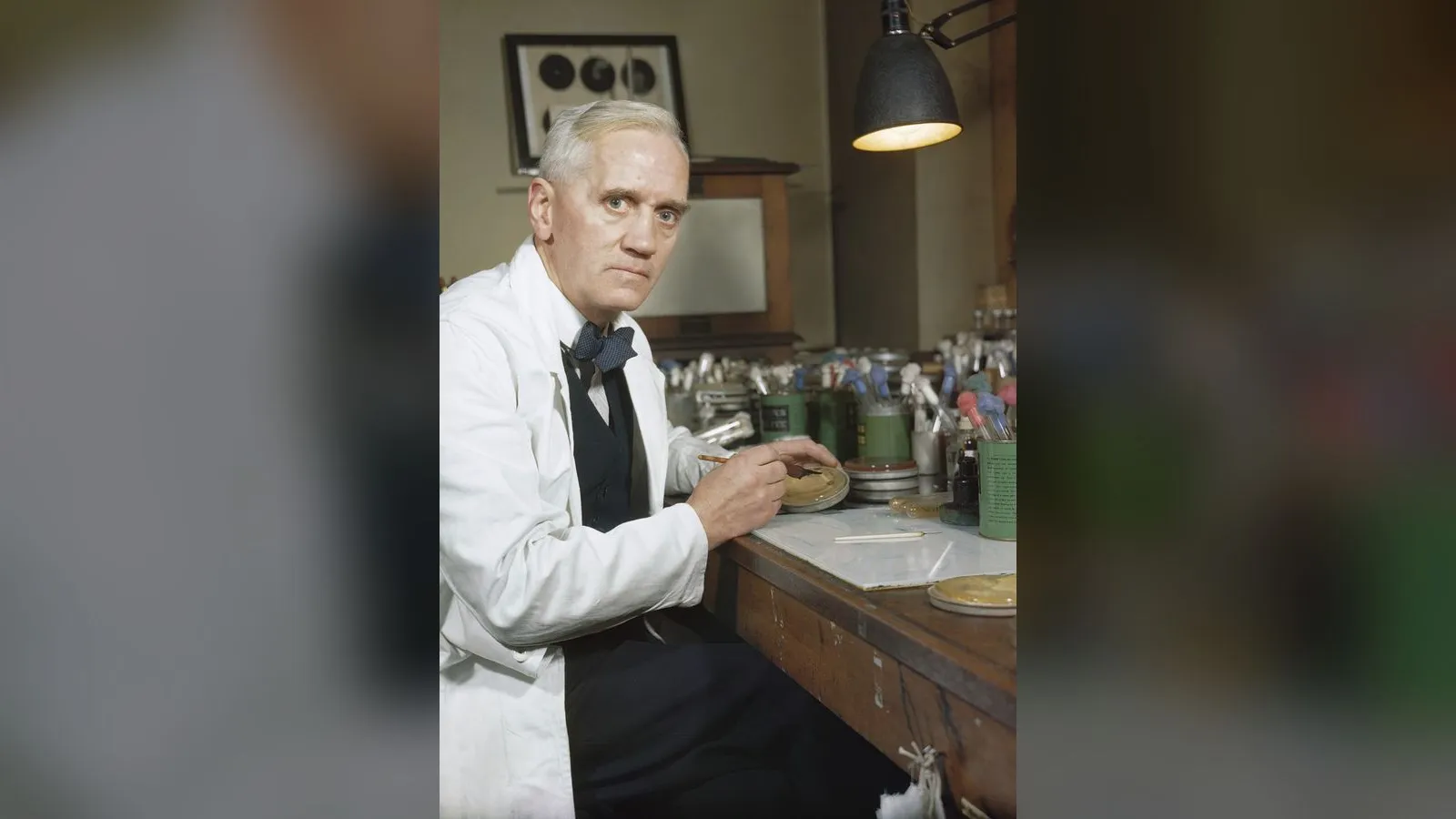

Sir Alexander Fleming (1881–1955)
Contents
TL;DR
- Established/Documented: Fleming discovered penicillin's antibacterial properties in 1928 at St Mary's Hospital, London, and shared the 1945 Nobel Prize in Physiology or Medicine with Howard Florey and Ernst Chain, whose Oxford team turned his laboratory observation into a mass-produced, life-saving drug.
- Disputed/Documented: The "sheer accident, no real skill involved" version of the discovery story does not survive close scrutiny. No contemporary record documents Fleming finding the famous mould-contaminated plate on the date usually given, there is a roughly two-month gap before it first appears in his lab notebook, and serious historians have proposed competing, more deliberate accounts of what actually happened — this card treats the precise sequence of events as genuinely uncertain rather than repeating the tidy textbook version as settled fact.
- Established/Documented: Fleming himself could not turn his discovery into a usable medicine — he lacked the chemistry expertise, institutional resources, and, for over a decade, scientific interest from his peers, and penicillin sat largely forgotten through the 1930s until Florey, Chain, and colleagues at Oxford solved the purification problem starting in 1939–40.
- Established/Documented: The widespread public impression that Fleming single-handedly discovered and developed penicillin — sometimes called "the Fleming Myth," a phrase Fleming himself reportedly used — arose largely because wartime press coverage focused on him after a dramatic 1942 clinical case, while Florey deliberately kept the Oxford team out of the media.
- Established/Documented: Fleming had already made a significant, under-recognised earlier discovery — lysozyme, a natural antibacterial enzyme found in tears, mucus, and other bodily fluids, identified in 1921–22 — which, while not itself a usable drug, demonstrates that his 1928 breakthrough built on years of prior, deliberate work studying natural antibacterial substances, not a single stroke of pure luck.
Key Facts
- Born
- 6 August 1881, Lochfield Farm, near Darvel, Ayrshire, Scotland
- Died
- 11 March 1955, London, England (aged 73)
- Education
- Louden Moor School and Darvel School; Kilmarnock Academy; St Mary's Hospital Medical School, Paddington, London (MBBS 1906, BSc in Bacteriology with gold medal, 1908)
- Known for
- Discovery of lysozyme (1921–22); discovery of penicillin's antibacterial action (1928)
- Key positions
- Lecturer, then Professor of Bacteriology, St Mary's Hospital Medical School / University of London (from 1928)
- Honours
- Knighted, 1944; Nobel Prize in Physiology or Medicine (shared with Florey and Chain), 1945; Fellow of the Royal Society, 1943; Légion d'honneur; Order of the Phoenix (Greece)
- Spouses
- Sarah Marion McElroy (m. 1915; d. 1949); Amalia Koutsouri-Vourekas (m. 1953)
Scottish Impact Index (SI Score)
- Global Influence
- 10/10
- Enduring Relevance
- 10/10
- Material Contribution
- 10/10
- Exceptional Achievement
- 10/10
- Lasting Legacy
- 10/10
- Recognition
- 9/10
59/60
Ranked =1st of 200 in Great Scots
Claim-Status and Evidence Note
Claims are evidence-tiered as Established/Documented (settled by primary records or broad scholarly consensus), Shared/Traditional (widely told and broadly accurate, though simplified), disputed (credible historians genuinely disagree), or Legend/Myth (unsupported and actively corrected here). Fleming's story is one of the clearest cases in this series where the popular version — a lucky accident, a single "eureka" moment, and a solitary genius who then cured the world — is a simplification that specialist historians have substantially complicated. This card presents the more accurate, more interesting version: a real discovery, made under circumstances that remain genuinely debated, that could not become a medicine without an entirely separate team's years of difficult chemistry.
Timeline
Born at Lochfield Farm, near Darvel, Ayrshire, the third of four children of farmer Hugh Fleming and Grace Stirling Morton.
Father dies when Alexander is seven.
Enrols at St Mary's Hospital Medical School, Paddington, funded by an inheritance from an uncle, after several years working in a shipping office.
Earns his MBBS degree with distinction.
Earns a BSc in bacteriology with a gold medal; becomes a lecturer at St Mary's.
Serves as a lieutenant, then captain, in the Royal Army Medical Corps on the Western Front, treating infected battlefield wounds; publishes 1917 research in The Lancet showing that standard antiseptics often failed to reach and could actively worsen deep wound infections.
Discovers lysozyme, a natural antibacterial enzyme present in tears, nasal mucus, and other bodily fluids, after nasal mucus he added to a contaminated culture plate inhibited bacterial growth.
Publishes the lysozyme findings in the Proceedings of the Royal Society B.
(conventionally dated) — Returns from holiday to find a culture plate of staphylococci contaminated with a mould, around which bacterial growth has been destroyed; identifies the mould as a Penicillium species.
Names the antibacterial substance "penicillin."
Presents the discovery at the Medical Research Club under an unassuming title; the talk attracts little interest.
Publishes the findings in the British Journal of Experimental Pathology; the paper receives little attention, and Fleming's own early clinical trial (treating a colleague's sinusitis) fails.
Penicillin research stalls, largely forgotten outside Fleming's own ongoing but chemically unsuccessful efforts, due to the extreme difficulty of purifying and producing it at scale.
Presents penicillin's potential medical importance at the Second International Congress of Microbiology; the scientific audience remains unpersuaded.
Ernst Chain and Howard Florey's team at Oxford, including Norman Heatley and Edward Abraham, begins systematic work to purify and mass-produce penicillin.
Fleming treats his brother Robert's associate, Harry Lambert, for life-threatening streptococcal meningitis, using an incompletely purified penicillin sample supplied by Florey, administered directly into Lambert's spinal canal; Lambert recovers within a week.
Fleming publishes the Lambert case in The Lancet; wide press coverage, especially in The Times, makes Fleming's name globally famous while Florey deliberately avoids publicity for the Oxford team; the UK Penicillin Committee is formally established to coordinate mass production.
By D-Day, enough penicillin has been mass-produced to treat all wounded Allied troops; Fleming is knighted.
Fleming, Florey, and Chain jointly awarded the Nobel Prize in Physiology or Medicine "for the discovery of penicillin and its curative effect in various infectious diseases."
Fleming's first wife, Sarah, dies.
Fleming marries Amalia Koutsouri-Vourekas, a Greek microbiologist and former colleague.
Dies of a heart attack at his London home, aged 73; ashes interred at St Paul's Cathedral.
Voted third-greatest Scot in a national poll, behind Robert Burns and William Wallace.
Details
Ayrshire roots and an unglamorous start
Alexander Fleming was born on a farm near Darvel, Ayrshire, in 1881, the third of four children; his father died when he was only seven. There was no obvious early trajectory toward scientific greatness — Fleming worked for four years in a London shipping office after school before an inheritance from an uncle let him enrol at St Mary's Hospital Medical School in Paddington in 1901, aged twenty. He proved an excellent student, earning his medical degree with distinction in 1906 and a bacteriology degree with a gold medal in 1908, and was retained at St Mary's as a lecturer — the institution where he would spend essentially his entire career.
The war that shaped his thinking about infection
Fleming's experience treating wounded soldiers on the Western Front during the First World War is not a side note to his later work — it is arguably the direct intellectual origin of it. Serving in the Royal Army Medical Corps from 1914, he observed that the standard treatment of the era, flooding wounds with antiseptic chemicals, frequently failed and sometimes actively worsened outcomes: antiseptics could kill surface bacteria while failing to reach deep infection sites, and in the process destroyed the body's own protective white blood cells along with the pathogens. Fleming published this finding in The Lancet in 1917. This wartime observation — that the medical establishment's confident standard treatment for infected wounds was fundamentally flawed — gave Fleming both the specific scientific question (is there a better way to fight infection?) and the professional scepticism toward received wisdom that shaped the rest of his career.
Lysozyme: the discovery that came before the famous one
Long before penicillin, Fleming made a genuine and interesting discovery that deserves more attention than it usually gets, precisely because it shows his later breakthrough was not an isolated fluke. In late 1921, while working with bacterial culture plates, Fleming found that nasal mucus he added to a contaminated plate created a clear zone where bacteria could not grow. Testing tears, sputum, blood, and egg white, he found the same antibacterial effect present across multiple bodily fluids, and named the responsible enzyme "lysozyme," publishing the findings in 1922. The discovery was met with almost total indifference from his scientific peers — his paper to the Royal Society reportedly drew no questions and no discussion. Lysozyme ultimately proved too weak against most disease-causing bacteria to become a useful drug, but the episode is directly relevant to what followed: Fleming had already spent years actively investigating natural antibacterial substances in the body, using exactly the kind of contaminated-culture-plate observation that would later produce his famous discovery. The 1928 breakthrough was not his first time noticing that something was inhibiting bacterial growth on a plate — it was at least his second.
September 1928: what actually happened is less certain than the textbook story
The conventional account, repeated in countless popular retellings, holds that Fleming returned from a summer holiday on 3 September 1928 to find a culture plate of staphylococci accidentally contaminated by an airborne mould spore, and noticed that bacterial colonies near the mould had been destroyed while those farther away remained healthy — prompting his famous remark, "That's funny." This version is broadly accurate in its outline, and Fleming's own later recollections support it in substance. But historians examining the documentary record have identified genuine problems with the precise, dramatised version of the story: no contemporary record actually documents the moment of discovery on the date usually cited, there is a gap of roughly two months before the observation first appears in Fleming's laboratory notebook, and — more fundamentally — penicillin is only effective against actively growing bacterial cells, not mature colonies of the kind already visible on an untouched plate, which raises real scientific questions about the mechanics of the standard story as usually told. Numerous attempts by later scientists to replicate the classic "left the plate on the bench and came back to a clean kill zone" scenario have failed under normal laboratory conditions.
Two serious alternative accounts have been proposed by historians of science. One, advanced by Ronald Hare in 1970, suggests Fleming inoculated staphylococci and mould together and then forgot to incubate the plate, with an unusual cold snap allowing the mould to establish itself before the bacteria could grow — an improbable but not impossible sequence of coincidences. A second, from Robert Root-Bernstein in 1989, argues Fleming was not simply working on staphylococci at all but was continuing his lysozyme research, systematically testing samples for antibacterial activity — making the discovery considerably less accidental, and more a matter of a prepared mind recognising the significance of an anomaly it was actively looking for. This card does not adjudicate between these competing accounts, since specialists themselves have not reached consensus; what can be said with confidence is that the tidy "pure luck, single afternoon" version taught in schools compresses and smooths over real uncertainty in the historical record. What is well documented, separately, is that the mould itself likely drifted up from a room below Fleming's, where a colleague's independent mycology work was being conducted — meaning even the most basic "where did the mould come from" element of the story rests on circumstantial, if plausible, later reconstruction (established in 1966) rather than contemporary proof.
A discovery that went almost nowhere for over a decade
What is not in dispute is what happened after the observation: essentially nothing, for more than ten years. Fleming named the substance "penicillin" in March 1929 and presented it to the Medical Research Club in February 1929 under the deliberately modest title "A medium for the isolation of Pfeiffer's bacillus" — a talk that generated no particular interest even from the meeting's own chair, Henry Dale, who later admitted he sensed nothing especially important in it. Fleming's 1929 published paper in the British Journal of Experimental Pathology likewise attracted little attention. His own attempt at clinical application — treating a colleague's sinusitis with penicillin in January 1929 — failed, most likely because the infection was caused by a bacterium penicillin does not kill. Despite working with professional chemists including Harold Raistrick, Fleming and his collaborators found that purifying penicillin into a stable, concentrated, storable form was extraordinarily difficult, and by the mid-1930s the substance had essentially languished. When Fleming presented on penicillin's potential medical significance at an international microbiology congress in 1936, in front of many of the world's leading bacteriologists, his own research assistant V.D. Allison recalled that there was simply no support for the idea and almost no discussion. This decade of near-total neglect is essential to an honest account of the discovery: Fleming identified something real and important in 1928, but identifying it and turning it into medicine were two entirely different scientific problems, and Fleming could only solve the first one.
Florey, Chain, and the Oxford team that made penicillin a medicine
The breakthrough that actually turned penicillin into a usable drug came from an entirely separate research group a decade later. At Oxford, Howard Florey and Ernst Chain — with crucial contributions from Norman Heatley, who devised a practical method for extracting penicillin's active ingredient by manipulating its solubility at different acidity levels, and Edward Abraham, who worked out penicillin's correct chemical structure including its distinctive beta-lactam ring — approached the purification problem systematically from 1939–40 onward, with institutional chemistry resources Fleming had never had access to. Chain's own reaction when Florey told him Fleming wanted to visit the Oxford lab — "Good God! I thought he was dead" — captures just how completely forgotten Fleming and his 1929 paper had become within the scientific community by the time Oxford's work began in earnest. By mid-1942, the Oxford team had produced pure penicillin in usable quantities.
Fleming remained involved and genuinely engaged with the problem throughout this period — his own notebooks show him experimenting with penicillin production methods as late as 1939, and he published a method for assessing penicillin's effectiveness in 1941 — but the decisive chemistry that turned his observation into a drug was Oxford's achievement, not his. As the immunologist Sir Henry Harris later summarised the full chain of dependency: "Without Fleming, no Chain; without Chain, no Florey; without Florey, no Heatley; without Heatley, no penicillin" — a formulation that credits Fleming's foundational observation honestly while making equally clear that four more names, not one, were required to get from laboratory curiosity to medicine.
The case that made Fleming famous — and the myth it created
The moment that brought penicillin, and Fleming personally, to wide public attention came in August 1942, when Harry Lambert — an associate of Fleming's own brother Robert — was admitted to St Mary's Hospital with life-threatening streptococcal meningitis, unresponsive to standard sulphonamide treatment. At Fleming's request, Florey supplied an incompletely purified penicillin sample, which Fleming administered directly into Lambert's spinal canal; Lambert showed improvement within a day and fully recovered within a week. Fleming published the case in The Lancet in 1943, and the story was picked up prominently by The Times and other press. Crucially, Florey — for reasons of scientific caution and a general dislike of publicity — actively kept the Oxford team out of media coverage, while Fleming, at St Mary's in London and readily available to journalists, became the public face of the discovery almost by default. The result was a lasting and significantly distorted popular impression that Fleming alone had both discovered and developed penicillin — a misconception widely reported to have been called "the Fleming Myth" by Fleming himself, who by most accounts remained genuinely and publicly modest about the Oxford team's far greater role in the practical achievement.
This press attention did have one entirely positive and well-documented consequence: it helped prompt direct government action. The British Ministry of Health and War Cabinet moved to accelerate penicillin production, and the UK Penicillin Committee was formally established in April 1943, coordinating British and American manufacturing efforts. By D-Day in June 1944, enough penicillin had been produced to treat every wounded Allied soldier who needed it — arguably the single clearest real-world demonstration of the discovery's ultimate significance.
Recognition, later life, and a warning that proved prophetic
Fleming, Florey, and Chain shared the 1945 Nobel Prize in Physiology or Medicine, and Fleming was knighted in 1944. He remained scientifically active and publicly engaged in his later career, and is notable for one specific piece of foresight that reads as remarkably prescient today: in his June 1945 Nobel lecture, Fleming explicitly warned of the danger of antibiotic resistance emerging from careless use of the very drug he had discovered, stating that a "thoughtless person playing with penicillin is morally responsible for the death of the man who finally succumbs to infection with the penicillin-resistant organism" — a warning that anticipated, with striking accuracy, one of the defining public health challenges of the twenty-first century. His personal life in this period included the death of his first wife, Sarah, in 1949, and his 1953 remarriage to Amalia Koutsouri-Vourekas, a Greek microbiologist and former research colleague at St Mary's.
Death and lasting legacy
Fleming died of a heart attack at his London home on 11 March 1955, aged 73; his ashes are interred at St Paul's Cathedral, a mark of the scale of national recognition he received. His laboratory at St Mary's Hospital is preserved today as the Alexander Fleming Laboratory Museum. In a 2009 Scottish public poll, he was voted the third-greatest Scot in history, behind only Robert Burns and William Wallace — testament to how completely, despite the real complexity of the discovery story, Fleming's name has become permanently and specifically attached to one of medicine's most consequential breakthroughs.
Did You Know
- Before penicillin, Fleming had already made a genuine antibacterial discovery — lysozyme, found in tears and mucus — in 1921, years before the famous mould incident, showing his 1928 breakthrough built on prior, deliberate research rather than being an isolated fluke.
- The precise story of the September 1928 discovery is less certain than the popular version suggests: there is no contemporary record of the exact moment, a roughly two-month gap exists before it appears in Fleming's notebook, and serious historians have proposed at least two competing, more complicated accounts of what actually happened.
- The mould that contaminated Fleming's plate most likely drifted up from a laboratory directly below his, where a colleague was independently conducting mycology research — established only in 1966, decades after the discovery itself.
- Fleming's own first attempt to use penicillin clinically, on a colleague's sinusitis in January 1929, failed — the infection happened to be caused by a bacterium penicillin doesn't kill.
- Penicillin was essentially ignored by the scientific community for over a decade after its discovery; when Fleming presented it at a major international congress in 1936, "no one believed him," according to his own research assistant.
- When Howard Florey told his Oxford colleague Ernst Chain that Fleming wanted to visit their lab in 1940, Chain's reaction was: "Good God! I thought he was dead" — a measure of how forgotten Fleming's 1929 paper had become.
- Fleming became a household name largely because Howard Florey deliberately kept the Oxford team that actually turned penicillin into a working drug out of the press — a decision Fleming himself reportedly called "the Fleming Myth."
- In his 1945 Nobel lecture, Fleming explicitly warned about antibiotic resistance — a problem now recognised as one of the major global health challenges of the twenty-first century, anticipated with striking accuracy nearly 80 years in advance.
FAQ
1Did Alexander Fleming discover penicillin by pure accident?
He did make the initial observation without deliberately searching for an antibacterial mould — but the popular "total accident, single lucky afternoon" version oversimplifies a more complicated and genuinely disputed historical picture, and it also obscures that Fleming had already spent years deliberately researching natural antibacterial substances (via lysozyme) before 1928.
2Did Fleming invent the penicillin drug people actually took?
No. Fleming identified penicillin's antibacterial properties in 1928 but could not purify or mass-produce it. That achievement belongs to Howard Florey, Ernst Chain, Norman Heatley, and Edward Abraham's Oxford team, who solved the chemistry from 1939–40 onward, roughly a decade later.
3Why does Fleming get most of the popular credit, then?
Largely because of a dramatic 1942 clinical case that brought Fleming, based at St Mary's in London, extensive press coverage — while Florey deliberately kept the Oxford team out of the media. This created a lasting public impression that significantly overstates Fleming's individual role relative to Florey and Chain's.
4Did Fleming himself claim sole credit?
No — by most accounts he was genuinely modest about it and is widely reported to have referred to the public's distorted version of events as "the Fleming Myth" himself, acknowledging Florey and Chain's far greater role in making penicillin an actual medicine.
5What was lysozyme, and why does it matter to the penicillin story?
Lysozyme was a natural antibacterial enzyme Fleming discovered in 1921–22, present in tears, mucus, and other bodily fluids. It was too weak to become a useful drug, but it shows Fleming was already an experienced, deliberate investigator of natural antibacterial substances years before 1928 — context usually missing from the "pure luck" version of the penicillin story.
6Is it true no one believed penicillin mattered for over a decade?
Yes, broadly. Fleming's 1929 publication attracted little attention, his own attempt at clinical use failed, and even his 1936 presentation to an international congress of leading microbiologists met with near-total indifference. The drug only became a serious research priority once Florey and Chain's Oxford team took it up around 1939–40.
7Who else deserves credit alongside Fleming, Florey, and Chain?
Norman Heatley, who devised the practical extraction method that made large-scale purification possible, and Edward Abraham, who determined penicillin's chemical structure, are both essential to the full story but were not included in the 1945 Nobel Prize, which is limited to three recipients under Nobel rules.
8How significant was penicillin's real-world impact?
Extremely significant and well documented: by D-Day in 1944, mass production driven by the UK Penicillin Committee had produced enough penicillin to treat all wounded Allied troops, and the drug went on to transform treatment of infections, gangrene, and bacterial diseases that had previously been frequently fatal.
9Was Fleming's antibiotic-resistance warning accurate?
Yes — his 1945 Nobel lecture warning about the dangers of resistance developing through careless use of penicillin is now recognised as remarkably prescient, anticipating antimicrobial resistance, one of the most significant global public health concerns of the present day.
10How is Fleming ranked among great Scots historically?
In a 2009 national poll, Fleming was voted the third-greatest Scot in history, behind only Robert Burns and William Wallace — reflecting his enduring, if somewhat overstated relative to Florey and Chain, association with the discovery of antibiotics.
Sources and Further Reading
Primary/Institutional
- NobelPrize.org, official biography and Nobel lecture, Alexander Fleming, 1945
- Alexander Fleming Laboratory Museum, St Mary's Hospital, London
- Science History Institute, "Alexander Fleming" scientific biography
Scholarly
- Asimov Press, "The Penicillin Myth" — historiographical review of competing accounts of the 1928 discovery, including the Hare (1970) and Root-Bernstein (1989) theories
- Wikipedia, "Discovery of Penicillin" — detailed sourced timeline drawing on primary laboratory notebook and correspondence records
- Henry Harris, published remarks on the Fleming–Chain–Florey–Heatley chain of contribution
General
- Encyclopaedia Britannica, "Alexander Fleming"
- Undiscovered Scotland, biography of Alexander Fleming
Caveats: Myths and Disputed Claims
The central myth this card addresses head-on is the "pure accident, single dramatic afternoon" version of the September 1928 discovery, which is widely taught but does not fully hold up against the documentary record: there is no contemporary account of the exact moment, a real gap before it enters Fleming's notebook, unresolved scientific questions about how mature bacterial colonies could have been affected by penicillin in the way described, and two distinct, more complicated scholarly reconstructions (Hare, 1970; Root-Bernstein, 1989) that this card presents as genuinely unresolved rather than picking a winner. The second major myth is the "Fleming alone discovered and developed penicillin" impression created by wartime press coverage — corrected here by giving full, specific weight to Florey, Chain, Heatley, and Abraham's essential and much longer scientific effort. Readers should take away that Fleming's 1928 observation was real, important, and built on years of relevant prior research (lysozyme) — but that turning it into the medicine that actually saved millions of lives was substantially someone else's achievement, a decade later.
Card 049 · Great Scots