
Alexander Selkirk (1676–1721): The Castaway Behind — but Not Simply — Robinson Crusoe
Contents
TL;DR
- Established (Documented): Selkirk, a quarrelsome Fife sailing master, was marooned voluntarily — at his own request — on the uninhabited island of Más a Tierra in September 1704 after a dispute with his captain over the seaworthiness of their ship, the Cinque Ports. He survived alone for four years and four months before rescue in February 1709.
- Established (Documented): His suspicions were vindicated: the Cinque Ports later sank, and her surviving crew endured years of brutal Spanish imprisonment — a fate Selkirk avoided entirely by staying behind.
- Disputed/Myth (widely overstated): Selkirk is popularly billed as "the real Robinson Crusoe," but literary scholars now regard this as a considerable oversimplification. Daniel Defoe's 1719 novel drew on multiple survival narratives, sets its castaway on a Caribbean island rather than a Pacific one, and gives Crusoe an indigenous companion and economic outlook with no equivalent in Selkirk's actual experience.
- Established (Documented): Far from a passive victim, Selkirk resumed privateering immediately after rescue, helped capture a Spanish treasure galleon, and completed a circumnavigation — returning home wealthier, not chastened.
- Established (Documented): He died at sea off West Africa in 1721, of disease contracted on a Royal Navy anti-piracy patrol, and was buried at sea — a considerably less romantic end than his island ordeal.
Key Facts
- Born
- 1676, Lower Largo, Fife, Scotland (baptised as Alexander Selcraig)
- Died
- 13 December 1721, at sea off the Gambia River, West Africa
- Parents
- John Selcraig, shoemaker and tanner; Euphan Mackie
- Occupation
- Sailing master, privateer, later Royal Navy officer
- Marooned
- September 1704, Más a Tierra, Juan Fernández Islands (now Robinson Crusoe Island), Chile
- Duration alone
- 4 years, 4 months
- Rescued by
- Captain Woodes Rogers's expedition, piloted by William Dampier, 2 February 1709
- Literary connection
- Widely but imprecisely cited as an inspiration for Daniel Defoe's Robinson Crusoe (1719)
- Marriages
- Sophia Bruce (1717); Frances Candis (1720, while first marriage's status was legally unresolved)
- Commemoration
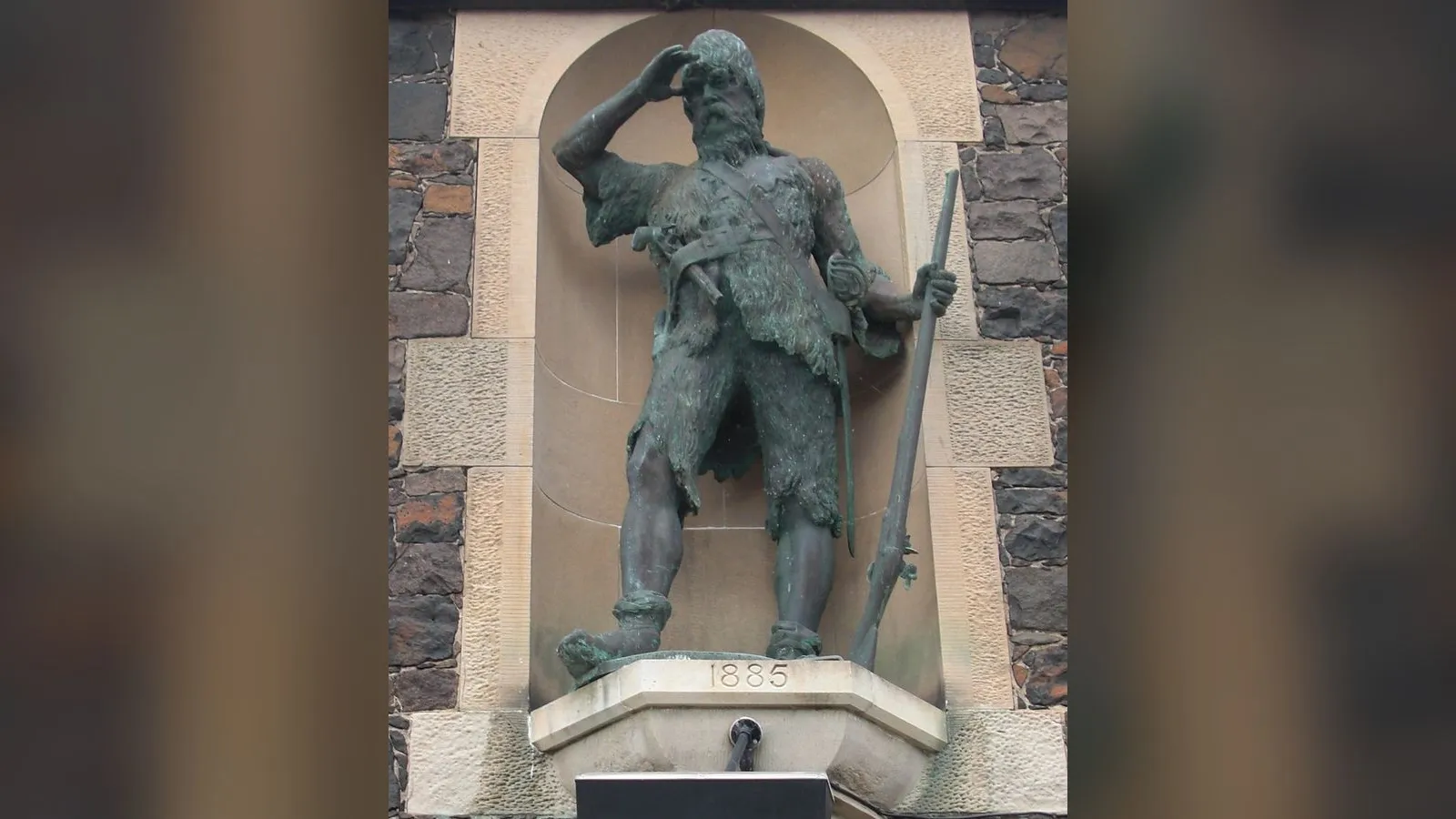
- Statue at Lower Largo (1885); Más a Tierra renamed "Robinson Crusoe Island" in 1966
Scottish Impact Index (SI Score)
- Global Influence
- 5/10
- Enduring Relevance
- 8/10
- Material Contribution
- 2/10
- Exceptional Achievement
- 3/10
- Lasting Legacy
- 5/10
- Recognition
- 6/10
29/60
Ranked =105th of 200 in Great Scots
A Note on Claim Status
This article follows ScottishInventions.co.uk's standard evidence tiers: Established/Documented (supported by primary sources or strong scholarly consensus), Shared/Traditional (widely repeated but resting on thinner evidence), disputed (credible sources disagree), and Legend/Myth (popular but unsupported or contradicted by the record). Selkirk's story is unusual in this series in that the popular version of his fame — "the real Robinson Crusoe" — is itself the single largest myth requiring correction, rather than a peripheral detail. This article treats that claim with considerably more scepticism than most tourist and popular accounts.
Timeline
Born in Lower Largo, Fife, to shoemaker John Selcraig and Euphan Mackie.
Summoned by church authorities for "indecent conduct in church"; by this point had already gone to sea.
Returns to Largo; involved in a violent altercation with his brothers.
Joins William Dampier's privateering expedition as sailing master of the Cinque Ports, under Captain Thomas Stradling; departs Kinsale, Ireland, 11 September.
Rounds Cape Horn after a stormy passage.
Stradling separates the Cinque Ports from Dampier's St George.
At Más a Tierra in the Juan Fernández Islands, Selkirk disputes the ship's seaworthiness and requests to be left ashore; Stradling agrees.
Survives alone on the island: initially by the shore, later inland among feral goats, using skills learned from his tanner father.
The Cinque Ports later founders off present-day Colombia; survivors, including Stradling, are captured and imprisoned by Spanish forces in Lima for four years.
Rescued by Woodes Rogers's expedition aboard the Duke and Duchess, piloted by William Dampier.
Resumes privateering; helps capture the Spanish galleon Nuestra Señora de la Encarnación y Desengaño (renamed Bachelor); serves as sailing master on the circumnavigating voyage home.
Arrives back in England after eight years away.
Edward Cooke publishes an account mentioning Selkirk's ordeal.
Woodes Rogers publishes a detailed account; Richard Steele writes about Selkirk in The Englishman. Selkirk faces assault charges in Bristol.
Marries Sophia Bruce in London after eloping with her from Largo.
Marries Frances Candis, a widowed innkeeper, in Plymouth, while his first marriage remained legally unresolved.
Daniel Defoe publishes The Life and Surprising Adventures of Robinson Crusoe.
Serving aboard HMS Weymouth off West Africa; contracts fever during an outbreak among the crew.
Dies at sea, likely of yellow fever or typhoid; buried at sea.
Bronze statue of Selkirk unveiled in Lower Largo.
Chilean president Eduardo Frei Montalva renames Más a Tierra "Robinson Crusoe Island" for tourism.
Details
A troublesome youth in Fife
Alexander Selkirk — born Selcraig — grew up in Lower Largo, a small fishing town on the Firth of Forth, the seventh son of a shoemaker and tanner. Even by the standards of the age, his youth was marked by open conflict with authority: in 1693 the local kirk session summoned him for "indecent conduct in church," and by the time officials went looking for him he had already run off to sea. A brief return to Largo in 1701 ended in a documented assault on his own brothers. The picture that emerges from the surviving record is not of a reluctant adventurer forced into a hard life, but of a genuinely difficult, combative young man for whom life at sea may have been as much an escape as an ambition.
The dispute that saved his life
In 1703, Selkirk signed on as sailing master of the Cinque Ports, part of a privateering squadron led by the veteran explorer William Dampier and authorised under wartime letters of marque to raid enemy shipping during the War of the Spanish Succession. The voyage did not go smoothly: after rounding Cape Horn in early 1704, the Cinque Ports, under Captain Thomas Stradling, separated from Dampier's ship in May.
By September 1704, anchored at Más a Tierra in the Juan Fernández Islands to take on water, Selkirk had become seriously alarmed about the Cinque Ports's condition, judging her dangerously unseaworthy. He proposed staying on the island rather than risk the onward voyage. Stradling, in what reads as more a fit of pique than careful judgement, agreed — leaving Selkirk with a musket, hatchet, knife, cooking pot, bedding, clothes, and a Bible. Selkirk apparently regretted the decision almost immediately and begged to be taken back aboard; Stradling refused. It was, in the event, the decision that saved Selkirk's life: the Cinque Ports later sank off the coast of present-day Colombia, and her surviving crew — Stradling included — were captured by Spanish forces and endured four brutal years of imprisonment in Lima before returning to England.
Four years and four months alone
Selkirk's ordeal on Más a Tierra divides into two distinct phases. At first he remained close to the shore, living on spiny crayfish and watching the horizon daily for a rescuing sail — a routine scholars have characterised as closer to despairing vigil than resourceful survival. Driven inland by the noise and stench of mating sea lions crowding the beaches, his fortunes changed. Feral goats, left on the island by earlier visiting sailors, provided him with meat, milk, and eventually clothing; wild turnips, cabbage-tree leaves, and native peppercorns rounded out his diet.
His father's trade as a tanner proved unexpectedly valuable: Selkirk forged a replacement knife from worn-out barrel hoops and made himself clothing from goatskins, stitched with a nail for a needle. He built two huts from pepper-wood trees — one for sleeping, one for cooking — and tamed feral cats to keep the island's rats from gnawing at him while he slept. He hunted goats with his musket until his gunpowder ran low, after which he pursued them on foot alone, on one occasion tumbling from a cliff during a chase and being saved from serious injury only by landing on the animal he had just caught. Selkirk also maintained his Bible reading and psalm-singing throughout, later crediting this practice with preserving both his religious conviction and his command of English. Twice, Spanish ships anchored at the island during his stay; on at least one occasion he narrowly avoided capture by hiding in a tree while a search party passed beneath him.
Rescue, and an unrepentant return to privateering
On 2 February 1709, Selkirk's ordeal ended when Woodes Rogers's privateering expedition — piloted, in one of history's tidier coincidences, by William Dampier himself — anchored at the island. Rogers, who led the landing party alongside ship's surgeon Thomas Dover, wryly dubbed the wild-looking, barely coherent figure they found "the governor of the island." Rogers later wrote with evident admiration that Selkirk's ordeal demonstrated "solitude and retirement from the world is not such an insufferable state of life as most men imagine" — though it is worth noting this was the conclusion of a man who had not himself endured it.
What followed complicates any reading of Selkirk purely as a survivor eager to leave adventure behind. Rogers promoted him to second mate and soon gave him command of a captured prize ship. Selkirk resumed privateering with evident enthusiasm, took part in looting raids on Spanish colonial settlements at Guayaquil, and helped capture and sail home the Spanish treasure galleon Nuestra Señora de la Encarnación y Desengaño, renamed Bachelor. He completed the return voyage as sailing master of the Duke, arriving back in England on 1 October 1711 — a full eight years after he had first set sail, and considerably richer than when he left, claiming roughly £800 from the voyage's plunder (equivalent to some £140,000 today), though the sum was contested in lengthy legal disputes.
Selkirk, Steele, Rogers — and then Defoe
Selkirk's ordeal became a minor sensation in Britain almost immediately: Edward Cooke mentioned it in a 1712 account of the voyage, Rogers published a fuller version within months, and the essayist Richard Steele profiled Selkirk directly in The Englishman in 1713. It was against this backdrop that Daniel Defoe published The Life and Surprising Adventures of Robinson Crusoe in 1719 — and the broad shape of a lone castaway surviving years on an isolated island was, to contemporary readers, an obvious echo of Selkirk's well-publicised story.
The myth, examined
This is where popular retelling and the documented record part ways most sharply. Selkirk is routinely marketed — not least by Chile's tourist board, which renamed Más a Tierra "Robinson Crusoe Island" in 1966 — as "the real Robinson Crusoe." Literary historians regard this framing as a substantial overstatement. The differences are not superficial: Crusoe is shipwrecked by accident, while Selkirk chose to stay behind and expected rescue within weeks rather than years; Crusoe's island sits in the Caribbean, roughly 4,300 kilometres from Selkirk's actual South Pacific location — a climate mismatch that makes Crusoe's goatskin wardrobe, lifted wholesale from Selkirk's real account, faintly absurd in a tropical setting; Crusoe's island is populated, most significantly by the character Friday, for whom scholars have identified a far more plausible real-world source in a Miskito castaway known as Will, marooned decades before Selkirk and recorded in an entirely separate narrative Defoe is known to have read. As literary scholar Paula Backscheider has put it, crediting Selkirk as Crusoe's primary source is "incorrect in dozens of ways." The more accurate — if less marketable — summary is that Selkirk's story was one of several real castaway accounts that lent Defoe's novel plausibility and cultural resonance, not that Crusoe is Selkirk transposed into fiction. Defoe himself never directly named Selkirk as his model.
A sailor to the end
Selkirk's post-rescue fame did not settle him. Months in London ended with fresh trouble — an assault charge in Bristol in 1713 carried a real risk of two years' confinement. Back in Largo, he met and eloped with a dairymaid, Sophia Bruce, marrying her in London in 1717; by 1720, while visiting Plymouth, he had married a second time, to a widowed innkeeper named Frances Candis, apparently without the legal status of his first marriage being resolved — a detail biographers have generally passed over quickly but which sits oddly with Selkirk's image as a reformed and settled man.
He enlisted in the Royal Navy and served as an officer aboard HMS Weymouth on anti-piracy patrol off West Africa. In 1721, storm damage forced the ship to linger near the mouth of the River Gambia while under repair; a wave of fever — almost certainly yellow fever, possibly compounded by typhoid — swept through the crew as men cut wood ashore in mosquito-infested forests. Selkirk fell ill in November and died on 13 December 1721, alongside a shipmate, William King. Both men were buried at sea — an end with none of the romance of his island years, and one that receives considerably less attention in popular retellings than his four years and four months as a castaway.
Did You Know?
- Selkirk was not shipwrecked — he chose to be left behind, after a heated argument with his captain over the ship's seaworthiness, and immediately regretted it.
- His suspicions about the Cinque Ports proved entirely correct: the ship later sank, and the surviving crew spent four years in a Spanish prison in Lima — a fate Selkirk avoided by staying on the island.
- The man who eventually rescued him, William Dampier, was the very privateer commander whose original expedition Selkirk had set sail with six years earlier.
- Selkirk's father was a tanner, and the leatherworking skills Selkirk learned as a boy in Fife directly enabled him to make clothing, tools, and shelter that kept him alive.
- Rather than retiring from adventure after his rescue, Selkirk immediately resumed privateering and helped capture a Spanish treasure galleon.
- Literary scholars increasingly regard the "real Robinson Crusoe" label as a considerable overstatement — Defoe's novel drew on multiple castaway accounts, and its most distinctive character, Friday, has a more plausible source in an entirely different, earlier survival story.
- Selkirk died at sea of fever off West Africa in 1721, just two years after Defoe's novel made his story world-famous — meaning he lived to see his own legend take shape in print.
- The island now called "Robinson Crusoe Island" was renamed for tourism in 1966; the neighbouring island bearing Selkirk's own name, Alejandro Selkirk Island, is one he in fact probably never set foot on.
Frequently Asked Questions
1Who was Alexander Selkirk?
A Scottish sailing master from Lower Largo, Fife, marooned alone on the uninhabited Pacific island of Más a Tierra for over four years (1704–1709) after a dispute with his ship's captain.
2Was Alexander Selkirk shipwrecked?
No. He voluntarily chose to remain on the island after arguing that his ship, the Cinque Ports, was too unseaworthy to continue sailing in. His captain agreed to leave him behind.
3How long was Selkirk stranded?
Four years and four months, from September 1704 until his rescue on 2 February 1709.
4Was he right about the ship?
Yes. The Cinque Ports later sank, and her surviving crew were captured and imprisoned by Spanish forces in Lima for four years.
5Is Alexander Selkirk really the basis for Robinson Crusoe?
Only loosely. His well-publicised ordeal likely influenced Daniel Defoe, but literary scholars now regard the popular "real Robinson Crusoe" label as a significant oversimplification — Defoe's novel drew on several castaway accounts, was set in a different ocean, and features an indigenous companion with no equivalent in Selkirk's own experience.
6Did Defoe ever confirm Selkirk was his inspiration?
No. Defoe never directly named Selkirk as the model for Crusoe; the connection rests on public perception at the time and later scholarly inference, not Defoe's own testimony.
7How did Selkirk survive alone on the island?
He lived on feral goats (for meat, milk, and clothing), wild turnips and cabbage-tree leaves, built shelter from pepper-wood trees, and used leatherworking skills learned from his tanner father to make tools and clothing.
8What happened to Selkirk after his rescue?
He resumed privateering almost immediately, helped capture a Spanish treasure galleon, completed a circumnavigation, and returned to England considerably wealthier than when he had left.
9How did Alexander Selkirk die?
He died of fever, likely yellow fever, on 13 December 1721 while serving as a Royal Navy officer off the coast of West Africa, and was buried at sea.
10Is "Robinson Crusoe Island" the island Selkirk was actually marooned on?
Yes — Más a Tierra, in Chile's Juan Fernández Islands, was renamed Robinson Crusoe Island in 1966 for tourism. A neighbouring island was separately renamed Alejandro Selkirk Island, though Selkirk almost certainly never visited it.
11Is there physical evidence of Selkirk's time on the island?
Yes. A 2005 archaeological excavation near a site now called Selkirk's Lookout uncovered a copper-alloy fragment from navigational dividers dating to the early 18th century, consistent with instruments Selkirk is known to have owned.
Sources and Further Reading
Primary / Institutional
- Undiscovered Scotland: Alexander Selkirk
- Wikipedia: Cinque Ports (1703 ship)
- Wikipedia: Woodes Rogers
Scholarly
- Smithsonian Magazine: The Real Robinson Crusoe
- National Geographic: Debunking the Myth of the 'Real' Robinson Crusoe
- World History Encyclopedia: Alexander Selkirk, The Inspiration For Robinson Crusoe
General
- Wikipedia: Alexander Selkirk
- Wikipedia: Robinson Crusoe Island
- Wikipedia: Alejandro Selkirk Island
- Wikipedia: Marooning
Caveats: Myths and Disputed Claims
- Selkirk is "the real Robinson Crusoe." Substantially overstated. While his well-publicised ordeal likely informed Defoe's novel, the two stories diverge sharply in setting, circumstance, and cast of characters, and literary scholars regard crediting Selkirk as the primary or sole inspiration as a considerable oversimplification. Defoe himself never confirmed the connection.
- Selkirk was shipwrecked. Myth. He was not the victim of an accident — he chose to be left behind after a dispute with his captain over the ship's seaworthiness, and initially regretted the decision.
- Selkirk returned from the island a changed, settled man. An oversimplification. He resumed privateering enthusiastically within weeks of rescue, faced fresh assault charges within two years of returning to Britain, and appears to have entered a second marriage in 1720 while his first, from 1717, remained legally unresolved — hardly the picture of quiet reform sometimes implied.
- Robinson Crusoe Island is where the fictional Crusoe was marooned. Myth, and a deliberately commercial one — Défoe's Crusoe is set in the Caribbean, thousands of kilometres away. The Chilean island was renamed for tourism in 1966, not for geographic or literary accuracy.
- Selkirk lived out his days peacefully after his adventures. Corrected by the record: he died relatively young, at 45, of fever contracted on a Royal Navy patrol off West Africa, and was buried at sea — an unglamorous end that sits in sharp contrast to his island fame.
Card 085 · Great Scots