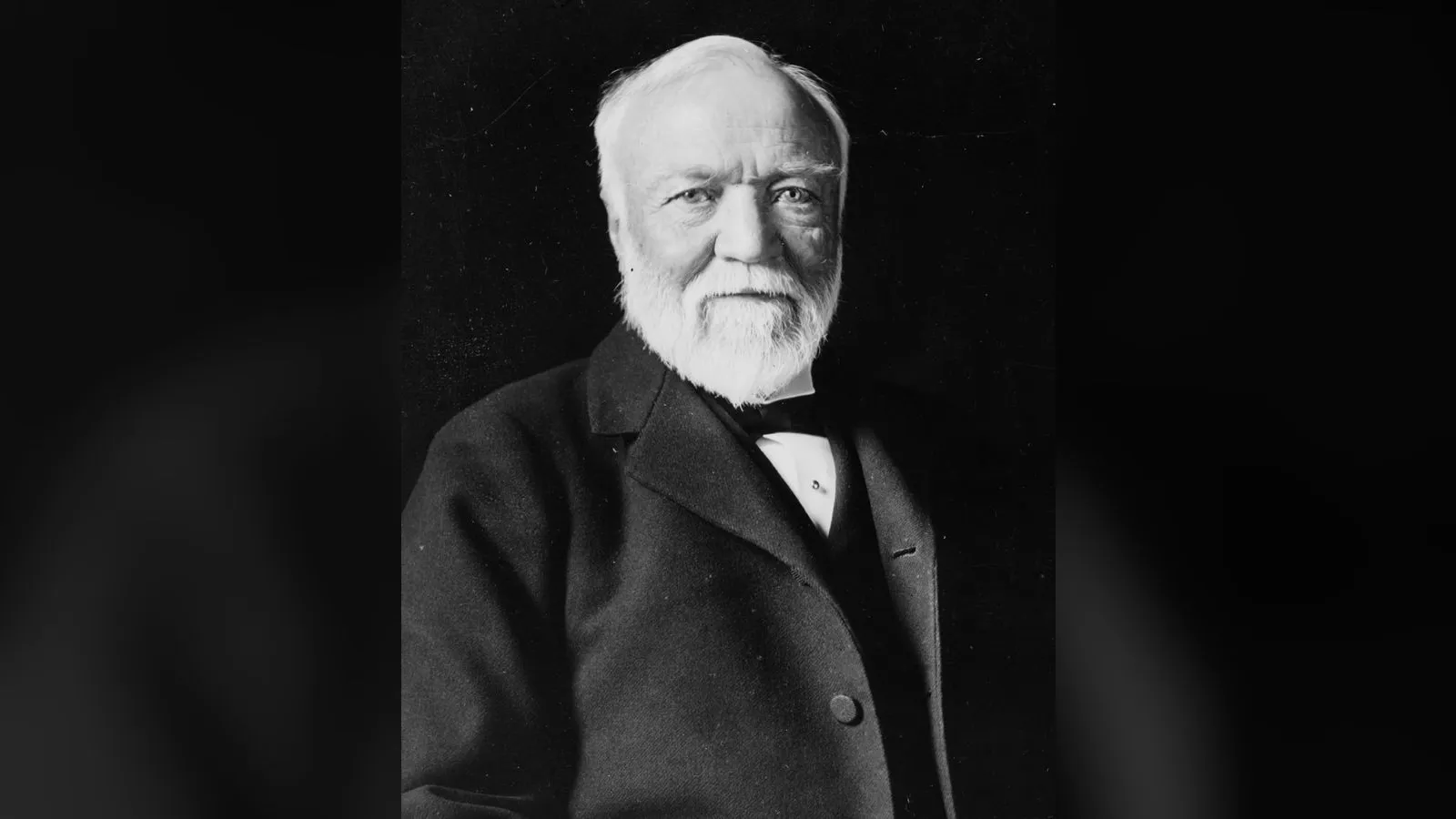

Andrew Carnegie (1835–1919): Steel, Libraries, and an Unresolved Contradiction
Contents
TL;DR
- Established/Documented: Andrew Carnegie rose from a Dunfermline weaver's son and Pittsburgh "bobbin boy" earning $1.20 a week to become, by 1901, the richest man in the world, building Carnegie Steel into the dominant force in American steel production before selling it to J.P. Morgan for $303.45 million.
- Established/Documented: Carnegie gave away roughly $350 million in his lifetime — close to 90% of his fortune — funding around 3,000 public libraries worldwide, major research and educational institutions, and international peace initiatives, guided by a philosophy he set out explicitly in his 1889 essay "Wealth," later known as "The Gospel of Wealth."
- Established/Documented: In July 1892, Carnegie Steel's Homestead, Pennsylvania plant became the site of one of the most violent labour conflicts in American history, after Carnegie's deputy Henry Clay Frick locked out the steelworkers' union and brought in 300 armed Pinkerton agents, resulting in a gun battle that killed at least seven strikers and three Pinkertons and ultimately crushed the union.
- Documented/Disputed: Carnegie was not present at Homestead — he had left for Scotland before the crisis escalated — and publicly maintained that Frick alone was responsible for the lockout and the Pinkertons' deployment; contemporaneous and later evidence, including Carnegie's own prior instructions to stockpile inventory and draft a notice withdrawing union recognition, substantially undermines the claim that he was merely an uninvolved bystander.
- Established/Documented: This is a direct and well-documented contradiction rather than an incidental footnote: Carnegie was on record publicly declaring that "no steel mill was worth a single drop of blood" and professing support for organised labour, while privately authorising and benefiting from a strategy that destroyed his own workers' union.
Key Facts
- Born
- 25 November 1835, Dunfermline, Fife, Scotland
- Died
- 11 August 1919, Shadow Brook estate, Lenox, Massachusetts, USA (aged 83)
- Occupation
- Industrialist, steel magnate, philanthropist, author
- Known for
- Building Carnegie Steel into the world's largest steel producer; funding approximately 3,000 public libraries; authoring "The Gospel of Wealth"
- Key achievement
- Pioneering vertically integrated, Bessemer-process steel production at industrial scale, then redistributing the resulting fortune through the largest programme of philanthropic giving of his era
- Notable relationships
- Business partner and deputy Henry Clay Frick; mentor Thomas A. Scott of the Pennsylvania Railroad; wife Louise Whitfield Carnegie
- Honours
- Freedom of Glasgow, St Andrews, Perth, and Belfast; honorary doctorates from Glasgow, Aberdeen, and Groningen; Lord Rector of the University of St Andrews (1901–1907)
- Legacy
- Carnegie Corporation of New York, Carnegie Mellon University, Carnegie Hall, Carnegie Endowment for International Peace, the Carnegie library network, and the ongoing historical debate over his business conduct
Scottish Impact Index (SI Score)
- Global Influence
- 10/10
- Enduring Relevance
- 9/10
- Material Contribution
- 9/10
- Exceptional Achievement
- 6/10
- Lasting Legacy
- 9/10
- Recognition
- 9/10
52/60
Ranked =7th of 200 in Great Scots
A Note on Claims and Evidence
This article tiers claims by evidential strength. Established/Documented claims rest on multiple independent, well-corroborated sources. Shared/Traditional claims are widely repeated but rest on thinner sourcing. disputed claims involve genuine historical disagreement. Andrew Carnegie's life presents an unusually stark editorial challenge for this series' "accuracy over patriotism" standard: he is, in material terms, the most consequential philanthropist this series has covered, and simultaneously a businessman whose methods, particularly at Homestead, caused serious and well-documented harm to the people who generated his wealth. This article does not attempt to resolve that tension into a tidier verdict than the historical record supports. Both halves are given full weight.
Timeline
Born 25 November in Dunfermline, Fife, son of handloom weaver William Carnegie and Margaret Morrison Carnegie.
Family emigrates to Allegheny, Pennsylvania, after William Carnegie's weaving trade collapses under industrial competition; Andrew begins work as a "bobbin boy" in a cotton mill earning $1.20 a week.
Becomes a telegraph messenger, then operator, for the Ohio Telegraph Company, distinguishing himself by learning to translate Morse code by ear.
Hired by Thomas A. Scott of the Pennsylvania Railroad as secretary and telegraph operator; Scott becomes a formative mentor in business and investment.
Promoted to superintendent of the Pennsylvania Railroad's Western Division, aged 24.
Serves in the U.S. Military Telegraph Corps during the Civil War, organising Union transportation and telegraph lines under Scott, then Assistant Secretary of War.
Invests in the Columbia Oil Company, which yields over $1 million in annual dividends, substantially building his early capital.
Builds an integrated iron and steel empire in Pittsburgh, founding Keystone Bridge Works and Union Ironworks, and adopting the Bessemer process for mass steel production.
Purchases the Homestead Steel Works near Pittsburgh, including its associated coal and iron fields, railway, and lake steamships.
Publishes "Wealth" in the North American Review (later republished as "The Gospel of Wealth"), arguing that the wealthy are morally obliged to distribute their fortunes to benevolent causes during their own lifetimes.
Combines his steel holdings into the Carnegie Steel Company. In July, the Homestead Strike erupts: with Carnegie in Scotland, deputy Henry Clay Frick locks out the Amalgamated Association of Iron and Steel Workers and deploys 300 Pinkerton agents, triggering a gun battle that kills at least seven strikers and three Pinkertons; the union is ultimately crushed.
Purchases Skibo Castle in Sutherland, Scotland, which becomes the Carnegie family's summer residence.
Sells Carnegie Steel to J.P. Morgan for $303.45 million, forming United States Steel Corporation; Carnegie's personal share, roughly $225.6 million, makes him the world's richest man. Establishes the Carnegie Trust for the Universities of Scotland with a $10 million gift. Elected Lord Rector of the University of St Andrews.
Establishes the Carnegie Institution of Washington with $2 million to fund scientific research.
Contributes $1.5 million toward construction of the Peace Palace at The Hague.
Establishes the Carnegie Hero Fund to recognise civilian acts of heroism.
Establishes the Carnegie Foundation for the Advancement of Teaching, including a major pension programme for American college professors.
Establishes the Carnegie Endowment for International Peace with a $10 million gift.
Establishes the Carnegie Corporation of New York to continue his philanthropic giving in perpetuity.
Dies of bronchial pneumonia at his Shadow Brook estate in Lenox, Massachusetts, aged 83; buried at Sleepy Hollow Cemetery, New York.
Details
From Dunfermline Weaver's Son to Pittsburgh Bobbin Boy
Andrew Carnegie's origins were genuinely humble, and this part of his story — unlike some later chapters — withstands close scrutiny without needing correction. He was born in 1835 in Dunfermline, Fife, the son of a handloom weaver whose trade was being steadily destroyed by industrial mechanisation, a bitter irony given the industrial fortune his son would later build. By the time Andrew was twelve, his father's income had collapsed to the point that his mother, Margaret, became the family's principal breadwinner, selling potted meats to make ends meet. The family borrowed money from a relative to emigrate to Allegheny, Pennsylvania, in 1848, arriving with essentially nothing. Carnegie's first American job, at age thirteen, was as a "bobbin boy" in a cotton mill, earning $1.20 a week — a detail Carnegie himself would repeat throughout his life as the foundation of his self-made-man narrative, and one that is well corroborated rather than a later embellishment.
shared A weavers' reading culture. Carnegie grew up among the craft most associated with self-education in Scotland. The historian Jonathan Rose, in The Intellectual Life of the British Working Classes (2001), argues that eighteenth- and nineteenth-century autodidact culture flourished especially among Scottish weavers, who were legendary for reading at the loom and for founding their own libraries and reading societies. Dunfermline had a Tradesmen's Library from 1808, which at first excluded fiction but gave way when weavers clubbed together to buy Walter Scott's novels; by 1823, 85 of its 290 volumes were fiction. Carnegie's later belief in libraries as ladders for working people therefore had local roots as well as the Allegheny ones he liked to emphasise.
A formative and genuinely instructive detail from this period: a local benefactor, Colonel James Anderson, opened his personal library of 400 volumes to working boys on Saturday nights, and the young Carnegie made full use of it. He later credited this access directly as the inspiration for his library philanthropy — a rare case of a philanthropic origin story that is both well documented and genuinely consistent with the adult behaviour it is said to explain.
Railroads, Mentorship, and Early Capital
Carnegie's rise through the Pennsylvania Railroad under the mentorship of Thomas A. Scott — first as a telegraph operator, then, by age 24, as superintendent of the railroad's Western Division — gave him both a formal business education and, crucially, early access to insider investment opportunities in railroad-adjacent industries: sleeping cars, iron, bridges, oil. His mother mortgaged the family's $700 home to help fund his first major investment, a $500 stake in the Adams Express Company, and later investments, particularly in the Columbia Oil Company from 1864, generated substantial returns that provided the capital base for his move into iron and steel.
Building the Steel Empire
Carnegie's dominance of American steel production rested on two genuine and significant business innovations, not merely on capital or connections. First, he was an early and aggressive adopter of the Bessemer process for mass steel production, dramatically lowering the cost of steel and enabling its rapid substitution for iron in railway construction. Second, and arguably more consequential, he pursued vertical integration with unusual thoroughness, systematically acquiring not just rival steel producers but the coal fields, iron ore sources, railways, and shipping needed to control every stage of production. By the late 1880s, Carnegie Steel was the world's largest producer of pig iron, steel rails, and coke, and by 1889 American steel output had overtaken Britain's, with Carnegie controlling a substantial share of that production.
It should be noted plainly that this dominance was not achieved through untrammelled free-market competition alone. Carnegie benefited significantly from protective U.S. tariffs, on which he lobbied Congress directly, and maintained close, price-coordinating relationships with railroad executives rather than relying purely on open market competition. This matters because Carnegie would later present himself as a disciple of the laissez-faire philosopher Herbert Spencer — a claim Spencer's own recorded reaction undercuts. Visiting Carnegie's Pittsburgh mills, Spencer reportedly remarked that "six months' residence here would justify suicide," and Spencer's broader writings explicitly condemned the kind of deliberate, government-assisted destruction of competitors that Carnegie practised as a form of "commercial murder." Carnegie's professed philosophical framework and his actual business conduct were, on the documented record, substantially at odds.
Homestead: Rhetoric Against Record
No single episode in Carnegie's life demands more careful, unflinching treatment than the Homestead Strike of 1892, and this article gives it commensurate weight rather than treating it as a regrettable but minor chapter in an otherwise triumphant career.
The background: Carnegie Steel's Homestead plant near Pittsburgh employed around 3,800 workers, of whom roughly 800 belonged to the Amalgamated Association of Iron and Steel Workers, a genuinely effective union that had secured significant contract protections in a previous 1889 strike. When that contract expired on 30 June 1892, management — under Carnegie's deputy Henry Clay Frick, who had been placed in charge of operations in 1881 — responded to the union's wage request not with a counteroffer but with a demand for a 22% wage cut affecting nearly half the union's membership, followed by a lockout and an announcement that the company would cease recognising the union altogether.
Carnegie's own public position on organised labour, stated repeatedly and on the record, was that "no steel mill was worth a single drop of blood," and he had cultivated a public reputation as sympathetic to workers' interests. But the documented private record tells a substantially different story: Carnegie personally ordered the Homestead plant to stockpile inventory in anticipation of a strike, and drafted — though did not ultimately release — a notice withdrawing union recognition, before departing for Scotland ahead of the crisis reaching its peak. When Frick subsequently fortified the plant with barbed wire, sniper towers, and high-pressure water cannons, and brought in 300 armed Pinkerton National Detective Agency agents by barge on 5–6 July 1892, Carnegie was not present — and when questioned in Scotland about Frick's tactics, he explicitly disclaimed responsibility, stating that Frick alone was in charge.
The resulting confrontation, when strikers and Pinkertons exchanged gunfire on the morning of 6 July, killed at least seven strikers and three Pinkertons (with some estimates higher), and injured scores more on both sides. Pennsylvania's governor eventually deployed over 4,000 state militia, who sided unambiguously with the company, enabling Frick to restart the plant with non-union strikebreakers within days. An assassination attempt on Frick by the anarchist Alexander Berkman on 23 July — an act with no connection to the union or to organised labour generally — further eroded public sympathy for the strikers. By November 1892, the shattered union voted narrowly to return to work on management's terms. Union membership in the industry collapsed from over 24,000 in 1891 to roughly 8,000 by 1895, and no Pennsylvania steel plant remained unionised by 1900.
This article treats Carnegie's physical absence from Homestead not as exculpatory but as a documented and deliberate feature of the episode. He retained ultimate authority over the company, had personally set the stockpiling and union-derecognition strategy in motion before leaving, and benefited directly from Frick's subsequent actions, while positioning himself, publicly and afterward, as a sympathetic bystander to a crisis he had substantially enabled. The historian Richard White's assessment — that Carnegie's later library philanthropy served in part to "justify the existing social order" his own business practices had helped construct, and that many Homestead steelworkers themselves despised the libraries built with the same fortune their exploitation had generated — is included here because it represents a serious, sourced historical judgment directly relevant to assessing Carnegie's legacy, not because this article adopts it as the final word. Readers can weigh it alongside the philanthropic record that follows.
The Sale and the World's Richest Man
By 1901, at 65, Carnegie was ready to retire from active business. J.P. Morgan purchased Carnegie Steel and merged it with other major producers to form United States Steel Corporation, the world's first billion-dollar corporation. Carnegie's personal share of the $303.45 million sale price was roughly $225.6 million, paid in gold bonds — making him, at a stroke, the richest private individual in the world, surpassing John D. Rockefeller. From this point forward, Carnegie devoted himself almost entirely to distributing this fortune.
The Gospel of Wealth
Carnegie's philosophy of giving was not a late-life improvisation but something he had articulated in explicit, almost doctrinal terms years before he had the means to act on it at scale. As early as 1868, at 33, he privately wrote that "the amassing of wealth is one of the worse species of idolatry. No idol more debasing than the worship of money," and resolved, on paper, to retire from business at 35 — a resolution he did not in fact keep, continuing to actively build his fortune for another three decades. His 1889 essay "Wealth," republished in Britain as "The Gospel of Wealth," set out the fully developed version of this philosophy: that a wealthy individual's life should consist of two distinct phases, first accumulating capital, then actively distributing it to benevolent purposes during their own lifetime, since, in Carnegie's own phrase, "the man who dies thus rich dies disgraced." Notably, Carnegie also expressed explicit sympathy for progressive and estate taxation as a societal check on hoarded fortune — a position that sits uneasily, and is presented here without resolution, alongside his vigorous opposition to unionisation as a check on his own company's practices.
A Philanthropic Programme of Unmatched Scale
Whatever judgment one reaches about how Carnegie's fortune was made, the scale and structure of how it was given away is itself historically significant and well documented. Beginning with a library gift to his hometown of Dunfermline in 1881, Carnegie ultimately funded approximately 3,000 public libraries across the United States, Britain, Ireland, Canada, and numerous other countries, using a distinctive matching-grant model: Carnegie would fund construction and equipment, but only if the local community provided the land and committed to ongoing operating funds — a structure designed to ensure genuine local investment rather than simple charity. Beyond libraries, his major philanthropic creations included the Carnegie Institution of Washington for scientific research, the Carnegie Foundation for the Advancement of Teaching (which established academic pension provision that evolved into the modern TIAA-CREF system), the Carnegie Endowment for International Peace, a $1.5 million contribution toward the Peace Palace at The Hague, the Carnegie Hero Fund, Carnegie Hall in New York, and a $10 million endowment establishing the Carnegie Trust for the Universities of Scotland. By the time of his death, Carnegie had given away roughly $350 million — close to 90% of his total fortune — with the remainder distributed through foundations after his death.
Death and a Contested Legacy
Andrew Carnegie died of bronchial pneumonia on 11 August 1919 at his Shadow Brook estate in Lenox, Massachusetts, and was buried under a deliberately simple Celtic cross at Sleepy Hollow Cemetery in New York — buried, notably, only yards from the grave of the labour leader Samuel Gompers, a juxtaposition later writers have found difficult to resist commenting on. His legacy remains genuinely, and appropriately, contested rather than settled. He is honoured today through Carnegie Mellon University, the Carnegie Corporation of New York, Carnegie Hall, hundreds of surviving Carnegie libraries still in active use, and extensive honours conferred by Scottish institutions including the Freedom of Glasgow, St Andrews, Perth, and Belfast, and an honorary doctorate from the University of Glasgow. At the same time, serious historians continue to treat the Homestead Strike, and the broader pattern of labour suppression and monopolistic practice that built his fortune, as inseparable from any full accounting of his life — not a stain to be weighed against the libraries and set aside, but a fact that shaped how, and at whose cost, the money that built those libraries was originally made.
Did You Know?
- Andrew Carnegie's father was a handloom weaver whose livelihood was destroyed by the very kind of industrial mechanisation that his son would later master and profit from on an enormous scale.
- Carnegie's first American job, at age thirteen, was as a "bobbin boy" in a cotton mill earning $1.20 a week — a detail he repeated throughout his life and one that is well corroborated rather than later embellishment.
- He credited his lifelong library philanthropy directly to a local Pittsburgh benefactor, Colonel James Anderson, who opened his personal 400-volume library to working boys on Saturday nights.
- Carnegie privately wrote in 1868, at age 33, that "the man who dies thus rich dies disgraced" — and then continued actively building his fortune for another three decades before acting on that conviction at scale.
- He was not present at the Homestead plant during the violent July 1892 confrontation; he was in Scotland, and publicly placed sole responsibility on his deputy Henry Clay Frick, despite having personally authorised the underlying strategy before departing.
- The philosopher Herbert Spencer, whose laissez-faire ideas Carnegie claimed to follow, reportedly said that "six months' residence" at Carnegie's Pittsburgh mills "would justify suicide" — and explicitly condemned the deliberate destruction of business competitors as "commercial murder."
- Theodore Roosevelt privately held Carnegie in contempt, writing that he found it "pretty difficult" to like a man who "makes a God of mere money-making" while loudly condemning war.
- Carnegie funded the construction of roughly 7,000 pipe organs in churches and temples of any denomination — a lesser-known but genuinely large-scale philanthropic commitment.
- He is buried at Sleepy Hollow Cemetery in New York only yards from the grave of labour leader Samuel Gompers.
- Gompers's own memoir, cited by the historian Jonathan Rose, names Carnegie's father among the British workingmen who loved the emigrants' song "To the West! to the West! to the land of the free".
- Dunfermline's weavers had a Tradesmen's Library from 1808, long before Carnegie gave the town its public library.
- A species of dinosaur, Diplodocus carnegii, and the Saguaro cactus genus Carnegiea gigantea are both named in his honour, alongside two American towns called Carnegie.
Frequently Asked Questions
1Was Andrew Carnegie a good employer?
The historical record is genuinely mixed and should not be flattened in either direction. Carnegie publicly supported workers' rights and later funded significant worker pension programmes, but his company's actual labour relations, particularly at Homestead in 1892, involved wage cuts, a lockout, the use of armed private security, and the deliberate destruction of the steelworkers' union — conduct that directly contradicted his own public statements on the subject.
2Did Carnegie personally order the violence at Homestead?
He did not personally order the Pinkerton deployment or direct the confrontation — that was Henry Clay Frick's decision, taken while Carnegie was in Scotland. However, Carnegie had personally set the underlying confrontational strategy in motion before leaving, including ordering inventory stockpiled in anticipation of a strike and drafting a notice to withdraw union recognition, and he retained ultimate authority over the company throughout. His claim to be an uninvolved bystander is not well supported by the documented record.
3How much money did Andrew Carnegie give away?
Approximately $350 million over his lifetime — close to 90% of his total fortune — funding around 3,000 public libraries, major research and educational institutions, peace initiatives, and pension programmes, with his remaining wealth distributed through foundations after his death in 1919.
4What was "The Gospel of Wealth"?
An 1889 essay, originally titled "Wealth," in which Carnegie argued that the wealthy had a moral obligation to actively distribute their fortunes to benevolent purposes during their own lifetimes rather than simply passing wealth to heirs, famously writing that "the man who dies thus rich dies disgraced."
5Why did Carnegie fund so many public libraries?
He credited his own early access, as a poor immigrant boy in Pittsburgh, to a local benefactor's personal library as formative to his self-education and later success, and sought to replicate that access broadly. His library grants used a distinctive matching model requiring local communities to provide land and ongoing operating funds rather than simply donating buildings outright.
6Did Carnegie's own business practices contradict his philosophical beliefs?
Yes, substantially and on the documented record. He presented himself as a follower of the laissez-faire philosopher Herbert Spencer, who explicitly condemned the deliberate destruction of business competitors — precisely the strategy Carnegie pursued through aggressive vertical integration and tariff lobbying. Spencer's own recorded reaction to visiting Carnegie's mills was scathing rather than approving.
7What happened to the union after the Homestead Strike?
It was effectively destroyed. Membership in the Amalgamated Association of Iron and Steel Workers collapsed from over 24,000 in 1891 to roughly 8,000 by 1895, and no Pennsylvania steel plant remained unionised by 1900. The union survived only in diminished form until merging into the United Steelworkers in 1942.
8How rich was Andrew Carnegie at his peak?
After selling Carnegie Steel to J.P. Morgan in 1901 for $303.45 million (his personal share roughly $225.6 million), Carnegie became the richest person in the world, surpassing John D. Rockefeller. In modern terms, his lifetime giving alone is estimated at roughly $6.9–8.7 billion in current value.
9Where is Andrew Carnegie buried, and how is he commemorated?
He is buried under a deliberately simple Celtic cross at Sleepy Hollow Cemetery, New York — close to the grave of the labour leader Samuel Gompers. He is commemorated globally through Carnegie Mellon University, Carnegie Hall, the Carnegie Corporation of New York, the Carnegie Endowment for International Peace, and hundreds of surviving Carnegie libraries.
10Is it fair to call Andrew Carnegie a hypocrite?
Reasonable historians differ on how to frame this, and this article does not adopt a single verdict. What is well documented is a genuine and significant contradiction between Carnegie's public pro-labour rhetoric and philosophical professions, and his company's actual conduct toward its workers, particularly at Homestead — a contradiction his own contemporaries, including Theodore Roosevelt, noted directly and critically at the time.
Sources and Further Reading
Primary / Institutional
- Andrew Carnegie, "Wealth," North American Review, June 1889 (later republished as "The Gospel of Wealth")
- Andrew Carnegie, Autobiography of Andrew Carnegie (published posthumously, 1920) — Peace Palace Library edition
- Carnegie Corporation of New York
Scholarly / Reference
- Jonathan Rose, The Intellectual Life of the British Working Classes (Yale University Press, 2001)
- Wikipedia: "Andrew Carnegie"
- Wikipedia: "Homestead strike"
- Wikipedia: "Amalgamated Association of Iron and Steel Workers"
- History.com: "Andrew Carnegie Destroyed the Unions He Claimed to Support"
- History.com: "Homestead Strike — Summary, Causes & Impact"
- AFL-CIO: "1892 Homestead Strike"
- Bucknell University: "100 Years Carnegie"
General / Popular
Caveats: Myths and Disputed Claims
- "Carnegie was an entirely self-made man who succeeded purely on merit." His rags-to-riches rise from bobbin boy is genuine and well documented, but his early capital accumulation depended significantly on insider investment access provided by his mentor Thomas A. Scott, and his later business dominance depended on protective tariffs he actively lobbied for and price coordination with railroad executives — not purely on open market competition.
- "Carnegie had no responsibility for the violence at Homestead because he was in Scotland." This is the version of events Carnegie himself promoted, and it is technically true that he did not order the Pinkerton deployment directly. But he had personally set the confrontational strategy in motion before leaving — ordering inventory stockpiled and drafting a notice to withdraw union recognition — and retained ultimate authority over the company throughout. Treating his absence as full exoneration is not well supported by the documented record.
- "Carnegie's pro-labour statements reflected his actual business practices." They did not, and this contradiction is well documented rather than a matter of interpretation. His public declaration that "no steel mill was worth a single drop of blood" sits directly alongside his company's lockout, use of armed Pinkerton agents, and the eventual destruction of the steelworkers' union under his ultimate authority.
- "Carnegie's philanthropy fully redeems or cancels out his business conduct." This article does not adopt that framing, nor its opposite. Both the scale and structural intelligence of his giving, and the serious, well-documented harm caused by his business practices — particularly at Homestead — are historically real and are presented here as two genuine, unresolved parts of the same life, consistent with serious historians' own continued disagreement on how to weigh them against each other.
Card 073 · Great Scots