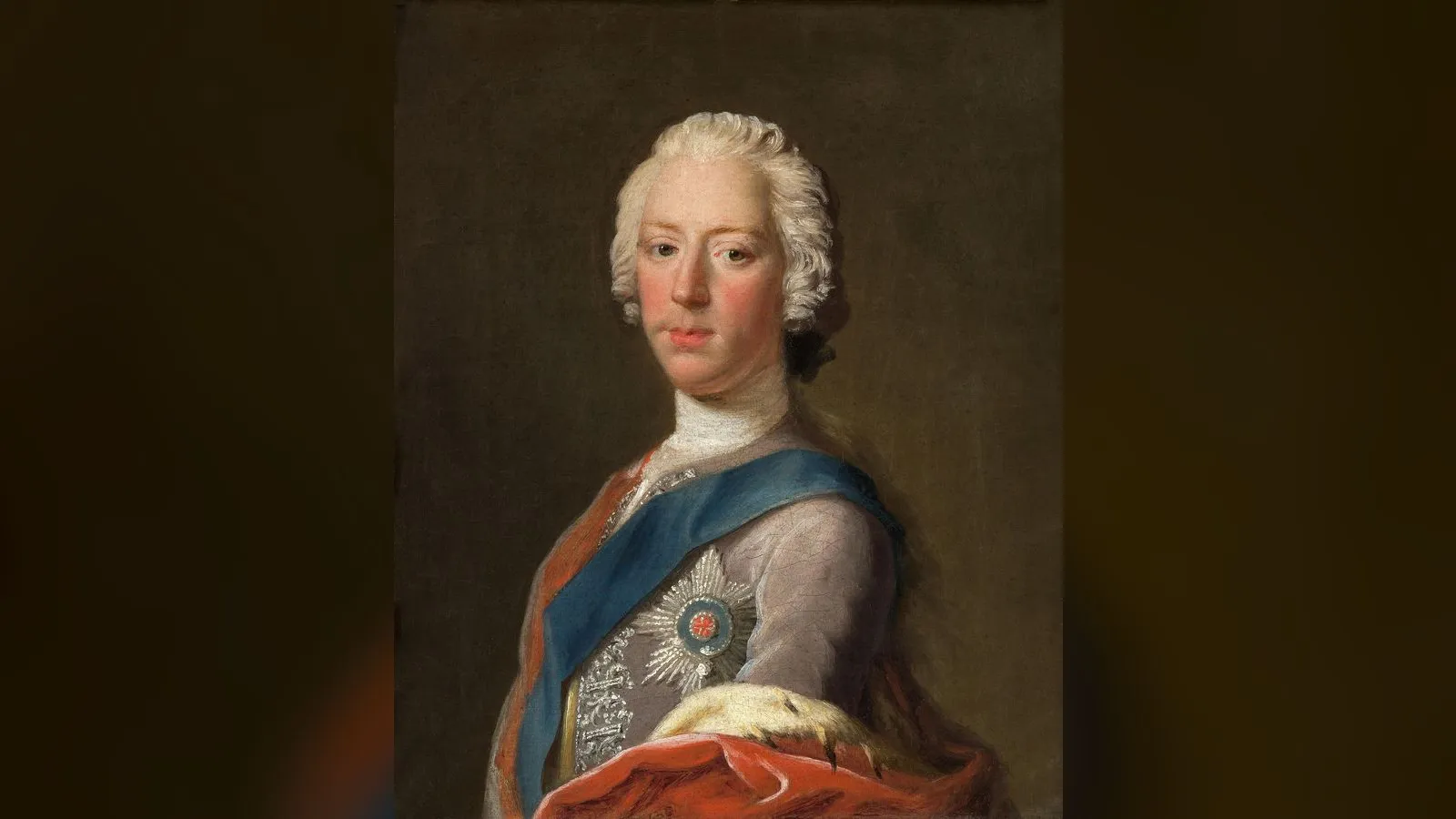

Bonnie Prince Charlie
Contents
Charles Edward Stuart, the "Young Pretender", led the Jacobite rising of 1745. In a single extraordinary year he won at Prestonpans, marched to Derby, lost at Culloden and escaped "over the sea to Skye". He became Scotland's great romantic hero, though he was born in Rome, spent barely 14 months in Scotland and declined into bitterness and drink in exile. This card tests the documented prince against the songs and the shortbread tins.
TL;DR
- established Charles was born at the Palazzo Muti in Rome on 31 December 1720, grandson of the deposed James VII and II. He grew up speaking Italian, English and French, not Gaelic.
- established He landed on Eriskay in July 1745 with no French army, raised his standard at Glenfinnan on 19 August, won at Prestonpans on 21 September and reached Derby on 4 December 1745, where his council voted to retreat.
- established His army was crushed at Culloden on 16 April 1746. He then evaded capture for five months, despite a £30,000 reward, helped by Flora MacDonald among others, and escaped to France on 20 September 1746.
- established In exile he drank heavily and treated his mistress and his wife badly. He died in Rome on 31 January 1788.
- shared Whether the retreat from Derby lost the Jacobites the crown is still debated, and many "Jacobite songs", including the "Skye Boat Song", were written long afterwards.
Key Facts
- Born
- 31 December 1720 (New Style), Palazzo Muti, Rome
- Parents
- James Francis Edward Stuart ("the Old Pretender") and Maria Clementina Sobieska
- Landed
- Eriskay, 23 July 1745
- Raised standard
- Glenfinnan, 19 August 1745
- Prestonpans
- 21 September 1745
- Reached Derby
- 4 December 1745; retreat agreed 5 December
- Culloden
- 16 April 1746
- Reward for his capture
- £30,000, never claimed
- Escaped to France
- 20 September 1746, aboard L'Heureux
- Married
- Louise of Stolberg-Gedern, 1772
- Died
- 31 January 1788, Rome
- "Skye Boat Song" lyrics
- Sir Harold Boulton, published 1884
Scottish Impact Index (SI Score)
- Global Influence
- 7/10
- Enduring Relevance
- 9/10
- Material Contribution
- 3/10
- Exceptional Achievement
- 5/10
- Lasting Legacy
- 5/10
- Recognition
- 8/10
37/60
Ranked =48th of 200 in Great Scots
A Note on Claims and Evidence
Each major claim carries one of three labels. established means supported by primary records, official bodies or several independent reliable sources. shared means the core fact is sound but sources disagree on details, dates or interpretation. traditional means widely repeated but not traceable to a primary or independent source.
The '45 is one of the best-documented episodes in Scottish history, through letters, orders, memoirs and government records. The romantic "Bonnie Prince Charlie" was largely created afterwards, in songs and in Sir Walter Scott's novels. Some famous episodes, such as his reply "I am come home, sir" and his secret visit to London in 1750, rest on later testimony. Numbers for Culloden vary between sources.
Timeline
Charles Edward Stuart is born in Rome.
Charles sails for Scotland; the ship carrying most of his weapons is turned back after a fight with HMS Lion.
Charles lands on Eriskay.
Charles raises his standard at Glenfinnan.
The Jacobites defeat Sir John Cope at Prestonpans.
The Jacobite army invades England and takes Carlisle.
The army reaches Derby; the council of war decides to retreat.
The Jacobites win at Falkirk Muir.
The Jacobites are defeated at Culloden.
Flora MacDonald helps Charles escape from Benbecula to Skye.
Charles escapes to France.
Charles is expelled from France under the Treaty of Aix-la-Chapelle.
Charles reportedly visits London in secret.
Charles marries Louise of Stolberg-Gedern.
Charles dies in Rome.
Sir Walter Scott's Waverley romanticises the Jacobites.
The "Skye Boat Song" lyrics are published.
Details
1. Birth and Origins: A Prince of Rome
Charles Edward Louis John Casimir Sylvester Severino Maria Stuart was born on 31 December 1720 at the Palazzo Muti in the Piazza dei Santi Apostoli, Rome — the residence the Papacy had granted his father. (British sources of the time often give 20 December 1720, because Britain had not yet adopted the Gregorian calendar.) His names were carefully chosen: Charles for his great-grandfather Charles I, Edward for Edward the Confessor, Louis for the King of France, Casimir for the kings of Poland, and Sylvester because he was born on St Sylvester's Day.
His father was James Francis Edward Stuart, the "Old Pretender," recognised by the Pope and by Jacobites as "James III and VIII," and himself the son of the Catholic James VII/II deposed in the Revolution of 1688. His mother was Maria Clementina Sobieska, a Polish noblewoman and granddaughter of Jan III Sobieski, the warrior-king of Poland who broke the Ottoman siege of Vienna in 1683. The Stuart claim rested on legitimate male-line descent: Charles was the grandson of the last reigning Stuart king.
It is worth puncturing a myth at the outset: Charles was not a Gaelic Highlander and never was one. He grew up in Rome and Bologna speaking Italian and English as his mother tongues (with French), in a household of English-speaking exiles and English governesses. Contemporary scholarship (e.g. Frances Owen in Historia) notes that an eyewitness, Andrew Henderson — no Stuart flatterer — recorded that Charles spoke intelligible English. The "European"-accented prince of film and television is dramatic licence.
His childhood was materially privileged but emotionally fractured. His parents' marriage collapsed publicly; in 1725, shortly after the birth of Charles's brother Henry, Maria Clementina left the Palazzo for a convent — partly in protest at her husband's relationship with a mistress (and over tensions about the Protestant governor appointed to her sons) — not returning for about two years. She died in January 1735, when Charles was fourteen; he was reported to be deeply distressed. His relationship with his father was distant and increasingly difficult. His younger brother, Henry Benedict Stuart (born 1725), would later become a Cardinal of the Catholic Church — a decision Charles bitterly resented as damaging to the Protestant-sensitive Stuart cause.
2. The '45 Rising: Context and the Gamble
The Jacobite movement — from Latin Jacobus, James — sought to restore the exiled Stuarts after 1688. There had been risings in 1689, 1708, 1715 and 1719, all failed. Why 1745? The answer is European war. The War of the Austrian Succession (1740–48) had set Britain and France against each other; much of the British Army was tied down in Flanders, and a French victory at Fontenoy in May 1745 emboldened the Jacobites. France had genuinely planned an invasion of Britain in 1744 with Charles aboard, but a storm wrecked the fleet, and French enthusiasm evaporated.
Charles, impatient, gambled. He sailed for Scotland in July 1745 with two ships and essentially no French army. One, the Elisabeth, carrying the bulk of his muskets, broadswords and artillery, was crippled in an engagement with HMS Lion and forced back to Brest. The other, the Du Teillay (Doutelle), landed Charles and seven companions — the "Seven Men of Moidart" — at Eriskay on 23 July 1745 (OS).
The reception was discouraging. The famous exchange is real in outline but should be quoted carefully: Alexander MacDonald of Boisdale advised him to go home, and Charles is reported to have replied, "I am come home, sir." The phrasing is preserved in early Jacobite tradition rather than in a contemporary signed document, so it should be presented as reported, not as a verbatim transcript. Crucially, the great Skye chiefs — Sir Alexander MacDonald of Sleat and Norman MacLeod of Dunvegan — refused to come out, having been dissuaded by Duncan Forbes of Culloden, the senior government law officer in Scotland. Charles crossed to the mainland and landed at Loch nan Uamh.
3. The Highland Campaign: Glenfinnan to Holyrood
The rising formally began when Charles raised his father's standard at Glenfinnan on 19 August 1745. It began precariously: he had perhaps 200 men and a hand-sewn standard, and for a time it looked as if no one would come. The decisive moment was the arrival of the Camerons. Donald Cameron of Lochiel — an astute businessman with everything to lose, and whose tenants would provide a large proportion of the Jacobite army — came only after Charles guaranteed the value of his estate against forfeiture (and after personal persuasion). With Lochiel's men, the rising became viable. The young Clanranald had already been shamed into joining when his lower-ranking kinsman pledged to die for the prince. Conversely, the MacLeods and the MacDonalds of Sleat stayed out — a reminder that this was never a united "Highlands" but a deeply divided one.
Charles marched south. At Prestonpans, near Edinburgh, on 21 September 1745, Lord George Murray led the army around a marsh to fall on Sir John Cope's government flank at dawn; Cope's inexperienced troops broke in roughly ten to fifteen minutes. Government losses were severe — on the order of 300 killed, 400–500 wounded and 1,400–1,500 captured (only about 170 of the foot escaped) — against Jacobite losses the Jacobites themselves estimated at just 35–40 dead and 70–80 wounded. The rout was immortalised in the mocking song "Hey, Johnnie Cope." Charles had already occupied Edinburgh (the city, not the castle, which held out under General Guest), and held a brief, glittering court at Holyroodhouse. Contemporaries — even hostile ones — noted his charm, dignity and good looks; he forbade celebrations over the enemy dead and saw to the wounded. It was the high-water mark of the romance.
Then came the fateful decision to invade England — pushed by Charles and his Irish advisers over the reservations of the Scots, who were more interested in securing Scotland and reversing the 1707 Union.
4. The March into England and the Turn at Derby
The army crossed into England in November 1745, took Carlisle, and marched through Manchester (where the small "Manchester Regiment" of English recruits was raised) to Derby, reaching it on 4 December — about 120–130 miles from London. London was in a panic; Bank of England stock fell, and there was genuine fear George II might flee.
At the council of war on 5 December, Lord George Murray argued forcefully for retreat. His reasons were sound on the evidence then available: the English Jacobites had not risen; there was no sign of the promised French landing; and Murray believed two government armies (under Wade and Cumberland) lay behind them and a third (a hastily assembled force) at Finchley ahead. Damningly, when pressed, Charles was forced to admit he had no written assurance of French support and had been concealing the lack of English commitments — a confession that destroyed trust between prince and council. A government spy, Dudley Bradstreet, posing as a Jacobite, reinforced the panic with a tale of a (non-existent) 9,000-strong army at Northampton.
The council voted overwhelmingly to retreat. The Jacobites called it "Black Friday" (6 December). Charles never forgave Murray and blamed him for the rest of his life.
Were they right? Historians remain genuinely divided, and an honest article should say so. The romantic case (advanced by some, and dramatised in fiction): London was undefended, the regime was panicking, the Hanoverians might have collapsed, and a French fleet was in fact being prepared. The sober case (favoured by many modern historians and reflected in Wikipedia's synthesis): contemporaries did not believe the regime would fall even if the Jacobites reached London; the small, lightly equipped Jacobite army could out-march its enemies but could not win a set-piece battle or hold a hostile capital; and the Duke of Richmond, then with the government army, privately listed a Jacobite retreat to Scotland as the worst possible outcome for the government. The verdict really turns on whether one thinks the rising's fatal weakness was proximity to London (it wasn't) or lack of French and English support (it was). On balance, the retreat was militarily defensible; the deeper error was the whole invasion of England on the strength of support that never materialised.
The retreat was conducted with real skill — Murray fought a successful rearguard action at Clifton Moor on 18 December — but morale and discipline suffered, and the split in the command never healed.
5. Culloden, 16 April 1746
Back in Scotland, the Jacobites won one more victory at Falkirk Muir (17 January 1746) but failed to take Stirling Castle, and fell back north to Inverness, short of food, money and men. Cumberland, well-supplied, advanced from Aberdeen.
The wrong ground. Charles's adjutant-general, the Irish officer John O'Sullivan, chose to give battle on Drumossie Moor (Culloden) — flat, open, boggy ground. Lord George Murray and other officers protested that it was the worst possible terrain for the Highland charge and favoured Cumberland's artillery and cavalry; Murray proposed steeper, broken ground across the River Nairn. Charles overruled them. This was, in hindsight, the decisive blunder.
The failed night march. On the night before the battle (15–16 April), the Jacobites attempted a night march of some 10–12 miles to surprise Cumberland's camp at Nairn (it was Cumberland's birthday and his men had been celebrating). The execution was disastrous: hungry, exhausted men strung out and lost their way in the dark; the head of the column was still about two miles short of the crossing an hour before dawn. Murray aborted the attack. The army staggered back to Culloden, many men collapsing from fatigue and hunger, some never receiving the order to turn back, and hundreds wandering off to find food — many missing the battle entirely.
The battle. On the morning of 16 April, an exhausted Jacobite army of perhaps 5,000–6,000 (at least a third of the full force had missed or slept through the night march) faced Cumberland's well-rested, well-equipped force of around 8,000. Cumberland's superior artillery opened a devastating bombardment, raking the Highland ranks for almost thirty minutes while Charles — positioned out of sight of much of his own army — left them standing under fire for a fatally long time. When the Highland charge finally came, the right wing crashed into the government line and suffered appalling losses (the Appin Stewarts' gentry took a quarter of the killed and a third of the wounded of their regiment); the MacDonalds on the left, aggrieved at being denied their traditional place of honour on the right, charged late or barely at all. Government volley fire, a flanking wall manned by Wolfe's regiment, and the breakthrough of Cumberland's troops broke the Jacobites. The fighting lasted less than an hour ("about 25 minutes" of serious fighting in some accounts).
Cumberland and "the Butcher." Here an honest article must hold two truths together. The post-battle conduct was genuinely atrocious: Cumberland's general orders of 17 April reminded his men that "the public orders of the Rebels Yesterday was to give us no Quarters," and for the next two days the moor was scoured and the wounded put to death; the repression that followed across the Highlands — burnings, killings of civilians, executions and transportations — was systematic. Of roughly 3,470 Jacobites taken prisoner, about 120 were executed and 88 died in prison, while 936 were transported to the colonies and a further 222 "banished"; the total Jacobite dead is usually put at around 1,250. The nickname "the Butcher" was not a later Scottish invention: it arose in England within weeks, recorded in Horace Walpole's letter of 1 August 1746 (the joke that he be made free of the Butchers' Company), and was largely a Tory jibe against a Whig hero who was simultaneously being lionised with Handel's "See, the Conquering Hero Comes."
But the scholarship is more nuanced than the simple villain. W.A. Speck's standard study, "The Butcher: The Duke of Cumberland and the Suppression of the '45" (1981), concludes — despite being written from the government side — that the title was deserved. By contrast, military historian Christopher Duffy ("The '45," 2003) credits Cumberland as a genuinely competent, even inspirational commander while insisting on Culloden as the death of a culture; and Jonathan Oates ("Sweet William or the Butcher?," 2008) argues, more sympathetically, that Cumberland largely acted within 18th-century norms of war — a view some critics consider a whitewash. The hardest line (Murray Pittock; the National Trust for Scotland's research) holds that the brutality was premeditated policy, not hot blood, pointing to notes in the Cumberland Papers suggesting such plans predated the battle.
The "No Quarter" order — flag this clearly. The justification for the slaughter was that the Jacobites had themselves ordered "no quarter." This rested on a document allegedly found on the field. It is now regarded by the National Trust for Scotland and most historians as a forgery: it is neither in Lord George Murray's hand nor signed by him, and the single surviving copy is written on the bottom half of a 1745 declaration. The condemned Jacobite lords Balmerino and Kilmarnock denied any such order before their executions. Whether Cumberland personally knew of or arranged the forgery is unknown and should not be stated as fact; what is documented is that he used the claim to justify what followed. (Responsibility for the on-field killing of the wounded is also shared with subordinates, notably the cavalry commander General Henry "Hangman" Hawley.)
6. The Flight: "The Prince in the Heather"
For five months after Culloden, Charles was a fugitive through the western Highlands and Hebrides, hunted by thousands of troops and the Royal Navy, with a £30,000 reward on his head — an enormous sum. The most celebrated episode is his escape "over the sea to Skye." The reality is less romantic and more interesting than the song.
The remarkable fact, repeatedly attested, is that despite the colossal bounty and widespread poverty, not one of the Highlanders who sheltered or guided him betrayed him. That loyalty — more than the prince himself — is the genuinely moving heart of the story.
Charles eventually reached the mainland and, after several botched rendezvous, was taken off from Loch nan Uamh aboard the French frigate L'Heureux (commanded by Richard Warren) on 20 September 1746 (some sources say 19 September), never to set foot in Scotland again. The traditional departure point is marked today by the Prince's Cairn.
7. Flora MacDonald: The Woman, Not the Legend
Flora MacDonald (1722–1790) deserves to be understood on her own terms, not as the lovelorn heroine of the Skye Boat Song. She was born at Milton on South Uist, the daughter of a tacksman (a middling gentleman tenant) — a member of the minor gentry, sharp-minded and strong-willed, not a romantic shepherdess. Critically, her own family largely supported the government, and she later insisted she had helped Charles out of simple humanity, telling her interrogators she would have done the same for anyone in distress (and reportedly saying as much to Frederick, Prince of Wales).
What she actually did, in June 1746: when Charles and his companions were trapped on the Uists, his Irish aide Captain Conn O'Neill (a distant relative) sought her help. Benbecula was controlled by a pro-government militia commanded by her stepfather, Hugh MacDonald of Armadale — and it was precisely this connection that let her obtain passes to the mainland for herself, a manservant, a boat's crew of six, and an Irish spinning maid named "Betty Burke" — who was Charles in disguise. (There is a strong suggestion her stepfather quietly connived at the escape, which would mean she was running less of a risk than legend implies, though still a grave one.) On 27 June 1746 they crossed from Benbecula to Skye, landing near Monkstadt; she escorted Charles to Portree and parted from him there on the 28th. They never met again. Contrary to the Skye Boat Song, there was no dramatic flight from baffled foes on the shore — the crossing was made unchallenged.
The boatmen later talked; Flora was arrested and taken to the Tower of London, then allowed to live under a "King's Messenger's" supervision, and released under the Act of Indemnity in 1747. Even staunch Hanoverians admired her, and sympathisers raised over £1,500 for her. In 1750 she married Allan MacDonald of Kingsburgh; Dr Samuel Johnson, who met her in 1773, called her "a name that will be mentioned in history, and if courage and fidelity be virtues, mentioned with honour" — the words now on her memorial at Kilmuir.
In 1774 she and Allan emigrated to North Carolina. In a final irony that the romantic version omits, during the American Revolutionary War her husband fought for the British Crown (in the Royal Highland Emigrants); their American estates were lost. After a hard period including a winter in Nova Scotia and a broken arm on the voyage home, she returned to Skye, where she died in 1790 and was buried at Kilmuir. What is documented is a brave, pragmatic act of charity by a government-leaning gentlewoman; what Jacobite hagiography added was the doomed-romance gloss.
8. After the '45: The Long Decline
This is the part the songs leave out, and an honest account must tell it. Charles returned to France a hero in exile — but the cause was shattered, and he proved incapable of accepting it. Under the Treaty of Aix-la-Chapelle (1748), which ended the War of the Austrian Succession, France was required to expel him. Charles refused to leave Paris, behaving provocatively in public; the French eventually arrested him and briefly imprisoned him before expelling him from the country. He then wandered a stateless exile — Avignon, Liège, and various locations — often under aliases, evading both French authorities and British agents.
His drinking, already a problem, became severe and is extensively documented by contemporaries. In 1752 he summoned Clementina Walkinshaw — a Scotswoman from a Jacobite family whom he had known during the '45 (she was at Bannockburn during the campaign) — to be his mistress. Their daughter Charlotte was born in 1753. The relationship was wretched: contemporaries and modern historians record that Charles was an abusive, violently possessive alcoholic, and in 1760 Clementina fled with Charlotte, with the help of Charles's own father, to protect the child. Charles never forgave her for taking "ye cheild" and for years refused to support them; modern scholarship has rehabilitated Clementina from the old slander that she was a spy, recasting her as a woman escaping documented abuse.
The claimed secret visit to London in 1750 should be flagged as reported-but-debated. The standard account is that Charles slipped into London incognito in September 1750, stayed several weeks (Lady Primrose's house in Essex Street is usually named), met supporters, reconnoitred the Tower, and renounced Catholicism by receiving Anglican communion. The detail that he "converted to Protestantism" is plausible and widely repeated, but the venue and even the certainty of the visit rest on later and partly second-hand testimony; it should be presented as the generally accepted account rather than hard documented fact. (A second secret visit in the 1750s is also sometimes claimed.)
In 1772, aged 51, Charles married the 19-year-old Princess Louise of Stolberg-Gedern, in hopes of producing a Stuart heir. There were no children, and the marriage failed badly. Living in Florence as the "Count and Countess of Albany," Louise — intelligent and charming — began a long affair with the Italian poet Vittorio Alfieri. After a violent incident in late 1780 (she said Charles, drunk, attacked her), she fled to a convent and the protection of Cardinal York; a formal separation was arranged in 1784 through the intervention of King Gustav III of Sweden. Louise lived openly with Alfieri thereafter.
In his last years Charles was reconciled with his daughter Charlotte, whom he legitimised in 1783 and created "Duchess of Albany"; she nursed him at the end. Charles Edward Stuart died at the Palazzo Muti in Rome on 31 January 1788, aged 67, of a stroke. He was first buried at Frascati Cathedral and later reinterred in the crypt of St Peter's Basilica beside his father and brother.
His brother Henry Benedict Stuart, Cardinal Duke of York, was now the last of the line. He had medals struck proclaiming him "Henry IX," but — content in the Church — made no attempt on the throne. When the French Revolution stripped him of his property and income, he fell into poverty; on the appeal of Sir John Coxe Hippisley and the recommendation of the Duke of Sussex, George III arranged (via the British Minister in Venice, around 1799–1800) the payment of a pension of £4,000 a year to the last of the royal Stuarts — variously read as charity, a bribe to extinguish the claim, or partial repayment of his grandmother Mary of Modena's unpaid dowry. When Henry died in 1807, the direct Stuart line — and with it any serious Jacobite claim — effectively ended (passing nominally to Charles Emmanuel IV of Sardinia). The monument to the royal Stuarts in St Peter's was later restored at the expense of Queen Elizabeth The Queen Mother.
9. The Cultural Legacy: "Jacobite Sentimentalism"
Why does a failed, Italian-born, French-speaking Catholic prince who spent barely fourteen months in Scotland remain its most romantic icon? The answer lies less in 1745 than in the decades after.
Once armed Jacobitism was safely dead, it became safe — and then fashionable — to be sentimental about it. Sir Walter Scott was central: his novel Waverley (1814) recast the Highlanders not as a barbaric threat but as noble, tragic idealists of a vanished age, and his stage-management of George IV's 1822 visit to Edinburgh rebranded tartan — only recently the banned uniform of rebellion — as a badge of royal and national pride. The "invention of tradition" was in full swing.
The famous "Jacobite songs" are a key part of the myth and must be flagged honestly: many are later compositions presented (or received) as authentic relics. "The Skye Boat Song" sets a tune adapted from the Gaelic air "Cuachag nan Craobh" (composed c.1782 by William Ross), but its familiar lyrics were written by Sir Harold Boulton, 2nd Baronet, and first published in 1884 in Songs of the North — nearly 140 years after the events — and were later re-worked by Robert Louis Stevenson. "Will Ye No Come Back Again?" and "Charlie is My Darling" were largely the work of Carolina Oliphant, Lady Nairne (1766–1845), and James Hogg, writing in the late 18th and early 19th centuries. As scholars including Murray Pittock note, these are literary artefacts of nostalgia, not contemporary battle-songs.
The uncomfortable disconnect is the whole point of an honest treatment. The "bonnie" prince of the songs — young, gallant, beloved — coexists with the documented later man: the abusive, alcoholic, self-pitying exile who treated the women in his life cruelly and never accepted responsibility for the disaster he led brave men into. Both are real.
Two harder questions deserve airing rather than dodging. First: would a Jacobite victory have been good for Scotland? It is far from obvious. The cause was bound up with absolutist, Catholic and pro-French politics; many Scots — including most Lowlanders and a large share of Highlanders — opposed it, and Scotland's 18th-century prosperity grew substantially within the Union the Jacobites sought to overturn. Second, the Highland Clearances connection, which must be handled as a counterfactual, not a fact. It is true that Culloden's aftermath accelerated the dismantling of the clan system — the Heritable Jurisdictions Act stripped the chiefs' powers, the Act of Proscription banned Highland dress and arms — and that the Clearances followed later in the 18th and 19th centuries. But it is a romantic oversimplification to say the '45 caused the Clearances, or that a Stuart victory would have preserved the clans. The clan system was already being eroded by commercialisation; chiefs were turning into landlords on both sides of the '45. Reputable history (e.g. ScottishHistory.org and historians of the Clearances such as T.M. Devine) explicitly warns against the common error of treating the Clearances as simple Hanoverian revenge for Culloden. The connection is real but indirect, and any counterfactual ("if the '45 had succeeded the clans would have survived") is speculation, not history.
Why France backed the '45: the European view
The historian Daniel Szechi argues that the '45 makes sense only as part of a European war. France had prepared a real invasion of England with a Scottish rising in 1743–4, after French defeats in Germany. It was abandoned when the English Jacobites asked for more time, the weather turned and the Royal Navy moved between the invasion ports and the south coast. That should have been the end of it.
Instead, Charles's rising handed France what Szechi calls "unearned strategic gains". It cost France almost nothing at first, because Charles raised his funds from the Scottish and Irish Jacobite networks and the early costs were met from Scottish, then English, resources. Prestonpans in September 1745 forced Britain to withdraw most of its troops from the allied army in Flanders, which let Marshal de Saxe press on with the French conquest of the Austrian Netherlands. By the time Cumberland's army returned in 1746 the allied position there was close to collapse. Szechi credits this "Scottish distraction" with much of France's ability to escape the War of the Austrian Succession with a draw.
The Jacobites' early successes also won Louis XV's personal sympathy. He sent regiments and supplies to Scotland in small batches and, in December 1745, tried to assemble a second invasion of southern England to relieve them. Szechi stresses that this commitment was to the Scottish Jacobites more than to Charles himself. In December 1746 Louis offered to send Charles and the exiles back to Scotland with 6,000 troops, arms and money. Charles refused and demanded 18,000–20,000 men for an invasion of England instead. A group of Scottish exiles led by Donald Cameron of Lochiel tried to take up the offer on their own; peace came before anything was settled. Szechi links Charles's later decline into "a violent, drunken brute" in the 1750s to his despair as the movement fell away.
Did You Know?
- The Jacobite white rose became a national rather than a dynastic emblem in the 20th century. SNP members wore white-rose buttonholes at the first sitting and the official opening of the Scottish Parliament in 1999 (Murray Pittock, 2002).
- In December 1746 Louis XV offered Charles Edward Stuart 6,000 French troops to return to Scotland; Charles turned it down and asked for 18,000–20,000 to invade England instead.
- Charles met and heard the boy Mozart perform in Rome in 1770.
- His arms and most of his ammunition never reached Scotland — the ship carrying ~1,500 muskets and ~1,800 broadswords was crippled by HMS Lion and turned back to France before he even landed.
- The £30,000 bounty on his head (offered by the government, an enormous fortune) was never claimed — not one Highlander betrayed him in five months on the run.
- Charles found the price on his own head distasteful: in a 1745 letter he recoiled at the government setting a price on his head and was uneasy about the proposal to put a price on Cumberland's in return.
- "Bonnie Prince Charlie" disguised himself as a woman — "Betty Burke," an Irish spinning maid — to escape to Skye.
- He may have made a secret incognito visit to London in 1750 and received Anglican communion there — turning Protestant for political advantage (reported, though disputed in detail).
- His younger brother became a Cardinal and the last Stuart claimant, "Henry IX" — and ended his days on a pension from the Hanoverian George III.
- The Battle of Culloden — the last pitched battle on British soil — was over in well under an hour.
- The British regiments that fought at Culloden do not list it among their battle honours.
- "The Skye Boat Song" lyrics were written by Sir Harold Boulton and first published in 1884 — Victorian, not Jacobite.
FAQ
1Was Bonnie Prince Charlie Scottish?
He was of the Scottish royal Stuart line, but he was born and raised in Rome and did not speak Gaelic.
2Why did he come to Scotland in 1745?
To restore his father, James, to the British thrones, hoping to exploit Britain's involvement in a European war.
3Did he bring a French army?
No. He landed with a handful of companions; most of his weapons were turned back at sea.
4How close did he get to London?
He reached Derby, about 120–130 miles from London.
5Why did the Jacobites turn back at Derby?
His council, led by Lord George Murray, feared being caught between government armies with no English rising and no French landing.
6Why did they lose at Culloden?
They fought on flat, boggy ground after an exhausting failed night march, against a larger, better-supplied army.
7Did anyone betray him?
No. Despite the £30,000 reward, no one who helped him in his five months on the run betrayed him.
8Did he really dress as a woman?
Yes. He was disguised as "Betty Burke", Flora MacDonald's maid, for the crossing to Skye.
9What happened to him afterwards?
He lived in exile, drank heavily, failed in his marriage, and died in Rome in 1788.
10Is the "Skye Boat Song" a Jacobite song?
No. Its words were written by Sir Harold Boulton and published in 1884.
11Was the "no quarter" order at Culloden genuine?
The document used to justify the slaughter after the battle is now regarded as a forgery.
Sources and Further Reading
Scholarly/Critical
- Murray G. H. Pittock, "The Jacobite Cult", in Edward J. Cowan and Richard J. Finlay (eds), Scottish History: The Power of the Past (Edinburgh University Press, 2002)
- Daniel Szechi, "Scottish Jacobitism in its International Context", in T. M. Devine and Jenny Wormald (eds), The Oxford Handbook of Modern Scottish History (Oxford University Press, 2012)
Further reading
- Frank McLynn, Charles Edward Stuart: A Tragedy in Many Acts (Routledge, 1988)
- Christopher Duffy, The '45 (Cassell, 2003)
- Murray Pittock, The Myth of the Jacobite Clans, 2nd edn (Edinburgh University Press, 2009)
- W. A. Speck, The Butcher: The Duke of Cumberland and the Suppression of the '45 (Blackwell, 1981)
- Daniel Szechi, The Jacobites: Britain and Europe 1688–1788 (Manchester University Press, 1994)
Caveats: Myths and Disputed Claims
- Do not present "I am come home, sir" as a verified quotation.
- Do not state the 1750 London visit and his Anglican conversion as hard fact.
- Do not present the Jacobite "no quarter" order as genuine.
- Do not reduce Cumberland's role to a simple verdict; historians disagree on his personal responsibility.
- Do not give exact figures for Culloden; use ranges.
- Do not say Culloden directly caused the Highland Clearances.
- Do not repeat the slander that Clementina Walkinshaw was a spy.
- Do not present the "Skye Boat Song" or similar songs as Jacobite-era compositions.
- Do not describe the crossing to Skye as a dramatic escape under fire; it was unchallenged.
Card 011 · Great Scots