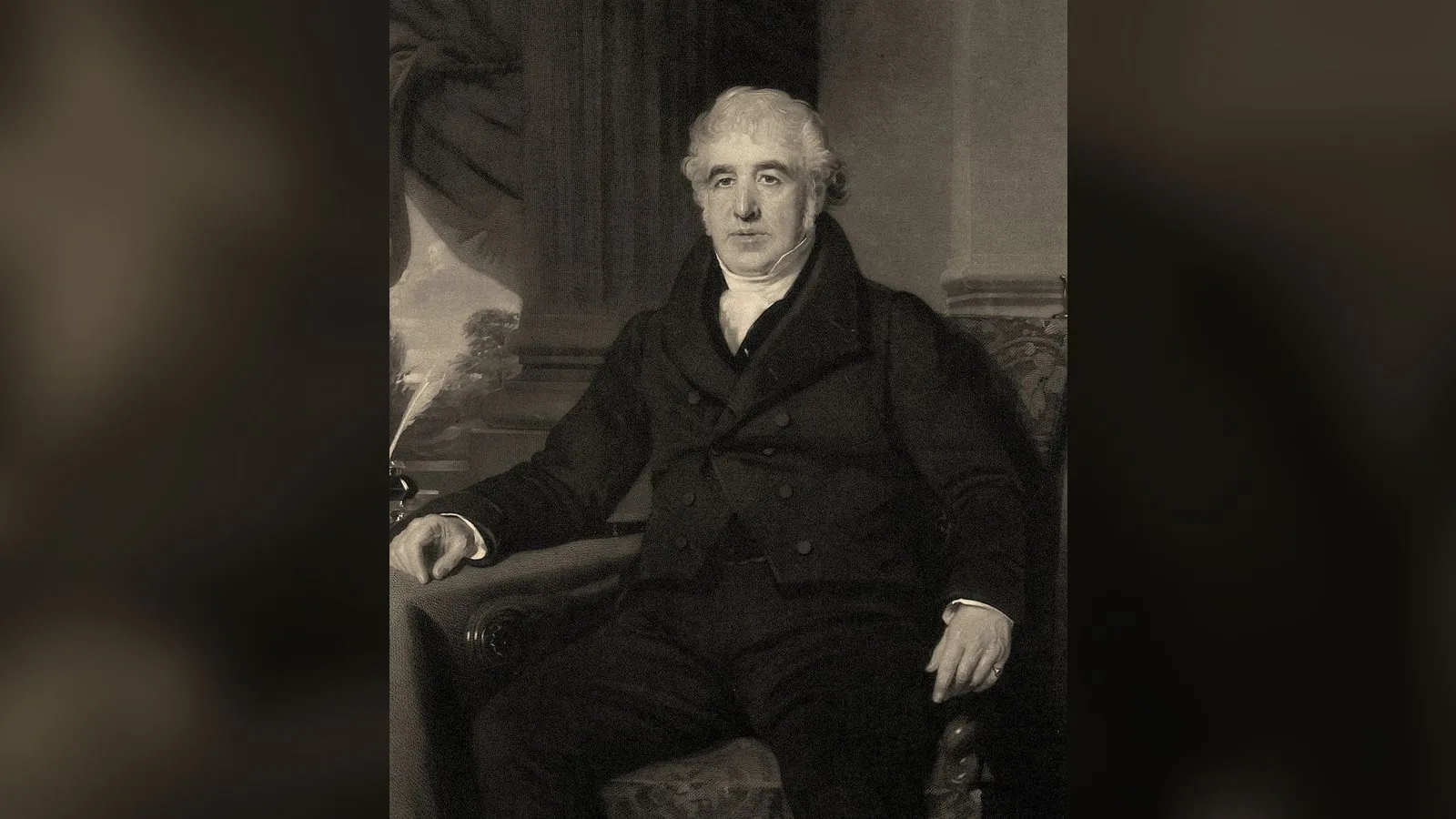

Charles Macintosh (1766–1843): The Chemist Behind the Waterproof Coat
Contents
TL;DR
- Established/Documented: Charles Macintosh was a serious industrial chemist for three decades before his famous invention — founding Scotland's first alum works, partnering with Charles Tennant to produce bleaching powder at the St Rollox chemical works, and manufacturing Prussian blue dye and cudbear — and was elected a Fellow of the Royal Society in 1823 largely on the strength of that wider chemical career.
- Established/Documented: His 1823 patent for cementing two layers of cloth with a rubber solution dissolved in coal-tar naphtha created the first commercially viable waterproof fabric, giving rise to the garment that still bears his name.
- Established/Documented: The original "mackintosh" coats were a genuinely flawed product — they smelled foul, turned sticky and malodorous in summer heat, and stiffened and cracked in winter cold — and were initially shunned by the civilian public, surviving commercially mainly on military and naval demand.
- Documented/Disputed: The reliable, wearable raincoat now associated with Macintosh's name owes at least as much to his later business partner Thomas Hancock, whose superior rubber-processing methods fixed the odour and consistency problems, and to the 1843–44 discovery of vulcanisation — a transformation that occurred at, and after, the very end of Macintosh's own life, and in which Macintosh himself played no direct chemical role.
- disputed Vulcanisation itself, which ultimately rescued the rubber-coat business Macintosh founded, is the subject of a genuine and separately well-documented priority dispute between Thomas Hancock (UK patent, 21 November 1843) and the American inventor Charles Goodyear, whose accidental discovery came several years earlier but whose US patent followed Hancock's by only weeks.
Key Facts
- Born
- 29 December 1766, Glasgow, Scotland
- Died
- 25 July 1843, Dunchattan, near Glasgow (aged 76)
- Occupation
- Industrial chemist, manufacturer
- Known for
- Inventing the rubberised waterproof fabric patented in 1823, the basis of the "mackintosh" raincoat
- Key achievement
- Founding Scotland's first alum works; co-developing bleaching powder manufacture with Charles Tennant at St Rollox; inventing the naphtha-rubber waterproofing process
- Notable relationships
- Son of dye manufacturer George Macintosh; studied under chemist Joseph Black; business partner Charles Tennant (bleaching powder); business partner Thomas Hancock (rubber manufacture); collaborator James Beaumont Neilson (hot blast iron process)
- Honours
- Fellow of the Royal Society (1823)
- Legacy
- The "mackintosh" (or "mac") remains a generic term for a waterproof coat; buried at Glasgow Cathedral
Scottish Impact Index (SI Score)
- Global Influence
- 7/10
- Enduring Relevance
- 9/10
- Material Contribution
- 6/10
- Exceptional Achievement
- 8/10
- Lasting Legacy
- 7/10
- Recognition
- 5/10
42/60
Ranked =33rd of 200 in Great Scots
A Note on Claims and Evidence
This article tiers claims according to the strength of supporting evidence. Established/Documented claims are supported by multiple independent, well-regarded sources. Shared/Traditional claims are widely repeated but rest on thinner sourcing. disputed claims involve genuine historical disagreement or priority questions. Macintosh's story is a useful test case for this standard, because popular shorthand — "Macintosh invented the raincoat" — compresses a much more interesting and more accurate story: a serious industrial chemist made a genuine breakthrough that was, in its original form, a flawed and commercially marginal product, rescued into lasting success mainly by a business partner's later innovations and by a separate discovery that arrived only as Macintosh's own life was ending.
Timeline
Born in Glasgow, son of George Macintosh, a manufacturer of cudbear (a lichen-derived purple dye) and other dyestuffs.
Resigns a clerking position to pursue chemistry seriously, studying under the chemist Joseph Black at the University of Edinburgh.
Establishes Scotland's first alum works at Hurlet, Renfrewshire, using waste shale.
Partners with Charles Tennant to develop and manufacture bleaching powder (calcium hypochlorite) at St Rollox, near Glasgow, which grew into one of the largest chemical works in the world.
As Glasgow's gasworks develop, Macintosh exploits coal-gas by-products — ammonia and coal-tar naphtha — to manufacture dyes and refined naphtha commercially.
Discovers that natural india-rubber dissolves in coal-tar naphtha, and patents a process for cementing two layers of cloth together with the resulting rubber solution, producing a genuinely waterproof fabric. Elected Fellow of the Royal Society the same year.
Establishes a waterproof garment manufacturing partnership with Manchester industrialist Hugh Hornby Birley, trading under the "Mackintosh" name (with an added "k").
Begins working with rubber innovator Thomas Hancock, whose own patented processes for treating rubber (originally developed independently, with solvent choices likely influenced by Macintosh's 1823 patent) improve on Macintosh's original fabric.
Collaborates with ironmaster James Beaumont Neilson on the development and commercial application of the hot blast process for iron smelting.
Macintosh's and Hancock's businesses formally merge, combining Hancock's superior rubber-processing techniques with Macintosh's original patent and manufacturing operation.
A fire destroys Hancock's London factory; Macintosh's original Glasgow operation had already closed by this point, with production consolidated in Manchester.
A second major fire strikes the Manchester operation.
Charles Macintosh dies at Dunchattan, near Glasgow, aged 76; buried at Glasgow Cathedral.
Thomas Hancock secures a UK patent for rubber vulcanisation using sulphur — four months after Macintosh's death, and roughly eight weeks ahead of Charles Goodyear's American patent for essentially the same process.
Charles Macintosh and Co.'s stand at the Great Exhibition in London reflects the company's transformed, vulcanisation-driven commercial success, achieved well after its founder's death.
Details
A Chemist Before He Was an Inventor
It is easy, given how completely his name has become attached to a single product, to forget that Charles Macintosh had a substantial and well-regarded career as an industrial chemist for roughly three decades before his famous 1823 patent. Born in Glasgow in 1766 to George Macintosh, who ran a business manufacturing cudbear — a purple dye derived from lichen — Charles left an early clerking job to study chemistry seriously under Joseph Black at the University of Edinburgh, one of the most respected chemists of the era. He went on to found Scotland's first alum works at Hurlet, Renfrewshire, in 1797, exploiting waste shale from local oil mines, and subsequently partnered with Charles Tennant to develop commercial bleaching powder production at St Rollox near Glasgow — a chemical works that grew into one of the largest in the world and became central to the Scottish textile-bleaching industry. As Glasgow's gasworks expanded after 1817, Macintosh found a further commercial use for coal-gas by-products, refining naphtha and manufacturing dyes from the ammonia and tar residues. His 1823 election as a Fellow of the Royal Society reflected this genuine, wide-ranging body of industrial chemistry work, not merely the waterproofing invention that would later overshadow it in public memory.
The Naphtha-Rubber Discovery
Macintosh's most famous breakthrough emerged directly from this chemical background rather than from any textile or garment-making expertise. Working with the naphtha by-products of coal-tar distillation — material he already had commercial access to through his gasworks-adjacent manufacturing — he discovered that natural india-rubber would dissolve in naphtha to form a viscous solution. He patented, in 1823, a process of cementing two separate layers of cloth together using this rubber-naphtha solution as an adhesive middle layer, producing a fabric that was, for the first time, genuinely and reliably impermeable to water on a commercial scale. It was an elegant piece of applied chemistry: rather than attempting to coat fabric directly with rubber (which earlier experimenters had tried with limited success), Macintosh used the dissolved rubber as a bonding agent between two fabric layers, sandwiching the waterproofing material where it could do its job without being directly exposed on either surface.
A Genuinely Flawed First Product
What followed was not the instant, celebrated success that the enduring popularity of the "mackintosh" name might suggest. The original fabric had real and serious practical problems. The rubber-naphtha layer produced a persistent, unpleasant smell that no amount of airing fully dispelled. In warm weather, the material became sticky and its odour worsened; in cold weather, the same rubber layer lost flexibility, becoming stiff and prone to cracking. These were not minor teething issues but fundamental limitations of the original chemistry, and the civilian public in the 1820s largely rejected the garments on that basis. The product survived commercially in this period mainly through steady institutional demand from the armed forces and merchant navy, for whom reliable waterproofing mattered more than comfort or smell — a considerably less romantic origin story than the one usually told.
Thomas Hancock and the Real Engineering of the Modern Raincoat
The fabric's transformation from a flawed novelty into a genuinely wearable, durable garment is substantially the achievement of Thomas Hancock, not Macintosh himself, and this article treats that distinction as an important correction to the popular record rather than a minor footnote. Hancock had been independently developing his own rubber-treatment processes from the mid-1820s, including a "masticating" technique that worked raw rubber into a more uniform, workable material, and his solvent choices in that work were likely influenced by Macintosh's published 1823 patent. From 1825 the two began collaborating directly, and Hancock's processing methods proved able to produce a far more uniform rubber film, with less smell and less unwanted penetration through the cloth, than Macintosh's original formulation. By 1830–31 the two businesses had formally merged, and it was substantially Hancock's ongoing technical refinements — not a further contribution from Macintosh himself — that gradually made the waterproof coat a commercially and practically viable civilian product over the following years.
Vulcanisation: A Transformation Macintosh Did Not Live to See
The single development that most decisively solved the rubber-garment industry's fundamental quality problems — the tendency of untreated rubber to soften in heat and stiffen in cold — was vulcanisation: the chemical treatment of rubber with sulphur to make it stable across a far wider temperature range. This breakthrough arrived only at the very end of Macintosh's life and reached full commercial application after his death. Thomas Hancock secured a UK patent for sulphur vulcanisation on 21 November 1843, four months after Macintosh died in July of that year. Hancock's UK patent came roughly eight weeks ahead of the equivalent US patent filed by the American inventor Charles Goodyear, whose own accidental discovery of the vulcanisation process is generally dated several years earlier, around 1839 — a genuine and well-documented priority dispute between the two men that belongs to the history of rubber chemistry generally, and is not a Macintosh-specific controversy, but which directly determined the fortunes of the company Macintosh had founded. Vulcanisation transformed Charles Macintosh and Co. from a business that had suffered two serious factory fires (1834 and 1838) and years of only marginal commercial success into a financially secure manufacturer capable of an award-winning display at the 1851 Great Exhibition — a transformation Macintosh himself never lived to see, let alone contribute to directly.
Beyond Rubber: The Wider Chemical Career
It is worth stating plainly that reducing Macintosh's career to the raincoat does him a disservice as a chemist, even as it somewhat overstates his personal role in perfecting that raincoat. His bleaching powder partnership with Charles Tennant at St Rollox was, independent of the waterproofing story entirely, a major contribution to the industrial-scale chemical processing that underpinned Scotland's textile industry. His 1828 collaboration with James Beaumont Neilson on the hot blast process for iron smelting — a genuinely transformative innovation in ironmaking that dramatically reduced fuel consumption — places him at the edge of yet another significant Scottish industrial breakthrough, working alongside rather than as the primary inventor.
Death and Legacy
Charles Macintosh died at Dunchattan, near Glasgow, on 25 July 1843, and was buried at Glasgow Cathedral. He died, notably, just months before vulcanisation — the development that would finally resolve the core quality problems of his signature invention — reached commercial application. The garment that bears his name (in its now-standard "mackintosh" spelling, with the extra "k" introduced by his manufacturing partnership with Hugh Hornby Birley) has become a generic term for a waterproof coat across the English-speaking world, a rare and durable form of commercial immortality, even though the product now associated with his name owes its practical success at least as much to Thomas Hancock's later refinements and to vulcanisation as it does to Macintosh's own original 1823 chemistry.
A Highland workforce in Glasgow
established Charles grew up in a strongly Highland household. His father, George Macintosh, was born in Ross-shire and moved to Glasgow, where by 1777 he had set up the Dunchattan cudbear works. The historical geographer Charles Withers, in Gaelic in Scotland 1698–1981 (1984), records that all its employees were Highlanders and that the morning roll call was taken in Gaelic. George Macintosh was the first president of Glasgow's Gaelic Club of Gentlemen, founded in 1780, and by 1803 had raised some 700 men, largely from his own workforce, as the Glasgow Highland Volunteers.
Did You Know?
- Charles Macintosh was a Fellow of the Royal Society and a serious industrial chemist for roughly 25 years before his famous 1823 waterproofing patent — his scientific reputation did not rest on the raincoat alone.
- The original "mackintosh" coats smelled so unpleasant, and behaved so badly in hot and cold weather, that ordinary civilians largely avoided them for years; early sales depended heavily on military and naval demand.
- The extra "k" in "mackintosh" comes from the name of Macintosh's manufacturing partnership with Hugh Hornby Birley, not from Charles Macintosh's own surname spelling.
- The man usually credited with actually fixing the smell and consistency problems of the waterproof fabric was Macintosh's business partner, Thomas Hancock — not Macintosh himself.
- Vulcanisation, the chemical process that finally made rubber garments stable in both hot and cold weather, was patented in the UK by Thomas Hancock just four months after Macintosh's own death.
- Hancock's UK vulcanisation patent (November 1843) beat the American inventor Charles Goodyear's US patent by only about eight weeks, despite Goodyear's own accidental discovery of the process dating back several years earlier — a genuine and long-running priority dispute in rubber-chemistry history.
- Before he is remembered for raincoats, Macintosh helped build one of the largest chemical works in the world, at St Rollox near Glasgow, in partnership with Charles Tennant.
- Macintosh also collaborated with James Beaumont Neilson on the hot blast process for iron smelting, placing him at the margins of a second major Scottish industrial breakthrough.
- At his father's Dunchattan dyeworks, the morning roll call was taken in Gaelic.
Frequently Asked Questions
1Did Charles Macintosh personally invent the modern raincoat as we know it today?
Not entirely. He invented and patented, in 1823, the original process of cementing two layers of cloth with a rubber solution dissolved in naphtha — a genuine and important breakthrough. But the reliable, comfortable, non-smelling waterproof coat now associated with his name owes substantial credit to his later business partner Thomas Hancock's processing refinements, and to the 1843 discovery of vulcanisation, which arrived only after Macintosh's death.
2Were the original mackintosh coats actually good products?
No, not by later standards. They had a persistent unpleasant smell, became sticky and malodorous in hot weather, and stiffened and cracked in cold weather. Civilian buyers largely avoided them in the early years, and the product survived commercially mainly through military and naval demand.
3Who was Thomas Hancock, and why does he matter to this story?
Hancock was an independent rubber innovator who began collaborating with Macintosh from 1825. His rubber-processing methods produced a more uniform fabric with less odour than Macintosh's original formulation, and their businesses formally merged around 1830–31. Hancock later patented vulcanisation in the UK in November 1843, a discovery that transformed the fortunes of the company Macintosh had founded.
4What is vulcanisation, and why is it relevant to Macintosh's story?
Vulcanisation is the process of treating rubber with sulphur to make it far more stable across temperature extremes, solving the core quality problems of early rubber products. It was patented in the UK by Thomas Hancock in November 1843, just months after Macintosh's death, and its commercial application is what finally made Charles Macintosh and Co. a lasting financial success — a transformation Macintosh himself did not live to see.
5Is there a dispute over who really invented vulcanisation?
Yes, though it is a dispute between Thomas Hancock and the American inventor Charles Goodyear, not one involving Macintosh directly. Goodyear's accidental discovery of the process is generally dated to around 1839, several years before Hancock's UK patent, but Hancock secured his UK patent about eight weeks before Goodyear's US patent was filed. Both men are credited in different regions and traditions as vulcanisation's discoverer.
6What else was Charles Macintosh known for, besides the raincoat?
He founded Scotland's first alum works, partnered with Charles Tennant to produce bleaching powder at the major St Rollox chemical works near Glasgow, manufactured dyes including Prussian blue and cudbear, and collaborated with James Beaumont Neilson on the hot blast iron-smelting process. He was elected a Fellow of the Royal Society in 1823.
7Why is the garment spelled "mackintosh" with a k, when Charles Macintosh spelled his own name without one?
The extra "k" originates from the manufacturing partnership formed in 1824 with Manchester industrialist Hugh Hornby Birley, which traded under the "Mackintosh" brand name. The spelling stuck for the product even though it differs from the inventor's own surname.
8Where is Charles Macintosh buried?
He is buried at Glasgow Cathedral, having died at Dunchattan, near Glasgow, on 25 July 1843.
9Did Macintosh's company survive after his death?
Yes, and it went on to considerably greater commercial success than during his lifetime, driven substantially by Hancock's vulcanisation breakthrough. By 1851, the company's display at the Great Exhibition in London reflected this transformed fortune.
Sources and Further Reading
Primary / Institutional
- UK Patent (1823), Charles Macintosh, for cementing cloth with a rubber-naphtha solution
- UK Patent (21 November 1843), Thomas Hancock, for sulphur vulcanisation of rubber
- Royal Society: Fellowship records, Charles Macintosh (elected 1823)
Scholarly / Reference
- Wikipedia: "Charles Macintosh"
- Wikipedia: "Thomas Hancock (inventor)"
- Wikipedia: "Vulcanization"
- Britannica: "Charles Macintosh"
- Graces Guide: "Charles Macintosh and Co"
- Graces Guide: "Thomas Hancock"
- EBSCO Research Starters: "Vulcanized Rubber"
General / Popular
- Undiscovered Scotland: "Charles Macintosh" biography
- Today in Science History: "Charles Macintosh" biography
- Linda Hall Library: "Thomas Hancock"
Scholarly/Critical
- Charles W. J. Withers, Gaelic in Scotland 1698–1981: The Geographical History of a Language (John Donald, 1984; ebook Birlinn, 2021)
Caveats: Myths and Disputed Claims
- "Macintosh invented the modern waterproof raincoat." Partially true at best. Macintosh invented and patented the original rubber-cementing process in 1823, but the product had serious smell and temperature-stability problems that were not solved in his lifetime. The reliable garment now sold under his name owes significant credit to Thomas Hancock's processing improvements and to vulcanisation, developed after Macintosh's death.
- "The mackintosh coat was an immediate civilian success." Untrue. Early coats were smelly, sticky in heat, and stiff in cold, and were largely rejected by civilian buyers; the product survived commercially in its early years mainly through military and naval demand.
- "Macintosh discovered vulcanisation." He did not. Vulcanisation was patented in the UK by his business partner Thomas Hancock in November 1843, four months after Macintosh's own death, and is separately credited in the United States to Charles Goodyear, whose earlier accidental discovery and later, narrowly-following patent form a genuine and distinct priority dispute in the history of rubber chemistry.
- Reducing Macintosh to a single product. Framing him solely as "the raincoat inventor" understates a substantial independent career in industrial chemistry, including significant contributions to alum manufacture, bleaching powder production, dye manufacturing, and the hot blast iron process — achievements that stood on their own before, and independent of, the 1823 waterproofing patent.
Card 070 · Great Scots