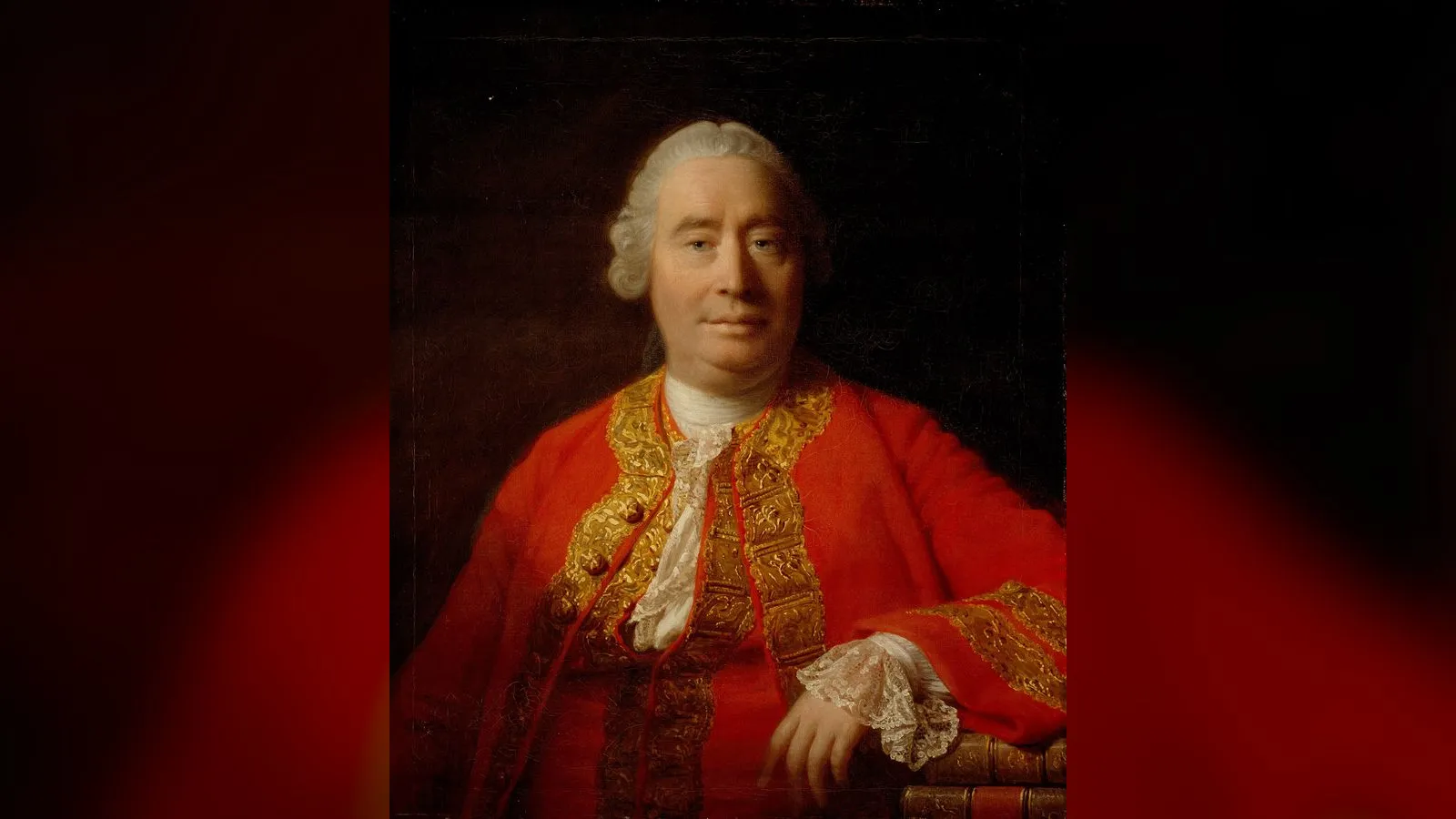

David Hume (1711–1776)
Contents
Scotland's Greatest Philosopher — and a Man Whose Own Century's Prejudices He Did Not Fully Escape
TL;DR
- established David Hume is widely regarded as one of the most important philosophers in the Western tradition and the central figure of the Scottish Enlightenment's philosophical achievement, whose work on empiricism, causation, induction and the is-ought problem still shapes philosophy, cognitive science and the philosophy of science today.
- established His masterwork, A Treatise of Human Nature (1739–40), was a commercial and critical failure on publication — it "fell dead-born from the press," in his own famous phrase — and only came to be recognised as his greatest work by later scholarship, long after his death; the more accessible Enquiries he wrote afterward were what made his reputation in his own lifetime.
- established Hume was twice denied a university chair — at Edinburgh in 1745 and Glasgow in 1751/52 — specifically over accusations of atheism and irreligion, and remained privately closer to atheism or thoroughgoing religious scepticism than his own careful public evasions on the subject always let on; historians differ on precisely how to characterise his personal position, but agree it cost him academic advancement.
- Disputed, and not to be minimised: Hume wrote a notorious footnote in his essay "Of National Characters" espousing racial hierarchy, and a 2014 archival discovery showed him personally facilitating a friend's investment in Grenadan slave plantations. This is a genuine and serious blemish on his legacy, actively debated by philosophers and historians today (including in the 2020 decision by the University of Edinburgh to rename the David Hume Tower), and this article treats it with the same rigour as his philosophical achievements rather than as a footnote to be skipped.
- Shared/Traditional: His reputation for remarkable personal calm and good humour in the face of his own death from cancer in 1776 — earning him the nickname "le bon David" among French admirers — is well documented, notably by Adam Smith's own account, though it also became something of a legend in its own right, held up by later secular and Enlightenment writers as an exemplary model of a philosophical death.
Key Facts
- Born
- 7 May 1711 (26 April, Old Style), Edinburgh, as David Home
- Died
- 25 August 1776, Edinburgh, of abdominal cancer, aged 65
- Family estate
- Ninewells, Chirnside, Berwickshire
- Education
- University of Edinburgh, entered around age 10–12; left without graduating
- Major works
- A Treatise of Human Nature (1739–40); Essays, Moral and Political (1741); An Enquiry Concerning Human Understanding (1748); Political Discourses (1752); The History of England (1754–1762); Dialogues Concerning Natural Religion (published posthumously, 1779)
- Career
- Librarian to the Faculty of Advocates, Edinburgh; diplomatic secretary in Paris (1763–65); Under-Secretary of State (1767–68)
- Chairs denied
- Edinburgh (1745) and Glasgow (1751/52), both amid accusations of atheism
- Key influence
- Foundational figure of empiricism and scepticism; formative influence on Immanuel Kant, Adam Smith, and later analytic philosophy
- Burial
- Old Calton Cemetery, Edinburgh, in a tomb of his own specified simple design
Scottish Impact Index (SI Score)
- Global Influence
- 9/10
- Enduring Relevance
- 10/10
- Material Contribution
- 4/10
- Exceptional Achievement
- 10/10
- Lasting Legacy
- 10/10
- Recognition
- 7/10
50/60
Ranked =13th of 200 in Great Scots
Claim-Status Note
Hume presents an unusual editorial challenge: his philosophical legacy is genuinely towering and rarely contested by serious scholars, while a specific, serious moral failing — racialised views expressed in his published work, and a documented instance of personally facilitating investment in slavery — is equally well evidenced and cannot be honestly omitted or minimised for the sake of a cleaner hero narrative. This article uses a four-tier framework — Established/Documented, Shared/Traditional, Disputed, Legend/Myth — and treats both halves of his legacy with equal evidentiary seriousness, in keeping with this site's standard that accuracy takes priority over national pride, including where the subject is one of Scotland's most celebrated intellectual figures.
Timeline
Born in Edinburgh as David Home; family seat at Ninewells, Berwickshire
Enters the University of Edinburgh at an unusually young age; leaves without graduating
Moves to La Flèche, Anjou, France, to write; alters his surname's spelling to "Hume"
Publishes A Treatise of Human Nature — a commercial and critical failure
Publishes Essays, Moral and Political, his first success
Denied the Chair of Pneumatics and Moral Philosophy at Edinburgh amid accusations of atheism
Publishes An Enquiry Concerning Human Understanding
Denied a philosophy chair at Glasgow; opposed even by his friend Adam Smith over fears of public backlash
Appointed Librarian to the Faculty of Advocates, Edinburgh; begins work on The History of England
Publishes the essay "Of National Characters," including the notorious footnote on racial hierarchy
Publishes The History of England in six volumes — a bestseller and standard reference for decades
Publishes "The Natural History of Religion"
All of Hume's works placed on the Catholic Church's Index of Forbidden Books
Serves as secretary at the British embassy in Paris; celebrated among French intellectuals
Brief, disastrous period hosting Jean-Jacques Rousseau in England, ending in public quarrel; writes a letter facilitating a friend's investment in Grenadan slave plantations
Serves as Under-Secretary of State for the Northern Department
Writes his brief autobiography "My Own Life"; dies on 25 August, at his home in Edinburgh, of abdominal cancer
Dialogues Concerning Natural Religion published posthumously
University of Edinburgh renames the David Hume Tower (to "40 George Square") over concerns about his views on race
The Details
An Unusually Early Student, and a Formative Crisis
Hume was born in Edinburgh in 1711 as David Home (he adjusted the spelling to "Hume" in 1734, reportedly because "Home" was too easily mispronounced in England), into a family holding the Ninewells estate in Berwickshire. His father died when David was an infant, and he was raised by his mother alongside his siblings. He entered the University of Edinburgh remarkably young — possibly as young as ten, more likely around twelve, against a typical starting age of fourteen — and, after briefly considering law to satisfy family expectations, found himself gripped by what he described as an "insurmountable aversion to everything but the pursuits of Philosophy and general Learning." He left without taking a degree, telling a friend that "there is nothing to be learnt from a Professor, which is not to be met with in Books."
Around eighteen, he underwent what he later called a transformative intellectual experience — a "new Scene of Thought" whose precise content he never fully specified — followed by a genuine physical and psychological crisis during a period of intense, self-directed study: what his physician diagnosed as the "Disease of the Learned," involving scurvy-like symptoms, palpitations, and considerable personal distress, treated (by 18th-century medical standards) with tonics, activity, and a notably rich diet, after which Hume transformed physically from "tall, lean and raw-bon'd" into the famously stout figure of his later life. established
The Treatise: A Masterpiece That Failed on Arrival
Hume spent several years in France, largely at La Flèche in Anjou — reportedly making use of the substantial library of the Jesuit college there — writing A Treatise of Human Nature, completed at just 27 years old and published in 1739–40. It laid out, in essentially complete form, the philosophical positions for which Hume is remembered today: a rigorous empiricism distinguishing vivid "impressions" from fainter "ideas"; a devastating argument (the "problem of induction") that our reliance on inferring future patterns from past experience cannot itself be rationally justified, resting instead on natural habit rather than proof; an analysis of causation as a matter of observed "constant conjunction" between events rather than any directly perceivable necessary connection; the famous "is-ought" distinction, observing that moral conclusions cannot be validly derived from purely factual premises alone; and a "bundle theory" of personal identity, denying any single unified, continuous self beneath the flow of individual perceptions.
The book was, in Hume's own memorable words, stillborn — it "fell dead-born from the press," received by contemporary reviewers as "abstract and unintelligible" and generating negligible sales. Hume himself later dismissed it as a work of youthful overreach and spent much of his subsequent career producing more accessible restatements of its arguments (principally the Enquiries) that he hoped posterity would judge him by instead. The historical irony is a central and well-documented fact of his legacy: modern scholarship has reversed his own verdict, regarding the Treatise as containing his most philosophically important and distinctive work, ranking among the most significant texts in the Western philosophical canon. established
Chairs Denied Over Atheism
Hume's reputation for irreligion — deserved or not in its full extent — had direct, material professional consequences. In 1745 he was a candidate for the Chair of Pneumatics and Moral Philosophy at Edinburgh, but lost the position after local ministers petitioned against him specifically over perceived atheism. In 1751 or 1752, he was again passed over, this time for a philosophy chair at Glasgow — notably opposed even by his friend Adam Smith, who feared the public backlash Hume's candidacy risked provoking. By 1761, the Catholic Church had placed his entire body of work on its Index of Forbidden Books, and in the 1750s his friends worked behind the scenes to head off a formal ecclesiastical heresy trial within the Church of Scotland. established
What Did Hume Actually Believe About Religion?
Precisely characterising Hume's own religious position is a genuine matter of ongoing scholarly debate, and this article resists the temptation to flatten it into a simple "Hume was an atheist" headline. His published arguments were consistently and deliberately corrosive toward the rational foundations of organised religious belief — his critique of miracles, his dismantling of the argument from design in the posthumously published Dialogues Concerning Natural Religion (which anticipates, in outline, aspects of Darwinian thinking about undirected order), and his 1757 essay tracing the origins of religious belief to psychological "dread of the unknown" rather than genuine revelation, all point in a strongly sceptical direction. Yet Hume was also notably careful, in public, never to declare outright atheism, and scholars differ on how to read this: some (such as Paul Russell) describe him as thoroughly sceptical without being confidently classifiable as a strict atheist, preferring the term "irreligion"; others (such as David O'Connor) argue for a "weakly deistic" final position, characterised more by Hume's own studied ambiguity than by a hidden, fully settled personal conviction either way. What is not seriously disputed is that his contemporaries widely suspected atheism, that this suspicion was the direct cause of his repeated exclusion from academic office, and that his own recorded deathbed conversation (notably with James Boswell, who visited him shortly before his death) shows him describing a belief in an afterlife as a "most unreasonable fancy." established that his views were widely perceived, and treated institutionally, as irreligious/atheistic; disputed as to the most precise modern philosophical characterisation of his actual personal position.
The History of England: His Actual Bestseller
While Hume's philosophy struggled for a mainstream audience during his lifetime, his six-volume History of England (1754–1762), researched and written while he served as Librarian to the Faculty of Advocates in Edinburgh, became a genuine bestseller and remained the standard popular reference history of England for well over half a century afterward. Hume himself, somewhat wryly, identified "love of literary fame" as his own "ruling passion" in his brief autobiography, "My Own Life," written in the final year of his life. established
Paris, Rousseau, and a Very Public Falling-Out
Hume's years as secretary at the British embassy in Paris (1763–1765) saw him lionised among French Enlightenment intellectuals, who affectionately nicknamed him "le bon David." This period also produced one of the more colourful episodes of his later life: in 1766, Hume helped arrange refuge in England for the persecuted philosopher Jean-Jacques Rousseau, only for the relationship to collapse dramatically amid Rousseau's escalating paranoid accusations against him — a public dispute serious enough that Hume felt compelled to publish his own written account defending his conduct. established
Race, Slavery, and a Legacy That Cannot Be Cleanly Separated From His Philosophy
This is the part of Hume's story that a "great Scots" retrospective too easily skips past, and this article does not skip it. In his 1753 essay "Of National Characters," Hume included a footnote (later revised for a posthumous 1777 edition) asserting a hierarchy of races and expressing scepticism that non-white peoples were capable of the same civilisational achievements as Europeans — language scholars and historians today variously describe as "especially shocking," "deeply puzzling," and "highly prejudicial speculation," even allowing for the genuinely different intellectual and moral context of the mid-18th century. This was not an isolated slip: in 2014, the historian Felix Waldmann uncovered a previously unknown 1766 letter in which Hume personally vouched for and encouraged a friend, Lord Hertford, to invest in a Grenadan slave plantation scheme, describing the men proposing it as "Men of Substance and Character" and framing the opportunity in favourable terms; bank records show Hume separately lent money, around the same period, to one of the men involved in the scheme.
The scholarly interpretation of exactly how far this goes — whether Hume was an active encourager of the investment and personally implicated in profiting from slavery, or a more passive conduit of information whose language has been over-read — remains genuinely contested among specialists (compare, for instance, the differing readings offered by Felix Waldmann, James Fieser, and Alan Bailey). What is not seriously disputed is that the letter exists, that Hume's own words in it went beyond neutral reportage into active endorsement of the men proposing the deal, and that this sits in real, unresolved tension with Hume's own published philosophical disavowals of slavery elsewhere in his work — tension some scholars describe frankly as a form of personal hypocrisy. This controversy has had concrete modern consequences: in 2020, the University of Edinburgh renamed its David Hume Tower (now known by its street address, 40 George Square) specifically citing concern over these views. This article treats the footnote and the plantation letter as established historical facts, and the precise degree of Hume's personal moral culpability for the latter as disputed among historians, rather than settled in either a fully exculpatory or fully condemnatory direction.
Death, and "Le Bon David's" Famous Composure
Hume died in Edinburgh on 25 August 1776, of abdominal cancer, at age 65. His final months produced two of the most-cited documents in his biography: his own brief autobiographical essay "My Own Life," in which he reflected on his career and reputation with characteristic wit and self-awareness ("I cannot say there is no vanity in making this funeral oration of myself, but I hope it is not a misplaced one"); and Adam Smith's own account of visiting the dying Hume, which records Hume speculating, with apparently genuine good humour, about a mythical conversation with Charon, the ferryman of the dead, joking that he might ask for a few more years to see "the downfall of some of the prevailing systems of superstition," only to be told, in his own imagined version, to "get into the boat this instant." This calm, even playful, acceptance of mortality — widely reported by contemporaries and consistent across multiple independent accounts — became something of a celebrated model of a specifically philosophical, irreligious "good death" for later secular and Enlightenment writers, and is genuinely well documented rather than invented after the fact, though its retelling over the following centuries has understandably taken on something of a legendary, exemplary quality beyond the bare historical record. established core facts; Shared/Traditional in its later symbolic elevation. Hume specifically requested a simple Roman-style tomb inscribed only with his name and dates, "leaving it to Posterity to add the Rest" — a request honoured in his surviving tomb in Edinburgh's Old Calton Cemetery.
Legacy
Hume's philosophical influence is difficult to overstate: Immanuel Kant credited Hume's account of causation and induction with waking him from what Kant called his own "dogmatic slumbers," directly prompting the critical philosophy for which Kant himself is remembered; Hume's moral sentimentalism shaped his friend Adam Smith's own ethical and economic thought; and his empiricism, scepticism about induction, and analysis of causation remain live, foundational reference points in contemporary philosophy of science, epistemology and cognitive science. The philosopher James D. Madden has argued that only Darwin rivals Hume's role in undermining confidence in design-based arguments within the Western intellectual tradition. established
The philosopher everyone had to answer
The philosopher Alexander Broadie argues that once Hume published A Treatise of Human Nature (1739–40), it became "difficult, almost impossible" for philosophers in Scotland or elsewhere in Europe to write as if he had not existed. Thomas Reid built the Scottish common sense school as an answer to him, and Immanuel Kant said that his own philosophy was driven partly by the need to reply to Hume. Hume also saw history as evidence for his "science of man": records of wars, intrigues and revolutions were, he wrote, "so many collections of experiments" from which the principles of human nature could be drawn.
Broadie also stresses that Hume was unusual among the Scottish literati. His writings on religion, The Natural History of Religion (1757) and the posthumous Dialogues Concerning Natural Religion (1779), still leave room for argument over whether he was an atheist, a deist or a sceptic, but most of the leading figures of the Scottish Enlightenment were committed Calvinists, and many were Kirk ministers. That is one of the main contrasts Broadie draws with France, where the leading thinkers held no university chairs and were mostly deists or sceptics.
Hume and America: admired historian, distrusted philosopher
The literary historian Andrew Hook, in Scotland and America: A Study of Cultural Relations, 1750–1835 (1975), shows that Americans received the two halves of Hume's work very differently.
Franklin's friend. established Hume met Benjamin Franklin during Franklin's Scottish tour of 1759, and the two corresponded. When Franklin prepared to sail home in 1762, Hume wrote that America had sent Britain "gold, silver, sugar, tobacco, indigo, etc., but you are the first philosopher and indeed the first great man of letters for whom we are beholden to her" (as quoted by Hook). On Franklin's second visit, in 1771, he stayed with Hume in Edinburgh, and Hume gave a large dinner in his honour. The young medical student Benjamin Rush met Hume at Sir Alexander Dick's table in 1766–68.
On the American quarrel. established Although a Tory in his view of English history, Hume attacked the government's policy towards the colonies with great force in his last years, and was among the Scottish friends of Franklin who opposed the war (Hook, following W. L. Mathieson).
Early American readers. established Jonathan Edwards wrote to the Edinburgh minister John Erskine on 11 December 1755 that he had read Hume's Enquiry concerning the Principles of Morals as well as Kames's Essays, one of the earliest signs of Scottish philosophy being read in America. In 1782 James Madison's list of books to be bought for Congress included Hume's History of England and his Essays and Treatises on Several Subjects.
The philosophy kept at arm's length. established Hook finds that Hume's reputation for irreligion limited his American publication. Apart from his autobiography (Philadelphia, 1778), nothing by Hume was printed in America until the first two volumes of the History of England appeared at Philadelphia in 1795. His Philosophical Essays were not printed there until 1817, at Georgetown and Philadelphia, bound with George Campbell's reply to Hume on miracles; Campbell's Dissertation on Miracles had been printed at Philadelphia in 1790. The Scottish common sense philosophy of Reid and Stewart, which presented itself as a reply to Hume, became the standard teaching in American colleges instead. A North American Review essay of 1830 granted Hume great natural acuteness but dismissed his metaphysics and morals as "strange aberrations" (as quoted by Hook).
The historian everyone read. established The History of England was a different matter. A seven-volume edition was published, probably simultaneously, at Baltimore, Philadelphia, New York and Boston in 1810, with further editions at Albany (1816) and Philadelphia (1821–22). Samuel Miller's Brief Retrospect of the Eighteenth Century (1803) said Hume had raised his country's standing in historical writing "to a very high rank". In 1832 the North American Review complained that Hume had "exercised an unbounded influence over American readers", so that young Americans, though "sworn friends of freedom", took the side of Charles I.
Jefferson's objection. established Thomas Jefferson, who owned Hume's works, came to see the History as a Tory text dangerous to young republicans. In 1810 he recalled the enthusiasm with which he had "devoured it when young" and the years it took "to eradicate the poison it had instilled into my mind" (Jefferson's letters, as quoted by Hook from Sowerby's catalogue of his library). The North American Review's complaint of 1832 echoed his.
shared Hook's picture, that Americans honoured Hume as a historian and stylist but kept his philosophy at a distance until well into the nineteenth century, fits the publication record. It concerns general readers and college teaching; a few individual Americans, Jefferson and Madison among them, read Hume's essays closely, and Madison's debt to Hume's political essays is a separate, much-discussed question.
Did You Know?
- Hume's philosophical masterpiece, A Treatise of Human Nature, was such a commercial and critical failure on publication that Hume himself described it as having "fallen dead-born from the press" — and yet modern scholars consider it his greatest work.
- He was denied university chairs twice, at Edinburgh and Glasgow, specifically over accusations of atheism — and his own friend Adam Smith opposed his Glasgow candidacy out of fear of public backlash.
- Kant credited Hume with waking him from his own "dogmatic slumbers" — a direct philosophical debt from one of history's most influential thinkers.
- Hume's actual bestseller during his lifetime wasn't his philosophy at all — it was his six-volume History of England, the standard popular history of the country for over sixty years.
- In 2020, the University of Edinburgh renamed its David Hume Tower over concerns about his documented views on race and a 1766 letter connecting him to investment in slavery.
- French intellectuals affectionately nicknamed him "le bon David" during his years in Paris.
- His deathbed conversations, recorded by Adam Smith and James Boswell, show him facing death with striking calm and even humour — joking about negotiating with the mythical ferryman of the dead for a few more years.
- Hume specifically requested a plain, simple tomb inscribed only with his name and dates — a request honoured in his surviving grave in Edinburgh's Old Calton Cemetery.
- Hume told Benjamin Franklin in 1762 that he was the first great man of letters America had sent to Britain, and Franklin stayed in Hume's house on his second Scottish visit in 1771.
- No American printer published Hume's philosophical essays until 1817, and then only bound together with a Scottish minister's refutation of his argument on miracles.
Frequently Asked Questions
1
- What is David Hume most famous for in philosophy?
His empiricism (the idea that all knowledge derives from experience), his "problem of induction" (that we cannot rationally justify assuming the future will resemble the past), his analysis of causation as observed constant conjunction rather than directly perceivable necessity, and the "is-ought problem" — the observation that moral conclusions can't be validly derived from purely factual statements.
2
- Was Hume's most important book a success when it was published?
No — quite the opposite. A Treatise of Human Nature (1739–40) was largely ignored and poorly reviewed on publication. Hume spent much of his subsequent career writing more accessible versions of its arguments, and it was only later scholarship that recognised it as his greatest philosophical work.
3
- Was David Hume an atheist?
This is genuinely debated by historians and philosophers. His published work was consistently and deliberately corrosive toward the rational foundations of religious belief, and he was widely perceived as an atheist in his own time — costing him university positions. But he never made an unambiguous public declaration either way, and scholars differ on whether "atheist," "sceptic," or "weak deist" best captures his actual private position.
4
- Why was Hume denied a university professorship?
Twice — at Edinburgh in 1745 and Glasgow in 1751/52 — specifically over accusations and suspicion of atheism, which local church figures and, in the Glasgow case, even his own friend Adam Smith (fearing public backlash), used to oppose his candidacy.
5
- Did David Hume hold racist views?
Yes, documented in a notorious footnote to his 1753 essay "Of National Characters," which asserted a hierarchy of races. This should not be minimised or explained away; it's treated by modern scholars as a genuine and serious flaw in his legacy.
6
- Was David Hume connected to slavery?
A 2014 archival discovery revealed a 1766 letter in which Hume personally encouraged and vouched for a friend's investment in a Grenadan slave plantation scheme. Historians debate the precise extent of his personal moral culpability, but the letter itself, and his favourable framing of the investment, are documented facts.
7
- Why was the David Hume Tower in Edinburgh renamed?
The University of Edinburgh renamed the building (now known by its address, 40 George Square) in 2020, citing concerns over Hume's documented views on race and his connection to the slave-plantation investment scheme.
8
- What was Hume's actual bestselling work during his own lifetime?
His six-volume History of England (1754–1762) — not his philosophy, which remained a comparatively niche, often poorly received pursuit until well after his death.
9
- Why is Hume important to modern science and psychology, not just philosophy?
His "problem of induction" remains a foundational challenge in the philosophy of science, since scientific reasoning itself relies on inferring general patterns from limited past observations. His analysis of the self as a "bundle of perceptions" rather than a fixed, unified entity also anticipates aspects of later cognitive science and continues to be debated by philosophers of mind today.
10
- How did David Hume die, and is it true he was famously calm about it?
He died of abdominal cancer in Edinburgh in 1776, aged 65. Contemporary accounts — notably from Adam Smith and James Boswell — consistently describe him facing death with remarkable equanimity and characteristic good humour, a reputation genuinely well documented in the historical record rather than invented afterward, though it has since taken on something of a legendary status as an exemplary "philosophical death."
11
- What does "le bon David" mean, and where does it come from?
It's a French nickname — "the good David" — given to Hume by admiring French Enlightenment intellectuals during his years as a diplomatic secretary in Paris in the 1760s, reflecting his warmth and popularity in Parisian intellectual society.
12
- Is it fair to celebrate Hume as a "Great Scot" given his views on race?
This is a genuine tension rather than a simple yes-or-no question. His philosophical achievement is real, foundational, and not seriously disputed by scholars; his racialised views and connection to slave-plantation investment are equally real and documented, and are actively being reckoned with today, including by his own former university. This article presents both facts plainly rather than resolving the tension for the reader.
13
- How was Hume received in early America?
As a historian, enthusiastically: his History of England went through several American editions from 1795, and in 1832 the North American Review said it had an "unbounded influence over American readers". As a philosopher, cautiously: his philosophical essays were not printed in America until 1817, and colleges taught the common sense philosophy written to answer him. Thomas Jefferson came to regard the History as Tory "poison".
14
- Did Hume know Benjamin Franklin?
Yes. They met in Edinburgh in 1759, corresponded, and Franklin stayed with Hume in 1771. Hume also opposed the government's war policy towards the American colonies.
Sources and Further Reading
Primary/Institutional
- David Hume, A Treatise of Human Nature (1739–40); An Enquiry Concerning Human Understanding (1748); Essays, Moral and Political (1741); The History of England (1754–1762); Dialogues Concerning Natural Religion (1779, posthumous); "My Own Life" (1776)
- The Hume Society — biographical and scholarly resources
- University of Edinburgh — 2020 statement on the renaming of the David Hume Tower
Scholarly
- Stanford Encyclopedia of Philosophy, "David Hume"
- Routledge Encyclopedia of Philosophy, "Hume, David (1711–76)"
- Paul Russell, work on Hume's religious scepticism/irreligion
- Felix Waldmann (2014 archival research on Hume's letter regarding Grenadan slave plantation investment); subsequent scholarly exchange including James Fieser, Alan Bailey, and Peter Hutton/David Ashton on interpretation of the letter
- Kendra Asher, on interpretations of Hume's footnote on race
- Alexander Broadie, "The Rise (and Fall?) of the Scottish Enlightenment", in T. M. Devine and Jenny Wormald (eds), The Oxford Handbook of Modern Scottish History (Oxford University Press, 2012)
- Cairns Craig, "The Literary Tradition", in T. M. Devine and Jenny Wormald (eds), The Oxford Handbook of Modern Scottish History (Oxford University Press, 2012) — further reading on Hume's theory of association and art
- Andrew Hook, Scotland and America: A Study of Cultural Relations, 1750–1835 (Blackie, 1975) — Hume's American editions and reception
- E. Millicent Sowerby, Catalogue of the Library of Thomas Jefferson (Washington, 1952–59)
General
- Encyclopedia.com, "David Hume"
- Philosophy Now, "David Hume (1711–1776)"
- Contemporary press coverage of the 2020 David Hume Tower renaming (The Scotsman, LBC, and others)
Caveats: Myths and Disputed Claims
- "Hume's philosophy was celebrated and successful throughout his lifetime." Not accurate — his most important philosophical work, the Treatise, failed on publication; his actual bestseller was his History of England. established correction.
- "Hume was a straightforward, openly declared atheist." He was widely perceived and institutionally treated as such, and his arguments were strongly corrosive to religious belief, but he never made an unambiguous public declaration, and precise scholarly characterisation of his personal position remains disputed.
- The footnote on race and the Grenada slavery letter are sometimes omitted entirely from popular celebratory accounts of Hume. This article treats both as established facts requiring serious engagement, not minimisation.
- The exact degree of Hume's personal moral culpability regarding the 1766 plantation letter is genuinely contested among specialists — treat confident claims in either direction (full exoneration or full condemnation) with appropriate caution. disputed
- Do not assume Hume's philosophy shaped early American college teaching directly. Americans read his History widely, but his philosophical essays were not printed in America until 1817, and the colleges taught Reid's and Stewart's replies to him. established (publication record).
- Hume's calm deathbed demeanour, while well documented, has taken on a somewhat legendary, exemplary quality in later secular retellings beyond the bare historical record. established core facts; Shared/Traditional in its later symbolic use.
Card 019 · Great Scots