
David Livingstone (1813–1873): Missionary, Explorer, and a Deeply Contested Legacy
Contents
TL;DR
- Established/Documented: David Livingstone rose from a ten-year-old cotton mill worker in Blantyre to become one of the most celebrated explorers of the 19th century, making genuine geographical discoveries — Lake Ngami, Victoria Falls, Lake Malawi, Lake Bangweulu — and mapping vast stretches of south-central Africa previously undocumented by Europeans.
- Established/Documented: As a missionary, Livingstone was, by the standard he himself would have used, a near-total failure: across more than a decade of direct mission work, he is recorded as having converted only one person, Chief Sechele, who subsequently resumed polygamy and was effectively abandoned by Livingstone as a result — though Sechele himself went on, independently, to spread Christianity among southern African peoples more effectively than Livingstone ever did.
- Established/Documented: Livingstone's Second Zambezi Expedition (1858–1864) was a documented disaster by the government's own contemporary assessment, marked by his failure to disclose in advance that the river was impassable beyond the Cahora Bassa rapids, the deaths of several expedition members and missionaries from malaria (including his own wife, Mary), and an expedition physician's written judgment that Livingstone was "out of his mind and a most unsafe leader."
- Established/Documented: Livingstone was a genuine and vocal opponent of the slave trade, yet became directly and repeatedly dependent on Arab and Swahili slave traders for supplies, guides, and protection during his final expedition, a contradiction the Livingstone family's own museum in Blantyre now poses directly to visitors: "He accepted help from slave traders. Why is he known as an abolitionist and freedom fighter?"
- Documented/Disputed: Livingstone's detailed mapping of previously undocumented African territory, intended by him to open the continent to "legitimate commerce" and Christian settlement as an alternative to slavery, is now widely assessed by historians as having directly enabled the European colonial expansion into Africa that followed within decades of his death — a consequence substantially at odds with his own stated intentions, and one this article treats as a documented historical outcome rather than a matter of Livingstone's personal culpability alone.
- disputed The historian T. M. Devine (2011) argues that the legend was carefully managed, through Waller's sanitised Last Journals, Stanley's best-seller and an emphasis on his Scottishness, but that Livingstone himself opposed white rule and believed in human equality, which is why African nationalists such as Kenneth Kaunda honoured him.
Key Facts
- Born
- 19 March 1813, Blantyre, Lanarkshire, Scotland
- Died
- 1 May 1873, Chief Chitambo's village, near Lake Bangweulu, present-day Zambia (aged 60)
- Occupation
- Missionary, physician, explorer
- Known for
- Geographical exploration of south-central Africa; discovery (to Europeans) of Victoria Falls; anti-slavery advocacy
- Key achievement
- Mapping vast, previously undocumented regions of south-central Africa, including Lake Ngami, Victoria Falls, Lake Malawi, and Lake Bangweulu
- Notable relationships
- Wife Mary Moffat Livingstone (died 1862 during the Second Zambezi Expedition); father-in-law and fellow missionary Robert Moffat; loyal attendants Abdullah Susi and James Chuma; explorer Henry Morton Stanley
- Honours
- Royal Geographical Society Patron's Medal (1855) and Gold Medal; interred at Westminster Abbey (1874); ranked 98th in a 2002 UK poll of the "100 Greatest Britons"
- Legacy
- Subject of ongoing, genuinely divided historical reassessment, formally acknowledged by the David Livingstone Birthplace museum itself: "a best-forgotten hangover from Scotland's colonial past" to some, "a cherished part of their cultural identity" to others
Scottish Impact Index (SI Score)
- Global Influence
- 9/10
- Enduring Relevance
- 9/10
- Material Contribution
- 3/10
- Exceptional Achievement
- 6/10
- Lasting Legacy
- 7/10
- Recognition
- 9/10
43/60
Ranked =27th of 200 in Great Scots
A Note on Claims and Evidence
This article tiers claims by evidential strength. Established/Documented claims rest on multiple independent, well-corroborated sources, including Livingstone's own journals, contemporary correspondence, and the findings of his own expedition's physician and biographers. disputed claims involve genuine historical disagreement, often about interpretation and consequence rather than underlying fact. Few figures in this series require a more careful, unflinching evidence-tiered treatment than David Livingstone. His genuine achievements — as an explorer, and as a sincere opponent of the slave trade — are real and documented. So, equally, are his documented failures as an expedition leader, the deaths his poor judgement and concealment caused among people who depended on him, his dependence on slave traders even as he condemned slavery, and the substantial, well-documented gap between his stated intentions and the colonial consequences his work helped enable. This article gives full weight to all of it, consistent with this series' "accuracy over patriotism" standard, applied here to a figure whose reputation has long depended on exactly the kind of uncritical retelling this standard exists to correct.
Timeline
Born 19 March in Blantyre, Lanarkshire, second of seven children of Neil Livingstone, a tea salesman and Sunday school teacher.
Begins work at age ten in Henry Monteith & Co.'s cotton mill as a piecer, working roughly fourteen-hour days while attending village school; continues mill work until age 26.
Enrols at Anderson's University, Glasgow, to study medicine, chemistry, and theology.
Accepted as a probationary candidate by the London Missionary Society (LMS).
Qualifies as a licentiate of the Faculty of Physicians and Surgeons of Glasgow, and is ordained as a Congregational minister.
Departs for Africa; arrives at Simon's Bay, Cape Colony, 15 March 1841.
Serves as a missionary at Mabotsa (1843–45), Chonuane (1845–47, abandoned due to drought), and Kolobeng (1847–52).
Mauled by a lion while defending village herds at Mabotsa, an injury from which his left arm never fully recovers; the mission deacon Mebalwe, a local Tswana man, is credited with saving his life by diverting the animal.
Marries Mary Moffat, daughter of missionary Robert Moffat; the couple eventually have six children, two of whom die young.
After roughly two years of "patient persuasion," converts Chief Sechele of the Kwena people — his only recorded conversion in over a decade of direct mission work. With William Cotton Oswell, crosses the Kalahari Desert and reaches Lake Ngami, earning a Royal Geographical Society chronometer award in 1850.
Reaches the Zambezi River, which he hopes will serve as a commercial "highway" into central Africa.
Undertakes the First Trans-Africa Expedition with Kololo guides provided by Chief Sekeletu, crossing from Linyanti to the Atlantic coast at Luanda (1854), then retracing his route and continuing east; becomes the first European to see Mosi-oa-Tunya, which he names Victoria Falls, and reaches the Indian Ocean at Quelimane in May 1856.
Publishes the bestselling Missionary Travels and Researches in South Africa; resigns from the LMS after it declines to fund further mission expansion north of the Zambezi; is appointed Her Majesty's Consul with a roving commission.
Leads the Second Zambezi Expedition. The river proves impassable beyond the Cahora Bassa rapids, a fact Livingstone had not previously disclosed or fully investigated. The expedition suffers repeated setbacks, internal conflict, and multiple deaths, including Bishop Charles Mackenzie (1862) and Mary Livingstone (27 April 1862), both from malaria. Physician John Kirk records his written judgment that Livingstone is "out of his mind and a most unsafe leader." The expedition is recalled by the government in 1864 and widely regarded as a failure.
Final expedition, in search of the source of the Nile. Deserted progressively by porters and assistants; loses most of his supplies, including medicines, to theft.
Witnesses the Nyangwe massacre, in which Arab slave traders kill an estimated 400 Africans at a market on the Lualaba River, an event that leaves him profoundly shaken.
Found at Ujiji by the journalist Henry Morton Stanley, sent by the New York Herald; the famous greeting "Dr. Livingstone, I presume?" is now widely regarded by historians as a likely later fabrication.
Dies at Chief Chitambo's village near Lake Bangweulu, in present-day Zambia, from malaria and internal bleeding caused by dysentery. His attendants Abdullah Susi and James Chuma bury his heart locally and carry his preserved body roughly 1,000 miles to the coast over 63 days.
His remains are returned to Britain and interred at Westminster Abbey on 18 April, after lying at the Royal Geographical Society's headquarters in London.
The Free Church founds the Livingstonia mission (1875) and the Church of Scotland the Blantyre mission (1876), both in what is now Malawi, in his memory.
Centenary of his birth marked across Scotland, including an exhibition at the Royal Scottish Museum in Edinburgh; Lord Curzon hails "the invincible Scotsman" at the Royal Geographical Society.
On the centenary of his death, thirty-four African countries issue memorial stamps, according to the historian T. M. Devine.
Details
From the Cotton Mill to the Mission Field
David Livingstone's early life shares a documented pattern with several other figures in this series: genuine working-class hardship transformed, through relentless self-education, into an entirely different kind of life. Born in 1813 in Blantyre, a Lanarkshire mill town, he began work at Henry Monteith & Co.'s cotton mill at age ten, labouring roughly fourteen-hour days as a piecer — tying broken threads on spinning machines — a job he continued until he was 26, attending village school alongside other mill children in whatever hours remained. This was not brief hardship overcome quickly; it was more than a decade and a half of industrial child and young-adult labour, run in parallel with sustained, self-directed study that eventually carried him to medical and theological training at Anderson's University, Glasgow, and ordination as a missionary with the London Missionary Society in 1840.
A Missionary Career Defined by Near-Total Failure
It is a genuinely striking and underreported fact, worth stating plainly rather than allowing the "great missionary explorer" framing to obscure it: across more than a decade of direct missionary work in southern Africa, from 1841 to 1852, Livingstone is recorded as having achieved only a single conversion — Chief Sechele of the Kwena people, won over after roughly two years of sustained effort in 1849. Sechele became literate in English with remarkable speed and began transcribing scripture into his own language, a genuine early success. But Sechele subsequently resumed polygamous marriage and traditional rainmaking practices despite his baptism, and Livingstone, judging him to have "lapsed," effectively abandoned the mission station and moved on.
The fuller story here requires an additional layer of correction rather than simply confirming Livingstone's own assessment of failure. After Livingstone's departure, Sechele did not abandon Christianity — he continued practising and, remarkably, went on to actively propagate Christianity among surrounding peoples himself, eventually converting a substantial portion of his own nation. The historian Neil Parsons has assessed that Sechele "did more to propagate Christianity in 19th-century southern Africa than virtually any single European missionary" — a genuinely striking finding that credits an African convert, largely written out of the popular Livingstone narrative, with achieving more of the missionary goal than Livingstone himself managed directly. This article restores that credit rather than allowing Livingstone's own departure-driven judgment of Sechele's "lapse" to stand as the final word.
Genuine Geographical Achievement
None of this failure as a missionary should obscure Livingstone's genuine and independently verified achievement as an explorer and geographer, which forms the strongest and least disputed part of his historical record. His 1849 crossing of the Kalahari Desert with William Cotton Oswell to reach Lake Ngami was a real feat, recognised at the time with a Royal Geographical Society award. His 1852–1856 trans-continental journey — from Linyanti to the Atlantic at Luanda, back across the continent, and on to the Indian Ocean at Quelimane — made him, by most credible accounts, the first European to cross south-central Africa at that latitude and to map substantial portions of the Zambezi's course, including his 1855 sighting of Mosi-oa-Tunya, which he named Victoria Falls after his queen. It should be noted, in the interest of precision rather than diminishment, that established Portuguese and Arab trade networks had already penetrated significant portions of the same interior before Livingstone's journeys; his achievement was substantially one of systematic European documentation and cartography rather than pure first contact with unknown territory, which itself already had inhabitants for whom the land was never "undiscovered."
The Second Zambezi Expedition: A Documented Disaster
If Livingstone's earlier travels represent the strongest part of his record, the Second Zambezi Expedition of 1858–1864 represents the most serious and well-documented failure of his career, and this article gives it full and direct weight rather than treating it as a minor setback on the way to later achievements. Appointed by the Foreign Office to lead a formally resourced government expedition, Livingstone proceeded up the Zambezi only to discover — or to finally disclose — that the river was impassable to boats beyond the Cahora Bassa rapids, a series of cataracts he had not adequately investigated or reported on during his earlier journey, despite having passed near them. This single failure of disclosure or diligence derailed the expedition's entire premise: the Zambezi could not serve as the "highway" to the interior on which his whole plan depended.
What followed was a documented pattern of poor leadership with real human consequences. Livingstone dismissed the expedition's artist, Thomas Baines. His biographer Tim Jeal has assessed Livingstone's management during this period as "indicative of a pattern of putting his goals and career above the lives of those around him" — a judgment specifically grounded in Livingstone's treatment of the Universities' Mission to Central Africa, whose members he had encouraged to follow him into Barotseland after understating the dangers of the journey and overstating the quality of the land, leaving the missionaries with what one assessment describes as "wholly inadequate supplies of quinine." Bishop Charles Mackenzie, who led that mission, died of malaria in 1862. Mary Livingstone, who had joined her husband on the expedition after years of family separation, died of malaria on 27 April 1862. The expedition's own physician, John Kirk, recorded in writing that he could "come to no other conclusion than that Dr Livingstone is out of his mind and a most unsafe leader" — not a later critic's retrospective judgment, but a contemporary professional assessment from within the expedition itself. The government formally recalled the expedition in 1864, and it was, in the plain assessment of the time, "castigated as a failure."
Dependent on the Slave Trade He Condemned
Perhaps the single most direct and uncomfortable contradiction in Livingstone's public record concerns his relationship to slavery. His anti-slavery advocacy was genuine, sustained, and documented across his journals in visceral, unflinching detail — he wrote of slaves "shot or stabbed through the body and lying on the path" and of what he termed "broken-heartedness" among captured people, and stated flatly of the slave trade's horror that "to overdraw its evil is a simple impossibility." This advocacy had real public impact in Britain, helping build popular support for abolition efforts.
And yet, from 1867 onward, during his final expedition, Livingstone became directly and repeatedly dependent on Arab and Swahili slave traders — including Mohamad Bogharib and Mohamad bin Saleh, known as "Mpamari" — for supplies, guides, and safe passage, men who themselves benefited commercially from the local influence Livingstone's presence lent them. He lacked the harsher methods some contemporary explorers, including Stanley, used to maintain porter discipline without such reliance, and was reportedly furious to discover on at least one occasion that replacement porters sent to assist him were themselves enslaved people. This is not a marginal footnote but a sustained, multi-year practical dependency that sits in direct tension with his public moral position, and the David Livingstone Birthplace museum in Blantyre — his own family's institutional memorial — now poses the contradiction to visitors directly: "He accepted help from slave traders. Why is he known as an abolitionist and freedom fighter?" This article treats that as the right question to ask, rather than one to answer away.
Witness to Atrocity: The Nyangwe Massacre
On 15 July 1871, Livingstone personally witnessed one of the most disturbing events of his career: the massacre of an estimated 400 Africans by Arab slave traders at a market in Nyangwe, on the banks of the Lualaba River. He was standing beside Dugumbe, a leading Arab trader who had previously assisted him. Subsequent analysis of Livingstone's own field diary indicates the massacre's origins were more complex than the version later published in his edited "Last Journals" (1874, edited by Horace Waller after Livingstone's death) suggested — including evidence that Livingstone's own hired servants, enslaved people sent to assist him by the acting British consul in Zanzibar, may have engaged in violent conduct against local populations that helped precipitate the retaliation. Waller's published edition simplified this complexity, presenting the villagers straightforwardly as passive victims and downplaying Livingstone's own party's possible role in events leading up to the massacre. Livingstone himself was reportedly left "too shattered to continue" his immediate mission after witnessing the killings — a genuine and documented moment of moral horror, complicated by the less comfortable fact that his own expedition's personnel arrangements were not entirely separate from the violence he witnessed.
The Stanley Meeting and a Likely Fabricated Quote
Livingstone's eventual "rediscovery" by the journalist Henry Morton Stanley at Ujiji on 10 November 1871, after roughly six years largely cut off from outside contact, produced one of the most famous lines in popular historical memory: "Dr. Livingstone, I presume?" This article states plainly what serious historians now generally accept: the phrase is very likely a later fabrication. It does not appear in Livingstone's own account of the meeting, Stanley is known to have torn pages from his diary covering the encounter, and the phrase first appears publicly only in an August 1872 New York Herald editorial, months after the meeting itself. Biographer Tim Jeal has suggested the line may reflect Stanley's own documented insecurity about his humble and irregular background, manufactured retrospectively to project a formality he had not actually managed in the moment — contemporary accounts suggest Stanley was in fact too overcome to embrace Livingstone directly at their actual meeting. The line remains one of the most widely repeated quotations in the English language, attached to an encounter it may never have accurately described.
Death, and an Extraordinary Final Act of Loyalty
Livingstone died on 1 May 1873 at Chief Chitambo's village near Lake Bangweulu, in present-day Zambia, from malaria and internal bleeding caused by dysentery, still pursuing his search for the source of the Nile — a search he never completed, and on which he was, by most later geographical assessment, simply mistaken about the river system involved. What followed is one of the more remarkable, and insufficiently celebrated, acts of loyalty in this entire series: his African attendants Abdullah Susi and James Chuma, rather than abandoning his body, buried his heart locally beneath a tree and then carried his preserved remains, his journals, and his belongings on a roughly 1,000-mile journey to the coast, a trek that took 63 days and was completed by 79 of his followers, ultimately allowing his remains and his papers to reach Britain. This article gives that achievement — undertaken by men whose names are far less widely remembered than Livingstone's own — the direct recognition it deserves as a genuinely extraordinary feat of endurance and personal devotion, independent of any judgment about the man they carried.
disputed The funeral itself was close to a state occasion. Devine describes the body lying at the Royal Geographical Society before being carried through huge crowds to Westminster Abbey, in an atmosphere he compares to the death of Nelson, and writes that Queen Victoria followed the cortège in the royal carriage. Westminster Abbey's own account of the funeral of 18 April 1874 records that the Queen sent a wreath, which was buried with him, but does not say she attended; this article has not been able to confirm her presence.
The Colonial Consequence
Livingstone's own stated vision for opening Africa to European contact was explicitly not formal colonial conquest. He envisaged Christian missionary settlement and "legitimate commerce" — principally the cotton trade — as an alternative that would undercut and eventually end the slave trade by economic substitution. The documented historical outcome diverged sharply from that intention. Livingstone's detailed mapping of roughly a million square miles of previously undocumented territory, precisely because it was so thorough and widely publicised through his bestselling books, directly and substantially assisted the European colonial expansion into central and southern Africa that followed within decades of his death — a consequence multiple historians now describe in essentially those terms, including the assessment that his geographical documentation "guided the machinery of empire to follow." This article treats that outcome as a well-documented historical fact about the consequences of Livingstone's work, distinct from, though related to, the separate question of Livingstone's personal intentions, which the evidence suggests were genuinely different from the colonial project his work helped make possible.
A Family Cost, Acknowledged by Livingstone Himself
Livingstone's pursuit of his exploratory and missionary ambitions came at a substantial, documented cost to his own family, a cost he himself later acknowledged rather than one imposed only by later critics. His wife Mary endured years of separation, repeated relocation, and poor health before dying of malaria in 1862 while accompanying him on the Second Zambezi Expedition. Of his six children, two died young — Elizabeth in infancy, and his son Robert, who died in 1864 as a prisoner of war after serving in the American Civil War, reportedly having enlisted at least in part due to estrangement from his father. Livingstone himself later expressed genuine regret that he "did not spend enough time with his children" — a rare moment of direct personal accountability in the historical record, and one this article includes precisely because it complicates any simple narrative of an unreflective man.
A Scottish Hero for the Empire
Esther Breitenbach, in the Oxford Handbook of Modern Scottish History (2012), notes that Livingstone was employed by the London Missionary Society, like his father-in-law Robert Moffat, yet both were celebrated in Scotland as missionary heroes in a tradition seen as fulfilling the spirit of John Knox's Reformation. His fame owed as much to exploration as to mission, though he himself always stressed his missionary aims. Coming from a humble background, he was held up as an aspirational model for working-class Scots. Breitenbach also points out that Scottish missionary supporters lobbied in 1888 for Nyasaland (Malawi) to become a British protectorate, to protect the missions established in the region Livingstone had explored.
Making the Legend: Devine's Reading
Established/Documented: The historian T. M. Devine, in To the Ends of the Earth (2011), calls Livingstone the most celebrated Scot of the Victorian era and explains the fame by its several layers. He was a "Protestant saint", admired for his attacks on slavery and his suffering; his tolerant, non-sectarian Congregationalism let him appeal across Scotland's rival Presbyterian churches; and his rise from the mill was told as a lesson in Victorian self-help, teaching the middle classes that effort transformed lives and the masses that self-help, not protest, was the road to betterment. Devine adds that his public lectures and Missionary Travels replaced the image of a parched, hostile interior with one of fertile land, open to settlement and trade along the Zambezi. He notes that at least one contemporary Scottish missionary dismissed him as an unreliable dreamer.
Established/Documented: Devine stresses how much the legend was managed. Horace Waller, editing the Last Journals, removed references to Livingstone's volatile moods, the physical punishment of some followers and his threats to shoot those who obstructed him, producing a saintly figure in which Susi and Chuma appeared as faithful disciples. Stanley's How I Found Livingstone (1872), which Florence Nightingale called "the very worst book on the very best subject" she had ever seen, ran to three editions within the year. Interest was already intense before Stanley: Waller wrote to Livingstone in October 1869 that the Royal Geographical Society "might in short be called the Livingstone Society".
Established/Documented: Biographers also played up his Scottishness. Much was made of his mixed ancestry: a Gaelic great-grandfather said to have fought at Culloden, and Lowland Covenanters on his mother's side. He visited his ancestral island of Ulva in 1864. Devine shows how writers claimed his Highland heritage let him understand African "tribes" as no Englishman could, by likening the clan system to African society, a myth that fed Scottish belief in a special national contribution to empire. The promoter of the Scottish National Memorial at Blantyre called it "a place of pilgrimage, a shrine".
disputed Devine argues that Livingstone's call to end the slave trade through "Commerce and Christianity" was later used to justify the Scramble for Africa, and that even Leopold II of the Belgians invoked him. But he insists Livingstone was no crude imperial propagandist: he opposed white rule and colonisation and held that Africans were neither better nor worse than Europeans, their poverty arising from institutions that could change. This, Devine argues, is why Kenneth Kaunda of Zambia could call him "the first freedom fighter", and why Blantyre in Malawi kept its name after independence. Others, including several sources cited above, give more weight to the colonial consequences of his mapping; both readings are defensible.
Established/Documented: The missions that bore his name were his most direct legacy in Scotland. Devine notes that Livingstonia (Free Church, 1875) and Blantyre (Church of Scotland, 1876) were designed less to preach theology than to build African Christian communities that would replace the slave economy, which is why they drew strong support from Glasgow businessmen. Some scholars, he adds with a note of caution, credit Livingstone alone with the rapid growth of missions in Central Africa in the 1870s and 1880s.
Did You Know?
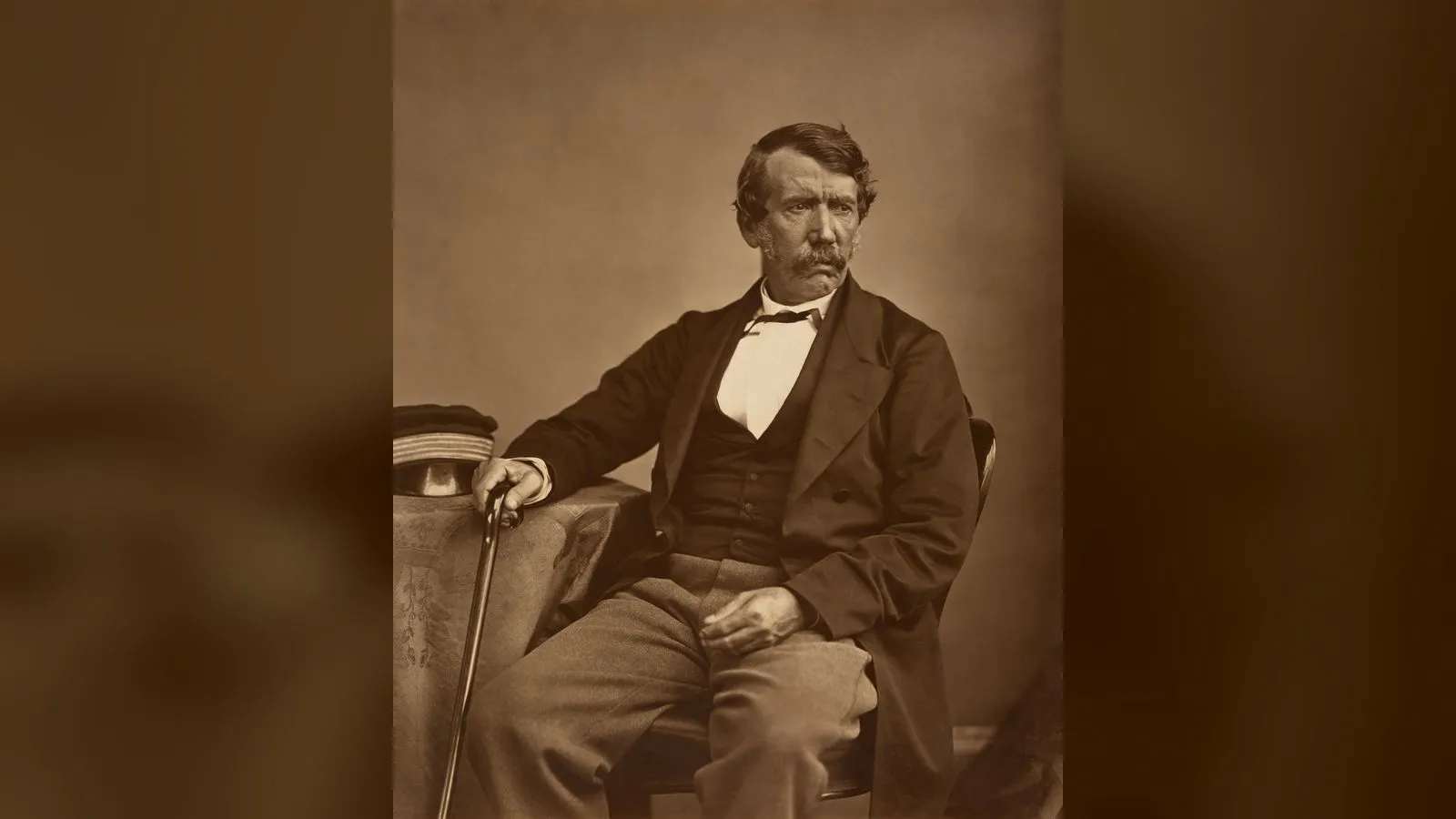
- Two of Scotland's leading early photographers portrayed Livingstone: Thomas Rodger of St Andrews, whose portrait was exhibited in Edinburgh in 1857–58, and Thomas Annan of Glasgow.
- David Livingstone began working fourteen-hour days in a Blantyre cotton mill at age ten, continuing mill work alongside self-directed study until he was 26.
- Across more than a decade of direct missionary work, Livingstone is recorded as converting only one person — Chief Sechele — who later resumed polygamy and was effectively abandoned by Livingstone as a result.
- Sechele himself went on to spread Christianity among southern African peoples far more effectively than Livingstone had managed directly, a fact frequently omitted from popular Livingstone narratives.
- Livingstone's Second Zambezi Expedition was formally recalled by the British government in 1864 after it was widely judged a failure; the expedition's own physician wrote that Livingstone was "out of his mind and a most unsafe leader."
- Despite being a genuine and outspoken opponent of the slave trade, Livingstone became directly dependent on Arab and Swahili slave traders for supplies and safe passage during his final years in Africa.
- The famous line "Dr. Livingstone, I presume?" is now widely regarded by historians as a likely fabrication, possibly invented by Henry Morton Stanley months after their actual meeting.
- Livingstone witnessed the massacre of an estimated 400 people by slave traders at Nyangwe in 1871 — and later evidence suggests his own hired assistants may have helped provoke the violence that preceded it.
- After his death, his African attendants Abdullah Susi and James Chuma carried his preserved body roughly 1,000 miles to the coast over 63 days so his remains and papers could reach Britain — an extraordinary act of loyalty often overshadowed by Livingstone's own fame.
- On the centenary of his death in 1973, thirty-four African countries issued stamps in his honour.
- Horace Waller's edition of the Last Journals quietly removed Livingstone's threats to shoot those who obstructed him.
- Livingstone visited his family's ancestral island of Ulva, off Mull, in 1864.
- Livingstone's own family museum in Blantyre now directly poses the question of his slave-trader dependency to visitors, rather than omitting it from his commemoration.
Frequently Asked Questions
1Was David Livingstone a successful missionary?
By his own church's traditional standard of conversion, almost entirely unsuccessful — across more than a decade of direct missionary work, he is recorded as converting only one person, Chief Sechele, who subsequently lapsed. Livingstone became far more significant as an explorer and geographer than as a missionary in the conventional sense.
Did David Livingstone really say "Dr. Livingstone, I presume?" Almost certainly not, according to most historians who have examined the evidence. The phrase does not appear in Livingstone's own account, Stanley tore out the relevant diary pages, and the line first surfaced in print only months after the meeting, in a New York Herald editorial rather than a direct contemporary record.
2Why is Livingstone remembered as an abolitionist if he relied on slave traders?
This is a genuine, documented tension rather than a settled contradiction. Livingstone's anti-slavery advocacy in his writing and public speaking was sincere and had real influence on British public opinion. But during his final expedition, he became repeatedly and directly dependent on Arab and Swahili slave traders for supplies and safe passage, a dependency his own family's museum now highlights directly to visitors rather than obscuring.
3Was the Second Zambezi Expedition really a failure?
Yes, by the contemporary British government's own formal assessment, which recalled the expedition in 1864. It failed in its central premise — the Zambezi proved impassable beyond rapids Livingstone had not adequately investigated — and several people died during it, including Livingstone's own wife and a bishop leading an affiliated mission, amid documented leadership problems.
4Did David Livingstone's work contribute to European colonialism in Africa?
Most historians now assess that it did, substantially, even though this was not Livingstone's own stated intention. His detailed mapping of previously undocumented territory, intended to enable Christian settlement and "legitimate commerce" as an alternative to slavery, is widely understood to have directly assisted the colonial expansion that followed within decades of his death.
5What were Livingstone's genuine achievements?
Substantial geographical exploration and mapping, including the European discovery of Victoria Falls, Lake Ngami, Lake Malawi, and Lake Bangweulu, and a trans-continental crossing of south-central Africa — genuine feats of endurance and documentation, independent of the more troubled aspects of his career.
6How did David Livingstone die, and what happened to his body?
He died of malaria and dysentery-related internal bleeding on 1 May 1873 near Lake Bangweulu, in present-day Zambia. His African attendants Abdullah Susi and James Chuma buried his heart locally and carried his preserved body roughly 1,000 miles to the coast over 63 days, enabling his remains to be returned to Britain and interred at Westminster Abbey in 1874.
7What happened to Livingstone's family while he was in Africa?
His wife Mary endured years of separation and died of malaria in 1862 while accompanying him on the Second Zambezi Expedition. Two of his six children died young, including a son who died as a prisoner of war during the American Civil War, reportedly having enlisted at least partly due to estrangement from his father. Livingstone later expressed genuine regret over the time he had not spent with his children.
8Is David Livingstone's legacy still debated today?
Yes, openly and substantially, including by his own family's museum in Blantyre, which now presents visitors with directly opposing views: that he is "a best-forgotten hangover from Scotland's colonial past" to some, and "a cherished part of their cultural identity" to others.
9Why did Livingstone become so famous in Scotland?
T. M. Devine points to several layers: a "Protestant saint" who attacked slavery, a non-sectarian figure acceptable to rival churches, a model of Victorian self-help, and a hero whose Scottishness biographers stressed. His heavily edited Last Journals and Stanley's best-seller kept the legend before the public.
10What missions were founded in his memory?
Livingstonia, by the Free Church in 1875, and Blantyre, by the Church of Scotland in 1876, both in what is now Malawi.
11Did African nationalists reject him?
Not generally. Kenneth Kaunda called him "the first freedom fighter", and Blantyre in Malawi kept its name after independence, which Devine attributes to Livingstone's opposition to white rule and belief in human equality.
12Who were Abdullah Susi and James Chuma?
Livingstone's loyal African attendants during his final years, who, after his death, arranged for his heart to be buried locally and then carried his preserved body roughly 1,000 miles to the coast so his remains could be returned to Britain — an extraordinary feat of endurance and loyalty that deserves recognition independent of Livingstone's own reputation.
Sources and Further Reading
Primary / Institutional
- David Livingstone, Missionary Travels and Researches in South Africa (1857)
- David Livingstone, The Last Journals of David Livingstone, ed. Horace Waller (1874)
- David Livingstone's 1871 Field Diary, published by the Livingstone Online project, University of Nebraska–Lincoln
- David Livingstone Birthplace museum, Blantyre
- Westminster Abbey: "David Livingstone" commemoration
Scholarly / Reference
- A. D. Morrison-Low, "Dr John Adamson and Thomas Rodger: Amateur and Professional Photography in Nineteenth-century St Andrews", in Julie Lawson, Ray McKenzie and A. D. Morrison-Low (eds), Photography 1900: The Edinburgh Symposium (National Museums of Scotland and National Galleries of Scotland, 1994) — further reading
- Esther Breitenbach, "The Impact of the Victorian Empire", in T. M. Devine and Jenny Wormald (eds), The Oxford Handbook of Modern Scottish History (Oxford University Press, 2012)
- T. M. Devine, To the Ends of the Earth: Scotland's Global Diaspora, 1750–2010 (Allen Lane, 2011)
- Wikipedia: "David Livingstone"
- Tim Jeal, Livingstone (biography, cited for assessment of expedition leadership)
- The Lancet: "Defining Dr Livingstone"
- Dictionary of African Christian Biography: "Livingstone, David"
General / Popular
Caveats: Myths and Disputed Claims
- "Livingstone was a hugely successful missionary." Untrue by any conventional measure. He is recorded as converting only one person directly, Chief Sechele, in over a decade of mission work, and that convert subsequently "lapsed" in Livingstone's own assessment, though Sechele went on to independently spread Christianity far more effectively than Livingstone himself.
- "Dr. Livingstone, I presume?" Almost certainly a later fabrication or embellishment rather than an accurate record of the actual 1871 meeting at Ujiji, based on the absence of the phrase from Livingstone's own account, Stanley's torn diary pages, and the phrase's first appearance in print months after the event.
- "Livingstone was straightforwardly an abolitionist hero." His anti-slavery advocacy was genuine and influential, but he became directly and repeatedly dependent on slave traders for logistical support during his final expedition — a documented contradiction now openly acknowledged by his own family's museum rather than one invented by later critics.
- "The Second Zambezi Expedition was simply an unlucky setback." It was formally judged a failure by the contemporary British government, involved multiple deaths attributable in part to documented failures of leadership and disclosure on Livingstone's part, and drew a direct written assessment from the expedition's own physician that Livingstone was unfit to lead.
- "Livingstone intended to enable colonialism." This overstates his personal intent. He explicitly envisioned Christian missionary settlement and legitimate trade as an alternative to both slavery and colonial conquest. What this article documents is a historical outcome — that his mapping work substantially assisted the colonial expansion that followed — distinct from, though a direct consequence of, his own stated and apparently genuine intentions.
- "Livingstonia is in Zambia." It is in northern Malawi, as is Blantyre; one passage of Devine's To the Ends of the Earth (2011) misplaces it. The Zambian town is Livingstone. Devine's text also spells Waller's name "Walter".
- "Livingstone's Highland blood explains his sympathy for Africans." A Victorian myth that likened clans to African tribes; Devine treats it as part of the story Scots told about their special role in empire, not as evidence.
- "African guides, converts, and attendants were passive figures in Livingstone's story." This article deliberately restores specific credit and agency to figures frequently reduced to background detail in popular accounts, including Chief Sechele's independent missionary success, Mebalwe's role in saving Livingstone's life during the 1844 lion attack, and Abdullah Susi and James Chuma's extraordinary feat in carrying Livingstone's remains to the coast after his death.
Card 078 · Great Scots