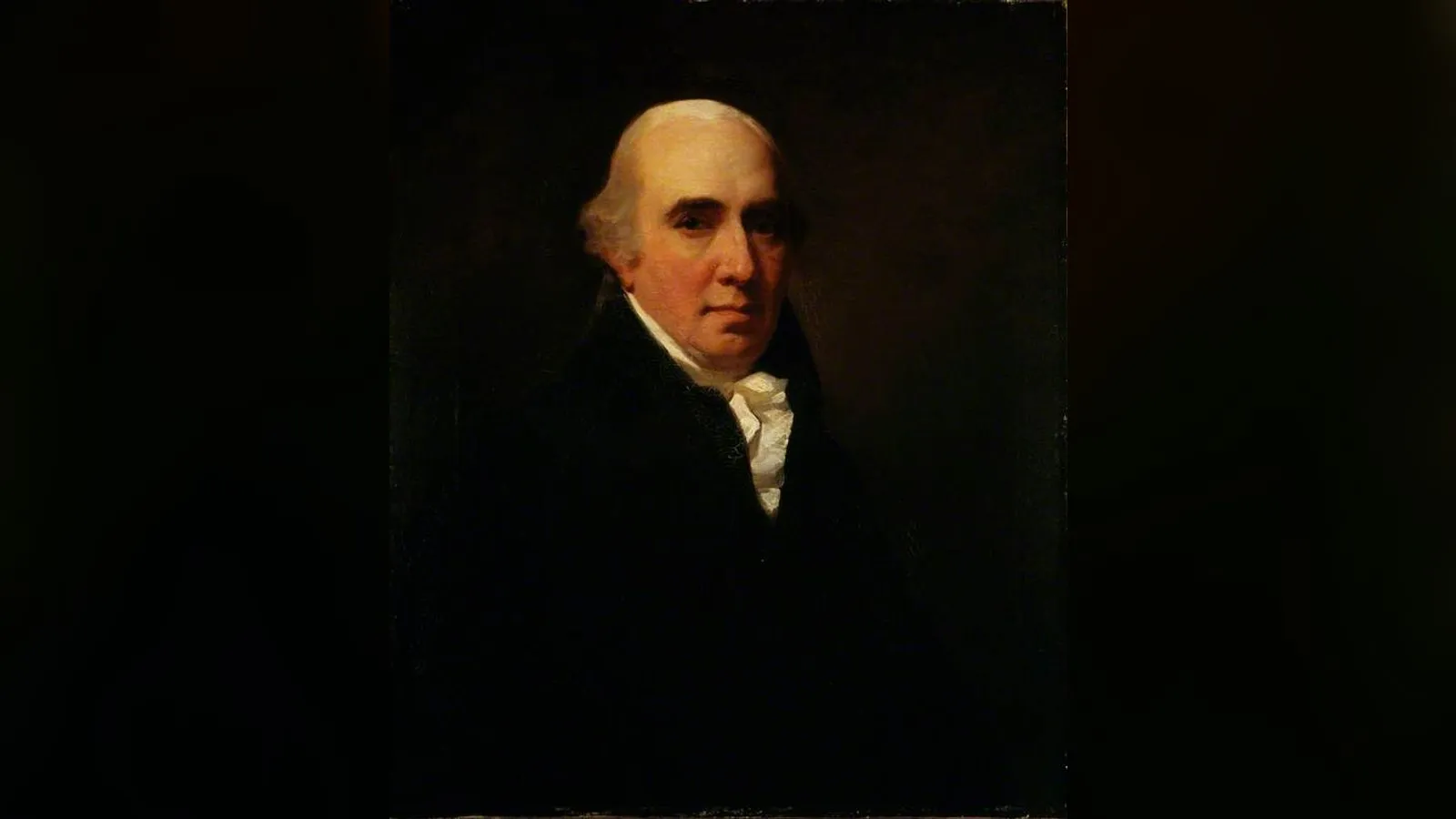

Dugald Stewart (1753–1828): The Great Communicator of the Scottish Enlightenment — Research Dossier for "Great Scots"
Contents
Dugald Stewart's historical importance rests overwhelmingly on his teaching, not on original philosophy: he was the most celebrated lecturer of late-Enlightenment Edinburgh, the chief systematiser and exporter of Thomas Reid's "common sense" school, and the teacher of a remarkable cohort of Whig politicians and reviewers — but, in Gordon Graham's words in the Stanford Encyclopedia of Philosophy (revised 2024), "in retrospect Stewart's thought continued the framework established by the 18th century Scots, and arguably made no notably innovative contribution to the central debate in Scottish philosophy." Most of the core biography is well documented; the parts that need correcting on the card are the "last tenant of Kinneil," the Watt–Stewart "connection," the "Athens of the North" attribution, the idea that every famous Edinburgh Whig was his disciple, and even one error in the official Historic Environment Scotland listing text.
TL;DR
- established Born in Edinburgh on 22 November 1753, son of mathematics professor Matthew Stewart; he took over his ailing father's classes from 1772, became joint professor of mathematics in 1775, and succeeded Adam Ferguson in the moral philosophy chair in 1785, lecturing until illness ended active teaching in 1809–10.[1]
- established His fame was as a lecturer: contemporaries from Henry Cockburn to James Mill described his eloquence in superlatives, and pupils including Palmerston, Brougham, Horner, Lord John Russell and Walter Scott sat in his classes; his Elements of the Philosophy of the Human Mind (1792, 1814, 1827) became a standard text in American colleges.
- [Scholarly consensus, with nuance] He was "after Thomas Reid, the most influential figure in the Common Sense School" (Madden, Routledge Encyclopedia of Philosophy), but not a major original thinker — Gordon Graham (Stanford Encyclopedia of Philosophy) judges that he "arguably made no notably innovative contribution to the central debate in Scottish philosophy"; his real modifications of Reid (nominalism, dropping the phrase "principles of common sense," engagement with Kant) are genuine but modest.
- [Established, interpretation disputed] In the 1790s he was pressured by Scottish judges over a respectful reference to Condorcet and responded with caution and partial retreat; historians disagree whether this was "cringing" capitulation or tactical survival that kept liberal ideas alive in the classroom.[2]
- [Myth/Disputed] Stewart did not live at Kinneil when James Watt worked there (Watt: 1769–70; Stewart: from 1809); he was not literally Kinneil's "last tenant"; and the claim that he coined "Athens of the North" is unsourced.
Key Facts
- Born
- 22 November 1753, in the mathematics professor's house within Edinburgh's old college buildings | Established
- Died
- 11 June 1828, Edinburgh, while visiting a friend | Established
- Buried
- Canongate Kirkyard, Edinburgh (enclosed vault/mausoleum) | Established
- Parents
- Matthew Stewart, Professor of Mathematics, Edinburgh; Marjory Stewart, daughter of Archibald Stewart | Established
- Education
- Edinburgh High School (1761–65); University of Edinburgh; University of Glasgow under Thomas Reid (1771–72) | Established
- Posts
- Deputy for his father from 1772; joint Professor of Mathematics 1775–85; Professor of Moral Philosophy 1785–1820 (active lecturing to 1809–10) | Established
- Major works
- Elements of the Philosophy of the Human Mind (3 vols, 1792/1814/1827); Outlines of Moral Philosophy (1793); Philosophical Essays (1810); Encyclopaedia Britannica Supplement "Dissertation" (1815, 1821); Philosophy of the Active and Moral Powers of Man (1828); memoirs of Adam Smith, William Robertson and Thomas Reid | Established
- Marriages
- Helen Bannatyne (m. 1783, d. 1787); Helen D'Arcy Cranstoun (m. 1790), poet and hostess | Established
- Later residence
- Kinneil House, Bo'ness, as tenant of the Duke of Hamilton, from 1809 | Established
- Memorials
- Dugald Stewart Monument, Calton Hill (W. H. Playfair, 1831; Category A listed, LB27835); Dugald Stewart Building, University of Edinburgh (2007) | Established
- Portrait
- Sir Henry Raeburn, c. 1810, National Galleries of Scotland (PG 821) | Established
Scottish Impact Index (SI Score)
- Global Influence
- 4/10
- Enduring Relevance
- 8/10
- Material Contribution
- 2/10
- Exceptional Achievement
- 6/10
- Lasting Legacy
- 5/10
- Recognition
- 2/10
27/60
Ranked =118th of 200 in Great Scots
Claim Status
This dossier applies the house four-tier framework:
- Established/Documented — supported by primary sources (Stewart's own publications, contemporaries' memoirs, correspondence) and/or the standard reference works (the Oxford Dictionary of National Biography article by Michael P. Brown, the 1885–1900 Dictionary of National Biography, statutory listing records).
- Shared/Traditional — widely repeated in reputable secondary literature and plausible, but resting on a thin chain of transmission, often traceable to a single Victorian source (commonly John Veitch's 1858 Memoir or the 1911 Encyclopaedia Britannica).
- disputed — sources conflict, or historians disagree on interpretation.
- Legend/Myth — popular claims unsupported or contradicted by evidence.
A special caution applies to Stewart: much of his reputation was written by admiring former pupils (Cockburn, Jeffrey's circle) and by Stewart himself, who, as Paul Wood and Michael Brown have shown, actively shaped the posthumous image of the "Scottish Enlightenment" through his memoirs of Smith, Robertson and Reid. Praise from inside the circle should be read as testimony, not neutral assessment.
Timeline
Born in Edinburgh, in the house attached to the mathematics professorship — Established
Attends the High School of Edinburgh — Established
Studies at the University of Edinburgh, including moral philosophy under Adam Ferguson — Established
Session at Glasgow under Thomas Reid, reportedly in hope of a Snell exhibition to Oxford; boards with Archibald Alison and befriends William Drennan — Established
Aged about 18–19, takes over his ailing father's mathematics classes — Established
Elected joint Professor of Mathematics with his father — Established
Lectures on moral philosophy as substitute while Ferguson is in America; also teaches mathematics and astronomy — Established
Founding fellow of the Royal Society of Edinburgh; marries Helen Bannatyne — Established
Again teaches moral philosophy for Ferguson — Established
Matthew Stewart dies at Catrine, Ayrshire — Established
Succeeds Ferguson in the Chair of Moral Philosophy — Established
First wife dies — Established
Summers in France; meets Thomas Jefferson in Paris — Established
Marries Helen D'Arcy Cranstoun — Established
Elements, vol. 1, published, containing the Condorcet passage — Established
First American edition of the Elements, vol. 1, Philadelphia — Established
Outlines of Moral Philosophy; reads his Account of the Life and Writings of Adam Smith to the RSE; Thomas Muir sentenced to 14 years' transportation — Established
Letter from Lord Craig relaying Lord Abercromby's demand that he retract his sympathy for "French" doctrines — Established
Begins a separate course on political economy — Established
Account of Thomas Reid; second edition of Elements adds a footnote distancing him from Condorcet; Edinburgh Review founded by former pupils and associates — Established
Defends John Leslie in the Leslie affair; General Assembly drops the case 96 to 84 — Established
Thomas Brown deputises; son George dies in 1809 — Established
Moves to Kinneil House — Established
Brown appointed conjoint professor; Philosophical Essays published — Established
Elements, vol. 2 — Established
Two parts of the Britannica Supplement "Dissertation" — Established
Brown dies; Stewart resigns; John Wilson ("Christopher North") elected — Established
Suffers a paralytic stroke — Established
Maria Edgeworth visits the Stewarts at Kinneil — Established
Elements, vol. 3 — Established
Philosophy of the Active and Moral Powers, a few weeks before his death — Established
Dies in Edinburgh — Established
Calton Hill monument approved and built (commissioned by the RSE) — Established
Helen D'Arcy Stewart dies (28 July) — Established
Sir William Hamilton's Collected Works (11 vols); John Veitch's Memoir in vol. x (1858) — Established
Monument listed Category A — Established
University of Edinburgh's Dugald Stewart Building opens — Established
Details
Birth, family and an unusual academic inheritance
Stewart was born on 22 November 1753 in a house attached to the mathematics professorship, part of the old college buildings of the University of Edinburgh.[3] His father, Matthew Stewart, a distinguished geometer, had held the Edinburgh mathematics chair since 1747; his mother, Marjory, was the only child of Archibald Stewart, writer to the signet. Dugald was the only child to survive childhood. established One small flag: sources give Matthew Stewart's birth year as either 1715 or 1717 (the old DNB uses 1717); this does not affect Dugald's story. [Disputed, minor]
He attended the High School from 1761 to 1765 and then the University of Edinburgh, where he read moral philosophy under Adam Ferguson and admired the "inductive method" he met in natural philosophy.[4] established
The father–son succession is genuinely unusual, and it is the right thing to stress. When Dugald returned from Glasgow in the autumn of 1772, his father's health was failing, and the 18- or 19-year-old took over the mathematics teaching.[2] Matthew Stewart withdrew to his estate at Catrine in Ayrshire; Dugald did the job well enough to be elected joint professor in 1775.[4] established Joint or "conjoint" chairs with the successor named in advance were a normal part of eighteenth-century Scottish university practice, so the family succession was not improper by the standards of the day. But a teenager running a senior chair for three years, then holding it formally beside his father, remains striking. Editors should present it as a family succession typical of the era, not as a unique prodigy story.
Glasgow and Thomas Reid: a real but brief teacher–student bond
Stewart spent the 1771–72 session at Glasgow, advised by Ferguson to hear Reid. The 1911 Britannica adds that he hoped to win a Snell exhibition to Oxford and a career in the English Church.[5] [Established; the Snell motive is Shared/Traditional] There he was particularly influenced by Reid's Inquiry into the Human Mind on the Principles of Common Sense (1764).[4][6] He boarded in the same house as Archibald Alison, later author of the Essay on Taste, and formed a lifelong friendship with William Drennan, later a founder of the United Irishmen.[2][7]
The direct teacher–student relationship with Reid is documented. The Stanford Encyclopedia of Philosophy confirms that at Glasgow "his moral philosophy professor was Thomas Reid."[8] established Its significance should not be overstated as a long apprenticeship: it was one session. The bond became intellectual rather than institutional. Stewart later became Reid's friend, his posthumous biographer (1802), and the man who carried Reid's philosophy to a far larger audience.
Academic career: substitute, successor, star
Stewart stood in for Ferguson in 1778–79, when Ferguson went to America as secretary to the peace commissioners.[5] According to the old DNB he delivered an original course on morals while also lecturing three hours a day on mathematics and giving, for the first time, a course on astronomy.[3] established Benjamin Vaughan wrote to Benjamin Franklin in 1783 that Stewart had twice replaced Ferguson and "twice completely excelled him in the opinion of every one, as was proved in particular by the attendance he had while he lectured."[9] He taught moral philosophy again in 1784–85.[2] When Ferguson resigned in 1785, Stewart moved to the moral philosophy chair and gave up mathematics.[4] established Chair dates vary slightly across sources (1785 in most scholarship, 1786 in some heritage texts) because the transfer straddled the 1785–86 session; use 1785.
The lecturer. The claims about Stewart's lecturing are among the best-documented superlatives in Scottish intellectual history, because they come from multiple independent witnesses:
- Henry Cockburn (Memorials of His Time) called the moral philosophy class "the great era in the progress of young men's minds." He also wrote that "to me Stewart's lectures were like the opening of the heavens. I felt that I had a soul." He described the delivery as "calm and expository, but rising into greatness, or softening into tenderness, whenever his subject required it," and noted an asthmatic habit of clearing his throat such that "there was eloquence in his very spitting." When Macvey Napier told Stewart this, the philosopher replied: "Then I am glad there was at least one thing in which I had no competitor."[10][11] [Established — primary testimony]
- James Mill, who disagreed with Stewart's philosophy, reportedly said that neither Pitt nor Fox, whose "most admired efforts" he had heard, was "nearly so eloquent." The old DNB cites Macvey Napier's Correspondence for this.[3] [Established — secondhand via Napier]
- Walter Scott recalled Stewart's "striking and impressive eloquence," which "riveted the attention even of the most volatile student." [Established — Scott's autobiographical fragment, printed by Lockhart][12]
Audience size and international draw. The old DNB states that his class "increased from 102 in 1785–6 to 196 in 1807–8 and 150 in 1808–9."[3] Michael Brown, drawing on Richard Sher's "Professors of Virtue" (1990), confirms that "Stewart's class size grew steadily during his tenure."[2] [Established in outline; exact figures should be checked against Sher or the full DNB text before print] Vaughan's letter to Jefferson in 1788 notes Stewart "had a much more numerous class than his friend [Ferguson]."[13] The old DNB also records that while the wars closed the Continent, "many young men of position were sent to Edinburgh instead of making the 'grand tour'."[3] The international draw is real but needs precision:
- Students from England are abundantly documented (Palmerston, Russell, Lansdowne, Ward).
- For America, the best-named candidate is Charles Lowell of Boston (father of James Russell Lowell), who studied at Edinburgh from 1802 to 1805.[1][14] His attendance at Stewart's class specifically rests on modern reference-work statements rather than a primary record. [Shared/Traditional]
- For continental Europe, the stock phrase that young men came "even from the Continent and America" goes back to the 1911 Britannica and Victorian memoirs.[5] This dossier could not confirm a named continental student in Stewart's class. [Shared/Traditional — keep it general]
- Stewart's most important American connection was a friend, not a pupil: Thomas Jefferson. They met in Paris in 1788–89; Jefferson nominated him to the American Philosophical Society;[15] and in 1824 Jefferson sought his help in recruiting professors for the University of Virginia. In 1820 Jefferson wrote to John Adams: "Stuart is a great man, and among the most honest living … I consider him and Tracy as the ablest Metaphysicians living."[16] [Established — Monticello/Founders Online correspondence]
Originality versus communication. The consensus is clear and should shape the card's tone. The Encyclopedia of Philosophy (Macmillan) calls him "an eloquent spokesman for Reid and Smith rather than an original thinker," who "left no legacy of his own but conveyed theirs."[17] That is the harshest standard verdict. The Scottish Philosophy project notes that "with hindsight, Stewart's own contribution to the subject cannot be declared one of great originality."[11] The University of Edinburgh's own alumni profile concedes that his popularity "rested as much on his ability to communicate in an eloquent and compelling way, as it did on his original thoughts and theories."[18] [Established consensus]
Philosophical contribution: transmission with real (but modest) modification
How much was original? Edward H. Madden's Routledge Encyclopedia of Philosophy entry gives the fairest balance. Stewart "followed Reid in claiming that any philosophy which contravenes the principles of common sense must be false." He also made identifiable changes:
- He added the requirement that philosophical propositions must not change the meanings of concepts in ordinary life.
- He added "a new dimension to Reid's agency theory."
- He avoided the phrase "principles of common sense" as misleading (preferring "fundamental laws of human belief").
- He "rejected his mentor's realistic interpretation of universals and provided his own nominalistic alternative."
- He "modified to some extent, though quite cautiously, Reid's rigid inductivism."
- "More than any other writer he emphasized correctly the epistemic similarities between Reid and Immanuel Kant."[19]
[Established — scholarly reference work] Emanuele Levi Mortera ("Stewart, Kant, and the Reworking of Common Sense," History of European Ideas 38:1, 2012) argues that Stewart "was the first metaphysician of any significance in Britain who attempted to take account of Kantian philosophy," and that "Kant's philosophy helped him in a reconsideration and reassessment of common sense philosophy," even though his published verdict on Kant looks dismissive. [Scholarly interpretation] The 1911 Britannica, by contrast, says he "owed to Reid all his theory of morality." It judges his theory of taste in the Philosophical Essays "perhaps his most valuable and original work," and says he drifted "unconsciously" toward moderate empiricism and the French idéologues.[5] [Older assessment; broadly consistent]
Verdict for the card: "Systematiser, refiner and populariser of Reid, with some genuine modifications" is accurate. "Co-founder of common sense philosophy" is not. established
Major works:
- Elements of the Philosophy of the Human Mind — vol. 1 (1792), vol. 2 (1814), vol. 3 (1827), spanning 35 years.[4] established[20]
- Outlines of Moral Philosophy (1793) — a synopsis of his lectures that became a long-lived textbook.[20] established[20]
- Philosophical Essays (1810). established[5]
- Philosophy of the Active and Moral Powers of Man (1828), published a few weeks before his death.[21] established[22]
- Biographical memoirs of Adam Smith (read to the RSE in 1793), William Robertson and Thomas Reid (1802).[2][23] established
The Britannica "Dissertation." In 1812 Stewart suggested to the publisher Archibald Constable that the Supplement to the 4th–6th editions of the Encyclopaedia Britannica should open with historical dissertations modelled on d'Alembert's Discours préliminaire to the Encyclopédie, and he undertook the first.[24] Titled "A General View of the Progress of Metaphysical, Ethical, and Political Philosophy, since the Revival of Letters in Europe," it appeared in two parts (1815; 1821).[5] Ill health meant he completed only the first part (to the end of the seventeenth century) and the second (eighteenth-century metaphysics); the ethical and political sections were never finished. Encyclopaedia Britannica reports that Constable paid Stewart "some £1,500" for the two parts.[24] established Its reach was transatlantic: a Boston edition (Wells and Lilly, 1817–22) circulated, and a copy owned and signed by John Adams survives in the Boston Public Library.[25][26] It was reviewed at length in both the Edinburgh Review and the Quarterly Review, and its ethical material was reissued with a preface by William Whewell in 1836.[27] established Its long-term significance lies in helping create the canonical "history of modern philosophy" narrative in English. Its importance was historiographical rather than original, and it is also one of the key texts through which Stewart shaped how the Scottish Enlightenment would later be seen. [Scholarly interpretation — Wood, Brown]
"Conjectural history." Stewart coined or popularised the term "theoretical or conjectural history" in his Account of Adam Smith (1793), to describe Smith's reconstructions of how institutions and languages probably developed. The Stanford Encyclopedia of Philosophy calls conjectural history "a concept especially associated with Dugald Stewart."[8] This is arguably his most durable conceptual contribution. established
Political economy. From 1800 he gave a separate course on political economy, largely following Adam Smith.[5] He is widely credited as one of the first to teach it as a distinct university subject.[27][28] The strong claim that he was "the first person to do so" (anywhere) should be softened to "among the first in Britain."[7] [Established that he did it; "first" is Disputed] Scholars including Donald Winch ("The System of the North," 1983) treat this course as a key channel by which Smithian economics reached the Whig elite.
Students: who was really his pupil?
The student list is where romantic overstatement creeps in. Here is a graded roster.
Documented direct pupils (strong evidence):
- Henry Temple, 3rd Viscount Palmerston — at Edinburgh 1800–03, lived in Stewart's house, and later said his time there produced "whatever useful knowledge and habits of mind I possess" (as cited in ODNB). established[3][29]
- J. W. Ward (later Earl of Dudley) — also lived in Stewart's house.[3] established[3]
- Henry Cockburn — attended moral philosophy; left the fullest eyewitness account of the lectures. established
- Walter Scott — attended the moral philosophy class in 1789–90 before law, and praised Stewart's eloquence. However, John Buchan judged that Stewart "was not to him, as he was to many of his contemporaries, an inspiring revelation." The University of Edinburgh Walter Scott Digital Archive notes Scott was sceptical of Stewart's belief that irrational customs could be "clinically eliminated," while absorbing his idea of society as evolving.[30][31] [Established attendance; influence Disputed/moderate]
- Henry Brougham, Francis Horner, Sydney Smith, Lord John Russell, Henry Petty (3rd Marquess of Lansdowne), Lord Webb Seymour — named as pupils or attenders in the old DNB and in Michael Brown's work.[2][3] Horner, Sydney Smith (then a tutor in Edinburgh) and Brougham attended the political economy lectures.[2][3][23] established
- James Mill — attended and admired the eloquence while rejecting the philosophy.[3] established
- Thomas Brown — attended the moral philosophy class in 1792, then became Stewart's deputy and successor.[32] established
- Archibald Alison the younger, Sir James Mackintosh — listed by the 1911 Britannica.[5] [Shared/Traditional — Mackintosh's attendance is less securely documented; check before print]
Looser or problematic associations:
- Francis Jeffrey — routinely listed as a Stewart pupil (including by the National Galleries of Scotland).[33][34] But the old DNB, citing Cockburn's Life of Jeffrey, says Jeffrey "was apparently forbidden by his father to attend the lectures of so dangerous a teacher."[3][34] Other biographical accounts make the forbidden teacher John Millar at Glasgow. The sources conflict; Jeffrey was certainly an admirer and part of Stewart's intellectual orbit, but his status as a class pupil is disputed.
- "The Edinburgh Review was founded by his pupils" — roughly true, but only as shorthand. The Review (first issue October 1802) was founded by Jeffrey, Sydney Smith, Brougham and Horner.[35][36] Smith, Brougham and Horner attended Stewart's lectures; Jeffrey's attendance is disputed. Stewart did not found, edit or direct it. Brown summarises the scholarly position that it was "significantly founded, edited, and shaped by students of Stewart."[2][23] [Established as influence; Myth if presented as Stewart's project]
- "Two future prime ministers" — Palmerston (certain) and Lord John Russell (documented as a pupil) make this defensible.[2][6] established
Politics and the 1790s: caution, pressure and partial retreat
Context. After 1792, Scottish sedition trials made reform talk dangerous: Thomas Muir was sentenced in 1793 to fourteen years' transportation.[2] established Stewart had spent the summers of 1788 and 1789 in France, knew liberal figures such as Suard and Degérando, and had, in the 1911 Britannica's words, "learned to sympathize with the revolutionary movement."[5] established His correspondence with Archibald Alison shows him still hopeful about the Convention in October 1792.[37] [Established — Hyard, Annales historiques de la Révolution française]
The Condorcet affair. The first volume of the Elements (1792), in a section on "The Use and Abuse of General Principles in Politics," quoted Condorcet at length. Ironically, the passage argued against seeking liberty "by blood and inevitable confusion." On 15 February 1794 Lord Craig, a Lord of Session, relayed to Stewart the view of his fellow judge Lord Abercromby. Abercromby expected Stewart to retract "in an open and manly manner, every sentiment you had ever entertained, and every word you had ever uttered, in favour of doctrines which had led to so giant a mischief."[2] [Established — letter printed in Veitch's Memoir]
What Stewart did — a genuine source conflict:
- The old DNB says Stewart, "while repudiating any sympathy with revolutionary excesses, declared that he had nothing to retract."[3]
- Alexandra Hyard quotes his reply of 20 February 1794 as regretting that he had "disgraced some of [his] pages by mentioning with respect the name of Condorcet."[38]
- Emma Rothschild (Economic Sentiments) calls it "an extraordinary act of abjuration" and cites a contemporary judgement that he was "sincerely under the influence of fear."[37][39]
- Bruce Lenman calls it "a cringing apology."[2]
- Michael Brown (2007) argues for a more complex picture: the 1802 edition reprinted the passage with a distancing footnote, while lectures and private letters kept more liberal sympathies alive.[2]
[Established that pressure and partial retreat occurred; degree and meaning Disputed]
Other signs of caution:
- Outlines (1793) reduced politics to a bare list of headings, promising a fuller course later.[2]
- Anand Chitnis states that after 1790 Stewart read his lectures from a full script rather than speaking from notes, "so as to minimise the political risks he ran."[2] [Scholarly claim — single source]
- His memoirs recast Smith and Reid as sober, apolitical figures. Rothschild argues that "Stewart's memoir is evidence of the effort to present Smith as a conservative, more than of Smith's conservatism."[39] [Disputed interpretation, influential]
- His son, Colonel Matthew Stewart, later burned many manuscripts, including an unfinished "Philosophy of Man as a Member of a Political Association" and about 170 pages continuing the Britannica Dissertation.[2] This permanently limits what we can know of Stewart's private politics. established
Consequences and comparison. Stewart suffered social coolness rather than prosecution. Cockburn says that for some years he was not cordially received outside Whig circles, and the 1911 Britannica calls the suspicion of "disaffection to the constitution" "undeserved."[3][5] established Compare Muir (transported) and his own friend Drennan (tried in Dublin in 1794):[2] Stewart's caution kept him safely in his chair. In 1805, in the John Leslie affair, he showed he could still fight for intellectual freedom against clerical pressure. He addressed the General Assembly with, in Cockburn's phrase, a "fine spirit … of scorn and eloquence," and the Assembly dropped the case against Leslie by 96 votes to 84.[3][4] established The 1885–1900 DNB records that "when the whigs came into power in 1806, Stewart was appointed to the writership of the Edinburgh 'Gazette,' a sinecure of 300l. a year," and the 1911 Britannica agrees on 1806 and £300, granted "in lieu of a pension"; one nineteenth-century memoir gives £600 instead, and a modern reference (Encyclopedia.com) dates a Gazette post to 1803 and frames it as a reward for "political loyalty." [Established for 1806 per DNB and Britannica; the 1803 date and £600 figure Disputed]
Personal life: two Helens, and a wife with her own voice
First marriage. In 1783 Stewart married Helen Bannatyne. Their son Matthew (later Colonel Matthew Stewart, d. 1851) survived; Helen died in 1787.[4][20][40] established
Second marriage. Stewart married Helen D'Arcy Cranstoun (13 March 1765 – 28 July 1838) in July 1790.[41] Sources differ on the day, giving 26 July or 29 July. [Established; exact day Disputed] She was a daughter of the Hon. George Cranstoun and sister of the judge George Cranstoun, Lord Corehouse, and of Jane Anne, Countess Purgstall, both close friends of Walter Scott.[42] established The tradition is that Stewart first noticed her through a poem shown to him by her cousin, Lord Lothian, whose son Stewart was tutoring.[42] [Shared/Traditional]
Should she be credited with independent standing? Yes, within limits.
- Her song "The tears I shed must ever fall" was printed in Johnson's Scots Musical Museum (vol. iv, 1792). Robert Burns called it a "song of genius" and supplied the first four lines of the final stanza.[41][43] established
- She was a leading Edinburgh hostess.[41][42]
- The 1911 Britannica records that Stewart "was in the habit of submitting to her criticism whatever he wrote."[6] [Shared/Traditional]
- Her own letters to William Drennan, held in Edinburgh University Library and quoted by Michael Brown, show her writing in her own voice about politics, including sympathy for Ireland after 1798.[2] established
- After Stewart's 1822 stroke, the old DNB says he was "able to prepare his work for the press, with the help of his daughter as amanuensis"; local-history accounts instead credit his wife with helping draft the text. [Disputed detail]
Her surviving published output is small, so "poet and intellectual partner" is fair; "major poet" would overstate it.
They had a son, George, whose death in 1809 devastated Stewart and precipitated his withdrawal from teaching,[4] and a daughter, Maria.[6] established
Character. Contemporaries describe him as dignified, reserved, courteous and fastidious in taste. Cockburn describes him as "about the middle size, weakly limbed, and with an appearance of feebleness."[44] In 1778 he gave only two guineas, against the ten given by most professors, to a subscription for troops for the American war, as Drennan noted approvingly.[2] That is a small but telling sign of his Whig leanings. established His Edinburgh homes included Whitefoord House and Lothian Hut in the Canongate, where he is recorded in 1797.[7] established
Kinneil House and the James Watt question
From 1809 Stewart lived mainly at Kinneil House, near Bo'ness, which the 1911 Britannica says was "placed at his disposal by the duke of Hamilton" and local historians describe as a tenancy.[5][21][45] He wrote the later volumes there. established Maria Edgeworth visited the Stewarts at Kinneil in June 1823.[46] established After his death his widow and daughter continued to occupy the house.[45] [Established — Falkirk Local History Society]
The Watt connection — true of the place, not of the man. James Watt did work at Kinneil, but some 40 years before Stewart arrived. In 1769–70 John Roebuck, then the tenant of Kinneil, employed Watt to develop his engine. The experiments were conducted in a cottage workshop beside the house, and Watt lodged his 1769 separate-condenser patent during this period. Historic Environment Scotland lists "James Watt's Cottage and boiler at Kinneil House" (LB52435, Category A, 2017) and calls it "the only surviving building in Scotland that can be directly associated with James Watt's pioneering experiments towards inventing his steam engine."[47][48] established There is no evidence of any Watt–Stewart collaboration at Kinneil. An index entry in Samuel Smiles's Memoir of John Murray calls Kinneil the "property of Dugald Stewart," where "Watts' first steam engine" was erected.[49] That entry conflates the two stories and is wrong on ownership. [Myth if implied as a link]
"Last tenant." Stewart is often called Kinneil's last tenant. The Falkirk Local History Society notes that this "had merely become shorthand for the original statement that he was 'the last tenant of note.'"[45] [Myth as usually stated; accurate as "last notable tenant"]
Heritage today: Kinneil House is in the care of Historic Environment Scotland. It was saved from demolition in 1936 when sixteenth-century mural paintings were found,[50] and it opens on limited open days with the Friends of Kinneil. The estate also contains Watt's cottage, Kinneil Museum, a medieval church ruin and a Roman fortlet on the Antonine Wall.[50][51] established
Retirement, succession and death
Withdrawal from teaching. Thomas Brown deputised during Stewart's illness in 1808–09 and took much of the teaching in 1809–10, after the death of Stewart's son George in 1809. At Stewart's request Brown was appointed conjoint professor in 1810.[5][32] Stewart kept the title, but did not teach, until Brown's death in 1820. established
The 1820 succession. On Brown's death Stewart resigned. He was unable to canvass, and the Tory-dominated town council elected John Wilson ("Christopher North") over Whig candidates, a political defeat for Stewart's circle.[3][5][52] established
Dates to use. For "retired," use "stopped lecturing in 1809–10; resigned the chair in 1820." Some sources give 1809, 1810 or 1820 without explanation.
Illness and death. In January 1822 he had a paralytic stroke that affected his speech and movement but not his mind, and he kept writing with help. He died in Edinburgh on 11 June 1828 while visiting a friend,[21][53] and was buried in Canongate Kirkyard.[3][22] established
Immediate reputation. The Royal Society of Edinburgh moved within two years to build a prominent public memorial, showing his standing in Edinburgh. Sir William Hamilton's eleven-volume Collected Works (1854–60) and Veitch's Memoir (1858) consolidated his reputation. Through Victor Cousin and Théodore Jouffroy in France, and American college curricula, his influence outlived his fame in Britain,[19][52][54] where Hamilton and then J. S. Mill's critique of the Scottish school displaced him.[21] established
A note on "his student and biographer." The standard Victorian biography, John Veitch's Memoir of Dugald Stewart (1858, in vol. x of the Collected Works), was not by a student. Veitch was born in 1829, after Stewart's death, and was a pupil of Sir William Hamilton. The eyewitness accounts by actual pupils are Cockburn's Memorials and the reminiscences gathered in Veitch. There are also early memoirs by his son Matthew (1838) and by his Genevan friend Pierre Prevost (1836).[55][56][57] established
Legacy and modern reassessment
The Calton Hill monument.
- Designed by William Henry Playfair and based on the Choragic Monument of Lysicrates in Athens: a podium, a circle of nine fluted Corinthian columns around an urn, a shallow stone dome and a plumed urn finial.[54][58]
- Inscribed "DUGALD STEWART / BORN NOVEMBER 22 1753 / DIED JUNE 11 1828."
- Commissioned by the Royal Society of Edinburgh; the Council granted permission in August 1830 and it was completed by September 1831 (some secondary sources say August 1831).
- Listed Category A on 19 April 1966 (LB27835).[54][59]
Historic Environment Scotland calls it "one of the best known landmarks on Calton Hill" and suggests that "the discreet reference to a choragic contest is significant, as Stewart was a renowned orator." In effect, the monument is itself a tribute to his lecturing. Thomas Hamilton's Burns Monument (1830–32) nearby uses the same model.[59] established
Correction needed: the HES listing text says Stewart was "Professor of Moral Philosophy at Edinburgh University from 1786-1828."[54][59] He held the chair from 1785 until 1820 and stopped lecturing in 1809–10; he did not hold it until his death. Editors should not copy that line. The monument's image is also the classic foreground of the view to Edinburgh Castle and Princes Street, which makes it far better known than the man.[60] [Established correction]
Standing in modern histories. The consensus is unambiguous: an important transmitter, synthesiser, educator and canon-maker rather than a major innovator.
- Madden: "Along with Reid and Cousin, Stewart made the Scottish tradition the dominant philosophy in America for half a century."[19][21]
- Paul Wood ("Dugald Stewart and the invention of the 'Scottish Enlightenment'," 2000) and Michael Brown ("Creating a canon," 2001) argue that his memoirs essentially constructed the idea of a coherent Scottish Enlightenment, and did so partly as a defensive, depoliticised canon.
That is a sophisticated reason for his importance, and one the card should use. [Established consensus] Robert Olson's argument that Stewart's geometric view of mathematics influenced later Scottish physicists (Maxwell, Rankine) is a scholarly thesis, not consensus.[4] [Disputed/speculative]
Transmission to America.
- Stewart's texts were widely used in American colleges.[1]
- Lord Acton, visiting Harvard in 1853, found that "the third year Reid becomes a text-book," with Stewart and others for advanced study.[61]
- Ralph Waldo Emerson praised Reid and Stewart in an 1821 undergraduate prize essay.[62]
- Noah Porter at Yale titled his works Elements of Intellectual Science (1871) and Elements of Moral Science (1885), echoing Stewart.
- A nineteenth-century American recollection quoted by the Stanford Encyclopedia of Philosophy notes "Dugald Stewart had been very generally studied in our leading colleges."[63]
established Present this as Reid-plus-Stewart transmission. Claims that Stewart single-handedly "created a wholly new political philosophy for America" (found on advocacy websites) are overstatements.[64] [Myth/overstatement]
The American reception in detail (Hook, 1975)
The literary historian Andrew Hook, in Scotland and America: A Study of Cultural Relations, 1750–1835 (1975), assembles the most detailed account of how Stewart was printed, taught and discussed in the United States in his own lifetime. His evidence fills out the outline above.
American editions. established The first volume of the Elements was printed at Philadelphia in 1793, a year after its British appearance. The second and third volumes came out at Boston in 1814 and Philadelphia in 1827, in the same years as in Britain. In between, editions of the Elements appeared at Brattleborough, Vermont (1808, 1813), Boston (1818, 1821, 1822), New York (1818) and Albany (1821, 1822). The Philosophical Essays were printed at Philadelphia in 1811, and the Britannica "Dissertation" (General View of the Progress of Metaphysical, Ethical, and Political Philosophy) at Boston in 1817 and 1822. A North American Review article of 1824, citing C. J. Ingersoll, counted eight American editions of the Elements, some 7,500 copies, in the thirty years since its first appearance.
In the curriculum. established Hook notes that courses in the "Philosophy of the Human Mind" became common in American colleges soon after the first volume of the Elements appeared in 1792. By about 1800 the "Moral School" at William and Mary studied Duncan, Reid and Stewart (Samuel Miller). The North American Review reported in 1818 that Harvard juniors and seniors read the Elements; the Scottish traveller John Duncan found Yale seniors reading it in 1818, and it was still set there in 1824; Brown taught it in 1827. Hook attributes Stewart's quick acceptance partly to his being seen as Reid's follower, at a time when Reid's position was already established.
How Americans rated him. established American reviewers praised Stewart above all for his style. In 1811 Robert Walsh's American Review printed "Letters on France and England" by a young American who had attended Stewart's lectures in Edinburgh and had never heard any public speaker "more eloquent in manner and in language". In 1815 the Analectic Magazine opened a defence of Stewart against the Quarterly Review with the words "In common with many of our countrymen we had adopted the metaphysical doctrines of Dugald Stewart". A North American Review essay of 1830 judged Hume the sharper mind but called Stewart likely to remain "the most popular professor of moral science" among English-language authors (all as quoted by Hook). This anonymous 1811 letter-writer is, with Charles Lowell, the clearest evidence of an American in Stewart's classroom, though he is not named.
American visitors. established The Yale chemist Benjamin Silliman, in Edinburgh in 1805–06, spent an evening at Stewart's house, admired its informality and found that neither Stewart nor his guests knew the names of American poets such as Timothy Dwight, Joel Barlow or John Trumbull. In August 1817 Washington Irving dined with Francis Jeffrey in the company of Stewart's wife and daughter, and was disappointed that Stewart himself could not come. The Scottish traveller James Stuart, visiting the Library of Congress around 1830, was shown Jefferson's copy of the Elements with Stewart's presentation letter of 1 October 1792 pasted inside, recalling their friendship in Paris. After the Princeton library fire of 1802 Stewart gave the college his Elements, his Life of Reid and Reid's Inquiry.
shared Hook argues that Stewart's American success depended on groundwork laid before the Revolution: his ideas were immediately usable because Reid's philosophy had already been introduced, notably by John Witherspoon at Princeton. Later historians broadly agree that Stewart reinforced a tradition rather than founding one.
Did You Know?
- Stewart was teaching university mathematics at about 18, standing in for his ailing father, and was made joint professor at 21.[4] established
- In contemporary documents he is often named "Dougal" rather than "Dugald."[7] established[7]
- The Calton Hill monument copies an Athenian monument built to celebrate a prize-winning performance, a probable nod to Stewart's fame as an orator (Historic Environment Scotland).[59] [Established; intent is HES interpretation]
- Henry Cockburn claimed there was "eloquence in his very spitting," and Stewart replied he was glad there was "at least one thing in which I had no competitor."[10] established
- Thomas Jefferson rated Stewart and Destutt de Tracy "the ablest Metaphysicians living." established[16]
- Stewart helped popularise the term "conjectural history," still used by historians of ideas.[8] established
- His wife's song "The tears I shed must ever fall" was praised by Robert Burns, who added lines to it. established[43]
- The future Prime Minister Lord Palmerston lived in Stewart's house as a student and credited Edinburgh with "whatever useful knowledge and habits of mind I possess." established[29]
FAQ
1
- Was Dugald Stewart a major original philosopher?
No. Standard reference works describe him as a refiner and populariser of Reid (and of Adam Smith's economics) with some real modifications, notably nominalism about universals, a revised terminology of "fundamental laws of belief," and engagement with Kant. His historical importance lies in teaching and transmission.
2
- Was his father really a professor, and did Dugald succeed him?
Yes. Matthew Stewart held the Edinburgh mathematics chair from 1747. Dugald took over his classes from 1772 and was made joint professor in 1775.[6]
3
- Did Stewart actually study under Thomas Reid?
Yes, for the 1771–72 session at Glasgow. Reid was his moral philosophy professor; they later became friends,[8][11] and Stewart wrote Reid's biography (1802).
4
- Whom did he succeed in the moral philosophy chair?
Adam Ferguson, in 1785, after twice substituting for him (1778–79 and 1784–85).[2]
5
- How big were his classes?
The Victorian DNB gives 102 students in 1785–86, rising to 196 in 1807–08.[3] Modern historians confirm steady growth; the exact figures should be verified against Richard Sher's work.
6
- Did Americans and Europeans really travel to hear him?
Students from England certainly came in numbers. The American and continental draw is reported by Victorian sources and repeated by modern institutions, but named individual cases are few (Charles Lowell of Boston is the best candidate). An unnamed young American who had attended his lectures praised them in Robert Walsh's American Review in 1811. His biggest American influence came through his books, which went through at least eight American editions by 1824, and his friendship with Jefferson.
7
- How widely was Stewart read in America?
Very widely. The Elements was reprinted in Philadelphia, Boston, New York, Albany and Brattleborough between 1793 and 1827, and was set at William and Mary, Harvard, Yale and Brown. Andrew Hook (1975) shows that American magazines treated him as the best-known Scottish philosopher of his day.
8
- Were Walter Scott and Palmerston really his students?
Yes, both are documented. Palmerston even lodged with him.[3] Scott attended in 1789–90 and admired his eloquence, but was only moderately influenced.
9
- Did Stewart found the Edinburgh Review?
No. It was founded in 1802 by Jeffrey, Sydney Smith, Brougham and Horner.[23] Most of them had attended his lectures, and his outlook shaped the journal, but it was not his project.
10
- Was he persecuted for supporting the French Revolution?
Not prosecuted. He was pressured in 1794 by two judges over a respectful reference to Condorcet and faced social coolness.[65] He responded cautiously, and historians debate whether he recanted abjectly or gave ground tactically.
11
- Did James Watt work on the steam engine at Stewart's house?
Watt worked at Kinneil in 1769–70 for John Roebuck, about forty years before Stewart moved there in 1809.[48] The two never overlapped at Kinneil.
12
- When did he retire?
He stopped lecturing in 1809–10 after his son's death and his own illness. Thomas Brown became conjoint professor in 1810, and Stewart resigned the chair in 1820.
13
- Did Stewart coin the phrase "Athens of the North"?
This is repeated online but no primary source has been identified. Other accounts link the phrase's popularity to the painter Hugh William Williams's 1822 exhibition.[60] Treat it as unproven.
Sourcing Framework for Editors
Primary / Institutional
- Stewart's own works (Elements, Outlines, the Account of Adam Smith, the Britannica "Dissertation").
- Sir William Hamilton (ed.), Collected Works of Dugald Stewart (11 vols, 1854–60), including John Veitch's Memoir (vol. x, 1858), which prints the 1794 Craig letter.
- Henry Cockburn, Memorials of His Time (1856).
- Scott's autobiographical fragment in J. G. Lockhart's Life of Scott.
- Jefferson–Stewart and Vaughan correspondence (Founders Online; Monticello).
- Stewart–Drennan letters, Edinburgh University Library (MS Dc.1.100).
- Historic Environment Scotland listings LB27835 (monument) and LB52435 (Watt's cottage).
- University of Edinburgh alumni profiles of Stewart and Palmerston, and the Walter Scott Digital Archive.
- National Galleries of Scotland (Raeburn portrait).
- Gap: no National Records of Scotland document (e.g. testament or burial record) was located for this dossier. Editors wanting archival confirmation of death and estate should consult NRS/ScotlandsPeople wills and testaments.
Scholarly
- Michael P. Brown, "Stewart, Dugald (1753–1828)," Oxford Dictionary of National Biography (2004; revised 2008).
- Leslie Stephen's entry in the 1885–1900 DNB.
- Edward H. Madden, Routledge Encyclopedia of Philosophy (1998).
- Stanford Encyclopedia of Philosophy, "Scottish Philosophy in the 18th Century" and "in the 19th Century."
- Michael Brown, "Dugald Stewart and the Problem of Teaching Politics in the 1790s," Journal of Irish and Scottish Studies 1 (2007).
- Michael Brown, "Creating a canon," History of Universities 16 (2001).
- Paul Wood, "Dugald Stewart and the invention of the 'Scottish Enlightenment'" (2000).
- Richard B. Sher, "Professors of Virtue" (1990).
- Donald Winch, "The System of the North" (1983).
- Alexandra Hyard, "Dugald Stewart, les 'Économistes' et la Révolution française," AHRF (2006).
- Emma Rothschild, Economic Sentiments (2001).
- Gordon Macintyre, Dugald Stewart: The Pride and Ornament of Scotland (2003) — the fullest modern biography.
- History of European Ideas 38:1 (2012), special issue "Dugald Stewart: His Development in British and European Context," edited by Knud Haakonssen and Paul Wood — including Cristina Paoletti, "Common Sense in the Public Sphere: Dugald Stewart and the Edinburgh Review," and Paul Wood's edition of "The Correspondence of Dugald Stewart, Pierre Prevost, and their Circle, 1794–1829."
- Alexander Broadie, "The Rise (and Fall?) of the Scottish Enlightenment", in T. M. Devine and Jenny Wormald (eds), The Oxford Handbook of Modern Scottish History (Oxford University Press, 2012) — further reading on Stewart and the Scottish Enlightenment
- Andrew Hook, Scotland and America: A Study of Cultural Relations, 1750–1835 (Blackie, 1975) — American editions, curricula and periodical reception of Stewart
General
- 1911 Encyclopaedia Britannica; Encyclopaedia Britannica online; MacTutor History of Mathematics.
- Scottish Philosophy project; Gazetteer for Scotland; Falkirk Local History Society; Friends of Kinneil.
- Use these for colour, not for contested claims.
Honest Caveats
- "Professor of Moral Philosophy 1786–1828" (HES listing and repeated on tourist sites) — Incorrect.[59] Chair 1785–1820; active teaching ended 1809–10.
- "Stewart and Watt at Kinneil" — Myth by implication. Watt was there in 1769–70 and Stewart from 1809; any overlap or collaboration is fiction.
- "Last tenant of Kinneil House" — Myth as stated. It means "last tenant of note"; his widow and daughter stayed on after his death.
- "Kinneil was Stewart's property" (Smiles index) — Incorrect. He was the Duke of Hamilton's tenant.
- "Stewart coined 'Athens of the North'" — Unproven/Legend. It appears in the Gazetteer for Scotland, on Find a Grave and on Citizendium without a primary source; a rival tradition credits H. W. Williams (1822).[6][66][67]
- "Jeffrey was Stewart's pupil" — disputed The old DNB says his father forbade him to attend;[3] other accounts name Millar. He was an admirer, certainly.
- "The Edinburgh Review was Stewart's creation" — Overstatement. It was founded by former pupils and associates; Stewart's role was intellectual inspiration, not founding.
- "Students flocked from America and the Continent" — Shared/Traditional. True in spirit for England; few named foreign students have been verified.
- "He abjectly recanted his French sympathies" vs "he refused to retract" — disputed The sources genuinely conflict; present both.
- "First person ever to teach political economy" — Overstated. He gave an early, influential separate course (from 1800); "first" claims need qualifying.
- Veitch as "his student and biographer" — Incorrect. Veitch was born in 1829; the student-witnesses are Cockburn and others.
- Class-size numbers (102 → 196) — Established in outline; the exact figures come from the Victorian DNB and should be checked against Sher before print.
- Dugald Stewart Building details — some sources confuse it with the neighbouring Informatics Forum (Crichton Street, 2008). The Dugald Stewart Building is at 3 Charles Street (2007) and houses the School of Philosophy, Psychology and Language Sciences.[6][68][69]
- Minor date conflicts: second marriage on 26 or 29 July 1790; monument completed August or September 1831; Matthew Stewart born 1715 or 1717.
Sources
- Dugald Stewart
- https://jiss.aberdeenunipress.org/article/211/galley/211/download/
- Dictionary of National Biography, 1885-1900/Stewart, Dugald - Wikisource, the free online library
- Dugald Stewart - Biography
- 1911 Encyclopædia Britannica/Stewart, Dugald - Wikisource, the free online library
- Dugald Stewart - Citizendium
- Dugald Stewart
- Scottish Philosophy in the 18th Century (Stanford Encyclopedia of Philosophy)
- Benjamin Vaughan to Benjamin Franklin, 8 August 1783
- MEMORIALS OF HIS TIME BY HENRY COCKBURN. NEW YORK: D. APPLETON AND COMPANY,
- Dugald Stewart
- J. G. Lockhart: Life of Walter Scott
- Thomas Jefferson Papers
- Lowell, Charles, 1782-1861 - Social Networks and Archival Context
- Thomas Jefferson Papers
- Monticello
- Stewart, Dugald (1753–1828)
- Dugald Stewart (1753 - 1828)
- Stewart, Dugald (1753–1828) - Routledge Encyclopedia of Philosophy
- Dugald Stewart: Biography on Undiscovered Scotland
- Dugald Stewart - New World Encyclopedia
- Dugald Stewart
- The Influence of Dugald Stewart
- Encyclopædia Britannica - Reference Work, Supplement, Editions
- A general view of the progress of metaphysical, ethical, and political philosophy : since the revival of letters in Europe. In two dissertations : Stewart, Dugald, 1753-1828 : Free Download, Borrow, and Streaming : Internet Archive
- Image 84 of A general view of the progress of metaphysical, ethical, and political philosophy, since the revival of letters in Europe ...
- (PDF) The Primacy of Moral Philosophy: Dugald Stewart and the Scottish Enlightenment
- (PDF) Political Economy as Moral Philosophy: Dugald Stewart of Edinburgh
- Viscount Palmerston (1784
- School and College
- Sir Walter Scott
- Thomas Brown (philosopher)
- Francis Jeffrey , Lord Jeffrey (1773-1850)
- Professor Dugald Stewart, 1753 - 1828. Philosopher by Sir Henry Raeburn
- The Influence of Dugald Stewart
- On October 10th 1802 the Edinburgh Review was first published “to erect a higher standard of merit, and secure a bolder and...
- Dugald Stewart, les « Économistes » et la Révolution française
- Dugald Stewart, les « Économistes » et la Révolution française
- Adam Smith, Revolutionary? - JSTOR Daily
- Matthew Stewart (British Army officer)
- Helen D'Arcy Stewart
- Helen D%27Arcy Stewart
- [BURNS, ROBERT] — ALEXANDER ROSS
- EDINBURGH UNDER SIR WALTER SCOTT
- Kinneil House
- Kinneil House
- James Watt's Cottage and boiler at Kinneil House, Bo'ness (LB52435)
- Kinneil Estate Feature Page on Undiscovered Scotland
- Smiles: Memoir of John Murray
- Kinneil House
- Kinneil House and Museum - History and Facts
- Sir William Hamilton, 9th Baronet
- Dugald Stewart
- Dugald Stewart Monument
- The Context of the Stewart–Prevost Correspondence: History of European Ideas: Vol 38 , No 1 - Get Access
- John Veitch (poet)
- Prof. John Veitch from The Gazetteer for Scotland
- Why is Edinburgh Called ‘The Athens of the North’? — Edinburgh Expert Walking Tours
- CALTON HILL, OFF REGENT ROAD, DUGALD STEWART'S MONUMENT (LB27835)
- The Athens of the North: Edinburgh’s Own Acropolis
- When American universities taught common sense - American Thinker
- The Life & Death of Common Sense
- Scottish Philosophy in the 19th Century (Stanford Encyclopedia of Philosophy)
- Modern Versus Western Thought: Thinking From The Founding
- Dugald Stewart on Reid, Kant and the Refutation of Idealism: British Journal for the History of Philosophy: Vol 13 , No 2 - Get Access
- Dugald Stewart from The Gazetteer for Scotland
- Professor Dugald Stewart (1753-1828) - Find a Grave Memorial
- Dugald Stewart Building
- Contact us
- Category:Dugald Stewart - Wikimedia Commons
- Edinburgh’s Local Heroes - Professor Dugald Stewart — Edinburgh Expert Walking Tours
- MAP OF KIRKYARD WITH SOME POINTS OF INTEREST
Card 025 · Great Scots