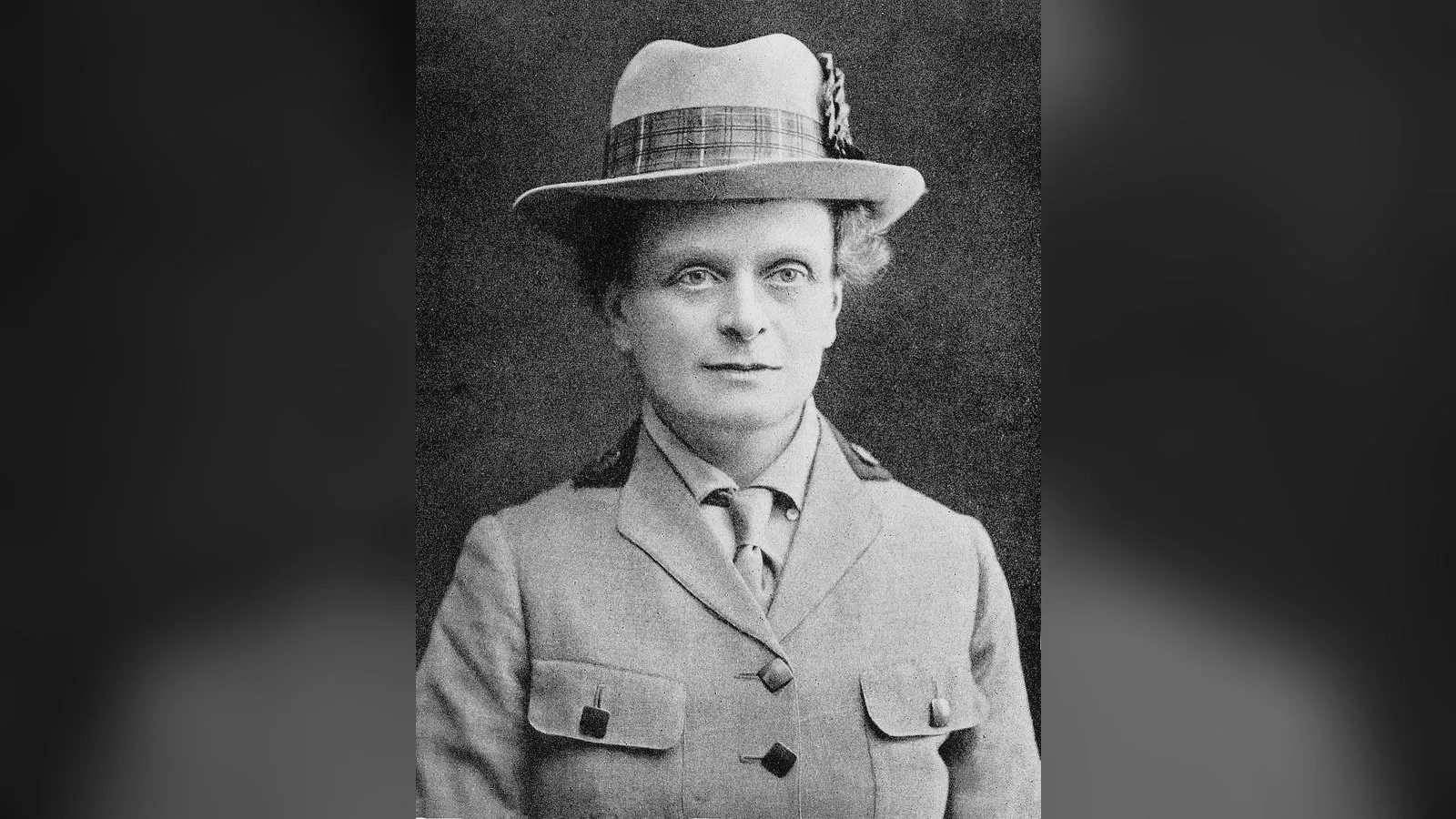

Elsie Inglis (1864–1917)
Contents
Elsie Inglis was an Edinburgh doctor and suffrage organiser who, after the War Office turned her away in 1914, founded the Scottish Women's Hospitals and led their units in Serbia and on the Romanian and Russian front. She died at Newcastle the day after landing from Russia in November 1917. This card tests her family background, her contested route into medicine, her pre-war hospital and suffrage work, and the dates and figures of her war service, checked against the memoir her friend Lady Frances Balfour published in 1918.
TL;DR
- established Inglis was born at Naini Tal in India on 16 August 1864, the daughter of John Inglis of the Indian Civil Service. She trained in Edinburgh and Glasgow, took the Triple Qualification in 1892 and an Edinburgh MB CM in 1899, and opened a maternity Hospice for poor women in the High Street in 1904.
- established She was honorary secretary of the Scottish Federation of Women's Suffrage Societies, and the federation's organisation and money launched the Scottish Women's Hospitals in October 1914 after an official told her, "My good lady, go home and sit still."
- established She led the Scottish unit in Serbia in 1915, was taken prisoner when the country was overrun, and was sent home through Austria and Switzerland in February 1916.
- established From September 1916 she led a unit with the Serbian Division in the Dobrudja, at Braila, Galatz and Reni, refused to leave until the Serbs were brought out, and died at Newcastle on 26 November 1917, the day after landing. She was buried in Edinburgh on 29 November after a service in St Giles'.
- shared Her illness is usually given as bowel cancer. Balfour's witnesses describe it only as dysentery and exhaustion, and the "Scotland's Florence Nightingale" label undersells her role as an organiser and suffragist.
Key Facts
- Born
- 16 August 1864, Naini Tal, India
- Baptised
- Elsie Maude (Balfour's spelling)
- Parents
- John Inglis (b. 1820), Indian Civil Service; Harriet Thompson
- Schooling
- Hobart, Tasmania; Charlotte Square Institution, Edinburgh; Paris (1882–83)
- Medical training
- Edinburgh School of Medicine for Women; Medical College for Women, Edinburgh; Glasgow Royal Infirmary (1891–92)
- Qualifications
- Triple Qualification (1892); MB CM, University of Edinburgh (1899)
- Early posts
- House surgeon, New Hospital for Women, London (1892–93); Rotunda, Dublin (1893–94)
- Practice
- With Dr Jessie MacGregor, Atholl Place, then 8 Walker Street, Edinburgh
- Hospice
- Nursing home, George Square (1901); Hospice, High Street (1904); joined with Bruntsfield Hospital (1910)
- Suffrage
- Honorary Secretary, Scottish Federation of Women's Suffrage Societies (c. 1906–1914)
- Scottish Women's Hospitals
- Scheme adopted October 1914; Inglis in Serbia 1915–16 and Romania/Russia 1916–17
- Died
- 26 November 1917, Station Hotel, Newcastle upon Tyne (aged 53)
- Funeral
- 29 November 1917, St Giles', Edinburgh; buried Dean Cemetery
- Honours
- Serbian Order of the White Eagle; Russian St George Medal (1917); Balfour notes orders from France, Russia and Serbia, and none from Britain
Scottish Impact Index (SI Score)
- Global Influence
- 6/10
- Enduring Relevance
- 8/10
- Material Contribution
- 3/10
- Exceptional Achievement
- 7/10
- Lasting Legacy
- 6/10
- Recognition
- 5/10
35/60
Ranked =62nd of 200 in Great Scots
A Note on Claims and Evidence
Each major claim carries one of three labels. established means supported by primary records, official bodies or several independent reliable sources. shared means the core fact is sound but sources disagree on details, dates or interpretation. traditional means widely repeated but not traceable to a primary or independent source.
The main near-contemporary source is Lady Frances Balfour, in her memoir Dr. Elsie Inglis (1918), written within a year of Inglis's death with the help of her sisters and her units. It quotes dozens of Inglis's own letters and reports, and those are used here for dates, places and figures. Balfour was a suffrage leader and Inglis's friend, so her judgements and praise are given as her view. Where the memoir conflicts with this card's other sources, both versions are shown. Several modern claims, such as the cause of death, the White Eagle "first woman" record and the guests at the funeral, are not in Balfour and rest on later accounts.
Timeline
Her great-grandfather Alexander Inglis, a younger son of Inglis of Kingsmills near Inverness, emigrates to Carolina and becomes a merchant in Charleston.
Alexander Inglis writes a farewell letter to his children before a duel in Charleston, in which he is killed.
Her grandfather David Inglis goes to India as a writer for the East India Company.
Her father, John Inglis, is born; he enters Haileybury in 1839 and later serves in the Punjab, Rohilkhand and Oudh.
Elsie Inglis is born at Naini Tal.
Her father is Chief Commissioner of Oudh, then retires; the family spends two years in Hobart, Tasmania.
The family settles at 70 Bruntsfield Place, Edinburgh; Elsie attends the Charlotte Square Institution.
She is at school in Paris.
Her mother dies of scarlet fever soon after Elsie's return from Paris.
She begins medical study at Sophia Jex-Blake's Edinburgh School of Medicine for Women.
After Jex-Blake expels two students, who then win a lawsuit against her, Inglis and other students promote a second school, the Medical College for Women.
She moves to Glasgow to finish her clinical training at the Royal Infirmary under William Macewen.
She passes the Triple Qualification and becomes house surgeon at the New Hospital for Women, Euston Road, London.
She studies midwifery at the Rotunda, Dublin.
Her father dies in Edinburgh.
She opens a practice with Dr Jessie MacGregor, first in Atholl Place, later at 8 Walker Street.
She graduates MB CM at the University of Edinburgh.
A nursing home for working women opens in George Square.
She runs the St Anne dispensary of the Little Sisters of the Poor.
The Hospice opens in the High Street, with an operating theatre and eight beds.
She is honorary secretary of the Scottish Federation of Women's Suffrage Societies.
The Hospice is joined with Bruntsfield Hospital and becomes a maternity and infant-welfare centre.
She is commandant of the 6th Edinburgh Voluntary Aid Detachment; in September she offers her services in London and is told to "go home and sit still".
The Scottish Federation adopts her hospital scheme and the name Scottish Women's Hospitals; the National Union of Women's Suffrage Societies adopts it on 15 October.
She writes from the new hospital at Royaumont Abbey, France, which is waiting for its inspection.
She reaches Kragujevac, Serbia, after sailing from Brindisi at the end of April.
She opens the fountain the Serbs built beside the camp hospital at Mladenovac.
The unit evacuates Kragujevac and moves to Kruševac.
After about three months under occupation, the unit is sent north under guard; they reach home through Vienna and Zürich by early March.
She sails with about 75 women for Archangel, then travels by train through Moscow to Odessa.
Her unit is pushed out of Medgidia in the Dobrudja on 22 October and works at Braila and Galatz.
She runs a hospital for Russian wounded at Reni on the Danube.
Prince Dolgorukov gives each member of the unit the St George Medal.
She leaves Russia with Serbian staff and about 2,000 Serbian soldiers on a special train to Archangel.
She lands at Newcastle, gravely ill.
She dictates a last message to her London committee and dies that evening at the Station Hotel.
Funeral service in St Giles', Edinburgh, with military honours; burial at Dean Cemetery.
Details
Kingsmills, Carolina and India
established Lady Frances Balfour, in her memoir Dr. Elsie Inglis (1918), traces the family through letters going back to 1740, when Hugh Inglis held Kingsmills near Inverness. His son Alexander, Elsie's great-grandfather, emigrated to Carolina about 1780 and became a merchant in Charleston, leaving his four children to be schooled in Scotland. His estates were confiscated after the American Revolution because he stayed loyal to the Crown. The schedule of his property lists 69 enslaved people valued at £60 each and 11 "house negroes". He was killed in a duel in Charleston in 1791; his farewell letter to his children is dated 29 March 1791.
established His son David went to India in 1798 as a writer for the East India Company, served through the Maratha war of 1803, and came home in 1812. David's son John, Elsie's father, was born in 1820, went to Haileybury in 1839, and spent his career in northern India: magistrate at Sialkot in the Punjab, service in the suppression of the 1857 rising around Bareilly, Commissioner of Rohilkhand, member of the Board of Revenue and the Legislative Council, and Chief Commissioner of Oudh from 1875 to 1877. Elsie's mother, Harriet Thompson, was one of nine daughters of an East India Company civil servant. The parents had "a first family" of six sons and a daughter, sent home to be schooled in England, and a "second little family" raised in India, of whom Elsie and her younger sister Eva were the closest.
established Elsie was born at Naini Tal, a hill station in the Himalayan foothills, on the morning of 16 August 1864, and baptised Elsie Maude that October. The family nurse, an ayah called Sona, had looked after all the children. Balfour stresses her closeness to her father, who wanted his daughters to have "the best and highest education". That judgement is Balfour's, but the letters she prints bear it out.
shared Modern accounts often call her the second daughter of nine children and give her father's full name as John Forbes David Inglis. Balfour gives no total and says only that John was "generally called David".
Schooling: Hobart, Charlotte Square and Paris
established After retiring from Oudh, John Inglis took the family to Hobart, Tasmania, for two years to settle two sons on the land. Elsie and Eva went to a school run by a Miss Knott, who had come from Cheltenham. The family then settled at 70 Bruntsfield Place in Edinburgh. The girls went to the Charlotte Square Institution, then the city's main girls' school, at 23 Charlotte Square. Schoolfriends recalled Elsie persuading the directors and every householder in the square to let the girls play in the private gardens, and making the school magazine, the Edina, pay. From September 1882 to the summer of 1883 she was at a small school in Paris run by a Miss Brown.
shared Her mother died of scarlet fever "not long" after Elsie came back from Paris, according to Balfour. Modern accounts date the death to 1885. From then on she kept house for her father.
A contested route into medicine
established Elsie first studied at Sophia Jex-Blake's Edinburgh School of Medicine for Women. Balfour records that she soon "had occasion to differ profoundly" with Jex-Blake. Two students who broke the school's rules were expelled, and they then won a lawsuit against her. The second school that came out of the split, the Medical College for Women, was "promoted by Elsie Inglis and other women students". Modern accounts credit her father's support, but Balfour presents it as the students' project.
established In February 1891 she moved to Glasgow, where women could study surgery and clinical teaching was better. She lived at the YWCA hostel and worked in the wards of William Macewen at the Royal Infirmary. Her letters describe the Infirmary managers' attempt in November 1891 to stop women attending mixed classes, a fight the students won. She passed the Triple Qualification in 1892.
established She then spent a year as house surgeon at the New Hospital for Women in the Euston Road, London, working under Elizabeth Garrett Anderson and Mary Scharlieb. There she wrote to her father, "I mean to have a hospital of my own in Edinburgh some day." From November 1893 to February 1894 she studied midwifery for three months at the Rotunda in Dublin. She came home to find her father dying; he died on 13 March 1894.
established When the University of Edinburgh admitted women to its medical examinations, she graduated MB CM in 1899. She lectured in gynaecology at the Medical College for Women, studied clinics in Vienna, and spent two months in the United States watching surgeons in New York, Chicago and Rochester.
shared This card previously said she studied maternity hospitals in Michigan in 1913. Balfour gives no date and names New York, Chicago and Rochester, and surgical rather than maternity work.
Practice, the Hospice and Bruntsfield
established In 1894 she went into practice with Dr Jessie MacGregor, first in Atholl Place and then at 8 Walker Street, which stayed her home. MacGregor later left to work in America. Balfour says Inglis founded the Hospice "with the help of a few friends", not with MacGregor. A nursing home for working women opened in George Square in 1901, in a house lent at a nominal rent by Dr Barbour. The Hospice proper opened in the High Street in 1904, with an operating theatre and eight beds, and became one of five centres in Scotland training midwives for the Central Midwives Board. In 1910 it was joined with Bruntsfield Hospital, which took the medical and surgical cases, while the Hospice kept maternity and infant welfare. Balfour describes it as the only maternity centre in Scotland run by women.
established She also ran the St Anne dispensary of the Little Sisters of the Poor from 1903 to 1913, and a dispensary at St Cuthbert's Mission in Morrison Street. She was honorary secretary of the Muir Hall of Residence for women students in George Square until her death. Former patients told Balfour she often refused fees and paid for one mother's six months in a sanatorium.
established The Hospice and its successor, the Elsie Inglis Memorial Maternity Hospital, which opened in 1925, served Edinburgh mothers until 1988.
Suffrage and politics
established Her politics were Liberal, and she was a Home Ruler. She was vice-president of the Central Edinburgh Women's Liberal Association for 16 years, sat on the first committee of the Women's Liberal League in 1901, and later left the party to work for the vote without party ties. In the early 1890s she spoke at a sanitary congress in Rothesay in favour of women sanitary inspectors, which a friend believed was the first time a woman doctor had spoken at such a congress.
established She was honorary secretary of the Scottish Federation of Women's Suffrage Societies through the campaign years from 1906 to 1914, and Balfour credits the federation's organisation largely to her. She opposed militancy and wanted the federation "purged" of militant members. Balfour admits her suffrage work cost her a large share of her practice.
shared Modern accounts also make her secretary of the Edinburgh National Society for Women's Suffrage from the 1890s and quote a contemporary who found her "courteous, sweet-voiced" with "the eyes of a seer", but with a "fixity of purpose" that warned off opponents. Balfour does not mention that post.
"Go home and sit still"
established When war came in August 1914, Inglis was commandant of the 6th Edinburgh Voluntary Aid Detachment and spent several weeks training it. She lent the main rooms of her house as a depot to fit out Cargilfield school as an auxiliary hospital, which was not accepted. In September she went to London to put her views to the National Union of Women's Suffrage Societies and the War Office. Balfour records that an official finally told her, "My good lady, go home and sit still." Balfour calls him a "departmental chief" and later "the local War Office official", but does not name him. Millicent Fawcett, quoted by Balfour, says the War Office refused her "official recognition" in 1914 and refused her again, "with contumely and insult", when she asked to take a unit to Mesopotamia in 1916.
shared Some modern accounts say the remark came from the Royal Army Medical Corps, or from the War Office in Edinburgh. Balfour, the earliest account used here, gives no name or office beyond "War Office".
established Back in Edinburgh she told a niece that they would raise a unit of their own. The suffrage offices became the headquarters. On 9 October 1914 she wrote to Fawcett explaining the committee's choice of a neutral name. She herself had wanted "British Women's Hospitals for Foreign Service". In the same letter she reports that Sir George Beatson of the Scottish Red Cross told her, "Our War Office will have nothing to say to you," and added that "there is no knowing what they may do before the end of the war." The Scottish Federation adopted the scheme and the name in October 1914, and the National Union adopted it on 15 October. Against cautious colleagues, she insisted on a public target of £50,000. Her colleague Miss Mair, writing for Balfour in 1918, says more than £200,000 had come in.
shared This card previously quoted Beatson as saying he could have "nothing to say to a hospital staffed by women". The wording in Inglis's own letter is the one given above, and in it Beatson is predicting the War Office's response, not giving his own. The figures of £100 of her own money and a first £1,000 within a month come from modern accounts, not Balfour.
established The first hospital opened under the French Red Cross at the Abbaye de Royaumont, north of Paris. On 22 December 1914 Inglis wrote that the four wards had been named after Blanche of Castile, Queen Margaret of Scotland, Joan of Arc and Millicent Fawcett, and that the staff were still waiting for the inspecting general. Later accounts say Royaumont grew to about 600 beds.
Serbia, 1915
established Inglis went out herself in spring 1915, when Dr Eleanor Soltau, head of the first Serbian unit, fell ill with diphtheria during the typhus epidemic. She was at Brindisi waiting for a boat on 28 April and reached Kragujevac in May. By then, as her letters show, the epidemic was dying down. The unit sent to nurse 300 beds was running 550 in three hospitals: a surgical hospital in a girls' school (Reserve Hospital No. 3), a typhus hospital (No. 6) and a relapsing-fever hospital (No. 7). The Serbian army then asked her to send the fever staff to run a disinfecting centre under canvas at Mladenovac. In August she visited Dr Alice Hutchison's tented hospital at Valjevo.
shared In her 1916 articles "The Tragedy of Serbia", quoted by Balfour, Inglis counted three deaths and nine cases of illness in the first unit during the three months of the epidemic, which killed 125 of Serbia's 425 doctors. This card previously gave four deaths. That figure appears in modern accounts and may include staff of other units or deaths after the epidemic. The nurse Louisa Jordan, who died at Kragujevac on 6 March 1915, was among them; Inglis was not yet in Serbia.
established On 7 October 1915, with a service by the Orthodox Church, Inglis opened a fountain the Serbs had built beside the camp hospital at Mladenovac to honour the Scottish women. She turned on the water herself. It was a tribute during her lifetime, not a memorial after her death.
Capture and release
established When German, Austrian and Bulgarian forces overran Serbia in October 1915, the unit evacuated Kragujevac on 25 October and fell back to Kruševac. Sir Ralph Paget let each member choose whether to retreat or stay, and of about 115 people in the Scottish unit, 20 left. Inglis and the rest stayed with their patients. They ran the Serbian military hospital at Kruševac, built for 400 beds, which held 900 to 1,200 wounded under occupation, and took over its sanitation and laundry. Inglis noted that they had no case of typhus. Vera Holme recalled that Inglis refused to sign a German statement that British prisoners had been well treated.
established On 11 February 1916 the unit was sent north under an Austrian guard, by way of Belgrade and Vienna, held for eight days at Bludenz, and released into Switzerland at Zürich. Inglis was home by about 1 March 1916.
shared This card previously said she stayed to help repatriate the wounded. Balfour and the Serbian Minister both say the women stayed to nurse wounded men who could not be moved. The award of the Order of the White Eagle in April 1916, and the claim that she was the first woman to receive it, come from modern accounts. Balfour does not date her Serbian decorations.
Romania and Russia, 1916–1917
established In 1916 she organised Kosovo Day in Britain, a day of lectures and flag-selling for Serbia, prepared in six weeks. The London committee of the National Union then funded a unit to serve the 1st Serbian Volunteer Division, formed in Russia from Austro-Hungarian Serbs, Croats and Slovenes taken prisoner by the Russians. Inglis sailed at the end of August 1916 with about 75 women. The Serbian writer Curcin gives 80. They took 14 cars, landed at Archangel, went by train through Moscow, and reached Odessa about 21 September.
established The unit opened a hospital at Medgidia in the Dobrudja, with a field hospital at Bulbulmic about seven miles from the front. Three weeks later, on 22 October, the retreat drove them out. At Braila, Inglis wrote, they found 11,000 wounded and only seven doctors, one of them a surgeon; she added that the official figure was 7,000. Her trained staff went straight to work in the town's hospitals. Evelina Haverfield told Balfour that at Galatz Inglis and her staff operated and dressed wounds for 58 out of 63 hours.
shared This card previously said her own team of a handful of doctors treated about 11,000 men at Braila. The seven doctors were the town's existing staff, and the 11,000 is the number of wounded Inglis found there, not a count of patients her unit treated.
established From January to August 1917 she ran a hospital for Russian wounded at Reni on the Danube. In March 1917 Prince Dolgorukov gave each member of the unit the St George Medal. That spring the unit was briefly suspected of spying, a charge withdrawn with apologies from the army command. On Easter Day the patients sent a written address thanking "highly respected and much beloved Doctor" for the unit's "constant and useful work". In August 1917, after the revolution, she noted "a great many left hands" among the wounded, implying self-inflicted wounds. She described the Serbian Division as 15,000 strong, losing 11,000 in one battle. Her worst complaint was of disbelief: "The ordinary male disbelief in our capacity cannot be argued away. It can only be worked away."
shared This card previously linked the Easter letter to Braila and quoted it as praising her "tireless and wonderful work". The letter Balfour prints came from patients at Reni in 1917, and its wording differs. Modern accounts also report that her nephew was blinded in the war; Balfour does not mention this.
established On 27 August 1917 the unit closed Reni and rejoined the Division at Hadji Abdul, near Galatz. Inglis, ill with what her staff called dysentery, refused to leave without the Serbs. On 29 October they left on a special train with about 2,000 Serbian soldiers. She spent 15 days on the train to Archangel and climbed a 20-foot ladder to board the transport.
Death at Newcastle
established The transport reached the Tyne in a storm. On the last morning Inglis got up to say goodbye to each of the Serbian officers, standing unsupported in her uniform. She landed on Sunday 25 November 1917 and was taken to the Station Hotel, Newcastle. On 26 November she dictated a last message to the London committee asking it to make sure the Serbs kept their hospitals and transport. Her sisters, Mrs Simson and Mrs Shaw McLaren, and her niece Evelyn Simson were with her when she died that evening. When a sister told her she had done magnificent work, she replied, "Not I, but my unit."
shared Her cause of death is usually given as cancer, often bowel cancer. Balfour's witnesses speak only of dysentery, pain and exhaustion, and Balfour suggests overwork and war rations hastened her death. Balfour's book also prints a sonnet by H. D. Rawnsley headed "Obiit Nov. 27, 1917", but the family's own account fixes the date as 26 November.
Funeral at St Giles'
established She lay in St Giles' with the flags of Britain and Serbia on her coffin. The service on 29 November 1917 was attended by her family, her suffrage colleagues, her units, the Serbian Minister and his legation, and the head of Scottish Command, who ordered military honours. The Hallelujah Chorus was played as the procession left, and buglers of the Royal Scots sounded a call. The coffin went on a gun carriage across the city and over the Water of Leith, and Serbian representatives carried it to the grave in the Dean Cemetery.
shared Modern accounts say British and Serbian royalty attended and that the buglers played the Last Post. Balfour names the Serbian Minister and legation, not royalty, and calls the bugle call "the Reveille". The words "will shine in history", attributed to Winston Churchill, are not in Balfour.
Legacy
established The Elsie Inglis Memorial Maternity Hospital opened in 1925 and closed in 1988. In Serbia, the British Residence in Belgrade was renamed Elsie Inglis House in 2015, and Serbia's first palliative-care hospice was named after her in 2020. In Scotland her portrait appeared on Clydesdale Bank £50 notes from 2009, and the University of Edinburgh named a medical school courtyard after her in 2017. Her name and image are on the plinth of the Millicent Fawcett statue in Parliament Square, unveiled in 2018.
shared A campaign launched in 2021 to put a statue of her on the Royal Mile raised £50,000 by 2022, but the choice of sculptor has caused public argument.
Did You Know?
- Her great-grandfather Alexander Inglis was a Charleston merchant and slaveholder, killed in a duel in 1791.
- As a schoolgirl she knocked on every door in Charlotte Square to get her school the use of the gardens.
- Her mother ran a working-men's club in Southampton and lectured there on Sunday evenings.
- As a student, Inglis secretly marked the class lists to show how well members of the Christian Union were doing, after a rumour that they neglected their work.
- The four wards at Royaumont were named after Blanche of Castile, Queen Margaret, Joan of Arc and Millicent Fawcett.
- The Serbs built a fountain in her honour at Mladenovac and she opened it herself in October 1915.
- She and her whole unit received the Russian St George Medal in March 1917.
- Her last message, dictated on the day she died, asked her committee to make sure the Serbs kept their hospitals and transport.
FAQ
1Why is Elsie Inglis significant?
She founded and led the Scottish Women's Hospitals, a women-staffed medical service that worked for the French, Serbian and Russian armies in the First World War when the British army would not accept women doctors. She did this after 20 years of building a practice, a maternity hospital and the Scottish suffrage organisation.
2Did the War Office really tell her to "go home and sit still"?
Lady Frances Balfour's 1918 memoir records the words "My good lady, go home and sit still", said by an unnamed War Office official in 1914. Balfour does not name him, so naming a person or department goes beyond the evidence.
3Where was she born and how did she come to Edinburgh?
At Naini Tal in India, where her father was in the Indian Civil Service. After he retired from Oudh in 1877, the family spent two years in Tasmania and then settled in Edinburgh.
4Where did she train?
At Sophia Jex-Blake's school in Edinburgh, then the Medical College for Women that she and other students promoted after a split with Jex-Blake, then at Glasgow Royal Infirmary. She took the Triple Qualification in 1892 and the Edinburgh MB CM in 1899.
5What was the Hospice?
A small maternity hospital for poor women in Edinburgh's High Street, opened in 1904 after a nursing home in George Square in 1901. It was staffed by women and joined with Bruntsfield Hospital in 1910.
6What was Inglis doing before the First World War?
Running a practice from 8 Walker Street, the Hospice and two dispensaries, lecturing at the Medical College for Women, and acting as honorary secretary of the Scottish Federation of Women's Suffrage Societies.
7How did Inglis die?
She died at the Station Hotel, Newcastle, on 26 November 1917, the day after landing from Russia. Later accounts give cancer as the cause. Her staff described her illness as dysentery.
8Why were the Scottish Women's Hospitals staffed by women?
It was deliberate. Inglis wrote to Millicent Fawcett in October 1914 that nothing would better show men "that women can help intelligently in any kind of work".
9What happened to Inglis during the Serbian campaign?
She stayed with her wounded at Kruševac when Serbia was overrun in late 1915 and worked under occupation for about three months. The unit was sent home through Austria and Switzerland in February 1916.
10What did she do in Russia and Romania?
From September 1916 she led a unit with the Serbian Division in the Dobrudja, worked through the retreat at Braila and Galatz, and ran a hospital at Reni from January to August 1917. She would not come home until the Serbs were brought out in October 1917.
11Where is she buried?
In the Dean Cemetery, Edinburgh, after a funeral service in St Giles' on 29 November 1917. Serbian representatives carried her coffin to the grave.
12How is Inglis remembered in Serbia today?
The British Residence in Belgrade was renamed Elsie Inglis House in 2015, and Serbia's first palliative-care hospice was named after her in 2020. In her lifetime the Serbs built a fountain in her honour at Mladenovac.
13Is there a statue of Elsie Inglis in Edinburgh?
Not yet. A campaign launched in 2021 for a statue on the Royal Mile raised £50,000 by 2022, but the choice of sculptor has been disputed.
14Was Inglis married or did she have children?
No. She lived with her father until his death, then at 8 Walker Street, where her brother Ernest's widow and three daughters joined her after 1910.
15What institution did her Edinburgh maternity hospital become?
The Hospice, which she founded, was succeeded by the Elsie Inglis Memorial Maternity Hospital, opened in 1925 and closed in 1988.
Sources and Further Reading
Primary/Institutional
- Lady Frances Balfour, Dr. Elsie Inglis (Hodder and Stoughton, 1918)
- University of Edinburgh, "Elsie Inglis – Superwoman," School of Medicine and Veterinary Medicine history pages
- Statue of Elsie Inglis campaign and biography, elsieinglis.org
- National Museum of Scotland — Scottish Women's Hospitals fundraising collection-box record
Scholarly/Critical
- Medicine, Conflict and Survival (Taylor & Francis), "The Scottish Women's Hospitals: the First World War and the careers of early medical women"
- Eva Helen Shaw McLaren, Elsie Inglis, The Woman With the Torch (1920) — contemporary biography by her sister
General
- The Scotsman, "Elsie Inglis: Scotland's Florence Nightingale"
- Undiscovered Scotland, biography of Elsie Inglis
- Wikipedia, "Scottish Women's Hospitals for Foreign Service"
Further reading
- Leah Leneman, In the Service of Life: The Story of Elsie Inglis and the Scottish Women's Hospitals (1994)
- Yvonne Fitzroy, With the Scottish Nurses in Roumania (1918)
Caveats: Myths and Disputed Claims
- Do not say her father founded the Medical College for Women; Balfour says Inglis and other students promoted it.
- Do not say she co-founded the Hospice with Jessie MacGregor, or date it to 1901; the George Square nursing home opened in 1901 and the High Street Hospice in 1904.
- Do not say she studied maternity hospitals in Michigan in 1913; Balfour names New York, Chicago and Rochester, with no date.
- Do not quote Sir George Beatson as refusing "a hospital staffed by women"; in Inglis's letter he says, "Our War Office will have nothing to say to you."
- Do not name the official who said "go home and sit still"; Balfour records the words but not the man.
- Do not say the Scottish Women's Hospitals were founded in August 1914; the scheme was adopted in October 1914.
- Do not say her own team of a handful of doctors treated 11,000 men at Braila; she found 11,000 wounded (officially 7,000) and seven local doctors there.
- Do not call the Mladenovac fountain a memorial; she opened it herself on 7 October 1915.
- Do not say she stayed in Serbia to repatriate the wounded; she stayed to nurse them under occupation.
- Do not state bowel cancer, royal mourners at the funeral or the Last Post as certain; Balfour's account does not confirm them.
Card 054 · Great Scots