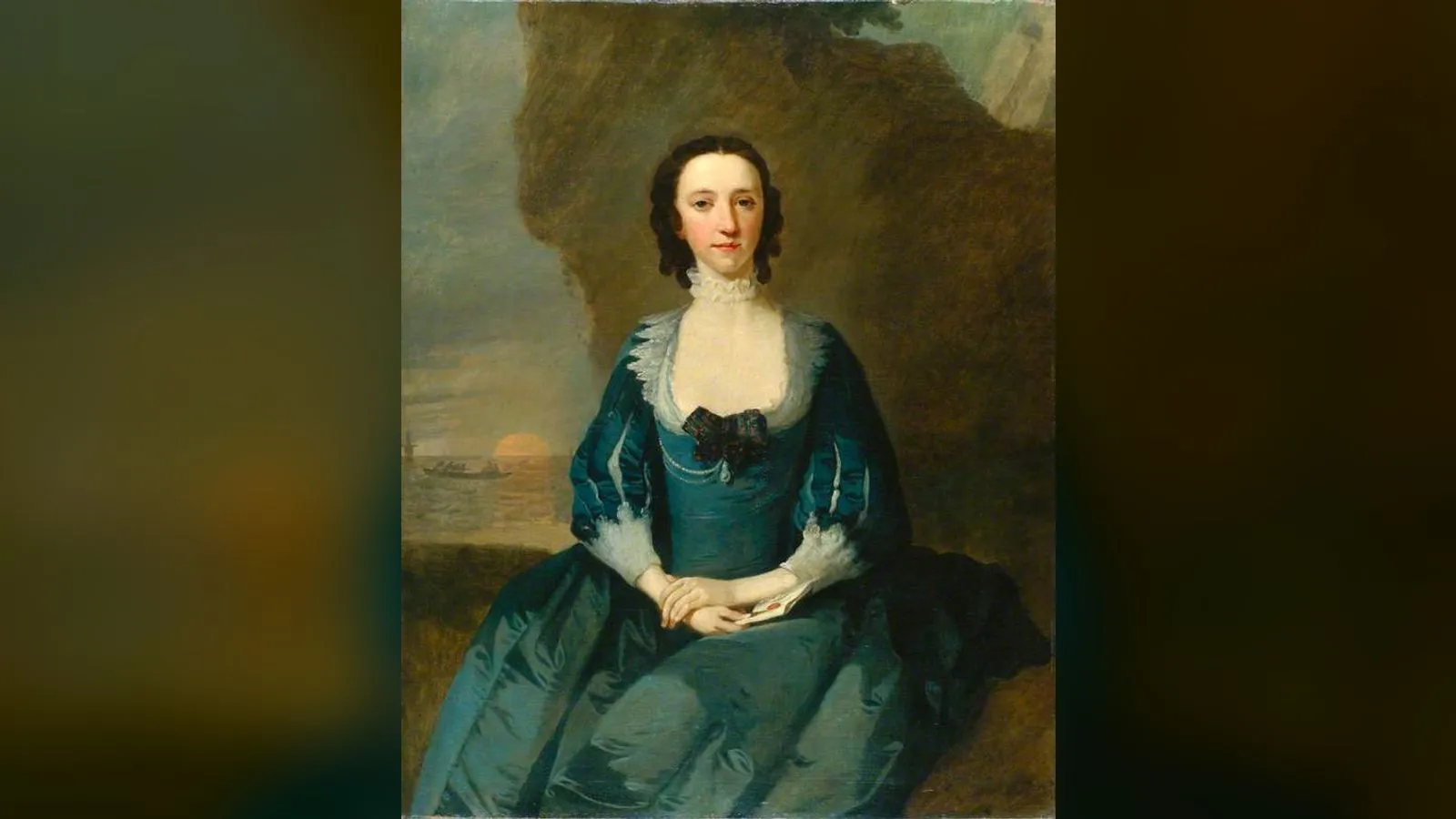

Flora MacDonald
Contents
Flora MacDonald, a young woman from South Uist, helped the fugitive Charles Edward Stuart escape to Skye in June 1746, disguised as her Irish maid "Betty Burke". The episode made her a heroine of song and legend. The real Flora came from a family that was largely on the government side, spent a year in comfortable custody in London, and later emigrated to North Carolina, where her family fought for the British Crown. This card tests the documented woman against the romance.
TL;DR
- established Flora MacDonald, in Gaelic Fionnghal nic Dhòmhnaill, was born in 1722 at Milton on South Uist, the daughter of a tacksman, a leaseholding gentleman of the clan system.
- established Her stepfather, Hugh MacDonald of Armadale, commanded a pro-government militia company. His travel pass let the escape party sail from Benbecula to Skye on 27–28 June 1746, with Charles dressed as "Betty Burke".
- established Her own sworn account of the escape, given on 12 July 1746, survives in the National Archives. She was arrested, taken to London, and released under the Act of Indemnity in 1747.
- established She married Allan MacDonald of Kingsburgh in 1750, met Samuel Johnson and James Boswell in 1773, emigrated to North Carolina in 1774, and returned to Skye, where she died on 4 March 1790.
- traditional Stories of a romance with the prince, her imprisonment in the Tower, and her rousing speeches in America are later legend. The "Skye Boat Song" was written in 1884.
Key Facts
- Gaelic name
- Fionnghal nic Dhòmhnaill
- Born
- 1722, Milton, South Uist
- Father
- Ranald MacDonald, tacksman of Milton and Balivanich
- Stepfather
- Hugh MacDonald of Armadale, militia commander
- Escape to Skye
- 27–28 June 1746, from Benbecula
- Sworn declaration
- 12 July 1746, National Archives SP 54/32/49E
- Released
- 1747, under the Act of Indemnity
- Married
- Allan MacDonald of Kingsburgh, 6 November 1750
- Met Johnson and Boswell
- September 1773, Kingsburgh
- Emigrated
- North Carolina, 1774
- Moore's Creek Bridge
- 27 February 1776; her husband captured
- Died
- 4 March 1790, Penduin, Skye; buried at Kilmuir
Scottish Impact Index (SI Score)
- Global Influence
- 5/10
- Enduring Relevance
- 9/10
- Material Contribution
- 2/10
- Exceptional Achievement
- 5/10
- Lasting Legacy
- 4/10
- Recognition
- 6/10
31/60
Ranked =84th of 200 in Great Scots
A Note on Claims and Evidence
Each major claim carries one of three labels. established means supported by primary records, official bodies or several independent reliable sources. shared means the core fact is sound but sources disagree on details, dates or interpretation. traditional means widely repeated but not traceable to a primary or independent source.
The escape is unusually well documented, thanks to Flora's own sworn declaration of July 1746 and the accounts of others involved. Her later life is recorded in letters, in Boswell's journal and in American records. But much of the popular legend was built after her death, especially in Victorian times, and some stories come from a discredited 1870s "autobiography" by her granddaughter. Several dates, including those of her emigration and return, differ slightly between sources.
Timeline
Flora is born at Milton, South Uist.
Her father dies.
Her mother marries Hugh MacDonald of Armadale.
The Jacobites are defeated at Culloden.
Flora helps Charles sail from Benbecula to Skye disguised as "Betty Burke".
Flora and Charles part at Portree.
Flora is arrested and gives her sworn declaration.
Flora is taken to London.
Flora is released under the Act of Indemnity.
Flora marries Allan MacDonald of Kingsburgh.
Johnson and Boswell stay at Kingsburgh.
The family emigrates to North Carolina.
Allan is captured at Moore's Creek Bridge.
Flora returns to Scotland.
Flora dies on Skye.
The Celtic cross at Kilmuir is erected.
The "Skye Boat Song" is written.
Details
1. Origins and early life
Flora MacDonald was born in 1722 at Milton (Gaelic Àirigh Mhuilinn) on the island of South Uist, in the southern Outer Hebrides. Her Gaelic name was Fionnghal nic Dhòmhnaill; the English "Flora" is a rendering of Fionnghal, and she sometimes signed herself "Flory." Sources give only the year, not a firm day, and a respectable strand of local tradition places the birth at Balivanich on Benbecula rather than Milton; the modern roadside sign on South Uist calling the surviving cottage "Flora MacDonald's Birthplace" overstates the certainty.
She was the third and last child of Ranald MacDonald, the tacksman (leaseholder) of Milton and Balivanich, and his second wife Marion, daughter of Angus MacDonald — and, on her mother's side, granddaughter of an Episcopalian clergyman (the "Strong Minister," Rev. Angus MacDonald, who died in 1724 while visiting friends at Largie in Kintyre). Through that line she was first cousin to the great Gaelic poet Alasdair mac Mhaighstir Alasdair. Crucially, she belonged to the tacksman class — the middling, leaseholding gentry of Gaelic society, related by blood to the clan elite — and not to the peasantry. The later image of Flora as a simple Highland lass or shepherdess is a romantic invention; the famous Allan Ramsay-school portraits that cast her as a shepherdess with a crook are a deliberate Arcadian conceit, not a record of her station.
Her father died when she was an infant (c.1723–24). In 1728 her widowed mother married Hugh MacDonald of Armadale on Skye; an old and oft-repeated tradition holds that Marion was "abducted" into the marriage, though this is folklore rather than documented fact. Flora was brought up partly in the household of the chief of her father's line, the MacDonalds of Clanranald, and was connected by visits to Lady Margaret MacDonald, wife of Sir Alexander MacDonald of Sleat.
On her education the sources genuinely conflict, and the article should be careful here. The popular tradition — repeated by Britannica and many older accounts — is that she received a formal education in Edinburgh, possibly after earlier schooling on the mainland (Largie in Kintyre is sometimes named). But the Oxford Dictionary of National Biography (Hugh Douglas) states flatly that "suggestions she was educated in Edinburgh cannot be confirmed," and some modern accounts argue she had no formal schooling at all in the institutional sense, learning instead at home and in the households where she was raised. The honest position: she was literate, musical and well-mannered (contemporaries agree on this), but the "three years at an Edinburgh ladies' college" story is unproven.
2. The political context of 1746 — her family's position
This is the single most misunderstood part of Flora's story, and the place where ScottishInventions.com's "accuracy over romance" standard matters most.
Flora's family was not a Jacobite family. During the 1745 Rising the dominant MacDonald grouping in her area — the MacDonalds of Sleat under Sir Alexander MacDonald — refused to come out for Charles, as did the MacLeods. Her stepfather, Hugh MacDonald of Armadale, was actually an officer in the pro-government militia, commanding one of the Independent Highland Companies raised to hunt down fugitives in the Hebrides. Her future husband, Allan MacDonald, also served the Hanoverian establishment. Flora herself was a practising Presbyterian, a faith generally aligned with the Hanoverian settlement rather than the Catholic/Episcopalian Stuart cause.
Flora's act, then, was not an expression of clan loyalty to the Jacobite cause. It was an act of individual humanity and nerve — and, the evidence suggests, of family entanglement, because the plot ran through her militia-commanding stepfather. Her own political views are genuinely uncertain. She told her captors that she acted out of charity; the Gaelic poet and fellow guide Niall mac Eachainn later sourly accused her of trying to win favour from both the Stuarts and the Hanoverians. In old age, according to the historian J. P. MacLean, she liked to say that she had served first the House of Stuart and then the House of Hanover, and had been "worsted in the cause of each." That wry remark captures the real Flora far better than the "doomed Jacobite heroine" of Victorian song.
3. The escape — what actually happened (June 1746)
After the Jacobite defeat at Culloden (16 April 1746), Charles Edward Stuart became a fugitive with a £30,000 price on his head — a reward the Government had proclaimed on 1 August 1745, at the very outset of the rising, for anyone seizing the Prince. By late June 1746 he was trapped in the Outer Hebrides as government troops and naval patrols combed the islands. He was hiding on South Uist with a tiny party including the Irish officer Captain Felix O'Neil (O'Neille) and Flora's kinsman Neil MacEachainn.
The contemporary documentary spine of the story is Flora's own sworn declaration, taken at Applecross Bay on 12 July 1746 and preserved in the National Archives (SP 54/32/49E) — the earliest account of the escape, given by Flora herself. According to that declaration, she had left her stepfather's house at Armadale to visit friends, was staying at a shieling (a hill grazing hut) belonging to her brother near Ormacleit, and was approached about 21 June by O'Neil ("or as they call him Nelson"), who proposed that the Prince travel with her to Skye disguised in women's clothes as her servant. She agreed.
The pass. Because her stepfather Hugh MacDonald commanded the local militia, Flora was able to obtain a pass for travel from Benbecula to Skye. The pass is traditionally said to have covered Flora, a manservant (Neil MacEachainn) and "Betty Burke, an Irish spinning maid," together with a boat's crew. A crucial honesty point: the exact wording of the pass is not reliably preserved, and the often-quoted versions are reconstructions. More importantly, it was Flora's own stepfather — the militia commander — who issued it, and witnesses later claimed Hugh MacDonald had even advised the Prince where to hide from the search parties. The strong implication, which the romantic narrative suppresses, is that Hugh was complicit in the escape, and that Flora's personal risk, while real, was smaller than the legend of a lone girl defying the whole British Army.
The crossing. On the night of 27–28 June 1746 the party put to sea from Rossinish on Benbecula in a small open boat crewed by several boatmen, the Prince dressed in the calico gown and hood of "Betty Burke." The disguise costume had been prepared with the help of Lady Clanranald. The famous phrase "over the sea to Skye" refers to this short, dangerous crossing of the Minch from Benbecula to Skye — not a voyage from the mainland. (The later "Skye Boat Song" and Robert Louis Stevenson's verses muddle the geography.)
Landing and the confusion at Monkstadt. They made for the area near Sir Alexander MacDonald's house at Monkstadt (Mugstot), near Uig. Because government troops were about, they did not land directly at the house; Flora went ahead to alert Lady Margaret MacDonald (Sir Alexander being away with the Duke of Cumberland's forces), while the Prince waited. Lady Margaret and her steward, Alexander MacDonald of Kingsburgh, arranged the next stage. At Kingsburgh's house the Prince was advised to drop the female disguise, as it was making him more conspicuous, not less.
The parting at Portree. On 30 June Flora rode to Portree, where the Prince — back in his own clothes — arrived, took refreshment, changed a guinea, paid his bill, and took his leave of her before being taken on towards Raasay. They never met again. Tradition holds that Charles gave her a keepsake (variously a locket with his portrait, or later a snuffbox inscribed "A gift from Prince Charles Stewart to Miss Flora Macdonald 1746," now in National Museums Scotland) and said, "I hope, madam, that we may meet in St James's yet." The keepsake objects are real and collected; the precise parting words are traditional and should not be stated as verbatim fact. The whole acquaintance lasted only about eleven or twelve days.
Neil MacEachainn. Largely written out of the popular story is Neil MacEachainn (see §9), the Uist man and kinsman who guided the party, coached the Prince in how to behave as a maidservant, and ran exactly the same risks as Flora.
4. Arrest, imprisonment and release
The boatmen who had carried the Prince were detained and, under pressure (one account says under threat of torture), gave up names and the "Betty Burke" disguise. Within about two weeks the plot was known. Flora was arrested around 12 July 1746 — the date of her declaration at Applecross — and held aboard a naval vessel involved in the search (sources name HMS Furnace, under the notorious Captain John Ferguson, and the overall search commander General John Campbell of Mamore, who ordered that she "be used with the utmost respect").
By contemporary standards she was treated remarkably well. She was moved to a prison ship at Leith (HMS Bridgewater) and then to London, arriving in December 1746 with recommendations from her captors requesting lenient handling. After a short period associated with the Tower of London, she was permitted to live under the supervision of a "King's Messenger" — effectively comfortable house arrest near St James's — rather than in a common gaol. Indeed, some scholars (e.g. Elizabeth Gray Vining) note that the dramatic "imprisoned in the Tower" image is overstated: well-born prisoners were routinely lodged in messengers' houses.
In London she became a celebrity. Visitors flocked to her; one admirer reportedly asked to lie in the same bed as the woman who had guarded the Prince. She was informally taken up by the wealthy Jacobite sympathiser Lady (Anne) Primrose, who organised a subscription that raised over £1,500 for her at her house in the Strand. She was released under the Act of Indemnity of 1747 and returned to Scotland — reportedly travelling north in Lady Primrose's own coach. She later sat for Allan Ramsay, the leading portraitist of the day.
The Frederick, Prince of Wales story — flag carefully. It is very widely repeated that Frederick, Prince of Wales (father of the future George III) visited Flora and/or contributed to the fund, and that when asked why she had helped his father's enemy she replied she would have done the same for him had she found him in distress. Our research finds this should be presented as tradition, not documented fact. The reliably documented core is that Lady Primrose was her patron and that the famous "I would have done the same for anyone in distress" sentiment traces to Flora's own stated motive. The dramatised royal exchange is attributed inconsistently across reputable sources — to Frederick (the old Victorian Dictionary of National Biography), to the Duke of Cumberland (National Museums Scotland), or to an unnamed "Hanoverian captor" (Flora Fraser's 2022 biography, Pretty Young Rebel). The modern, archive-based scholarship conspicuously does not confirm a personal Frederick audience or donation. A separate, later royal connection — a pension granted in her old age — is associated with the future George IV, which may be the root of some confusion.
5. Marriage and life in Scotland
On 6 November 1750 Flora married Allan MacDonald of Kingsburgh, a captain who had served in the British Army and the son of Alexander MacDonald of Kingsburgh — the very man who had sheltered the Prince in 1746 and had himself been arrested for it. The couple first farmed at Flodigarry on Skye's Trotternish peninsula; Allan succeeded to the tack of Kingsburgh when his father died in 1772. They had seven surviving children (two daughters and five sons); two sons were later lost at sea (1781 and 1782), while a third, John, made a fortune in India that eased his parents' last years. Allan, by contemporary account, was an ambitious but poor businessman who lost much of Flora's money.
The Johnson and Boswell visit, September 1773. During their celebrated tour of the Hebrides, Dr Samuel Johnson and James Boswell stayed at Kingsburgh on 12–13 September 1773. Boswell, in his Journal of a Tour to the Hebrides (published 1785), recorded the visit affectionately: they were received by Allan, "completely the figure of a gallant Highlander," and at supper appeared "the celebrated Miss Flora Macdonald," whom Boswell described as "a little woman, of a mild and genteel appearance, mighty soft and well-bred." The punch, he noted, was "super-excellent." Johnson slept in the very bed that had reputedly held the Prince. Johnson's own tribute — later inscribed on her Kilmuir monument — called her "a name that will be mentioned in history, and if courage and fidelity be virtues, mentioned with honour," and he described her as "a woman of soft features, gentle manners, kind soul, and elegant presence."
Boswell's account also punctures the "mighty soft" first impression: over the following days he found her witty and tough, teasing Johnson and ready to retell the escape. As to motive, the consistent thread in what she actually said is that she acted out of charity — that she would have helped anyone in distress — rather than from political devotion to the Stuart cause.
6. Emigration to North Carolina (1774)
By the early 1770s the tacksman class was being squeezed: rising rents on Skye, poor harvests, and the collapse of the old clan economy after the '45 drove what Johnson called an "epidemic desire of wandering." At the time of his 1773 visit, more than 800 people from the Sleat lands were preparing to emigrate. In 1774 (some sources say 1773) Flora, Allan and part of their family sailed for North Carolina, settling in the Cape Fear region — by then home to the largest Highland Scottish community in the American colonies (nearly 15,000 Highland Scots in the Upper Cape Fear by 1776). They took up a plantation in what was then Anson County (later Montgomery County), near Cheek's Creek, which they named "Killegray," and were warmly welcomed by settlers who remembered Flora's fame.
Then came the deep irony at the heart of her American years. When the American Revolutionary War broke out, the MacDonalds sided with the British Crown — the same dynasty that had devastated the Highlands after Culloden. Allan helped raise Loyalist Highlanders for royal governor Josiah Martin and took a commission in the 84th Regiment of Foot (Royal Highland Emigrants); their sons served too. Tradition says Flora herself rallied the Highland settlers to the Loyalist cause with stirring Gaelic speeches in 1775–76 — but serious accounts note there is no good evidence she made such a speech, and the most colourful versions derive from the unreliable 1870s "autobiography" written by her granddaughter.
Why so many Highlanders took the Crown's side is debated. Recent oaths of loyalty, promises of land, half-pay officers and tacksman leaders such as Allan all played a part. The historian David Hackett Fischer, in Albion's Seed (1989), adds a regional argument. He describes the Cape Fear Highlanders, settled there from about 1732, as a separate Gaelic-speaking culture, so dominant locally that even some non-Scots spoke Gaelic, and suggests they became Tories largely because their backcountry neighbours, mostly of Ulster and Border stock, were Whigs. That is his interpretation, not a settled finding, and the backcountry also produced many Loyalists.
The Loyalist Highlanders marched for the coast and were routed at the Battle of Moore's Creek Bridge on 27 February 1776 — the "Lexington and Concord of the South" — where Patriot militia under Richard Caswell and Alexander Lillington crushed the broadsword charge. Allan and a son were captured; about 850 Loyalists were taken prisoner (the Patriots lost only one man, John Grady of Duplin County). In 1777 Loyalist property was confiscated and the family was evicted from Killegray, losing nearly everything. Flora endured two miserable years, shunned by neighbours who blamed her husband for raising the Highlanders, and at one point broke her arm in a fall from a horse. Allan, after about 18 months' captivity, was exchanged in 1777 and posted to Fort Edward, Nova Scotia; Flora joined him there in 1778.
7. Return to Scotland and final years
In 1779 Flora took ship for Britain. The voyage was rough, and famously her ship was attacked by a privateer. As to her injuries, we are unusually lucky to have Flora's own account: in a 1789 letter to Sir John MacPherson she explained that she had first "dislockated the wrist … and brock some tendons" in a fall before the voyage, and then, aboard ship, hurrying below when a sail was sighted, "fell and brock the dislockated arm in two." (The popular image of Flora heroically refusing to leave the deck to rally the crew is romantic embellishment — again traceable to the spurious "autobiography" — but the broken arm and the privateer attack are genuine.) Ill-health delayed her onward journey, and she reached Scotland around 1779–80, living with various relatives on Skye. Allan, unable to afford to resettle in Nova Scotia, returned to Scotland around 1784–85. Kingsburgh itself was now occupied by Flora's half-sister, so the couple took up tenant farming at nearby Penduin (Peinduin).
Flora MacDonald died on 4 March 1790 (some sources say 5 March) at Penduin, near Kingsburgh, aged 67–68. Tradition holds her funeral was the largest ever seen on Skye — said to have drawn thousands of mourners who consumed hundreds of gallons of whisky — and that she was buried in a shroud made from a bedsheet on which Bonnie Prince Charlie had slept. She was buried at Kilmuir on the Trotternish peninsula. The original grave-marker (a marble slab placed by her son) was chipped away by souvenir hunters over the years; the present tall Celtic (Iona-style) cross of granite, designed by Alexander Ross, was erected by public subscription in 1880 (an earlier monument is also said to have been destroyed in a gale in 1871). A marble plaque was added in 1922, and the monument was restored in 2019. It carries Johnson's words. A bronze statue of Flora, with her dog, was raised at Inverness Castle in 1899.
8. The myth vs the woman
Flora MacDonald is one of those historical figures whose legend has almost swallowed the person — and the legend was largely built after she was safely dead and Jacobitism had become a harmless, romantic lost cause.
The single biggest engine of the myth is the "Skye Boat Song," whose familiar words were written in 1884 by Sir Harold Boulton, 2nd Baronet, to a Gaelic air collected in the 1870s by Anne Campbell MacLeod (1855–1921) and first published in Songs of the North; the tune is an adaptation of William Ross's c.1782 "Cuachag nan Craobh." The song is a Victorian confection — composed nearly 140 years after the event — that recasts a desperate, frightened evasion amid reprisals and famine as a windswept, sentimental idyll, and it even garbles the geography (Stevenson's rival verses imply a flight from the mainland past Mull, Rum and Eigg, which never happened). The Highland dance "Flora MacDonald's Fancy" and a wave of Victorian portraiture, fiction (Scott's Waverley heroine Flora MacIvor is partly modelled on her) and statuary completed the transformation into the "doomed Jacobite heroine."
The real Flora is more interesting than the myth. She was a tough, practical, witty tacksman's daughter from a politically mixed — indeed largely pro-government — family, who acted in 1746 out of humanity (and family entanglement) rather than ideology; who spent a comfortable celebrity imprisonment and was lionised by London society; who then fought, with her husband and sons, on the British Loyalist side in America against the Revolution; and who spent much of her life grappling with the hard economic decline facing Highland Scots. She did not, as far as the record shows, dwell on the escape: she "rarely spoke of the episode," and made no effort to inflate her own role. Her own verdict — that she had served both the Stuarts and the Hanoverians and been worsted in each cause — is rueful and clear-eyed, not the language of a romantic martyr.
Did she ever express regret or pride? The honest answer is that she said little. What survives suggests neither regret nor self-dramatisation, but a consistent insistence that she had simply helped a fellow human being in distress and would have done the same for anyone — including, she is supposed to have told a Hanoverian, the royal family's own. The supreme irony — the Loyalist Flora versus the Jacobite myth — is real, documented, and far more revealing than the song.
9. Neil MacEachainn — the forgotten hero, and a marshal of France
If Flora has been over-remembered, her kinsman Neil MacEachainn (MacEachen) has been almost forgotten — unjustly, because he shared the danger and arguably did more of the practical work. A Uist man from Howbeg, of the tacksman class, he had been educated abroad at the Scots College at Douai and was fluent in Gaelic, Latin, Greek, English and French. He served as a guide to the fugitive Prince on South Uist, was present through the planning of the escape, helped coach Charles in playing "Betty Burke," and crossed with the party to Skye. He ran exactly the same risk of the gallows that Flora did.
After the '45 Neil escaped to France, took a French commission (in the Ogilvy regiment), and — for reasons unknown, possibly French difficulty with "MacEachen" — adopted the surname MacDonald. He settled at Sedan in the Ardennes, where his son Étienne Jacques Joseph Alexandre MacDonald was born on 17 November 1765. Neil died in relative poverty at Sancerre in 1788, never having returned to Scotland despite the 1784 amnesty, "leaving to his son as estate only his name, and the example of his virtues."
That son rose to extraordinary heights. Étienne MacDonald became one of Napoleon's Marshals of France, created Duc de Tarente (Duke of Taranto) soon after the Battle of Wagram in 1809 — famously made a marshal on the battlefield itself. He commanded armies across Europe, covered the retreat from Leipzig (swimming the Elster to escape), and was one of the few marshals to stay loyal to Napoleon to the abdication, later serving the restored Bourbons as a peer of France and chancellor of the Legion of Honour. In a remarkable closing of the circle, in 1825 Marshal MacDonald travelled to Scotland and the Hebrides to find his father's roots, keeping a diary (rediscovered in the French archives and since published) of his meetings with figures from Sir Walter Scott to his own Uist kinsfolk. The grandson of a hunted Hebridean schoolmaster returned as a Napoleonic duke, fêted by the British establishment — a fitting coda to a story whose ironies never quite stop multiplying.
(For Charles Edward Stuart's own flight, character and later decline, see the companion "Great Scots" article on Bonnie Prince Charlie; this piece deliberately keeps the focus on Flora and on those, like Neil MacEachainn, who shared her risk.)
Did You Know?
- "Over the sea to Skye" was a short hop, not an epic mainland voyage. Charles crossed from Benbecula in the Outer Hebrides to Skye on 27–28 June 1746 — the disguise-and-boat trip, not a flight from the Scottish mainland.
- Flora wrote the first account of the escape herself. Her sworn declaration of 12 July 1746 survives in the National Archives (SP 54/32/49E) — the earliest source for the whole "Betty Burke" story.
- The man who let the escape happen was Flora's own stepfather — Hugh MacDonald of Armadale, commander of the pro-government militia, who issued the travel pass and may even have advised the Prince where to hide.
- She fought on the British side against American independence. In the Revolution, Flora's family were Loyalists; her husband Allan was captured at Moore's Creek Bridge in 1776, and they lost their North Carolina plantation.
- Her own epitaph was written by Dr Johnson — "Her name will be mentioned in history, and if courage and fidelity be virtues, mentioned with honour" — after he met her on Skye in 1773.
- Her kinsman's grandson became a Napoleonic marshal. Neil MacEachainn, co-guide of the escape, was father of Étienne MacDonald, Duc de Tarente, one of Napoleon's marshals — who came back to the Hebrides in 1825 to find his roots.
- The "Skye Boat Song" is younger than the railway. Its words date from 1884, almost 140 years after the escape — a Victorian romance, not a Jacobite original.
- Souvenir hunters destroyed her first gravestone, chipping it away piece by piece; the towering Celtic cross at Kilmuir was put up by public subscription in 1880.
FAQ
1Who was Flora MacDonald?
A woman from South Uist who helped Charles Edward Stuart escape to Skye in 1746.
2Was her family Jacobite?
No. Her stepfather commanded a pro-government militia company, and the local MacDonalds did not join the rising.
3How did the escape work?
With a travel pass from her stepfather, she sailed from Benbecula to Skye with Charles disguised as her maid, "Betty Burke".
4Was she in love with the prince?
There is no evidence of a romance. They knew each other for less than a fortnight.
5Was she imprisoned in the Tower of London?
Not for long. She spent most of her detention in comfortable house arrest.
6Did she meet Dr Johnson?
Yes, in September 1773. He wrote that her name would be "mentioned in history, and if courage and fidelity be virtues, mentioned with honour".
7Why did she go to America?
Rising rents and hard times on Skye led many tacksman families to emigrate in the 1770s.
8Which side did her family take in the American Revolution?
The British Crown. Her husband was captured at Moore's Creek Bridge in 1776.
9Why did the Cape Fear Highlanders side with the Crown?
Historians point to oaths, land, officers and tacksman leadership. David Hackett Fischer also argues they opposed their Whig backcountry neighbours, but that is an interpretation.
10Where is she buried?
At Kilmuir on Skye.
11Who was Neil MacEachainn?
Her kinsman, who guided the escape with her. His son became one of Napoleon's marshals.
Sources and Further Reading
Scholarly/Critical
- Murray G. H. Pittock, "The Jacobite Cult", in Edward J. Cowan and Richard J. Finlay (eds), Scottish History: The Power of the Past (Edinburgh University Press, 2002)
- David Hackett Fischer, Albion's Seed: Four British Folkways in America (Oxford University Press, 1989)
Further reading
- James Boswell, The Journal of a Tour to the Hebrides with Samuel Johnson (1785)
- Hugh Douglas, Flora MacDonald: The Most Loyal Rebel (Sutton, 1993)
Caveats: Myths and Disputed Claims
- Do not give an exact birth date or present her birthplace as certain.
- Do not state that she was formally educated in Edinburgh.
- Do not suggest a romance with the prince.
- Do not quote the wording of the travel pass or the Portree parting words as verbatim.
- Do not say she was held in the Tower of London throughout her detention.
- Do not present her meeting with Frederick, Prince of Wales, or her famous reply to him, as fact.
- Do not repeat the story of her recruiting speech in North Carolina.
- Do not present funeral statistics or the shroud story as documented.
- Do not describe the "Skye Boat Song" as a Jacobite song.
Card 012 · Great Scots