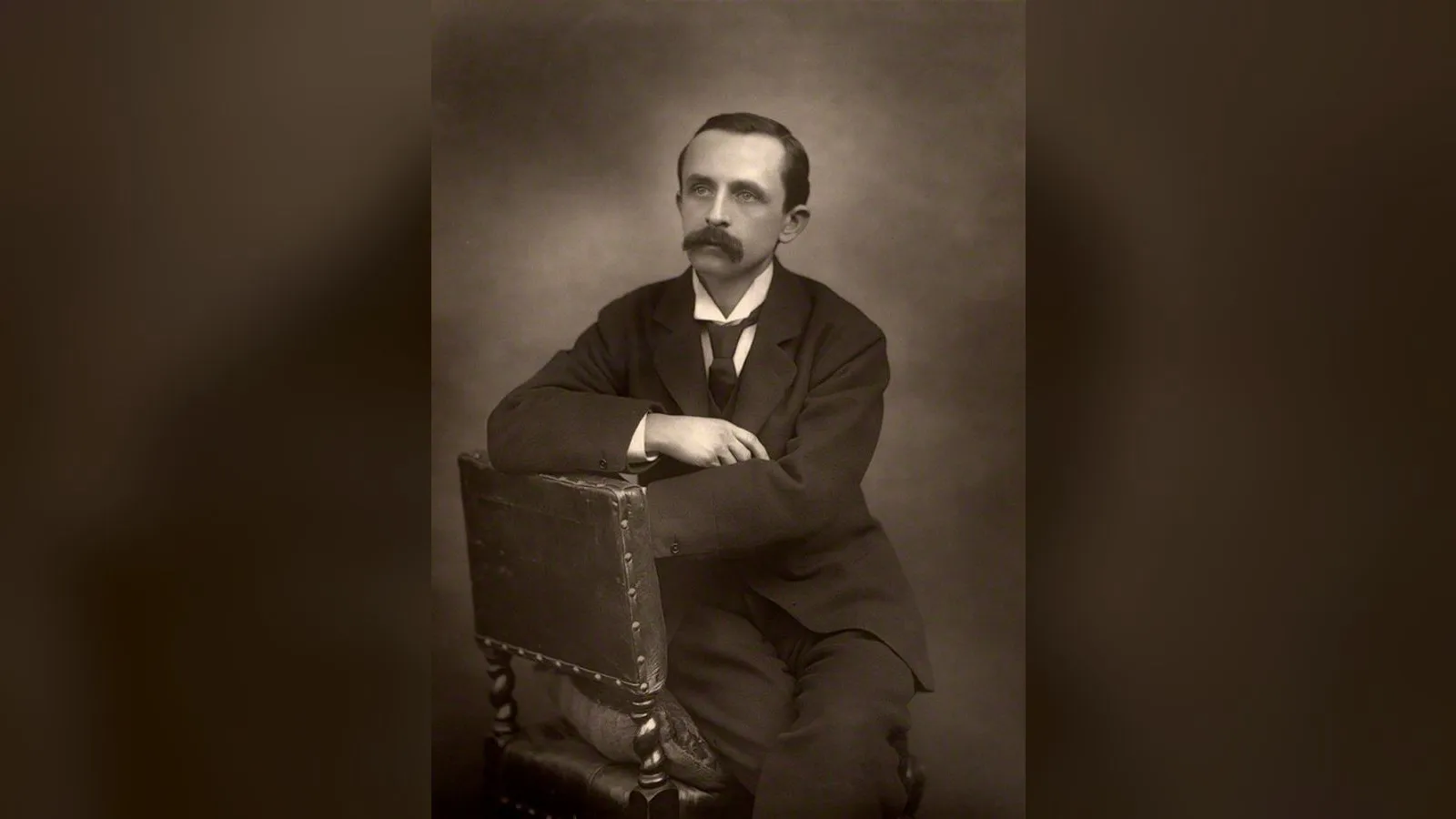

J.M. Barrie (1860–1937): The Man Who Wrote a Boy Who Never Grew Up
Contents
TL;DR
- Established (Documented): Barrie's most defining childhood experience — his elder brother David's death in a skating accident when Barrie was six, and his grieving mother's lasting consolation in the idea that David "would remain a boy forever" — directly shaped the central emotional premise of Peter Pan decades later.
- Established (Documented): Barrie's marriage to actress Mary Ansell was, by strong biographical consensus, unconsummated and childless; it ended in 1909 after Mary's affair with a younger writer, a divorce Barrie's friends actively worked to keep out of the press.
- Established (Documented): Barrie became deeply involved with the Llewelyn Davies family from 1897, eventually serving as guardian to their five sons after both parents died, and the boys and their invented adventures were the direct, acknowledged inspiration for Peter Pan.
- Disputed, and treated with appropriate care: Barrie's intense, sustained emotional closeness to the Davies boys has drawn genuine scholarly speculation about its nature. This article states plainly what the serious evidence actually supports: there is no documented evidence of sexual contact, no contemporary suspicion during his lifetime, and the surviving boys themselves — including the youngest, Nico, well into adulthood — firmly and specifically denied any impropriety. The discomfort some scholars register is real and worth naming, but it does not amount to evidence of wrongdoing.
- Established (Documented): Barrie donated the full copyright of Peter Pan to Great Ormond Street Hospital for Children in 1929, a gift that has provided the hospital substantial ongoing income for nearly a century.
Key Facts
- Born
- 9 May 1860, Kirriemuir, Angus, Scotland
- Died
- 19 June 1937, Marylebone, London, aged 77
- Parents
- David Barrie (weaver) and Margaret Ogilvy
- Education
- University of Edinburgh, M.A. 1882
- Height
- Reportedly just 5'3½" as an adult
- Wife
- Mary Ansell, married 1894, divorced 1909; marriage reportedly unconsummated and childless
- Major work
- Peter Pan; or, The Boy Who Wouldn't Grow Up (stage play, 1904)
- Key relationship
- Guardian to the five Llewelyn Davies boys following both parents' deaths
- Major bequest
- Donated all Peter Pan copyright to Great Ormond Street Hospital, 1929
- Honours
- Baronet (1913); Order of Merit (1922); Chancellor, University of Edinburgh (1930–37)
Scottish Impact Index (SI Score)
- Global Influence
- 8/10
- Enduring Relevance
- 9/10
- Material Contribution
- 7/10
- Exceptional Achievement
- 9/10
- Lasting Legacy
- 8/10
- Recognition
- 8/10
49/60
Ranked =15th of 200 in Great Scots
A Note on Claim Status
This article follows ScottishInventions.co.uk's standard evidence tiers: Established/Documented (supported by primary sources or strong scholarly consensus), Shared/Traditional (widely repeated but resting on thinner evidence), disputed (credible sources disagree), and Legend/Myth (popular but unsupported or contradicted by the record). Barrie's relationship with the Llewelyn Davies boys is the most sensitive subject in his biography, and this article treats it with the precision the evidence warrants: genuine scholarly unease about the intensity of his attachment to children is worth stating honestly, but it must be kept clearly distinct from an actual accusation, for which no credible documentary evidence exists, and which the surviving boys themselves explicitly rejected as adults.
Timeline
Born in Kirriemuir, Angus, the ninth of ten children.
Elder brother David dies in an ice-skating accident the day before his 14th birthday; their mother's grief profoundly shapes young Barrie.
Sent to Glasgow Academy under the care of older siblings.
Studies literature at the University of Edinburgh; graduates with an M.A.
Begins journalism career in Nottingham.
Publishes early Scottish novels drawing on his mother's stories: Auld Licht Idylls, A Window in Thrums, The Little Minister.
Meets actress Mary Ansell while casting his play Walker, London.
Marries Mary Ansell in Kirriemuir.
Meets George and Jack Llewelyn Davies in Kensington Gardens; later meets their parents, Arthur and Sylvia.
Invites the Davies family to his country retreat, Black Lake Cottage; creates the photo album The Boy Castaways of Black Lake Island, a direct precursor to Peter Pan.
Peter Pan first appears as a character in The Little White Bird.
Peter Pan; or, The Boy Who Wouldn't Grow Up premieres at London's Duke of York's Theatre.
Arthur Llewelyn Davies dies.
Mary Ansell begins an affair with writer Gilbert Cannan.
Barrie discovers the affair; sues for divorce after Mary refuses to end it.
Divorce granted; Barrie's friends largely succeed in keeping the story out of most newspapers.
Sylvia Llewelyn Davies dies; Barrie becomes guardian to the five Davies boys, alongside other named trustees in her will.
A statue of Peter Pan is secretly erected overnight in Kensington Gardens; Barrie is disappointed the sculptor did not use his preferred child model.
Created a baronet by King George V.
George Llewelyn Davies killed in action in Flanders during the First World War, aged 21.
Elected Rector of the University of St Andrews.
Michael Llewelyn Davies drowns at Sandford Lock near Oxford, weeks before his 21st birthday; contemporaries suspected but could not confirm suicide.
Appointed to the Order of Merit; delivers his celebrated Rectorial Address, "Courage," at St Andrews.
Donates all Peter Pan copyright to Great Ormond Street Hospital for Children.
Serves as Chancellor of the University of Edinburgh.
Receives the Freedom of Kirriemuir.
Dies of pneumonia in London, aged 77.
Peter Llewelyn Davies, the last of the surviving "Peter Pan" boys still carrying the association into adulthood, dies by suicide.
Details
A death that shaped a myth of eternal boyhood
James Matthew Barrie was born in 1860 in Kirriemuir, the ninth of ten children in a strict Calvinist weaving family. The defining event of his childhood occurred when he was six: his much-admired elder brother David died in a skating accident the day before his fourteenth birthday. Their mother Margaret's grief was profound and lasting, and young Barrie, in a documented and genuinely poignant response, attempted to fill the emotional void by adopting his dead brother's mannerisms and even his clothing — recalling, in his own later memoir of his mother, that "I thought it was the dead boy she was speaking to" on occasions when he stood in for David. Crucially, his mother found a specific, lasting form of consolation in the thought that David, having died a boy, "would remain a boy forever, never to grow up and leave her." This is not incidental biographical colour: it is, by direct and widely accepted scholarly consensus, the emotional seed of Peter Pan's entire premise decades before Barrie ever met the Llewelyn Davies family.
An unconsummated marriage, quietly dissolved
Barrie's literary career developed through Scottish stories and novels drawing on his mother's own storytelling, and he met his future wife, the actress Mary Ansell, in 1891 while casting one of his plays. They married in 1894, but the marriage — by strong biographical consensus, though inherently a matter some discretion necessarily surrounds — was unconsummated and produced no children. The relationship deteriorated over the following decade and a half; Mary began an affair in 1908 with the writer Gilbert Cannan, twenty years her junior, and when Barrie discovered this in 1909 and she refused to end it, he sued for divorce, which was granted that October. Notably, and to his credit, Barrie continued providing Mary with financial support for years afterward, even presenting his annual contribution at private dinners marking her subsequent wedding anniversary with Cannan — an unusual, generous gesture from a man whose own marriage had publicly and painfully failed. His friends actively worked to keep the divorce out of most newspapers, and largely succeeded.
The Llewelyn Davies family, and the birth of Neverland
Barrie's relationship with the Llewelyn Davies family began in 1897, when he met young George and Jack Llewelyn Davies and their nurse in Kensington Gardens while walking his dog; he later met their mother Sylvia, daughter of illustrator George du Maurier, and became a regular presence in the household of Sylvia and her husband Arthur, despite both Barrie and Sylvia being married to others at the time. By 1901, Barrie was inviting the family — by then including five sons, George, Jack, Peter, Michael, and Nicholas — to his country retreat, where he created a photographic album titled The Boy Castaways of Black Lake Island, documenting the boys in an invented pirate adventure narrative that became the direct, acknowledged germ of Peter Pan. The character himself first appeared in print in 1902's The Little White Bird, before achieving lasting fame in the 1904 stage play.
Guardian to five boys, and a question that deserves careful handling
Following Arthur Llewelyn Davies's death in 1907 and Sylvia's in 1910, Barrie became guardian to all five Davies boys, named alongside other trustees in Sylvia's will, which expressed her confidence that the boys should "treat him (& their uncles) with absolute confidence & straightforwardness." Barrie's financial support proved essential to the family's stability, his considerable income from Peter Pan and his other works covering the boys' living expenses and education for years.
It is here that the most genuinely sensitive question in Barrie's biography arises, and it deserves precise, honest treatment rather than either dismissal or insinuation. Barrie's emotional intensity regarding the boys — his close, sustained attention to their lives, correspondence, and company across years, combined with the unusual, celibate nature of his own marriage — has prompted real and ongoing scholarly discussion about what, exactly, underlay his attachment. Some critics have pointed to passages in his own fiction, including a scene in The Little White Bird (1902) in which the adult narrator helps a small boy undress for bed and shares a bed with him at the child's own request, as suggestive material worth examining rather than ignoring.
What the serious evidence actually supports, however, is considerably more limited and more reassuring than speculation alone might suggest. There is no documented evidence that Barrie had sexual contact with any child, and — importantly — he was not suspected of any such thing during his own lifetime, a period in which Victorian and Edwardian society was not, whatever its other limitations, silent on such matters when genuine suspicion arose. Nico, the youngest of the Davies boys, addressed the question directly and firmly as an adult, stating: "I don't believe that Uncle Jim ever experienced what one might call 'a stirring in the undergrowth' for anyone — man, woman, or child," adding pointedly, "He was an innocent — which is why he could write Peter Pan." The surviving boys maintained warm, sustained relationships with Barrie well into their own adulthoods, a pattern considerably more consistent with genuine, if intensely expressed, paternal affection than with any predatory dynamic. Serious modern biographers, including Andrew Birkin, whose research remains the standard scholarly account, are explicit that the speculation, while understandable given Barrie's evident emotional intensity, remains exactly that — speculation, unsupported by documentary evidence of wrongdoing. The most balanced scholarly characterisation available describes his attachment as "an affection that was as selfless as its holder knew how to make it" — a judgement this article adopts as the fairest available reading of a genuinely difficult question, rather than either denying the discomfort some readers reasonably feel or treating unresolved unease as if it were proof.
Peter Pan's stage triumph, and the character that eclipsed the man
The 1904 premiere of Peter Pan; or, The Boy Who Wouldn't Grow Up at London's Duke of York's Theatre became, by any measure, Barrie's defining achievement, eventually overshadowing his other substantial theatrical and literary work — plays including The Admirable Crichton, What Every Woman Knows, and Dear Brutus that earned serious admiration from contemporaries including George Bernard Shaw. George Bernard Shaw himself described Peter Pan as "ostensibly a holiday entertainment for children but really a play for grown-up people," recognising the deeper emotional and social material beneath its surface fantasy. The tradition of casting an adult woman in the title role, now so strongly associated with the play, arose from the practical fact that children were not legally permitted to act on the London stage at the time — a detail of theatrical regulation, not artistic intention, that nonetheless became one of the production's most enduring conventions.
Repeated grief among the boys he loved
Barrie's later life was marked by profound, repeated loss among the very boys whose imagined adventures had created Peter Pan. George Llewelyn Davies was killed in action in Flanders in 1915, aged 21. Michael Llewelyn Davies — with whom Barrie had corresponded daily during his school and university years, a closeness some biographers read as evidence of the depth, if not necessarily the nature, of Barrie's attachment — drowned at Sandford Lock near Oxford in 1921, weeks before his own 21st birthday; the death was officially ruled accidental, though contemporaries suspected, without ever confirming, that it may have been suicide, with some speculation linking it to private struggles in Michael's own life. Peter Llewelyn Davies survived into adulthood, becoming a successful publisher, but the burden of his own name's permanent association with Barrie's fictional boy reportedly weighed on him throughout his life; he died by suicide in 1960, throwing himself in front of an Underground train — a genuinely bleak final chapter to the "Lost Boys" story, and one that complicates any purely sentimental reading of Barrie's relationship with the family, whatever its underlying nature.
A final gift, and a lasting legacy
In April 1929, in an act of considerable and lasting generosity, Barrie donated the entire copyright of Peter Pan — in all its forms — to Great Ormond Street Hospital for Children in London, a gift that has provided the hospital substantial ongoing income for nearly a century since, a rare example of an author's single creative work becoming a permanent, self-renewing charitable endowment. He was honoured extensively in his later years — created a baronet in 1913, appointed to the Order of Merit in 1922, and serving as Chancellor of the University of Edinburgh from 1930 until his death in 1937 of pneumonia, aged 77. He was buried in Kirriemuir alongside his parents and two of his siblings, including, presumably, not far from the memory of the brother whose death had, seven decades earlier, set the entire imaginative project of his life in motion.
Barrie and the Kailyard
established Before Peter Pan, Barrie made his name with sketches and novels of "Thrums", a thinly disguised Kirriemuir: Auld Licht Idylls (1888), A Window in Thrums (1889) and The Little Minister (1891). Their gentle, humorous, sentimental pictures of small-town Scottish religious life sold in great numbers in Britain and America. With S. R. Crockett's The Stickit Minister (1893) and Ian Maclaren's Beside the Bonnie Brier Bush (1894), they were labelled the "Kailyard" school, from the Scots for a cabbage patch, by the critic J. H. Millar in 1895.
shared The label became a term of abuse for a parochial, sentimental Scotland of ministers, dominies and deathbeds, untouched by industry and cities. George Douglas Brown's savage The House with the Green Shutters (1901) was written as a deliberate reply. Later critics, Hugh MacDiarmid among them, blamed the Kailyard for decades of Scottish literary decline. More recent scholars argue that the label lumps together very different writers and that Barrie's Thrums books are subtler and darker than the caricature allows.
Did You Know?
- Barrie's early bestsellers were set in "Thrums", a fictional version of his home town of Kirriemuir.
- The central premise of Peter Pan — a boy who never grows up — traces directly to Barrie's own childhood: his mother's lasting comfort, after his brother David's death at thirteen, was the thought that David would remain a boy forever.
- Barrie's marriage to actress Mary Ansell was, by strong biographical consensus, never consummated, and the couple had no children.
- The character of Peter Pan originated in real stories Barrie told the young Llewelyn Davies boys, including the claim that babies were once birds and that parents put bars on nursery windows to stop them flying away.
- Barrie's attachment to the Davies boys has drawn genuine scholarly discussion, but no documented evidence of wrongdoing exists, he was never suspected during his own lifetime, and the boys themselves, including Nico Davies as an adult, explicitly and firmly denied any impropriety.
- Three of the five Davies boys Barrie helped raise died young or tragically: George killed in WWI combat in 1915, Michael drowned in 1921 in circumstances some suspected as suicide, and Peter died by suicide decades later in 1960.
- Adult actresses, not children, have traditionally played Peter Pan on stage — not as an artistic choice by Barrie, but because child actors were not legally permitted on the London stage at the time of the play's 1904 premiere.
- In 1929, Barrie donated the entire copyright of Peter Pan to Great Ormond Street Hospital for Children — a gift that continues generating income for the hospital nearly a century later.
- Barrie founded an amateur cricket team, the Allahakbarries, whose players at various points included Arthur Conan Doyle, Rudyard Kipling, and P.G. Wodehouse.
Frequently Asked Questions
1Who was J.M. Barrie?
A Scottish novelist and playwright (1860–1937), born in Kirriemuir, best known as the creator of Peter Pan, whose central premise was shaped directly by his own childhood experience of loss.
2What inspired Peter Pan?
Two main sources: Barrie's own childhood, particularly his mother's grief over his brother David's death and her consolation in the idea of eternal boyhood, and the real Llewelyn Davies boys, whose invented adventures with Barrie became the direct basis for the character and story.
3Was Barrie's marriage happy?
No. His marriage to actress Mary Ansell was, by strong biographical consensus, unconsummated and childless, and ended in divorce in 1909 after her affair with a younger writer.
4Did Barrie really become guardian to the Llewelyn Davies boys?
Yes. Following the deaths of both parents, Arthur in 1907 and Sylvia in 1910, Barrie became guardian to all five sons, named in Sylvia's will alongside other trustees.
5Was there anything inappropriate about Barrie's relationship with the boys?
This has drawn genuine scholarly discussion given the intensity of his attachment and the unusual nature of his own marriage, but no documented evidence of sexual misconduct exists. He was not suspected during his lifetime, and the surviving boys, including Nico Davies well into adulthood, explicitly and firmly denied any impropriety.
6What happened to the Llewelyn Davies boys later in life?
Tragically, three of the five died young or in difficult circumstances: George was killed in WWI combat in 1915; Michael drowned in 1921 in circumstances some suspected, without confirmation, as suicide; and Peter died by suicide in 1960, reportedly burdened in part by his lifelong association with Barrie's famous character.
7Did Barrie profit from Peter Pan for his whole life?
Yes, substantially, until 1929, when he donated the entire copyright to Great Ormond Street Hospital for Children — a gift that has continued providing the hospital significant income for nearly a century since.
8Why is an adult woman traditionally cast as Peter Pan on stage?
Not by artistic design — child actors were not legally permitted on the London stage when the play premiered in 1904, so adult actresses were cast instead, establishing a theatrical tradition that has persisted regardless.
9What other works did Barrie write?
Several well-regarded plays beyond Peter Pan, including The Admirable Crichton, What Every Woman Knows, and Dear Brutus, alongside earlier Scottish novels such as The Little Minister.
10How did J.M. Barrie die?
He died of pneumonia in London in June 1937, aged 77, and was buried in Kirriemuir alongside his parents and two siblings.
Sources and Further Reading
Primary / Institutional
- Undiscovered Scotland: J.M. Barrie
- Yale University Press: J.M. Barrie and the Lost Boys
- Beinecke Library, Yale: Highlights from the J.M. Barrie Collection
Scholarly
- Hazlitt: The Lost Ones — The Real Boys of Neverland
- Monash University: Colloquy — A. Birkin, J.M. Barrie and the Lost Boys
General
Caveats: Myths and Disputed Claims
-
Do not treat "Kailyard" as a school Barrie joined; it was a hostile label applied by critics.
-
Barrie was a proven predator toward the Llewelyn Davies boys. Not supported by the evidence. No documented instance of sexual misconduct exists, he was not suspected during his own lifetime, and the surviving boys explicitly and firmly denied any impropriety as adults. Genuine scholarly discomfort with the intensity of his attachment is worth naming honestly, but it is not equivalent to evidence of wrongdoing, and this article treats the two as distinct.
-
Barrie's relationship with the boys was simply warm, uncomplicated paternal affection with no complexity at all. Also an oversimplification in the other direction. The unusual, celibate nature of his own marriage and the sustained intensity of his attachment to the boys are real, documented features of his biography that responsible scholarship continues to examine rather than dismiss outright.
-
Barrie invented Peter Pan purely from imagination, unconnected to his own life. Incomplete. The character's central emotional premise traces directly and specifically to his mother's grief over his brother David's death decades earlier — a formative personal experience, not an abstract literary invention.
-
The tradition of casting a woman as Peter Pan reflects some deliberate artistic or thematic choice by Barrie. Not accurate. It arose from the straightforward legal fact that child actors could not perform on the London stage at the time of the 1904 premiere.
-
Barrie remained personally wealthy from Peter Pan throughout his life. Only partly true. While he did profit substantially from the work for 25 years, he voluntarily donated the entire copyright to Great Ormond Street Hospital in 1929, forgoing continued personal royalties from his most famous and valuable creation.
Card 094 · Great Scots