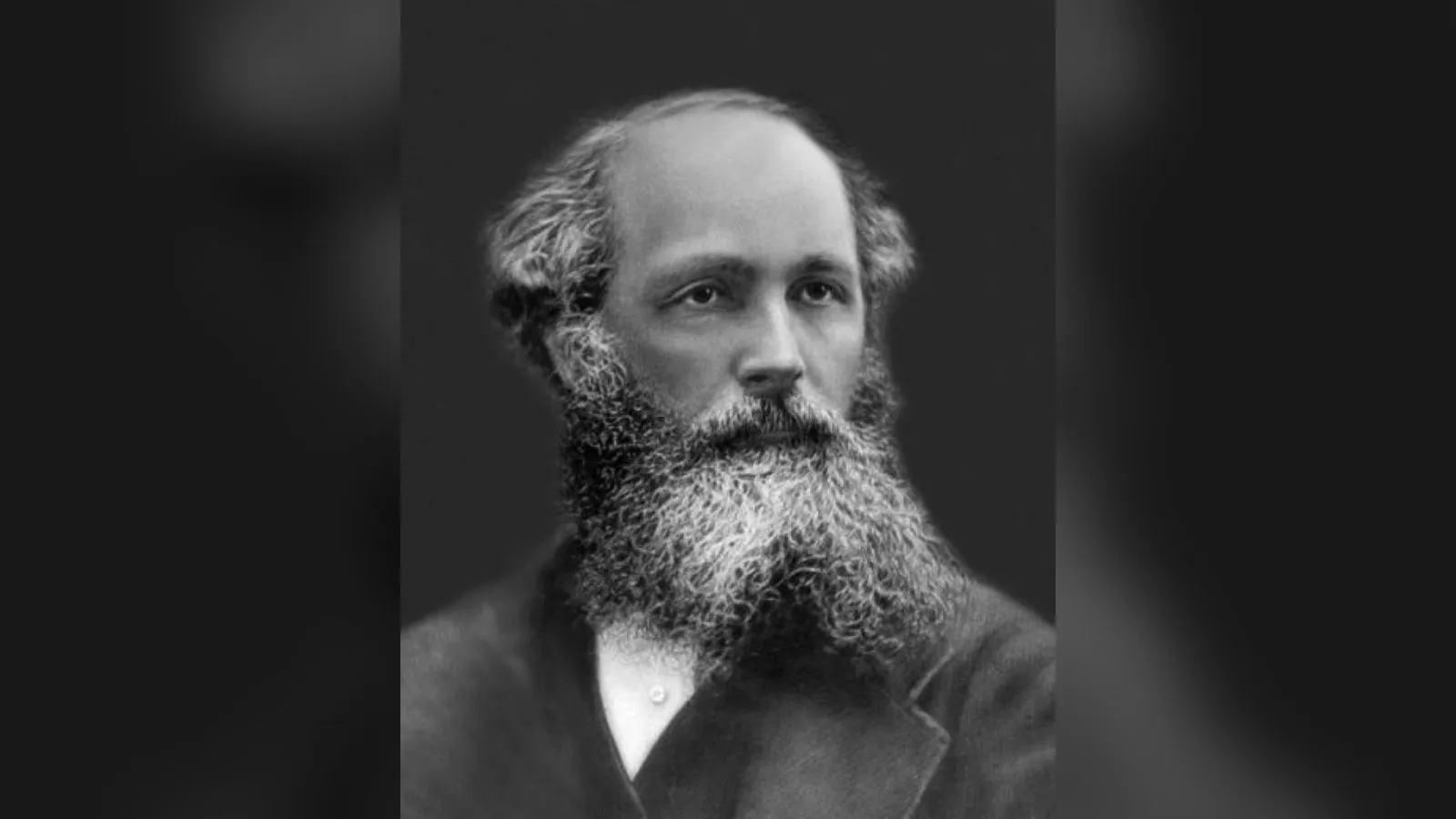

James Clerk Maxwell
Contents
James Clerk Maxwell, born in Edinburgh in 1831, showed that electricity, magnetism and light are aspects of one phenomenon. His equations predicted electromagnetic waves, the basis of radio, radar, television and wireless communication. He also explained Saturn's rings, helped found statistical physics, made the first durable colour photograph and designed the Cavendish Laboratory. Physicists rank him with Newton and Einstein. This card tests his achievements and some popular claims about him.
TL;DR
- established Maxwell was born at 14 India Street, Edinburgh, on 13 June 1831 and grew up at Glenlair in Galloway. At 14 he wrote a paper on oval curves that was read to the Royal Society of Edinburgh.
- established In "A Dynamical Theory of the Electromagnetic Field" (1865) and A Treatise on Electricity and Magnetism (1873) he unified electricity, magnetism and light. Heinrich Hertz confirmed electromagnetic waves in 1887, after Maxwell's death.
- established He showed that Saturn's rings must be made of many separate particles, derived the distribution of molecular speeds in a gas, and on 17 May 1861 presented the first durable colour photograph using three colours.
- established He was the first Cavendish Professor of Experimental Physics at Cambridge from 1871. He died of abdominal cancer on 5 November 1879, aged 48.
- traditional The claims that he had the highest IQ ever recorded, and that Einstein said he stood "on Maxwell's shoulders", are not supported by evidence.
Key Facts
- Born
- 13 June 1831, 14 India Street, Edinburgh
- Family home
- Glenlair, Galloway
- First paper
- Oval curves, read to the Royal Society of Edinburgh in 1846
- Education
- Edinburgh Academy; University of Edinburgh; Cambridge (Second Wrangler, 1854)
- Marischal College, Aberdeen
- Professor from 1856
- King's College London
- Professor from 1860
- First colour photograph
- 17 May 1861
- Electromagnetic theory
- 1865 paper; 1873 Treatise
- Cavendish Professor
- From March 1871; laboratory opened 16 June 1874
- Died
- 5 November 1879, Cambridge
- Buried
- Parton, Galloway
Scottish Impact Index (SI Score)
- Global Influence
- 10/10
- Enduring Relevance
- 10/10
- Material Contribution
- 9/10
- Exceptional Achievement
- 10/10
- Lasting Legacy
- 10/10
- Recognition
- 7/10
56/60
Ranked =5th of 200 in Great Scots
A Note on Claims and Evidence
Each major claim carries one of three labels. established means supported by primary records, official bodies or several independent reliable sources. shared means the core fact is sound but sources disagree on details, dates or interpretation. traditional means widely repeated but not traceable to a primary or independent source.
Maxwell's scientific work survives in his published papers and books, and his life is recorded in the 1882 biography by Lewis Campbell and William Garnett. His achievements need no exaggeration, but popular sources add some: an "IQ" figure, an undocumented Einstein quotation, and an unqualified claim to the "first colour photograph". Some dates, such as that of his Adams Prize essay, are given differently in different sources.
Timeline
James Clerk Maxwell is born in Edinburgh.
He starts at the Edinburgh Academy.
His paper on oval curves is read to the Royal Society of Edinburgh.
He studies at the University of Edinburgh.
He graduates from Cambridge as Second Wrangler.
He becomes Professor of Natural Philosophy at Marischal College, Aberdeen.
He marries Katherine Mary Dewar.
His essay on Saturn's rings wins the Adams Prize.
He moves to King's College London.
He presents the first durable colour photograph at the Royal Institution.
"A Dynamical Theory of the Electromagnetic Field" is published.
"On Governors" lays foundations for control theory.
He becomes the first Cavendish Professor of Experimental Physics.
A Treatise on Electricity and Magnetism is published.
The Cavendish Laboratory opens.
Maxwell dies at Cambridge.
Heinrich Hertz confirms the existence of electromagnetic waves.
Details
Birth, family and early education
James Clerk Maxwell was born on 13 June 1831 at 14 India Street in Edinburgh's Georgian New Town, the only child of John Clerk Maxwell, an advocate of the Clerk family of Penicuik, and Frances Cay. The "Maxwell" surname was added by his father on inheriting the Middlebie estate in Galloway. When James was young the family moved to Glenlair, a house his father built on the estate of about 1,500 acres. His mother Frances took charge of his early education but died of abdominal cancer when James was eight.
His curiosity was famous from toddlerhood — "what's the go o' that?" and "show me how it doos" were constant questions, recorded in a family letter written when he was not yet three. From 1841 he attended the Edinburgh Academy, where he befriended Lewis Campbell (later his biographer) and Peter Guthrie Tait (later a leading physicist). At 14 he produced his first paper, "On the Description of Oval Curves," simplifying earlier work of Descartes; it was read to the Royal Society of Edinburgh in 1846 by Professor James Forbes because Maxwell was considered too young to present it himself.
He studied at the University of Edinburgh (1847–1850), then went to Cambridge, entering Peterhouse in October 1850 before migrating to Trinity College, where fellowships were easier to obtain. He graduated in 1854 as Second Wrangler and joint winner of the Smith's Prize, and was elected a Trinity fellow in 1855.
Academic career
Maxwell became Professor of Natural Philosophy at Marischal College, Aberdeen in 1856, at age 25. When Marischal merged with King's College to form the University of Aberdeen in 1860, his post was made redundant; he applied unsuccessfully for the Edinburgh chair (lost to his friend Tait) and was appointed Professor of Natural Philosophy at King's College London in 1860, where the most productive five years of his career unfolded. In 1865 he resigned and returned to Glenlair, writing much of his great work there, before accepting appointment as the first Cavendish Professor of Physics at Cambridge in 1871.
Electromagnetism — Maxwell's equations
Maxwell's supreme achievement was unifying electricity, magnetism and light. Building on Faraday's experimental concept of fields, he developed the theory across a series of papers — "On Faraday's Lines of Force" (1856), "On Physical Lines of Force" (1861–62, introducing the crucial displacement current), and the definitive "A Dynamical Theory of the Electromagnetic Field" (1865). The 1865 paper presented a field theory stripped of mechanical models, derived an electromagnetic wave equation, and found the waves travel at a speed matching the measured speed of light. Maxwell concluded that "light consists in the transverse undulations of the same medium which is the cause of electric and magnetic phenomena."
His "A Treatise on Electricity and Magnetism" (1873) is the comprehensive statement of the theory. Maxwell's original formulation comprised 20 equations; Oliver Heaviside recast them into the four compact vector equations now taught, around 1884. The physicist Freeman Dyson, in an essay for the James Clerk Maxwell Foundation (1999), wrote that "we can see clearly that Maxwell's paper was the most important event of the nineteenth century in the history of the physical sciences," adding that including the biological sciences it was "second only to Darwin's 'Origin of Species'." Richard Feynman likewise judged, in the Feynman Lectures on Physics (1964, Vol. II), that "from a long view of the history of mankind — seen from, say, ten thousand years from now — there can be little doubt that the most significant event of the 19th century will be judged as Maxwell's discovery of the laws of electrodynamics," remarking that "the American Civil War will pale into provincial insignificance in comparison." Heinrich Hertz confirmed electromagnetic waves experimentally in 1887, opening the path to radio, radar, television and all wireless technology. Maxwell did not live to see it.
Saturn's rings (1859 Adams Prize)
For the 1857 Adams Prize, St John's College Cambridge set the problem of the stability of Saturn's rings. Maxwell devoted roughly two years to it, proving mathematically that a solid ring would be unstable and a fluid ring would break into blobs; the rings must therefore consist of numerous small particles (he called them "brick-bats") each independently orbiting Saturn. He won the prize in 1859 with "On the Stability of the Motion of Saturn's Rings," and was the only entrant to submit a substantial essay. The Voyager and Cassini spacecraft later confirmed the particulate nature of the rings.
Kinetic theory and Maxwell's demon
Maxwell was the first to derive the statistical distribution of molecular speeds in a gas — the Maxwell–Boltzmann distribution — developed between 1859 and 1866 and later generalised by Ludwig Boltzmann. This work, foundational to statistical mechanics, replaced certainty with probability in thermodynamics. His wife Katherine assisted with experiments on gas viscosity. In his 1871 book "Theory of Heat" he introduced the thought experiment later called "Maxwell's demon," a hypothetical being sorting fast and slow molecules through a trapdoor to seemingly violate the second law of thermodynamics. The paradox stimulated decades of work linking thermodynamics and information theory, culminating in Leó Szilárd's analysis and Rolf Landauer's principle.
Colour theory and the first colour photograph (1861)
Maxwell's work on colour vision showed that any colour can be matched by combining red, green and blue light — the basis of additive colour and modern screens. On 17 May 1861, at a Royal Institution lecture on colour theory, he presented the first durable colour photograph: a tartan ribbon, photographed by Thomas Sutton three times through red, green and blue filters, then projected through matching filters and superimposed. The wet-collodion plates of the era were nearly insensitive to red and green. As Ralph M. Evans of the Kodak Research Laboratories established when he re-investigated the experiment in 1961 (published in Scientific American, November 1961, "Maxwell's Color Photography"), the partial success of the red-filtered exposure was due to ultraviolet light reflected by the red dye that the red filter also transmitted. This connects to the site's existing pillar on "The First Permanent Colour Photograph"; Maxwell's interest was in the physics of light and vision, not photography itself, and he made no further effort to develop the technology.
The Cavendish Laboratory
Appointed the first Cavendish Professor of Experimental Physics in March 1871, Maxwell designed the Cavendish Laboratory, funded by a £6,300 benefaction from William Cavendish, 7th Duke of Devonshire. It opened on 16 June 1874. Maxwell established experimental physics teaching at Cambridge and devoted much of his final years to editing the unpublished electrical papers of Henry Cavendish, after whom (and the Duke's relative) the laboratory is named. The lab he founded went on to produce discoveries including the electron, the neutron and the structure of DNA.
Personal life, faith and death
In June 1858 Maxwell married Katherine Mary Dewar, daughter of the Principal of Marischal College; the marriage was childless and was described by his biographer as one of "unexampled devotion." Katherine assisted in his colour and gas experiments — Maxwell's paper "On the Theory of Compound Colours" records observations by an anonymous "observer K," confirmed to be Katherine. Maxwell was a devout Christian, an elder of the church near Glenlair, who memorised scripture and wrote poetry, including the comic "Rigid Body Sings," a parody of Burns. From 1877 he suffered the symptoms of abdominal cancer; told in October 1879 he had about a month to live, he died on 5 November 1879 at Cambridge, aged 48. After a funeral service at Trinity College Chapel he was buried at Parton churchyard, Galloway, where Katherine joined him after her death in 1886.
Honours and legacy
Maxwell is widely ranked among the greatest physicists ever. In Physics World's November–December 1999 millennium poll of leading physicists, he finished third, behind Einstein (first) and Newton (second). He is commemorated by: the "maxwell" (Mx), the CGS unit of magnetic flux; Maxwell Montes, the highest mountain range on Venus; a lunar crater; the Maxwell Gap in Saturn's rings; asteroid 12760 Maxwell; the James Clerk Maxwell Telescope near the summit of Maunakea, Hawaii (its 15-metre dish makes it the largest single-dish telescope in the world dedicated to submillimetre astronomy; it began operations in 1987); the James Clerk Maxwell Building at the University of Edinburgh; and a statue by Alexander Stoddart unveiled on George Street, Edinburgh, in 2008, showing Maxwell holding a colour wheel with his dog Toby at his feet. The James Clerk Maxwell Foundation, a Scottish charity founded in 1977, maintains the museum at his birthplace.
A Scottish education, and Kelvin's worry
The philosopher Alexander Broadie stresses the breadth of Maxwell's Scottish education. At Edinburgh University he read logic and metaphysics under Sir William Hamilton and also attended classes in moral philosophy, physics and chemistry, a formation he valued all his life. It shows in his inaugural lecture at Marischal College, Aberdeen, in 1856 and in an essay arguing that determinism is not supported by particle physics. The family link to the Enlightenment was direct: his great-grandfather George Clerk Maxwell went on geological field trips with James Hutton.
Broadie also notes how unsettling Maxwell's ideas were to his contemporaries. His work on the kinetic theory of gases showed that the second law of thermodynamics is a statistical law rather than an absolute one. Lord Kelvin named the thought experiment "Maxwell's demon", and was permanently troubled by the statistical view of physical reality it implied, though he never managed to overturn Maxwell's argument.
Did You Know?
- "What's the go o' that?" As a toddler Maxwell relentlessly demanded to know how everything worked, a trait recorded in a family letter before he was three.
- A poet as well as a physicist. Maxwell wrote witty verse, including "Rigid Body Sings" ("Gin a body meet a body / Flyin' through the air"), a pastiche of Robert Burns he reportedly sang while playing guitar.
- Father of control theory. His 1868 paper "On Governors" mathematically analysed steam-engine speed regulators and is regarded as a founding work of control theory and cybernetics — a status revived after Norbert Wiener highlighted it in 1948.
- Maxwell Montes is exceptional on Venus. Almost all Venusian features are named for women; Maxwell Montes is one of only a handful of exceptions, named because his equations underpin the radar used to map the planet.
- He edited Henry Cavendish's papers. Maxwell spent much of his final years editing the unpublished electrical researches of the reclusive 18th-century scientist Henry Cavendish.
- A statue with a dog. The Edinburgh statue includes Maxwell's dog Toby; the Maxwells always kept a dog and always named it Toby.
FAQ
1What is Maxwell most famous for?
Unifying electricity, magnetism and light in a single theory, expressed in Maxwell's equations.
2Did Maxwell discover radio waves?
He predicted electromagnetic waves; Heinrich Hertz demonstrated them in 1887.
3What did he discover about Saturn's rings?
That they must be made of many small separate particles, not solid or liquid rings.
4Did he take the first colour photograph?
He presented the first durable colour photograph made by the three-colour method, in 1861, though its success was partly lucky.
5What is Maxwell's demon?
A thought experiment about a being that sorts fast and slow molecules, used to explore the second law of thermodynamics.
6Why was he called "Dafty" at school?
Because of his rural accent, home-made clothes and shy manner.
7Did he have the highest IQ ever?
No. He never took an IQ test; such figures are later estimates.
8Did Einstein say he stood on Maxwell's shoulders?
That quotation is not documented.
9Where is he buried?
At Parton in Galloway.
10How is he commemorated?
By the unit called the maxwell, a mountain range on Venus, a telescope, and a statue in Edinburgh's George Street.
Sources and Further Reading
Scholarly/Critical
- Alexander Broadie, "The Rise (and Fall?) of the Scottish Enlightenment", in T. M. Devine and Jenny Wormald (eds), The Oxford Handbook of Modern Scottish History (Oxford University Press, 2012)
Further Reading
- Lewis Campbell and William Garnett, The Life of James Clerk Maxwell (Macmillan, 1882)
Caveats: Myths and Disputed Claims
- Do not give Maxwell an IQ figure.
- Do not quote Einstein's "I stand on Maxwell's shoulders" as documented.
- Do not call the 1861 image the first colour photograph without qualification.
- Do not give a single unqualified date for the Adams Prize essay.
- Do not explain the "Dafty" nickname as a sign of low intelligence.
- Do not say Maxwell wrote the four equations in their modern form; Oliver Heaviside did, around 1884.
Card 031 · Great Scots