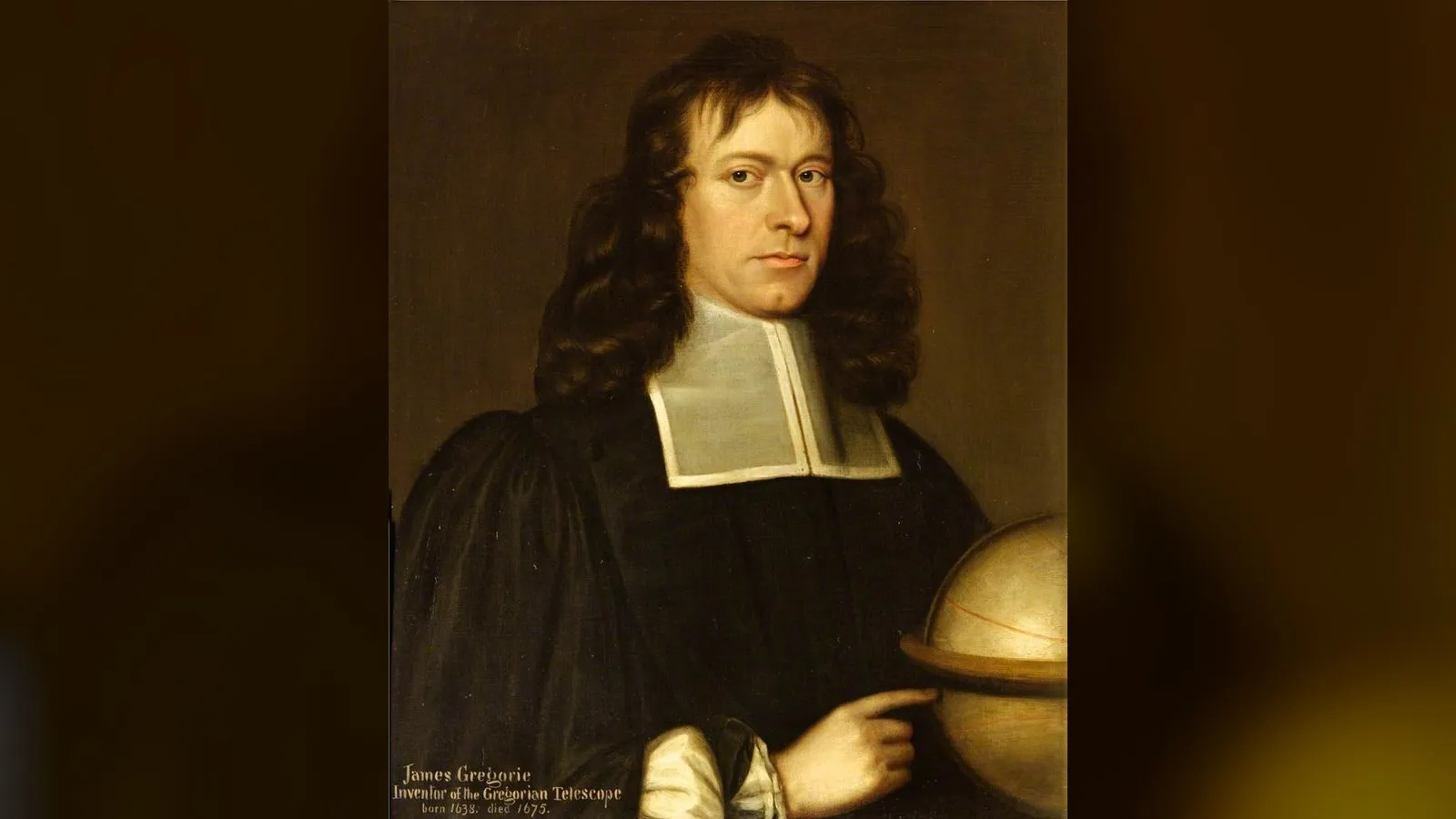

James Gregory (1638–1675)
Contents
TL;DR
- established Born in Drumoak, Aberdeenshire, Gregory designed the reflecting telescope that bears his name, the Gregorian telescope, in his 1663 treatise Optica Promota — a genuinely innovative design using a parabolic primary mirror and concave secondary mirror that eliminated both spherical and chromatic aberration, though Gregory himself lacked the practical optical skill to have one built, and no working example was constructed until roughly a decade after his death.
- established His 1668 work Geometriae Pars Universalis contained the first published statement and proof of what became known as the fundamental theorem of calculus, a genuinely foundational mathematical achievement that predates and, in important respects, parallels the independent and more famous work of Isaac Newton and Gottfried Leibniz.
- Shared/Traditional. Evidence suggests Gregory privately discovered methods for computing power series using higher derivatives — the technique later formalised and published by Brook Taylor in 1715 as "Taylor series" — decades before Taylor's publication, but withheld his own findings from publication, apparently believing he had merely rediscovered a method Isaac Newton had already developed; this article presents this as a genuine, documented case of an earlier independent discovery left unpublished, without overstating it into a settled priority dispute Gregory himself did not claim.
- established He became the first Regius Professor of Mathematics at the University of St Andrews in 1668, a position created for him by King Charles II, and established the first meridian line at St Andrews in 1673, predating the Greenwich meridian by roughly two centuries.
- established Gregory died suddenly in October 1675, aged just 36, days after suffering a stroke that caused temporary blindness while he was observing the moons of Jupiter with his students — a genuinely dramatic and premature end to a career this article does not understate.
Key Facts
- Born
- November 1638, Drumoak, Aberdeenshire, Scotland
- Died
- October 1675, Edinburgh, Scotland, aged 36
- Known for
- The Gregorian reflecting telescope; early work on calculus and infinite series
- Education
- Aberdeen Grammar School; Marischal College; University of Padua
- Academic posts
- First Regius Professor of Mathematics, University of St Andrews (1668); later Professor, University of Edinburgh
- Honour
- Fellow of the Royal Society (1668); a lunar crater bears his name
Scottish Impact Index (SI Score)
- Global Influence
- 5/10
- Enduring Relevance
- 8/10
- Material Contribution
- 3/10
- Exceptional Achievement
- 8/10
- Lasting Legacy
- 5/10
- Recognition
- 2/10
31/60
Ranked =84th of 200 in Great Scots
A Note on Claims and Evidence
Gregory's biography, his telescope design, and his documented mathematical publications are extensively recorded in mathematical and scientific historical scholarship and treated as Established. The evidence that he privately anticipated Taylor series decades before Brook Taylor's 1715 publication is treated as Shared/Traditional among historians of mathematics — well supported by surviving correspondence and later analysis of his papers, but resting on reconstructed evidence of unpublished work rather than a formal, contemporaneous claim of priority that Gregory himself advanced.
Timeline
Born in Drumoak, Aberdeenshire, to an Episcopalian minister and Janet Anderson, whose family had mathematical connections.
His father dies; his elder brother David takes responsibility for his upbringing.
Attends Marischal College, Aberdeen, earning an AM degree.
Publishes Optica Promota, proposing the reflecting telescope design that becomes known as the Gregorian telescope; visits London and meets scientist John Collins and Royal Society founder Robert Moray.
Travels to the University of Padua, studying under mathematician Stefano Angeli.
Publishes Vera circuli et hyperbolae quadratura in Italy.
Publishes Geometriae Pars Universalis, containing the first published statement and proof of the fundamental theorem of calculus; elected Fellow of the Royal Society; becomes the first Regius Professor of Mathematics at the University of St Andrews.
Sends mathematician John Collins a letter containing power series expansions for seven trigonometric functions, later known as "Gregory's series."
Establishes the first meridian line at St Andrews.
Moves to the University of Edinburgh as professor of mathematics.
Suffers a stroke causing temporary blindness while observing the moons of Jupiter with students; dies days later, aged 36.
Details
A mathematical upbringing in Aberdeenshire
Gregory was born in 1638 in Drumoak, Aberdeenshire, the son of an Episcopalian minister; his mother, Janet Anderson, came from a family with genuine mathematical connections through the earlier mathematician Alexander Anderson, and it was she who cultivated his early interest in geometry during his home education, following his father's death when Gregory was just twelve. He went on to study at Aberdeen Grammar School and Marischal College, earning his degree in 1657, before travelling to London in 1663, where he made connections with the scientist John Collins and Royal Society founder Robert Moray that would shape the remainder of his career.
A telescope design he could never build
In the same year, 1663, Gregory published Optica Promota, proposing an innovative reflecting telescope design using a parabolic primary mirror and a concave secondary mirror — a design that would, in principle, eliminate both the spherical and chromatic aberration that limited the refracting telescopes of the period, a genuinely significant theoretical advance in optical instrument design. This article notes directly, as a real and somewhat poignant limitation of his achievement, that Gregory himself lacked the practical optical and mechanical skill to have a working instrument built, and despite attracting serious interest from figures including Robert Hooke, no functioning Gregorian telescope was successfully constructed during Gregory's own lifetime — it fell to Hooke himself to build the first working example roughly a decade after Gregory's death, a gap between brilliant theoretical design and practical realisation this article treats as a genuine, documented feature of his story rather than a minor technicality.
Continental study and major mathematical publications
Gregory travelled to the University of Padua in 1664, studying under the mathematician Stefano Angeli and absorbing the influence of leading Italian mathematical thought of the period, publishing two significant geometric treatises while abroad: Vera circuli et hyperbolae quadratura in 1667 and Geometriae Pars Universalis in 1668. The latter work contained what is now recognised as the first published statement and proof of the fundamental theorem of calculus — connecting the operations of differentiation and integration — a genuinely foundational mathematical result that predates the more widely credited, independently developed work of Isaac Newton and Gottfried Leibniz, and which earned explicit acknowledgment from the prominent English mathematician Isaac Barrow.
An early, unpublished brush with Taylor series
Gregory's mathematical correspondence, particularly a notable 1671 letter to John Collins containing power series expansions for seven trigonometric functions — subsequently termed "Gregory's series" — provides strong supporting evidence that he had independently developed methods for computing power series using higher derivatives decades before Brook Taylor formally published the technique in 1715, in what became known as the Taylor series. This article presents this genuinely significant finding carefully: Gregory appears to have withheld his own results from publication, apparently believing, by some accounts, that he had merely rediscovered a method Isaac Newton had already developed independently, rather than making any public claim to have anticipated it. This reported modesty — or caution — on Gregory's part means his documented early insight into the technique is best understood as a real, evidenced case of an earlier independent discovery left unpublished, rather than as a formal priority dispute Gregory himself ever pressed.
Academic recognition and a historic meridian
Gregory's return to Britain brought substantial recognition: elected a Fellow of the Royal Society in 1668, he became the first Regius Professor of Mathematics at the University of St Andrews that same year, a chair specifically created for him by King Charles II, likely at the recommendation of his earlier acquaintance Robert Moray. In 1673, he established the first meridian line at St Andrews — a genuinely notable achievement that predated the establishment of the Greenwich meridian, which would later become the international standard, by roughly two centuries. He went on to take up a further professorship at the University of Edinburgh, continuing his mathematical and astronomical work there.
A sudden, dramatic death
Gregory's career ended abruptly and dramatically: roughly a year after assuming his Edinburgh professorship, in October 1675, he suffered a stroke that caused sudden blindness while observing the moons of Jupiter alongside his students — a vivid, well-documented final scene this article preserves rather than reducing to a vague account of illness. He died just days later, aged only 36, cutting short a career whose mathematical achievements, properly understood, place him among the most significant and genuinely under-recognised figures of seventeenth-century European mathematics.
Did You Know?
- The Gregorian telescope design was never successfully built during Gregory's own lifetime, despite his genuine optical innovation.
- He appears to have privately discovered the mathematical technique later known as the "Taylor series" roughly four decades before Brook Taylor's 1715 publication.
- He established the first meridian line at St Andrews in 1673, roughly two centuries before the Greenwich meridian became the international standard.
- He was the first person to hold a Regius Professorship of Mathematics at the University of St Andrews, a chair created specifically for him by King Charles II.
- He discovered a form of diffraction grating by observing sunlight passing through a bird's feather, independently of Isaac Newton's prism experiments.
- He died suddenly after suffering a stroke that caused temporary blindness while observing the moons of Jupiter with his students.
- A lunar crater is named in his honour.
- His nephew David Gregory also became a prominent mathematician and professor.
FAQ
1What is James Gregory best known for?
Designing the Gregorian reflecting telescope and making foundational early contributions to calculus, including the first published proof of the fundamental theorem of calculus.
2Did Gregory ever actually build his telescope?
No — despite his innovative design, he lacked the practical skill to construct one, and no working example was built until roughly a decade after his death.
3Did he discover Taylor series before Brook Taylor?
Strong evidence from his correspondence suggests he privately developed the underlying technique decades earlier, but he did not publish it, apparently believing he had merely rediscovered a method of Isaac Newton's.
4How did James Gregory die?
He suffered a stroke that caused sudden blindness while observing Jupiter's moons with students in October 1675, dying days later, aged 36.
5What was his connection to St Andrews?
He became the university's first Regius Professor of Mathematics in 1668 and established the first meridian line there in 1673.
6Where was he born?
Drumoak, Aberdeenshire, Scotland, in 1638.
7Was he related to other notable scientists?
Yes — his nephew David Gregory also became a prominent mathematician and professor.
8What other scientific discovery is he credited with?
Independently identifying a form of diffraction grating by observing sunlight pass through a bird's feather.
Sources and Further Reading
Caveats: Myths and Disputed Claims
- Clarification: Gregory's early anticipation of Taylor series is sometimes presented as a settled priority dispute with Brook Taylor. This article treats it instead as a well-evidenced but unpublished earlier discovery, since Gregory himself did not press a public priority claim and appears to have believed he was rediscovering Newton's work.
- Note: The Gregorian telescope is widely associated with Gregory's name despite his never having successfully built one; this article is explicit that the design, not a constructed instrument, is his documented personal achievement.
Card 156 · Great Scots