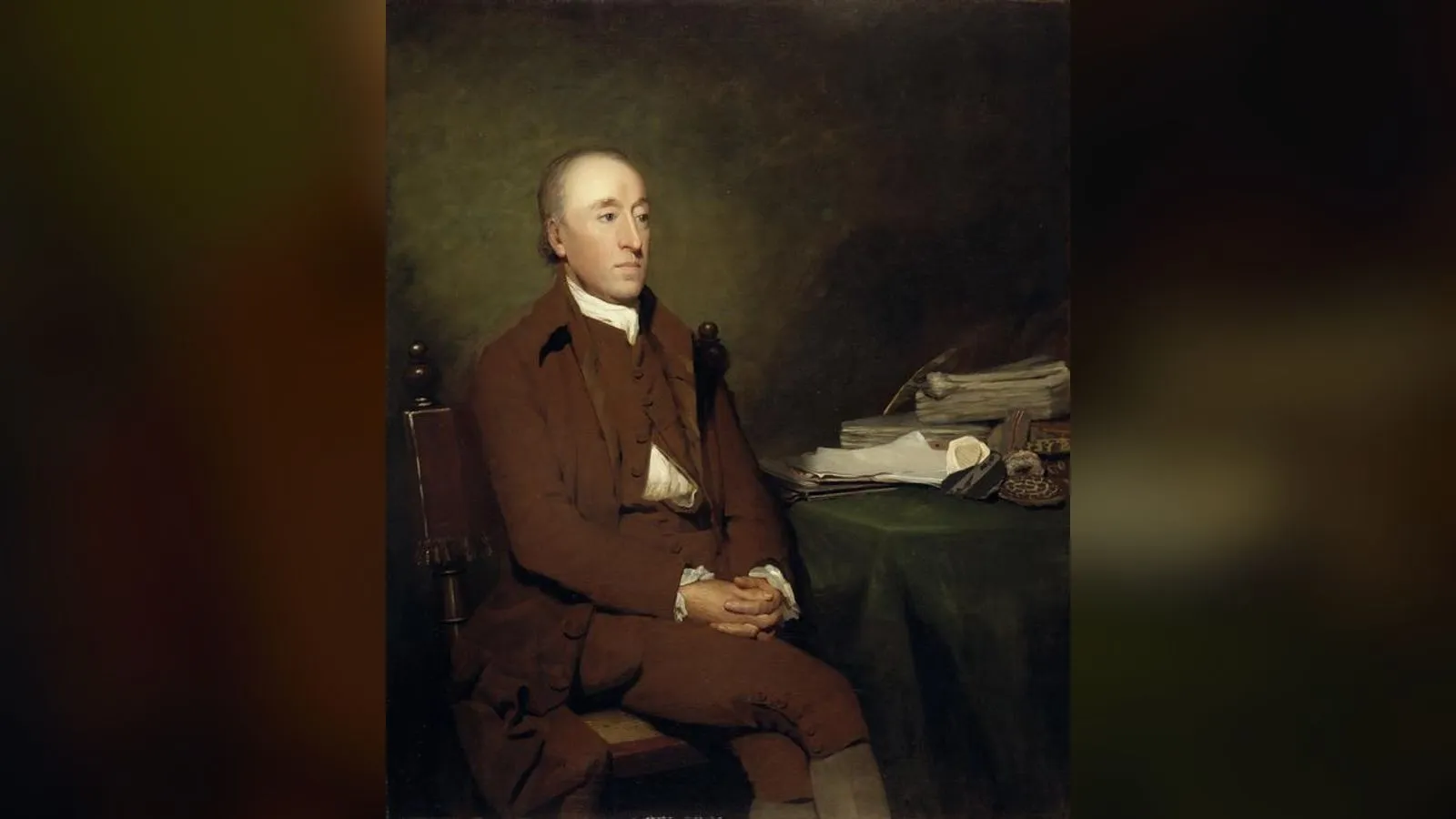

James Hutton (1726–1797)
Contents
TL;DR
- Established/Documented. Hutton overturned the near-universal assumption that the Earth was a few thousand years old, arguing from direct field observation of rock formations that geological processes required vastly longer timescales than anyone had previously proposed — the foundation of what is now called "deep time."
- Established/Documented. His famous 1788 field trip to Siccar Point on the Berwickshire coast, where horizontal sandstone sits visibly atop near-vertical older rock, remains one of the most celebrated moments in the history of science — his companion John Playfair wrote that "the mind seemed to grow giddy by looking so far into the abyss of time."
- Established/Documented. Hutton's ideas were genuinely controversial in his own time, not merely difficult — they directly contradicted a widely held biblical chronology (some contemporaries cited a specific creation date of 4004 BC) and were attacked by critics as effectively atheistic.
- Established/Documented, and central to understanding his historical obscurity. Hutton was not a household name in his own lifetime, and this wasn't a later myth invented for dramatic effect — his dense, difficult prose genuinely limited how many people read and understood his work; his ideas only reached a wide audience after his death, via John Playfair's clearer 1802 restatement of them.
- Shared/Traditional, worth nuance. He's widely called the "father of modern geology" and credited with foreshadowing evolutionary thinking. Both are broadly fair, but his own theory of cyclical, non-directional geological change differs from how modern geology actually understands Earth's history, and his speculation about species adaptation stopped well short of anything resembling Darwinian evolution.
Key Facts
- Born
- 3 June 1726, Edinburgh
- Died
- 26 March 1797, Edinburgh (aged 70)
- Education
- University of Edinburgh; medical studies in Paris and at Leiden (MD, 1749)
- Careers
- Briefly considered medicine; ran a successful sal ammoniac chemical business; farmed in Berwickshire; ultimately a full-time natural philosopher
- Major work
- "Theory of the Earth" (read to the Royal Society of Edinburgh 1785, published 1788; expanded two-volume edition, 1795)
- Key concepts
- Deep time; uniformitarianism ("the present is the key to the past"); the rock cycle; Plutonism
- Key site
- Siccar Point, Berwickshire — the unconformity that became geology's most famous outcrop
- Modern title
- Widely known as the "father of modern geology"
Scottish Impact Index (SI Score)
- Global Influence
- 8/10
- Enduring Relevance
- 10/10
- Material Contribution
- 3/10
- Exceptional Achievement
- 10/10
- Lasting Legacy
- 9/10
- Recognition
- 5/10
45/60
Ranked #24 of 200 in Great Scots
How This Article Handles the Evidence
Hutton is unusual among 18th-century scientific figures in that his obscurity during his own lifetime is itself a well-documented historical fact, not a romantic exaggeration added later. This article treats that obscurity, and the specific mechanism by which his ideas eventually reached a wide audience — largely through a friend's more readable summary of his work, published after his death — as central to his story rather than a footnote. It also treats his tentative, unpublished speculation about species adaptation carefully, distinguishing it clearly from Darwinian evolution rather than inflating the connection.
Timeline
Born in Edinburgh, son of a merchant; his father dies when James is three.
Enrols at the University of Edinburgh at age 14, initially studying classics; later apprenticed to a lawyer before abandoning that path.
Studies medicine in Edinburgh, then Paris, then at the University of Leiden.
Obtains his medical doctorate at Leiden with a thesis on blood circulation; never establishes a substantial medical practice.
Returns to Edinburgh; partners with John Davie in a successful business manufacturing sal ammoniac from soot, previously available in Britain only through Egyptian imports.
Inherits farms in Berwickshire (Slighhouses and Nether Monynut); spends years farming and closely observing the land and rock formations, later writing that he had "become very fond of studying the surface of the earth."
Becomes a central figure in Edinburgh's intellectual circle, close to Adam Smith, David Hume, chemist Joseph Black, and mathematician John Playfair; co-founds the informal Oyster Club for weekly discussion with Smith and Black.
Builds a house at St John's Hill, Edinburgh, overlooking Salisbury Crags — rock formations that fed directly into his geological thinking.
Joint founder of the Royal Society of Edinburgh, which becomes the primary venue for his scientific work, since he never held a university post.
Presents his "Theory of the Earth" to the Royal Society of Edinburgh (7 March and 4 April); undertakes his first major geological field excursion, to Glen Tilt in the Cairngorms, observing granite intrusions that contradict the prevailing theory of rock formation.
Identifies an angular unconformity on the Isle of Arran, then the "Great Unconformity" near Jedburgh — tilted older rock beneath horizontal younger strata.
With Playfair and James Hall, visits Siccar Point on the Berwickshire coast, finding a further, now-famous example of unconformity; his "Theory of the Earth" is published in the Transactions of the Royal Society of Edinburgh.
Publishes an expanded, two-volume edition of Theory of the Earth, responding to critics including Richard Kirwan, who had characterised his ideas as effectively atheistic.
Dies in Edinburgh, aged 70, after several years of severe illness from bladder stones; buried in Greyfriars Kirkyard near his close friend Joseph Black.
John Playfair publishes Illustrations of the Huttonian Theory of the Earth, restating Hutton's ideas in far more accessible language and giving them the wide readership Hutton's own writing had failed to achieve.
Charles Lyell's Principles of Geology, building on Hutton and Playfair, firmly establishes uniformitarianism as a foundational principle of geology and goes on to influence Charles Darwin directly.
Details
An unlikely path to geology
Hutton's route to becoming one of the most consequential scientific thinkers of the Scottish Enlightenment was anything but direct. Born in Edinburgh in 1726 to a merchant family, he initially trained in medicine — studying in Edinburgh, Paris, and finally Leiden, where he took his doctorate in 1749 with a thesis on blood circulation. He never built a medical practice. Instead, back in Edinburgh, he turned to industrial chemistry, successfully manufacturing sal ammoniac (ammonium chloride) from soot in partnership with John Davie — a product previously imported from Egypt, and one that made Hutton financially independent.
It was farming, not formal scientific training, that gave Hutton his real education in geology. Inheriting land in Berwickshire in the early 1750s, he spent years working the soil directly, developing an intense, practical interest in the physical structure of the land itself. As he put it himself in 1753, he had "become very fond of studying the surface of the earth" — a fondness that would, over three decades of patient observation, harden into one of the most consequential theories in the history of science.
Edinburgh's intellectual circle
By the 1760s Hutton was thoroughly embedded in Edinburgh's Enlightenment intellectual life, on close terms with Adam Smith, David Hume, chemist Joseph Black, and mathematician John Playfair — the last of whom would later prove crucial to Hutton's posthumous reputation. Hutton, Smith, and Black together founded the informal Oyster Club for weekly discussion among Edinburgh's leading minds. In 1783 Hutton was a joint founder of the Royal Society of Edinburgh, which — since he never held a university position — became the principal venue through which he presented his scientific work to the world.
Deep time and the rock cycle
Hutton's central insight, developed gradually over three decades of direct field observation rather than arrived at in a single flash of inspiration, was that the Earth's visible rock formations could only be explained by processes of erosion, deposition, compaction, and uplift operating over enormously long stretches of time — far longer than the few thousand years most of his contemporaries assumed. This is now generally referred to as "deep time," and Hutton's articulation of it represents a fundamental break with the prevailing understanding of Earth's history in his era.
Closely related is the principle now known as uniformitarianism: that the same geological forces observable acting in the present — erosion, sedimentation, volcanic and tectonic activity — were also responsible for shaping the Earth in the past, given sufficient time to act. This is often summarised as "the present is the key to the past," and it stands in direct opposition to explanations relying on singular catastrophic or supernatural events.
Hutton proposed what is now called the rock cycle: land eroded by wind and water is carried into the sea as sediment, consolidated into new rock under heat and pressure, and eventually uplifted again to form new land — a process he envisioned as capable of repeating indefinitely. This also placed him firmly on the "Plutonist" side of a major scientific debate of the era, against the dominant "Neptunist" view (associated with the German geologist Abraham Werner) that virtually all rock had originally precipitated out of a universal ocean. Hutton instead argued that the Earth's internal heat was the primary driving force behind rock formation and geological change.
The unconformities, and Siccar Point
Hutton's theoretical framework needed physical evidence, and he found it in a specific and now-famous category of rock formation: the angular unconformity, where clearly older, tilted or vertical rock layers sit directly beneath younger, horizontal layers — physical proof, if correctly interpreted, of immense spans of time involving deposition, uplift, erosion, and renewed deposition.
His first major fieldwork excursion, to Glen Tilt in the Cairngorms in 1785, found granite visibly intruding into surrounding schist in a way that indicated the granite had once been molten — directly contradicting Neptunist assumptions about how granite formed. In 1787 he found unconformities on the Isle of Arran and, later that year near Jedburgh, what became known as the "Great Unconformity," recording his reaction plainly: he "rejoiced at my good fortune in stumbling upon an object so interesting in the natural history of the earth."
The most celebrated of these discoveries came in spring 1788, when Hutton, accompanied by Playfair and James Hall, visited the Berwickshire coast at Siccar Point and found a striking example washed bare by the sea — near-vertical grey older rock (greywacke) directly overlain by younger horizontal Old Red Sandstone. Hutton himself called it "a beautiful picture of this junction." Playfair's own account of the moment has become one of the most quoted passages in the history of geology: "the mind seemed to grow giddy by looking so far into the abyss of time." Established/Documented: Siccar Point remains, to this day, one of the most visited and celebrated geological sites in the world, largely because of this specific 1788 visit.
Controversy — genuinely religious, not merely academic
Established/Documented, and worth stating without softening: Hutton's theory was not simply an abstract scientific disagreement among specialists — it collided directly with a widely held biblical chronology that placed the Earth's creation only a few thousand years in the past (a chronology some contemporaries dated with striking specificity, to 4004 BC). Hutton's famous closing formulation in his 1788 paper — "we find no vestige of a beginning, no prospect of an end" — was received by some critics, notably the chemist Richard Kirwan, as effectively atheistic, since it appeared to remove any need for a divine act of creation with a definite starting point. Hutton's expanded 1795 edition of Theory of the Earth was, in part, a direct response to this criticism. This religious dimension of the controversy is essential context, not incidental detail — Hutton was proposing something that genuinely threatened the intellectual foundations many of his contemporaries took for granted.
Why he wasn't famous in his own lifetime
Established/Documented: despite his closeness to some of the most celebrated minds of the Scottish Enlightenment — Adam Smith, David Hume, and later Robert Burns among his Edinburgh circle — Hutton died in 1797 without his geological theory having achieved anything like the wide recognition it would eventually receive. The primary documented reason was not neglect or suppression, but Hutton's own famously difficult prose: his writing was dense, technical, and hard to follow even for engaged contemporary readers. John Playfair himself later observed candidly that "the great size of the book, and the obscurity which may justly be objected to many parts of it, have probably prevented it from being received as it deserves." It took Playfair's own considerably more readable 1802 restatement, Illustrations of the Huttonian Theory of the Earth, to bring Hutton's ideas to a genuinely wide audience — and it was this more accessible version, rather than Hutton's own original text, that fed forward into Charles Lyell's hugely influential Principles of Geology in the 1830s, and from there into the scientific milieu that shaped the young Charles Darwin.
A speculative brush with evolutionary thinking
In an unpublished work, Elements of Agriculture, Hutton speculated about how animals might become better adapted to their environments over generations — describing, for instance, how dogs with greater "swiftness of foot and quickness of sight" would tend to survive and reproduce while less capable animals would "be the most subject to perish." Disputed/worth precise framing: this has sometimes been presented as an early anticipation of Darwinian natural selection, and some scholars have speculated whether Darwin, who studied in Edinburgh decades later, might have had some indirect exposure to Hutton's ideas. However, Hutton explicitly rejected the idea that such adaptive variation could give rise to genuinely new species, and interpreted the phenomenon instead as evidence of a benevolent divine design suited to his own deist worldview — a fundamentally different conclusion from Darwin's. This article treats the connection as a genuine point of historical interest, not as evidence that Hutton anticipated evolutionary theory in any meaningful modern sense.
Final years and legacy
From 1791, Hutton suffered severely from bladder stones, a condition that forced him to abandon further fieldwork and focus his remaining energy on completing his written work; a surgical attempt to treat the condition failed. He died in Edinburgh in March 1797, aged 70, unmarried, and was buried in Greyfriars Kirkyard near his close friend Joseph Black. He had a son, James Smeaton Hutton, born outside marriage, with whom he had minimal recorded involvement — a detail modern biographical accounts include rather than omit.
Hutton's modern reputation as the "father of modern geology" rests on a real and substantial foundation: he was the first to articulate, from direct and patient field observation, both the immense timescale over which the Earth's surface had actually formed and a set of processes — uniform, ongoing, and non-catastrophic — sufficient to explain that formation without appeal to supernatural intervention. Shared/Traditional, worth the precise caveat: his own model imagined this process as an essentially endless, cyclical one, without a clear directional history — a picture modern geology has since substantially revised in favour of an Earth with a specific, datable formation and a directional geological and biological history. His fundamental insight about deep time and uniform process, however, remains foundational to the science as practised today.
Did You Know
- Hutton's geology had a determined critic in the mining engineer John Williams. His Natural History of the Mineral Kingdom (1789) defended a biblical chronology against Hutton's deep time, while also issuing one of the first warnings that Britain's coal could run out (Jonsson, 2013).
- Hutton trained as a doctor and ran a successful industrial chemical business — manufacturing sal ammoniac from soot — before turning to geology at all.
- His years as a working farmer in Berwickshire gave him the direct, hands-on familiarity with the land that shaped his entire geological theory.
- His most famous phrase — "no vestige of a beginning, no prospect of an end" — was considered so radical that a leading contemporary chemist accused him of effective atheism.
- His companion John Playfair's account of visiting Siccar Point with Hutton in 1788 — "the mind seemed to grow giddy by looking so far into the abyss of time" — is one of the most quoted lines in the history of science.
- Hutton was, by most accounts, a genuinely difficult writer, and this — not obscurity of subject or lack of connections — is the well-documented reason his ideas weren't widely read during his own lifetime.
- It took a friend's more readable summary of his work, published five years after Hutton's death, to bring his ideas to a wide audience at all.
- In an unpublished agricultural manuscript, Hutton speculated about how animals adapt to their environments over generations — but explicitly rejected the idea that this could produce new species, unlike Darwin decades later.
- His name lives on today in the James Hutton Institute, a major Scottish research organisation, and — more unexpectedly — in a 1989 punk song by the American band Bad Religion that quotes his most famous line.
Field trips with the Clerks
The philosopher Alexander Broadie notes that Hutton demonstrated his theory in the field, often with friends such as the artist John Clerk of Eldin and John's brother George Clerk Maxwell. George Clerk Maxwell was the great-grandfather of the physicist James Clerk Maxwell, one of several threads that tie the eighteenth-century Enlightenment to nineteenth-century Scottish science.
Broadie also stresses that the Kirk's response was divided. Some ministers attacked Hutton's theory, but the "moderate party" in the Church of Scotland was comfortable with Enlightenment inquiry, and most of the leading literati were themselves practising Calvinists.
Frequently Asked Questions
1Was James Hutton famous during his own lifetime?
Not especially, despite his closeness to figures like Adam Smith and David Hume. His writing was genuinely difficult to read, and his geological theory only reached a wide audience after his death, through John Playfair's much clearer 1802 restatement of it.
2What exactly did Hutton discover at Siccar Point?
An angular unconformity — a striking visible junction where near-vertical older rock is directly overlain by horizontal younger sandstone — which he and his companions correctly interpreted as physical proof of the vast timescales his theory required.
3Why were his ideas considered controversial or even blasphemous?
Because they directly contradicted a widely accepted biblical chronology placing the Earth's creation only a few thousand years in the past. His conclusion that geological history showed "no vestige of a beginning, no prospect of an end" was attacked by at least one prominent contemporary critic as effectively atheistic.
4Did Hutton anticipate Darwin's theory of evolution?
Only in a limited, speculative sense. In an unpublished manuscript he described how animals better suited to their environment tend to survive and reproduce — but he explicitly rejected the idea that this process could create new species, interpreting it instead as evidence of divine design. This is a genuine point of historical interest, not a case for Hutton as an unrecognised evolutionary theorist.
5Was Hutton a professional scientist or university academic?
No — he trained in medicine, ran a successful chemical manufacturing business, and farmed for years before devoting himself to geology. He never held a university post; his main scientific platform was the Royal Society of Edinburgh, which he helped found.
6How is his theory different from modern geology?
Hutton envisioned Earth's history as an essentially endless, repeating cycle without a fixed starting point. Modern geology has since established that the Earth does have a specific, datable origin and a directional geological history — but Hutton's core insights about deep time and uniform, gradual process remain foundational to the science.
7Why is he called the "father of modern geology"?
Because he was the first to argue, from sustained direct field observation rather than theory alone, that ordinary processes acting over vast timescales — not sudden catastrophe or divine intervention — could explain the Earth's rock formations, a framework (uniformitarianism) that underpins the modern discipline.
Sources and Further Reading
Primary/Institutional
- James Hutton, "Theory of the Earth; or an Investigation of the Laws observable in the Composition, Dissolution, and Restoration of Land upon the Globe," Transactions of the Royal Society of Edinburgh (1788)
- John Playfair, Illustrations of the Huttonian Theory of the Earth (1802)
- James Hutton — Edinburgh Geological Society
- James Hutton — Scottish Geology Trust
Scholarly
- Fredrik Albritton Jonsson, Enlightenment's Frontier: The Scottish Highlands and the Origins of Environmentalism (Yale University Press, 2013)
- The Blasphemous Geologist Who Rocked Our Understanding of Earth's Age — Smithsonian Magazine
- James Hutton — Britannica
- Alexander Broadie, "The Rise (and Fall?) of the Scottish Enlightenment", in T. M. Devine and Jenny Wormald (eds), The Oxford Handbook of Modern Scottish History (Oxford University Press, 2012)
General
Caveats: Myths and Disputed Claims
- The Oxford Handbook dates Archbishop Ussher's calculation of the Creation (to 4004 BC) to 1685. Ussher's Annales Veteris Testamenti was published in 1650, and he died in 1656.
- "Hutton was a celebrated, famous figure in his own time." Corrected directly — he was well-connected but not widely read, and his fame is substantially posthumous, driven by Playfair's clearer 1802 restatement of his ideas.
- "Hutton anticipated Darwinian evolution." Overstated in some popular accounts; his own unpublished speculation about adaptation explicitly rejected species change and was framed as evidence of divine design, a materially different conclusion from Darwin's.
- His theory as originally stated envisioned an essentially cyclical, non-directional Earth history — a model modern geology has since revised, even as his core insights about deep time and gradual process remain foundational.
- The controversy around his work is presented here as genuinely religious in nature, not merely a dry academic dispute, since some contemporaries explicitly accused him of atheism.
Card 037 · Great Scots