
James IV
Contents
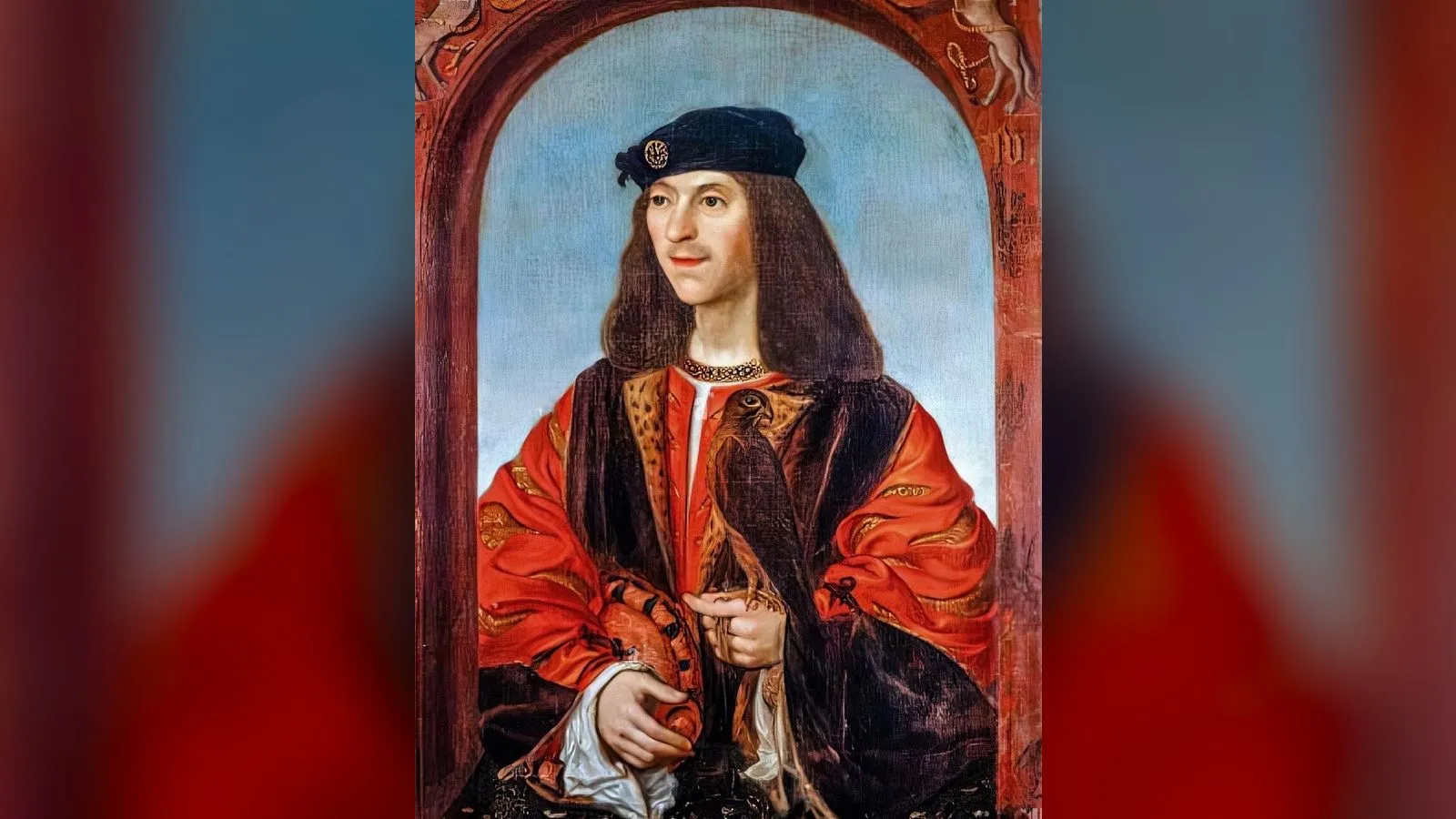
James IV, King of Scots from 1488 to 1513, is often called the most successful of the Stewart kings. He broke the Lordship of the Isles, built the greatest warship in Europe, licensed Scotland's first printing press and filled his court with poets, surgeons and alchemists. His marriage to Margaret Tudor led, a century later, to the Union of the Crowns. Then he invaded England and died at Flodden with much of his nobility. This card tests the Renaissance king against the stories told about him.
TL;DR
- established James was born at Stirling Castle on 17 March 1473. Aged 15, he was the figurehead of the noble rebellion that defeated and killed his father, James III, at Sauchieburn on 11 June 1488.
- established He forfeited the Lordship of the Isles in 1493, built a royal navy including the Great Michael (launched 1511), and licensed Scotland's first printing press in 1507.
- established In 1502 he made the Treaty of Perpetual Peace with England, and on 8 August 1503 he married Margaret Tudor. Their great-grandson James VI inherited the English throne in 1603.
- established He invaded England in support of France and was killed at Flodden on 9 September 1513, the last monarch in the British Isles to die in battle. His body was never buried.
- established His Treasurer's accounts name more harpers and clàrsach players than any other Scottish source of the period, including the Galbraith family of Gaelic harpers from Galloway.
- traditional The story that he wore an iron belt all his life in penance for his father's death, adding a link each year, comes from a chronicler writing some 80 years later.
Key Facts
- Born
- 17 March 1473, Stirling Castle
- Parents
- James III and Margaret of Denmark
- Sauchieburn
- 11 June 1488; James III killed
- Crowned
- 24 June 1488, Scone
- Lordship of the Isles forfeited
- May 1493
- Treaty of Perpetual Peace
- 24 January 1502
- Married Margaret Tudor
- 8 August 1503, Holyrood
- Royal College of Surgeons
- Seal of Cause 1505
- First Scottish printing press
- Chepman and Myllar, chartered 1507
- Great Michael launched
- 12 October 1511, Newhaven
- Flodden
- 9 September 1513
- Scottish dead at Flodden
- Estimates from about 5,000 to 15,000
Scottish Impact Index (SI Score)
- Global Influence
- 5/10
- Enduring Relevance
- 9/10
- Material Contribution
- 3/10
- Exceptional Achievement
- 5/10
- Lasting Legacy
- 5/10
- Recognition
- 4/10
31/60
Ranked =84th of 200 in Great Scots
A Note on Claims and Evidence
Each major claim carries one of three labels. established means supported by primary records, official bodies or several independent reliable sources. shared means the core fact is sound but sources disagree on details, dates or interpretation. traditional means widely repeated but not traceable to a primary or independent source.
James IV's reign is documented in royal accounts, parliamentary records, treaties and the reports of foreign ambassadors such as the Spaniard Pedro de Ayala. Many of the most colourful stories, including the iron belt and the manner of his father's death, come from Robert Lindsay of Pitscottie and other chroniclers writing decades later. Figures for Flodden and for the Great Michael are estimates.
Timeline
James is born at Stirling Castle.
Rebels led in his name defeat James III at Sauchieburn; the king is killed.
James IV is crowned at Scone.
An unnamed harper plays for the king at Linlithgow, the first harper in his Treasurer's accounts.
Parliament declares the Lordship of the Isles forfeit to the crown.
King's College, Aberdeen, is founded under Bishop Elphinstone.
Pedro de Ayala writes his famous description of the king.
The accounts pay "Pate harpar on the harp" and "Pate harper on the clarsach" side by side, distinguishing gut-strung and wire-strung harps.
The Treaty of Perpetual Peace with England is concluded.
James marries Margaret Tudor at Holyrood.
The Edinburgh surgeons receive their Seal of Cause.
Chepman and Myllar receive the charter for Scotland's first press; John Damian attempts to fly from Stirling Castle.
The Great Michael is launched at Newhaven.
James invades England in support of France.
James is killed at Flodden.
His great-grandson James VI becomes King of England.
Details
1. Birth, Origins and a Childhood Among Rebellions
James was born on 17 March 1473 at Stirling Castle, the eldest of three sons of King James III of Scotland and Queen Margaret of Denmark. As heir apparent he was Duke of Rothesay from birth, and he spent most of his infancy and youth at Stirling in his mother's care; in 1478 Margaret was formally entrusted with his custody and education.
Relatively little is documented about his early years, but he received a good humanist education from Archibald Whitelaw, the scholar and royal secretary, and the theologian John Ireland. His upbringing was shaped by the chronic instability of his father's reign. James III was widely disliked by the Scottish nobility — criticised for relying on low-born favourites, debasing the coinage, hoarding money and failing to enforce justice. As a small child James had even been betrothed (in 1474) to Cecily, daughter of Edward IV of England, as part of his father's unpopular pro-English foreign policy; the match never happened.
By the late 1480s, aristocratic resentment had hardened into open revolt — and the rebels needed a respectable figurehead. They found one in the teenage heir.
2. The Rebellion and Accession (1488): Sauchieburn and the Iron Belt
In the spring of 1488 a powerful faction of nobles took the 15-year-old prince as their nominal leader; he began styling himself "Prince of Scotland." After months of manoeuvring, the royal and rebel armies met on 11 June 1488 at Sauchieburn, a stream about two miles south of Stirling, near the field of Bannockburn (James III pointedly carried Robert the Bruce's sword into battle). The royal army was routed, and James III was killed — in the official rebel phrasing, he "happinit to be slane."
How James III actually died is genuinely uncertain. The vivid later legend — that the wounded king fled, fell from his horse at a mill, and was stabbed by a man impersonating a priest — derives from unreliable 16th-century chroniclers (Pitscottie, Lesley, Buchanan) writing decades after the event, and there is no contemporary evidence for it. The younger James is said to have extracted oaths that his father would not be harmed; whether that is true or later exculpatory spin is impossible to verify.
The iron belt — handle with care. The most repeated story about James IV is that, consumed by guilt, he wore a heavy iron chain or belt next to his skin for the rest of his life, adding a link or weight every year. This is repeated by the Royal Family's own website and countless popular sources — but it deserves explicit scepticism:
- The narrative source is Robert Lindsay of Pitscottie, writing in the 1570s, some 80 years after Sauchieburn and well after James IV's death. He was not a contemporary witness, and his account of the period is widely regarded as propagandistic, designed to absolve James IV and blacken his father and the Catholic clergy.
- The one documentary anchor is an entry in the Accounts of the Lord High Treasurer recording purchase of an iron chain/belt for the king — dated to around January 1507, roughly nineteen years after Sauchieburn. That timing undercuts the popular claim that he donned it in grief in 1488 and added to it yearly from then.
- The old Dictionary of National Biography already noted the penance was "somewhat ostentatious," worn (to judge from his portraits, such as the 1591 Seton Armorial) over his clothing rather than secretly next to the skin — suggesting symbolic/iconographic display as much as private mortification.
The sober reading: James was a conspicuously pious king (frequent pilgrimages to Whithorn and Tain, lay-brother affiliations), and may well have worn a penitential belt in later life. But the romantic "lifelong guilt from age fifteen, a link a year" version is embellishment, not established fact.
The new regime consolidated power with remarkable speed — James issued his first charter on 12 June, only a day after the battle — and he was crowned at Scone on 24 June 1488. He saw off a serious counter-rebellion in 1489 and, unusually for a Stewart, achieved a broad-based settlement: by the end of his reign his royal council embraced an exceptionally wide spread of magnates.
3. A Renaissance Prince
James IV is the textbook example of the Renaissance monarch in Scotland. Pedro de Ayala, the Spanish ambassador resident at his court, sent Ferdinand and Isabella a famous pen-portrait in July 1498:
"The King is 25 years and some months old. He is of noble stature, neither tall nor short, and as handsome in complexion and shape as a man can be… He speaks the following foreign languages: Latin, very well; French, German, Flemish, Italian, and Spanish… His own Scots language is as different from English as Aragonese from Castilian. The King speaks, besides, the language of the savages who live in some parts of Scotland and on the islands."
The languages — what the evidence actually supports. The "seven (or more) languages" claim is essentially Ayala's. The strongest evidence:
- Latin — "very well" (Ayala); consistent with his humanist education.
- French, German, Flemish, Italian, Spanish — listed by Ayala; Spanish singled out (he liked receiving Spanish letters and pronounced it "more distinctly" than a named marquis).
- Gaelic — Ayala's "language of the savages… on the islands" is taken to mean Scottish Gaelic. James is generally held to be the last Scottish monarch known to have spoken Gaelic.
- Claims sometimes added (Danish, etc.) go beyond Ayala and should be treated cautiously. Ayala was a flatterer with a diplomatic agenda, so the list is best presented as a contemporary testimonial rather than a verified language CV.
Medicine and dentistry. James had a genuine, hands-on fascination with surgery. The Treasurer's accounts record him paying his subjects to let him pull their teeth and try bloodletting and wound-dressing — an unusual inversion (the patient was paid, not the practitioner). The Royal College of Surgeons of Edinburgh traces its foundation to a Seal of Cause granted by Edinburgh Town Council on 1 July 1505, confirmed by a royal charter from James IV on 13 October 1506 — making it, by its own account, the oldest surgical college in the world. He is also credited with encouraging early medical teaching at Aberdeen.
Alchemy and the flying abbot. James funded an alchemy laboratory at Stirling (and Holyrood), staffed by the Italian John Damian de Falcuis, hunting for the "quinta essentia" and the transmutation of base metals into gold. Damian's enduring fame rests on his attempt, in September 1507, to fly from the walls of Stirling Castle using feathered wings — he crashed, broke his thigh (or leg), and reportedly blamed his failure on hen feathers among the eagle plumage, since hens "covet the middens and not the sky." The episode is documented in two near-contemporary sources: the satirical poems of William Dunbar (who loathed Damian) and the more sympathetic later account of Bishop John Lesley. Treasurer's records confirm Damian was real, richly paid, and still at court gambling with the king years later. The detail level varies between the two literary sources, so the more colourful flourishes (a flock of birds attacking him, the precise height) are literary embellishment.
The arts. His court was the high point of the "makars" — Scotland's Chaucerian court poets. William Dunbar was its central figure (his works include "The Thrissil and the Rois" and the "Lament for the Makaris"). Robert Henryson (Testament of Cresseid; Morall Fabillis), though not strictly a court poet, belongs to the same flowering, and Gavin Douglas completed his Eneados in 1513 — the first full translation of Virgil's Aeneid into any Anglic language. James also kept a cosmopolitan, music-loving household, with French, Italian and German minstrels, and was devoted to tournaments and chivalric display.
3a. Harpers and Clàrsach Players at Court
established The record. The Lord High Treasurer's accounts for James's reign are the richest source anywhere for harping in medieval Scotland. Keith Sanger and Alison Kinnaird, in Tree of Strings (1992), the standard history of the harp in Scotland, worked through them name by name. The first harper they found is an unnamed musician who played for the king at Linlithgow at Easter 1491, paid on the same occasion as Blind Harry and a fiddler called Bennat. From then on harpers appear constantly, either as court musicians on regular wages or as travelling players rewarded for one performance.
Two kinds of harp. The clerks usually distinguished the "harp", probably the gut-strung harp of the European courts, from the "clarsach", the wire-strung Gaelic harp. On 13 April 1501 the accounts pay "Pate harpar on the harp, Pate harper on the clarsach, James Mylson harpar, the Ireland clarsach, and an English harpar" 13 shillings each, as quoted by Sanger and Kinnaird. Two men called Pate Harper were on the books at once, and only the instrument told them apart. Sanger and Kinnaird found that harps were paid most often in Lowland and east-coast places such as Linlithgow, Elgin and Dingwall, and clàrsachs mostly in the west and the Highland fringe: Dumbarton, Balquhidder, Glenluce, Wigtown, Inchmahome and Ayr.
The Galbraith harpers. The best-documented family are the MacBhreatnaich, or Galbraiths, Gaelic clàrsach players from Galloway. "Martyn harper clarsach" appears from 1491, often with "toder Ersche clareschaw" (the other Gaelic harper), perhaps his son. The Exchequer rentals show Martyn holding Clutag and Knockann near Wigtown from at least 1471; John MacBhreatnaich, "clarshioner", took over the tacks in 1489–90; and Rolland MacBhreatnaich received the tack of Knockann in January 1506 and appears at court from 1507. shared Sanger and Kinnaird identified Rolland with the harper Lachlann MacBhreatnaich mocked in a satirical Gaelic poem by Duncan Campbell of Glenorchy, who accuses him of begging young ladies for little dogs and ferrets. Both men are thought to have died at Flodden, and the Galbraiths no longer held Knockann after 1513.
Other court harpers. James Mylson, a harper and "minstrell", is paid from 1496; in 1497 the king gave him the forfeited goods of Thomas Young, a Perth goldsmith. Alexander Harper first appears on 15 November 1501, when he was given money towards a horse. Sanger and Kinnaird linked him, with reasonable confidence, to an Alexander Harper who owned property between the New Row and the Abbey wall in Dunfermline and who survived Flodden. In 1496 and 1497 the accounts pay "Johne harpar with the ane hand". Adam Dickson, paid between 1507 and 1512, is called a lutenist, a harper and a piper by turns, and in 1511 received five ells of russet for his livery gown. Payments to pairs and trios, such as a fiddler and a harper together, suggest that harps were often played in small consorts with fiddle and drum.
shared A murder on the books. In September 1503 a drummer named William, known at court as Guilliam, was outlawed for killing a Patrick Harper, and in May 1506 the king pardoned "William Broun alias Gilliam Tawbronare" for it. Yet Guilliam went on performing for the king, and both Pates were still paid on 1 January 1504. After that date the two are never listed together. Sanger and Kinnaird thought the harp-playing Pate was probably the victim, but the record does not settle it.
Harpers in the train of the great. Highland chiefs and churchmen brought their own players: the clàrsach players of Maclean and of the Earl of Argyll in September 1506, the Bishop of Ross's harper in 1506 and the Prior of Whithorn's clàrsach player in 1506–07. At Balquhidder in 1501 the king heard a clàrsach player and "tua Heland bardis". The accounts for 1506–07 also record a leather case bought for a clàrsach, and in 1513 a payment to "Odonelis harpar", the harper of the Irish lord O'Donnell. After Flodden this world faded fast: James V preferred viols and lutes, and harpers became rare in the royal accounts.
4. Government, Justice and the Navy
James was a serious and effective ruler, not merely a glittering one.
The Lordship of the Isles (1493). The semi-independent Norse-Gaelic Lordship of the Isles, held by Clan Donald, had long rivalled the crown in the west; John MacDonald II had even treasonously allied with Edward IV of England in 1462. With the Lordship fracturing, the Scottish Parliament declared it forfeit to the crown in May 1493. James personally toured the west by sea — arriving at Dunstaffnage in August 1493 — receiving the chiefs' submissions; John MacDonald was pensioned off and lived out his days in the Lowlands. The "daunting of the Isles" was real but incomplete: the crown struggled to provide stable governance afterwards, and the 16th century became known in the Gàidhealtachd as linn nan creach, "the time of raids."
Justice and Parliament. James took an unusually direct, personal interest in justice, driving the justice ayres (circuit courts) across the south and north-east, intervening in major noble feuds (e.g. the Drummonds and Murrays in Strathearn), and using law to assert royal authority. The earliest surviving justice-ayre records (Lauder and Jedburgh 1493, Selkirk 1495, Peebles 1498) date from his reign. The Education Act of 1496 required the eldest sons of barons and substantial freeholders to attend grammar school — described as Scotland's first education act. Crown revenue roughly doubled over the reign, with Treasurer's receipts rising from around £4,500 in 1496–97 to about £28,000 by 1512, funded partly by his 1498 act of revocation, feudal casualties and judicial fines.
Building programme. James spent lavishly on royal residences in the latest Renaissance idiom: he commissioned the Palace of Holyroodhouse (c.1501–1505), developed Falkland Palace (from 1501) as a hunting palace, and built at Stirling the magnificent Great Hall (completed c.1503) — "the grandest secular building erected in Scotland in the late Middle Ages."
The first standing navy. James founded royal dockyards and built or acquired dozens of ships. His core fleet included the Margaret, the James, the Treasurer and — above all — the Great Michael, a carrack laid down at the new dock at Newhaven and launched on 12 October 1511. At roughly 1,000 tons, with thick oak walls, four masts and a heavy gun armament, she was the largest ship afloat when launched, with about twice the displacement of England's Mary Rose — so formidable that Henry VIII responded by ordering the 1,000-ton Henri Grâce à Dieu ("Great Harry"). She reportedly cost around £30,000 Scots, against an annual royal revenue of roughly £35,000 — close to a full year's income. After Flodden she was sold to France in 1514 and her ultimate fate is uncertain (most accounts say she rotted at Brest; Norman Macdougall, in "James IV's Great Michael," suggested the unproven possibility that under her French name she fought at the Battle of the Solent in 1545).
5. The Treaty of Perpetual Peace and the Marriage of the Thistle and the Rose (1502–1503)
After years of friction — including James's support for the pretender Perkin Warbeck and a 1497 truce (Treaty of Ayton, brokered by Ayala) — England and Scotland concluded the Treaty of Perpetual Peace on 24 January 1502, the first full peace treaty between the kingdoms since 1328. It promised "good, real and sincere, true, sound, and firm peace… to last all time coming," and was reinforced by a papal guarantee threatening excommunication on whichever king broke it. James ratified it at the high altar of Glasgow Cathedral on 10 December 1502.
The treaty was sealed by a marriage. James IV married Margaret Tudor, eldest daughter of Henry VII, by proxy on 25 January 1503 (the Earl of Bothwell standing in for James), and in person on 8 August 1503 at Holyrood. James was about 30; Margaret was 13. William Dunbar celebrated the union with his allegorical poem "The Thrissil and the Rois" ("The Thistle and the Rose"), the thistle for Scotland and the rose for England.
This is genuinely one of the pivotal moments in British history. The "perpetual peace" itself collapsed within a decade — but the bloodline endured. James and Margaret's great-grandson, James VI of Scotland, inherited the English throne as James I in 1603: the Union of the Crowns, a direct consequence of the 1503 marriage 100 years earlier. Henry VII reportedly brushed aside fears that the match might one day bring Scotland into the English succession, predicting that the greater (England) would absorb the lesser — a prophecy that turned out backwards, since it was a Scottish king who gained London.
6. The Auld Alliance and Flodden (1513)
Relations with England curdled after the belligerent young Henry VIII succeeded Henry VII in 1509. Henry joined the Holy League against France and invaded France in 1513; under the terms of the Auld Alliance (the Franco-Scottish bond dating to 1295), Louis XII of France appealed to James to attack England as a diversion. James had earlier resisted French overtures, but Henry's provocations — and the appeal from Louis (and his queen, Anne of Brittany) — drew him in. James gave formal agreement to renew the alliance in 1512, sent his fleet (including the Great Michael) to join the French, and led a large army across the Tweed in August 1513. He had by then been excommunicated, the papacy having sided with England.
The battle (9 September 1513). The aged but wily English commander Thomas Howard, Earl of Surrey, marched north and manoeuvred his army around the Scots, threatening to cut James's line of retreat and forcing the Scots to shift from the strong position of Flodden Edge to Branxton Hill (the battle is sometimes called Branxton). Key factors in the catastrophe:
- Pikes vs bills. The Scots had adopted the continental/Swiss-style massed pike (some 5 yards / up to ~18 feet), supplied and trained by the French. But the pike needs disciplined movement and firm ground; on the boggy, downhill, slippery terrain the formations broke up, and the English bill — a shorter hooked polearm — proved deadlier at close quarters. Bishop Ruthall wrote that "the bills disappointed the Scots of their long spears."
- English longbows and well-placed artillery added to the carnage; the Scots' guns, shooting downhill, were largely ineffective.
- James himself charged into the thick of the fighting on foot — gallant but, as Ayala had foreseen, tactically reckless — and was killed close to Surrey's position, reportedly with an arrow wound to the jaw and his neck and hand slashed.
The toll. Estimates of Scottish dead vary widely. Encyclopædia Britannica's "Battle of Flodden" entry gives Scottish losses as 10,000 of about 30,000, against English losses of 1,500 of 26,000; Historic England's official Battlefield Report cites English estimates of Scottish dead "between 10,000 and 15,000," while George Buchanan's 1582 history gives a lower figure of around 5,000. Among the slain were the king, his illegitimate son Alexander Stewart (Archbishop of St Andrews), and a huge swathe of the nobility — nine earls, many barons and several churchmen. English losses were far lighter (often given as around 1,500, though some estimates reach 4,000). It was the last battle in which a British monarch was killed, and is often called the last great medieval battle in the British Isles. The grief is preserved in the lament "The Flowers of the Forest," still played at Scottish remembrance services; at Selkirk, the legend of the lone survivor returning with a captured flag is commemorated annually at the Common Riding.
James's infant son was crowned James V three weeks later, opening yet another destabilising royal minority.
7. The Strange Afterlife of the King's Body
James IV's death produced one of the genuine macabre mysteries of British royal history.
His body was found among the dead the next day, identified by captured Scottish soldiers and by Thomas, Lord Dacre. It was taken to Berwick, embalmed and sealed in lead, and transported south to the Carthusian monastery of Sheen (near Richmond Palace, Surrey). His blood-stained surcoat was sent to Henry VIII in France by Catherine of Aragon.
Then it simply… stopped. Because James had died excommunicated, he could not receive Christian burial. Henry VIII obtained the Pope's permission (late November 1513) to bury him honourably — even suggesting St Paul's — but no funeral ever took place. The embalmed, lead-wrapped body was left in a store-room/lumber-room at Sheen. The antiquarian John Stow later claimed to have been shown the body after the monastery's dissolution, "lapped in lead, throwne into an old waste roome, amongst old timber, stone, lead, and other rubble."
What happened next is unverifiable and partly grotesque legend:
- A widely repeated tale says workmen severed and played with the head; that Elizabeth I's master glazier, Lancelot Young, took the embalmed, still-red-haired head home as a curio in Wood Street, London, before it was eventually thrown into a charnel pit at the church of St Michael, Wood Street (Cripplegate). That church was later demolished and the site redeveloped.
- The site of Sheen now reportedly lies under a golf course (Royal Mid-Surrey).
- Border legends meanwhile insisted James survived, or was spirited away — including a 19th-century claim of a skeleton with a chain round its waist found in the well of Hume Castle (since vanished).
Bottom line: James IV almost certainly has no known grave, and the fate of his remains is, in honest terms, unknown.
8. Legacy and Reputation
James IV's standing among historians is high. He is "generally regarded as the most successful of the Stewart monarchs," and the standard modern biographer, Norman Macdougall (James IV, 1989/1997), presents him as a genuinely capable and audacious king rather than a doomed romantic. His achievements were real: a pacified and better-governed kingdom, a doubled revenue, a navy, a print culture, a flowering court, and Scotland negotiating as an equal in European affairs.
And yet the reign is forever read backwards through Flodden. As Macdougall himself observed, writers tend to keep James only briefly "on his precarious pedestal as a paragon of Scottish kingly virtues" before there is "a stampede towards the seemingly inevitable disaster of Flodden."
So how should Flodden be judged?
- Not simply reckless folly. Recent scholarship (e.g. George Goodwin's Fatal Rivalry, 2013) emphasises that James was responding to genuine English provocation by Henry VIII and to binding alliance obligations; the decision to intervene was defensible statecraft, not mere vanity.
- But the conduct of the campaign and battle was flawed. James lingered, allowed Surrey to outmanoeuvre him, surrendered his strong ground, adopted unfamiliar weapons his troops had not mastered, and then — exactly as Ayala had warned 15 years earlier — fought like a brave man-at-arms instead of a commanding general.
The fairest verdict is that Flodden was an honourable miscalculation by a gifted king — strategically reasonable, tactically disastrous — whose personal courage was also his undoing. Scotland lost not just a battle but a generation of leadership, and a king who, on the evidence of everything before September 1513, was the finest of his dynasty.
Did You Know?
- James IV paid people to let him pull their teeth — the king practised dentistry and surgery as a hobby, and the royal accounts record the fees he handed over to his patients.
- His court alchemist tried to fly to France from Stirling Castle in 1507 with feathered wings, crashed into a dunghill, broke a bone, and blamed the hen feathers for being too fond of the ground.
- He built the Great Michael, the biggest ship afloat in Europe when launched — so alarming to Henry VIII that England answered with the "Great Harry."
- His marriage to Margaret Tudor in 1503 is the reason a Scottish king inherited the English throne in 1603 — the Union of the Crowns was the long fuse lit by the "Thistle and the Rose."
- James IV was the last monarch in the British Isles to die in battle (Flodden, 1513).
- He may have been the last Scottish king to speak Gaelic.
- His body was never buried — it was left, embalmed and wrapped in lead, in a store-room near London, and his head allegedly ended up as a household curio before being tipped into a charnel pit.
- He chartered Scotland's first printing press (Chepman and Myllar, 1507) and confirmed the charter of the world's oldest surgical college (Edinburgh, 1505/1506).
- Two harpers called Pate Harper served James at the same time; the clerks told them apart as "Pate harpar on the harp" and "Pate harper on the clarsach".
- His accounts pay a "Johne harpar with the ane hand" in 1496 and 1497.
- James IV is reputed to have said that half the people of Nairn could not understand the other half, since one half spoke Gaelic and the other Scots.
FAQ
1How did James IV become king?
As the 15-year-old figurehead of a noble rebellion that defeated and killed his father at Sauchieburn in 1488.
2Did he wear an iron belt for his father's death?
A royal account of about 1507 records an iron belt or chain, but the story of a lifelong penance with a link added each year comes from a much later chronicler.
3How many languages did he speak?
The Spanish ambassador Pedro de Ayala said he spoke Latin, French, German, Flemish, Italian, Spanish and Gaelic. That is a flattering report, not a verified list.
4What was the Great Michael?
A huge warship launched in 1511, said to be the largest ship afloat in Europe at the time.
5Did James IV really pull people's teeth?
Yes. His treasurer's accounts record him paying subjects to let him do so.
6Who tried to fly from Stirling Castle?
His alchemist, John Damian, in 1507. He crashed.
7Why is his marriage so important?
His marriage to Margaret Tudor led to their great-grandson James VI inheriting the English throne in 1603.
8Why did he invade England in 1513?
To support France under the Auld Alliance, after Henry VIII invaded France.
9Why did the Scots lose at Flodden?
They were outmanoeuvred, left strong ground, and fought with long pikes on boggy ground against English bills, longbows and artillery.
10Where is James IV buried?
Nowhere known. His embalmed body was taken to Sheen in Surrey and never given a funeral.
11Did James IV employ harpers?
Yes, many. His Treasurer's accounts pay court harpers such as James Mylson, Alexander Harper and two men called Pate Harper, the Galbraith family of Gaelic clàrsach players, and travelling harpers across the country.
12What is the difference between a "harp" and a "clarsach" in his accounts?
The clerks used "clarsach" for the wire-strung Gaelic harp and "harp" for what was probably the gut-strung European harp, and sometimes paid both on the same day.
Sources and Further Reading
Specialist
- Keith Sanger and Alison Kinnaird, Tree of Strings: Crann nan Teud. A History of the Harp in Scotland (Kinmor Music, 1992), chapter 7
Scholarly/Critical
- Andrea Thomas, "The Renaissance", in T. M. Devine and Jenny Wormald (eds), The Oxford Handbook of Modern Scottish History (Oxford University Press, 2012)
Further reading
- Norman Macdougall, James IV (John Donald, 1989; new edn 2006)
- Andrea Thomas, Princelie Majestie: The Court of James V of Scotland, 1528–1542 (John Donald, 2005)
Caveats: Myths and Disputed Claims
- Do not present the lifelong iron belt, with a link a year, as fact.
- Do not repeat the story of James III's murder by a fake priest at a mill as fact; there is no contemporary evidence.
- Do not treat Ayala's list of languages as verified.
- Do not give a single exact figure for the Scottish dead at Flodden.
- Do not present the stories about the fate of James's head or body as fact; he has no known grave.
- Do not give the Great Michael's dimensions or cost as exact.
- Do not credit James personally with founding institutions such as King's College, Aberdeen.
- Do not present the identification of the court harper Rolland MacBhreatnaich with the Lachlann of Glenorchy's satire, or of the murdered Patrick Harper with the king's harper, as certain; both are reasonable inferences.
Card 004 · Great Scots