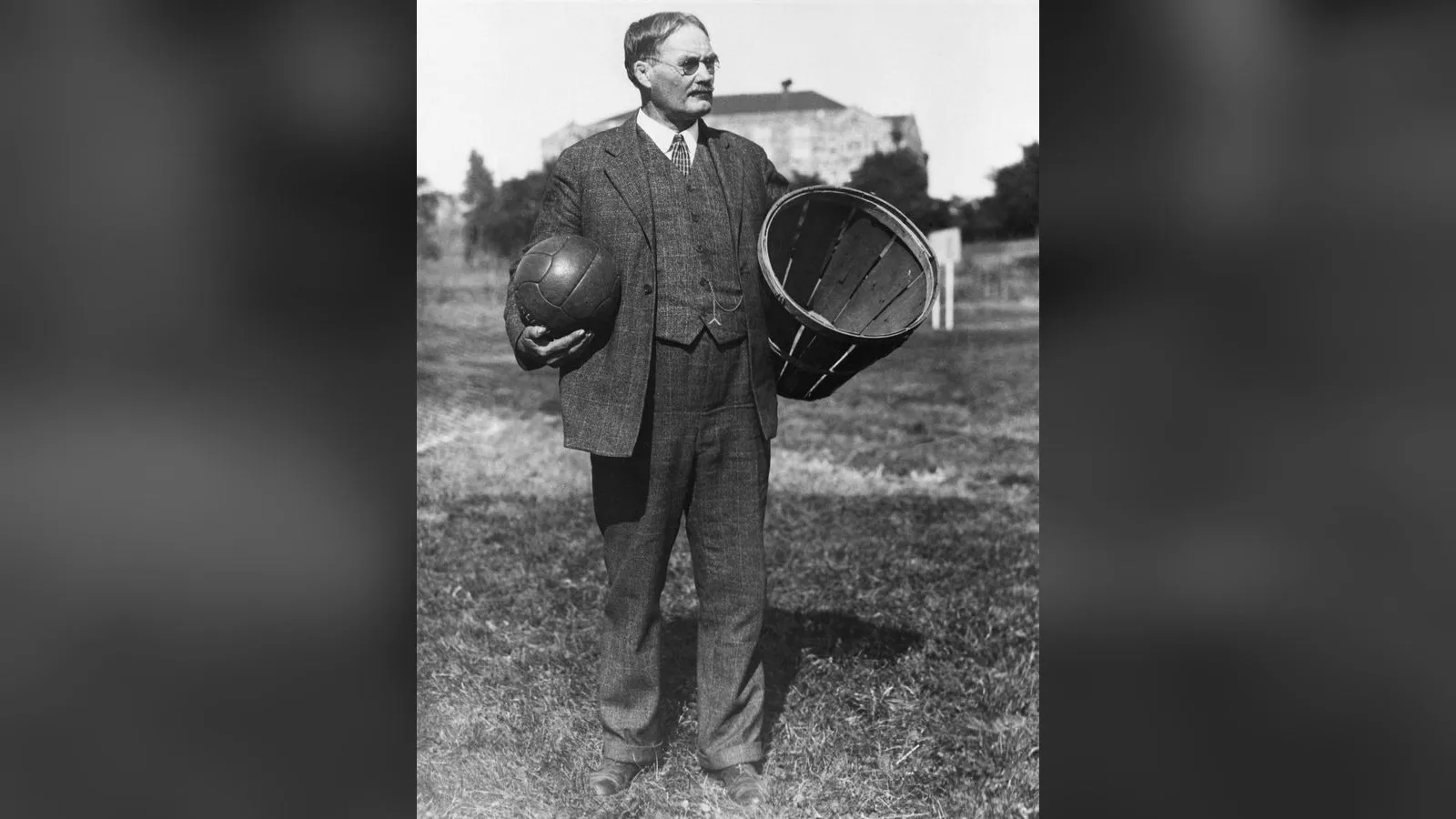

James Naismith (1861–1939)
Contents
TL;DR
- established Born in Almonte, Ontario, to Scottish immigrant parents, Naismith invented basketball in December 1891 while working at the YMCA Training School in Springfield, Massachusetts, tasked with creating an indoor winter activity for a restless physical education class.
- established His original 13 rules — drawing on elements of rugby, lacrosse, and a childhood game he had played in Ontario called "duck-on-a-rock" — emphasised safety and minimal physical contact, and the very first game was played with a soccer ball and two peach baskets nailed to a gymnasium balcony.
- established Naismith went on to found the basketball program at the University of Kansas, where he served as head coach from 1898 to 1907 — and compiled a losing record (55–60), the only losing coaching record in the university's basketball history, a genuinely notable fact given his status as the sport's inventor.
- established He held a notably skeptical, education-first view of the sport he created, favouring its value as physical and moral education for ordinary students over intensive competitive training — a perspective modern competitive basketball has moved well beyond.
- established He was orphaned as a child after losing both parents and a brother within a short period, was largely raised by relatives in the Almonte area, and went on to combine formal theological study with physical education — a combination that directly shaped his original conception of basketball as a vehicle for moral as well as physical development.
Key Facts
- Born
- 6 November 1861, Almonte, Ontario, Canada (to Scottish immigrant parents)
- Died
- 28 November 1939, Lawrence, Kansas, aged 78
- Known for
- Inventing basketball, December 1891, at the Springfield, Massachusetts YMCA Training School
- Education
- McGill University (BA, physical education); Presbyterian College theology studies; medical degree, Denver
- Coaching career
- University of Kansas, 1898–1907; career coaching record 55–60
- Military service
- WWI chaplain
Scottish Impact Index (SI Score)
- Global Influence
- 8/10
- Enduring Relevance
- 8/10
- Material Contribution
- 7/10
- Exceptional Achievement
- 9/10
- Lasting Legacy
- 8/10
- Recognition
- 6/10
46/60
Ranked =21st of 200 in Great Scots
A Note on Claims and Evidence
Naismith's invention of basketball, his original 13 rules, and the details of the first game are extensively documented, including in his own later writings, and are treated as Established. His University of Kansas coaching record and his documented skepticism toward intensive athletic competition are likewise Established from institutional and biographical records.
Timeline
Born in Almonte, Ontario, to Scottish immigrant parents.
Both parents die within a short period, along with a brother, leaving Naismith orphaned; he is raised by relatives in the Almonte area.
Attends McGill University, excelling across multiple sports and earning a BA in physical education.
Begins theological studies at Presbyterian College, Montreal, while also teaching physical education at McGill.
Moves to Springfield, Massachusetts, to study at the YMCA Training School.
Invents basketball, devising 13 original rules and running the first game using a soccer ball and two peach baskets as goals.
Marries Maude Sherman; the couple go on to have five children.
Joins the University of Kansas, founding its basketball program.
Serves as head basketball coach at Kansas, compiling a 55–60 record — the only losing record in the program's history.
Becomes an ordained Presbyterian minister (having completed earlier theological study).
Serves as a YMCA secretary and chaplain with American troops during the First World War.
Becomes a naturalised United States citizen.
Attends the Berlin Olympics, where basketball is included as an Olympic sport for the first time, and witnesses his invention played on a global stage.
His first wife, Maude, dies; he remarries, to Florence Kincaid, later that year.
Dies in Lawrence, Kansas, aged 78, from a brain hemorrhage.
Details
A hard Ontario childhood
Naismith was born in 1861 in Almonte, a small town in Ontario, to parents who had emigrated from Scotland. His childhood was marked by real early tragedy: both of his parents and a brother died within a short span of time when he was still a boy, and he was subsequently raised by relatives in the Almonte area. This article includes this directly rather than skipping past it, since the combination of hardship, physical activity, and later formal religious study shaped the moral and educational framework he would eventually bring to the invention of basketball.
From McGill athlete to Springfield innovator
Naismith proved an unusually versatile athlete at McGill University between 1883 and 1887, competing seriously in football, lacrosse, rugby, soccer, and gymnastics while earning a degree in physical education. He combined this athletic background with formal theological study at Presbyterian College in Montreal, teaching physical education at McGill in parallel — a dual grounding in sport and moral instruction that directly anticipated the purpose he would later assign to his most famous invention. In 1890 he moved to the YMCA Training School in Springfield, Massachusetts, where he was given a specific, practical problem: a physical education class of restless students needed an indoor activity to occupy them safely through the winter months, after earlier attempts at modified football and lacrosse had proven too rough for indoor play.
Inventing basketball
In December 1891, Naismith devised a new game built around 13 original rules, deliberately designed to minimise physical contact and reduce injury risk — a response, in part, to the rough indoor games that had preceded it. He drew inspiration from elements of rugby and lacrosse, as well as a childhood game he had played growing up in Ontario called "duck-on-a-rock," which involved throwing a stone in an arc toward a target rather than hurling it directly. The very first game, played with a soccer ball and two peach baskets nailed to the gymnasium balcony as goals, was by Naismith's own later account a modest beginning — "the class did not show much enthusiasm, but followed my lead," he recalled — a detail this article keeps because it offers an honest, grounded picture of the moment, rather than retrospectively dramatising what began as a practical classroom exercise into an instant sensation.
A losing record — from the man who invented the sport
Naismith went on to found the basketball program at the University of Kansas in 1898, coaching the team himself from 1898 to 1907. In a detail this article treats as a genuinely notable and worth-preserving fact rather than an embarrassing footnote to smooth over, his career coaching record at Kansas was 55 wins and 60 losses — the only losing record in the long history of the university's basketball program, despite Naismith being the sport's actual inventor. He went on to mentor Forrest "Phog" Allen, who became a far more successful coach at Kansas and established an influential coaching lineage that later produced figures such as Dean Smith and Adolph Rupp.
A reluctant evangelist for competitive sport
Naismith held a notably skeptical view of the direction competitive basketball would eventually take. He conceived of the game primarily as a tool for physical and moral education — a healthy, structured activity for ordinary young men — rather than as a vehicle for intensive athletic competition or spectacle, and he reportedly expressed reservations about the increasingly competitive emphasis basketball acquired even within his own lifetime. This perspective sits in genuine tension with the sport's eventual global, highly competitive development, a tension this article preserves rather than resolves in favour of a simple triumphant-inventor narrative.
Later life and a long career in education
Naismith combined his academic career at Kansas with ongoing religious and civic commitments, becoming an ordained Presbyterian minister and serving as a YMCA secretary and chaplain with American troops during the First World War. He became a naturalised United States citizen in 1925, and in 1936 travelled to the Berlin Olympics to witness basketball's debut as an Olympic sport — a notable full-circle moment for the game's inventor. His first wife, Maude Sherman, with whom he had five children, died in 1939; Naismith remarried later that same year, to Florence Kincaid, shortly before his own death from a brain hemorrhage in November 1939, at age 78.
Did You Know?
- The first basketball game was played with a soccer ball and two peach baskets — players had to retrieve the ball manually after each score, since the baskets had no open bottom.
- Naismith's own Kansas coaching record was a losing one, 55–60 — the only losing record in the program's history, despite his being the game's inventor.
- He drew on a childhood Ontario game called "duck-on-a-rock" when devising basketball's arcing shot mechanics.
- He was orphaned as a child, losing both parents and a brother within a short span of time.
- He attended the 1936 Berlin Olympics to see basketball's Olympic debut, decades after inventing it.
- He combined ordained ministry with his career in physical education and coaching.
- He mentored Phog Allen at Kansas, who became a far more successful coach and founded an influential coaching tree.
- His original 13 rules of basketball, handwritten in 1891, later sold at auction for millions of dollars.
FAQ
1Where was James Naismith born?
Almonte, Ontario, Canada, in 1861, to Scottish immigrant parents.
2When and why did he invent basketball?
In December 1891, while working at the YMCA Training School in Springfield, Massachusetts, tasked with creating a safe indoor winter activity for a restless physical education class.
3Was James Naismith a good basketball coach?
Not statistically — his career coaching record at the University of Kansas, 55–60, remains the only losing record in the program's history, despite his being the sport's inventor.
4What were the original baskets made from?
Peach baskets, nailed to the gymnasium balcony; they retained their closed bottoms, so the ball had to be retrieved manually after each score.
5Did he view basketball as a competitive sport?
Not primarily — he conceived of it mainly as physical and moral education for ordinary students, and held reservations about its eventual intensive competitive direction.
6Did he serve in the military?
Yes — he served as a YMCA secretary and chaplain with American troops during the First World War.
7Who did he mentor at Kansas?
Forrest "Phog" Allen, who became a significantly more successful coach and established an influential coaching lineage.
8How did he die?
He died of a brain hemorrhage in November 1939, aged 78, in Lawrence, Kansas.
Sources and Further Reading
Primary/Institutional
- James Naismith — Wikipedia
- Dr. James Naismith — Naismith Memorial Basketball Hall of Fame Foundation
Scholarly/Critical
General
Caveats: Myths and Disputed Claims
- Clarification: Naismith is sometimes imagined as having also been a great basketball coach by virtue of inventing the game. In fact, his own career coaching record at Kansas was a losing one — a detail this article includes as a genuinely interesting and honest part of his story rather than omitting it to preserve an uncomplicated inventor's legacy.
- Note: The specific claim that the first game ended 1–0 is widely repeated but should be treated as part of the broader, well-documented account of an early, low-scoring contest played under very different original rules (including no dribbling), rather than verified with the same precision as his authorship of the 13 rules themselves.
Card 144 · Great Scots