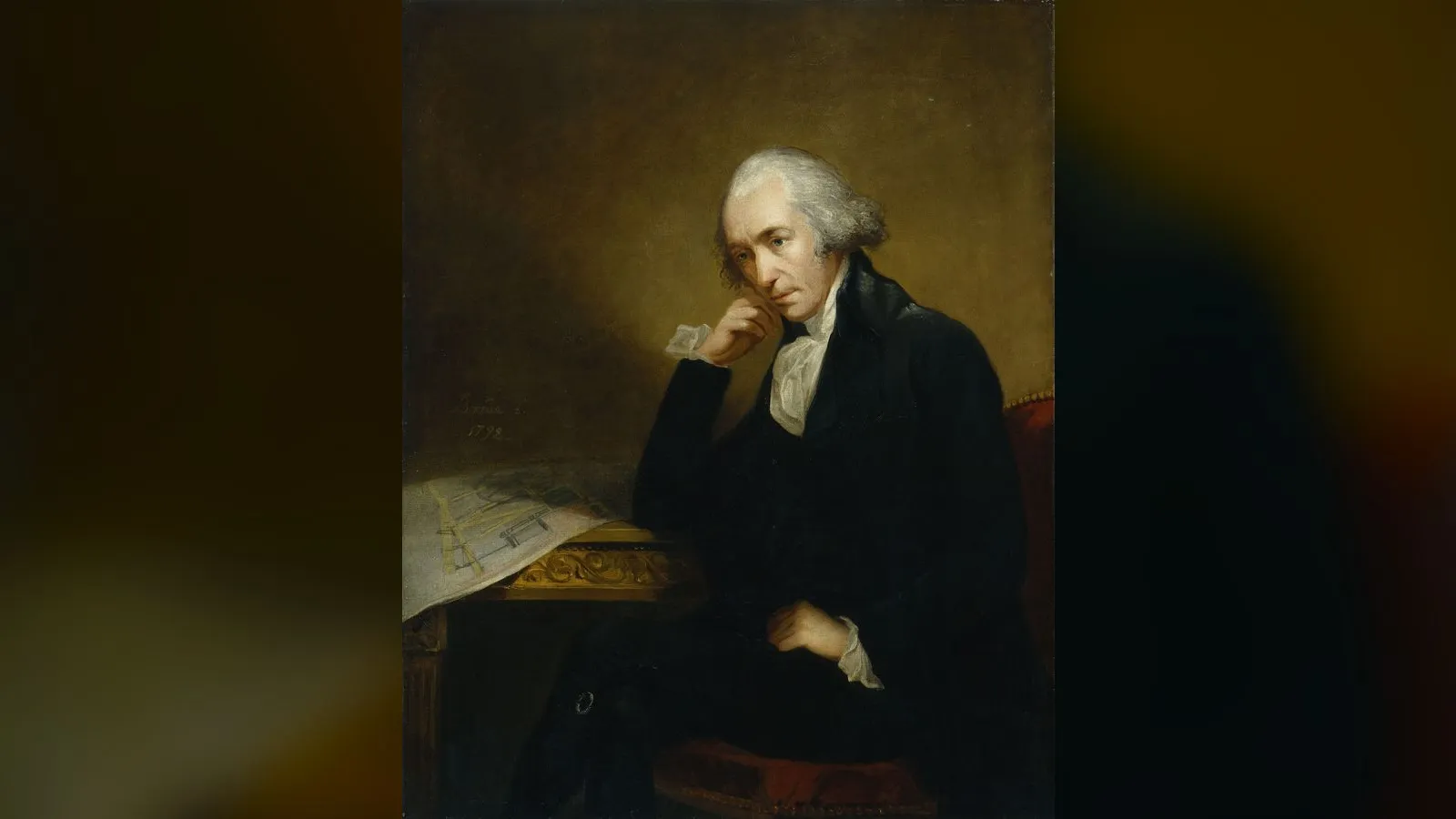

James Watt
Contents
James Watt, an instrument maker from Greenock, made the steam engine efficient enough to power the Industrial Revolution. He did not invent the steam engine; his breakthrough, in 1765, was the separate condenser, which cut fuel use dramatically. With Matthew Boulton he built and sold hundreds of engines, and the unit of power, the watt, is named after him. This card tests what he invented, what he improved, and the famous story of the boiling kettle.
TL;DR
- established Watt was born in Greenock on 19 January 1736, trained as a mathematical instrument maker, and became instrument maker to the University of Glasgow around 1757.
- established Thomas Savery (1698) and Thomas Newcomen (1712) built steam engines before him. While repairing the university's model Newcomen engine, Watt conceived the separate condenser in May 1765 and patented it in 1769.
- established From 1775 his partnership with Matthew Boulton in Birmingham made the engine a commercial success; by 1800 the firm had built 496 engines.
- shared Several inventions credited to Watt were partly the work of others: the sun-and-planet gear is attributed to William Murdoch, and the recording steam indicator to John Southern.
- traditional The story of the boy Watt discovering steam power by watching a kettle comes from a family anecdote that was later reshaped; Watt himself dated his interest in steam to about 1759.
Key Facts
- Born
- 19 January 1736, Greenock
- Training
- Instrument maker, London, 1755–1756
- University of Glasgow
- Mathematical instrument maker from c.1757
- Separate condenser conceived
- May 1765, Glasgow Green
- Patent
- 1769; extended by Act of Parliament, 22 May 1775, to 1800
- Partnership with Matthew Boulton
- From 1775, Soho, Birmingham
- Engines built by 1800
- 496
- Letter-copying press
- Patented 1780
- Double-acting engine
- Patented 1782
- Parallel motion
- Patented 1784
- Fellow of the Royal Society
- 1785
- Died
- 25 August 1819, Heathfield Hall, Handsworth
- Unit of power named after him
- The watt, adopted 1889
Scottish Impact Index (SI Score)
- Global Influence
- 10/10
- Enduring Relevance
- 10/10
- Material Contribution
- 10/10
- Exceptional Achievement
- 10/10
- Lasting Legacy
- 10/10
- Recognition
- 9/10
59/60
Ranked =1st of 200 in Great Scots
A Note on Claims and Evidence
Each major claim carries one of three labels. established means supported by primary records, official bodies or several independent reliable sources. shared means the core fact is sound but sources disagree on details, dates or interpretation. traditional means widely repeated but not traceable to a primary or independent source.
Watt's patents, letters and business records survive in large numbers, so his work is well documented. The difficulties lie in credit: some devices were patented in his name but invented by employees, and his claim to have discovered the composition of water was disputed with Henry Cavendish and Antoine Lavoisier. His reputation was also polished after his death by his son. Modern scholarship has drawn attention to the slave-trade origins of part of his family's wealth.
Timeline
James Watt is born in Greenock.
He trains as an instrument maker in London.
He becomes mathematical instrument maker to the University of Glasgow.
He repairs the university's model Newcomen engine.
He conceives the separate condenser.
He marries Margaret Miller.
He patents the separate condenser.
He surveys a canal route through the Great Glen; the line is later adopted for the Caledonian Canal.
Parliament extends the patent; the partnership with Matthew Boulton begins.
The first Boulton and Watt engines go to work.
He marries Ann MacGregor.
He patents the letter-copying press.
The sun-and-planet gear is patented.
He patents the double-acting engine.
He patents parallel motion.
He applies the centrifugal governor to engines.
The condenser patent expires; Watt retires.
Watt dies at Handsworth.
The British Association adopts the watt as a unit of power.
Details
Biography
James Watt was born on 19 January 1736 in Greenock, on the Firth of Clyde, the eldest of five surviving children of Agnes Muirhead and James Watt senior, a shipwright, ship-owner, merchant and town baillie. A delicate, migraine-prone child, he was largely educated at home by his mother and in his father's workshops, where he developed exceptional manual dexterity making models of cranes and barrel organs. (Sources: Wikipedia; Britannica; National Library of Scotland.)
Part of the family's wealth derived from his father's trading in slaves and slave-produced goods — a fact now emphasised in modern reassessments of Watt.
After his mother's death (when Watt was about 17–18) and the decline of his father's business, Watt went to Glasgow and then to London, where he trained as an instrument maker for about a year (1755–56) under John Morgan in Cornhill. London's atmosphere damaged his fragile health, and he returned to Scotland. The Glasgow Guild of Hammermen blocked him from setting up shop because he had not completed a seven-year apprenticeship, but professors at the University of Glasgow rescued him by appointing him "Mathematical Instrument Maker to the University" (c.1757) and giving him a workshop on university grounds. There he befriended the chemist Joseph Black (discoverer of latent heat) and John Robison. (Sources: Wikipedia; Encyclopedia.com; DNB 1885–1900.)
Watt married his cousin Margaret (Peggy) Miller in 1764; she died in childbirth in 1773. In 1777 he married Ann MacGregor. He was initiated into Freemasonry in the Glasgow Royal Arch Lodge No. 77 in 1763. According to Encyclopædia Britannica, "By 1790 Watt was a wealthy man, having received £76,000 in royalties on his patents in 11 years." He retired in 1800, bought the Doldowlod estate in Wales, and died on 25 August 1819 aged 83. He was buried at St Mary's Church, Handsworth. (Sources: Britannica; Wikipedia.)
The steam engine: what Watt did and did NOT invent
Watt did not invent the steam engine. Thomas Savery patented a steam pump in 1698; Thomas Newcomen built the first practical "atmospheric" engine in 1712. Newcomen engines were already widespread by Watt's day — a total of 1,454 Newcomen engines had been built by 1800 (per Kanefsky & Robey's figures), and several hundred were in use by the time Watt filed his 1769 patent. (Sources: Britannica; World History Encyclopedia; Engines of Our Ingenuity; Wikipedia.)
In the winter of 1763–64, Watt was asked to repair a model Newcomen engine belonging to the University of Glasgow and was struck by how much steam — and fuel — it wasted. The defect was that the single cylinder had to be alternately heated by steam and cooled by injected water on every stroke, losing most of the steam's latent heat. In May 1765, Watt's insight (reputedly on a Sunday walk on Glasgow Green) was to condense the steam in a separate vessel kept permanently cold, allowing the cylinder to stay permanently hot. This "separate condenser" was his first and greatest invention. Drawing on Joseph Black's concept of latent heat, the improvement — in Britannica's words — "saved three-fourths of the fuel." (Sources: Britannica; EBSCO; Science Museum Group; Wikipedia.)
Watt added many further refinements: sealing the cylinder top and using a steam jacket; the double-acting engine (steam acting on both sides of the piston, patented 1782); methods of working steam "expansively"; the sun-and-planet gear (1781); parallel motion (1784); a flywheel; the centrifugal governor (1788); and a pressure gauge (1790). As fully developed, a Watt engine used about 75% less fuel than a comparable Newcomen engine, and by 1784 was around four times more efficient. (Sources: Britannica; Lumen Learning; Engines of Our Ingenuity.)
Boulton & Watt and the Industrial Revolution
Watt's first backer was John Roebuck of the Carron ironworks, who funded a prototype at Kinneil House and helped secure the 1769 patent in exchange for two-thirds of the profits. When Roebuck went bankrupt, his share passed to Matthew Boulton, the Birmingham manufacturer who owned the Soho Manufactory. Watt moved to Birmingham, and the partnership of Boulton & Watt was formed in 1775. Boulton provided capital, business acumen and access to the world's best ironworkers — crucially John Wilkinson, whose precision cannon-boring techniques could bore accurate cylinders. (Sources: Graces Guide; Britannica; Wikipedia; Kinneil.)
The firm's first engines (1776) were pumping engines for mines, especially in Cornwall. Boulton pushed Watt to develop a rotative engine to drive mill machinery, opening the vast textile market. Boulton's famous line — "I sell here, sir, what all the world desires to have — POWER" — captures the firm's significance (it now appears on the Bank of England £50 note). Their business model charged customers a premium equal to one-third of the fuel saved versus a Newcomen engine. They built their own Soho Foundry at Smethwick in 1795. The partnership passed to their sons in 1800. (Sources: Britannica; Lumen Learning; Wikipedia.)
Lesser-known inventions
- Sun-and-planet gear (patented October 1781): A means of converting the beam's reciprocating motion into rotary motion without using a crank — devised to bypass the crank patent held by James Pickard (1780). It was actually invented by Boulton & Watt's brilliant Scottish engineer William Murdoch, but patented in Watt's name. (Sources: Wikipedia; Britannica; William Murdoch sources.)
- Parallel motion (patented 1784): A linkage that guided the piston rod in a near-straight vertical line for the double-acting engine. Watt described it as "one of the most ingenious, simple pieces of mechanism I have contrived," and wrote to his son in 1808: "I am more proud of the parallel motion than of any other invention I have ever made." (Sources: Wikipedia; Britannica; EBSCO.)
- Centrifugal (fly-ball) governor (1788): Watt adapted an existing device (used in windmills, with roots in Christiaan Huygens) to automatically regulate engine speed, following a suggestion from Boulton. Watt did not invent the governor concept but pioneered its application to the steam engine. (Sources: Wikipedia; Grokipedia.)
- Steam indicator / indicator diagram: A device to measure cylinder pressure through the stroke. The crucial recording version (a pencil tracing a pressure–volume diagram) was developed by Watt's assistant John Southern around 1796, and kept a closely-guarded trade secret. (Sources: Science Museum Group; Wikipedia; eoht.info.)
- Letter-copying press (patented 1780): An early document-copying machine. Watt, frustrated by the tedium of copying business correspondence, developed (1778–80) a process that pressed special slow-drying ink onto damp thin paper to create a reversed copy readable from the back. Patented in 1780 (with Boulton and James Keir in the firm James Watt & Co.), it included both a roller press and a screw press. By the end of 1780, 150 machines had been sold; 630 in the first full year. Subscribers included Josiah Wedgwood, Erasmus Darwin and Benjamin Franklin; George Washington owned one; the Law Society reportedly used the process into the 1950s. (Sources: ICE; Powerhouse Museum; Mount Vernon; Founders Online; Sotheby's.)
- Sculpture/medallion copying machines: In retirement, Watt built (but never patented) machines for copying three-dimensional sculptures; one of the first pieces he produced was a small head of his friend Adam Smith. (Sources: Wikipedia; Science Museum.)
- Other: improvements to oil lamps, a steam mangle, a method of measuring distances by telescope, and survey/canal work as a civil engineer. (Sources: Wikipedia; engineeringhalloffame.org.)
"Horsepower" and the watt
Watt coined/popularised horsepower to market his engines to customers who thought in terms of draft horses. He was not the first to compare engines to horses (Savery did so in 1702), but Watt standardised it: experiments around 1782–83 led him and Boulton to define one horsepower as 33,000 foot-pounds per minute. This remains the standard imperial horsepower (~745.7 W). (Sources: Wikipedia; EBSCO; Chronicle of the Horse.)
The SI unit of power, the watt (one joule per second), is named in his honour. It was proposed by William Siemens in 1882, adopted by the British Association in 1889, and incorporated into SI by the 11th General Conference on Weights and Measures in 1960. (Sources: Wikipedia; unitconverters.net.)
The Lunar Society and Enlightenment connections
Watt was a leading member of the Lunar Society of Birmingham, an informal dinner-and-experiment club that met near the full moon (for safer travel home). Verifiable long-term members included Matthew Boulton, Erasmus Darwin, Thomas Day, Richard Lovell Edgeworth, Samuel Galton Jr., Robert Augustus Johnson, James Keir, Joseph Priestley, William Small, Jonathan Stokes, James Watt, Josiah Wedgwood, John Whitehurst and William Withering. Watt first visited Soho in 1767. During the 1791 Priestley Riots, Boulton and Watt armed their workers to protect the Soho Manufactory. (Sources: Wikipedia; Britannica; Birmingham City Council.)
Patents, enforcement and the innovation debate
Watt's 1769 condenser patent, extended to 1800, is a famous case study in patent policy. Boulton & Watt dominated steam-engine manufacture and spent much of the 1790s in litigation against competitors Watt called "pirates." In Boulton & Watt v. Hornblower (final appeal 1799), the courts upheld Watt's patent against Jonathan Hornblower's more advanced compound (multi-cylinder) engine, which used a separate condenser. Economists Boldrin and Levine argue this monopoly blocked development of the compound engine and high-pressure steam, retarding growth, and that the 1775 patent extension was unnecessary rent-seeking. A counter-view (George Selgin, John Turner, and historian Richard Hills) holds that Boulton & Watt were relatively reluctant litigators who ultimately licensed their technology, and that the "innovation-blocking monopoly" is overstated. Either way, the period after the 1800 expiry saw rapid innovation by others (Trevithick's high-pressure engines; Woolf's revival of the compound engine in 1804). (Sources: Mises Institute; Selgin/GMU; Oxford Academic; William Symington site.)
Disputed claims and controversies to flag
- "Invented the steam engine": False. Watt improved the Newcomen engine. (Universally agreed.)
- Kettle story: Apocryphal in its popular form (see Caveats).
- Sun-and-planet gear: Credited to Watt by patent, but invented by William Murdoch (Samuel Smiles and a drawing in Murdoch's hand support this).
- Recording steam indicator: Often attributed to Watt (sometimes dated "1785"), but the recording version was developed by John Southern c.1796; the "1785 indicator" is regarded by historians as forgery or folklore.
- Centrifugal governor: Watt applied it to engines but did not invent the device.
- Composition of water: Watt is one of three claimants (with Henry Cavendish and Antoine Lavoisier) in the 19th-century "water controversy"; priority cannot be cleanly assigned and the dispute was driven partly by nationalism and filial loyalty.
- Watt himself routinely filed pre-emptive patents to secure credit, which some contemporaries resented. There is no dispute, however, that he was the sole inventor of the separate condenser.
Honours, legacy and memorials
- Fellow of the Royal Society of Edinburgh (1784) and the Royal Society of London (1785); honorary LLD from Glasgow (1806); Foreign Associate of the French Academy of Sciences (1814). He declined a baronetcy.
- Buried at St Mary's Church, Handsworth, Birmingham, where his son commissioned a chapel and a statue by Sir Francis Chantrey. Boulton and William Murdoch are also buried there ("the cathedral of the Industrial Revolution").
- A colossal Chantrey marble statue was placed in Westminster Abbey (installed 1834, cost over £6,000), removed in 1960, and now resides in Scotland (National Museum of Scotland / Scottish National Portrait Gallery). Statues also stand in George Square, Glasgow and elsewhere.
- The Watt Memorial Library in Greenock began with Watt's 1816 donation of scientific books; the associated Watt Institution evolved into James Watt College. Heriot-Watt University in Edinburgh traces its roots to the Edinburgh School of Arts (1821), the world's first mechanics' institute, and is named partly for Watt.
- His preserved garret workshop is displayed at the Science Museum, London ("James Watt and our world").
- Boulton and Watt appeared together on the Bank of England £50 note announced in 2009 — the first dual portrait on the back of an English banknote (Watt's inscription: "I can think of nothing else but this machine").
- 2019 marked the bicentenary of his death and 250th anniversary of his 1769 patent.
Watt among the Glasgow scientists
The philosopher Alexander Broadie places Watt firmly inside the Glasgow Enlightenment. While working as the university's mathematical instrument maker, Watt was close to the chemist Joseph Black and discussed the practical uses of steam with John Robison, who in 1757 had written a paper on improving the Newcomen engine. Watt's separate condenser followed in 1765. Broadie also notes Watt's wider engineering work, including a survey made ahead of Thomas Telford's Caledonian Canal (built 1803–22).
Watt, the Great Glen and Thomas Telford
established The 1773 survey. Before he moved to Birmingham, Watt worked as a surveyor of canals in Scotland. In 1773 he surveyed a line for a canal through the Great Glen, linking Loch Linnhe and the Moray Firth through Loch Lochy, Loch Oich and Loch Ness, and he reported on it the next year. Sources give the survey as 1773 or 1774 depending on whether they mean the fieldwork or the report; Julian Glover, in his biography Man of Iron (2017), uses both dates in different chapters.
established Telford adopts Watt's line. John Rennie endorsed a similar route in 1793. When the Treasury sent Thomas Telford north in 1801, he took Watt's and Rennie's reports with him, consulted both men, and in his 1803 report concluded that the line first proposed by Watt was the best. The Caledonian Canal was built on that line between 1803 and 1822. A Boulton and Watt beam engine kept the rock-cut lock chambers at Corpach, near Fort William, pumped dry while they were built.
established Friendship with Telford. Telford moved in circles close to Boulton and Watt from the mid-1780s and came to count Watt as an ally. In February 1799 he wrote to his friend Andrew Little that he had become "intimately acquainted with Mr Watt & his son", calling Watt "the steam engine Man from Glasgow". In 1801 Watt was among the experts Telford consulted about his design for a single iron arch to replace London Bridge, and in 1805 Telford wrote to Watt to protect his reputation from what he saw as John Rennie's disparagement.
Did You Know?
- A lifelong hypochondriac: Watt suffered chronic migraines and was famously preoccupied with his ailments.
- A musical instrument maker: To avoid competition from hostile Glasgow tradesmen, Watt made flutes, guitars and even a fine organ — despite reportedly having little musical ability, studying the science of harmony to do it.
- He heated his study with steam via a pipe connected to a boiler — an early form of central heating.
- He declined a knighthood (baronetcy).
- His son made history too: James Watt Jr. fitted out the Caledonia, helping make it among the first steamships to leave an English port.
- Glasgow Green epiphany: Watt said his condenser idea came to him during a Sunday walk on Glasgow Green in May 1765.
- His workshop was sealed like a shrine for nearly a century after his death before going to the Science Museum.
FAQ
1Did James Watt invent the steam engine?
No. Thomas Savery and Thomas Newcomen built steam engines before him. Watt greatly improved them.
2What was the separate condenser?
A separate chamber where steam was condensed, so the main cylinder could stay hot, saving a great deal of fuel.
3Is the kettle story true?
Only loosely. It grew from a family anecdote that was reshaped after his death.
4Who was Matthew Boulton?
The Birmingham manufacturer whose partnership with Watt from 1775 made the engine a commercial success.
5Did Watt invent the sun-and-planet gear?
It was patented in his name, but is attributed to his employee William Murdoch.
6Did Watt invent the governor?
No. He adapted an existing device to control engine speed.
7Where does "horsepower" come from?
Watt standardised it to help customers compare his engines with the horses they replaced.
8Did Watt's patents slow down progress?
Some economic historians argue that strict enforcement held back other inventors until 1800; others disagree.
9Did Watt discover the composition of water?
His claim is disputed with Henry Cavendish and Antoine Lavoisier.
10Where is Watt buried?
At St Mary's Church, Handsworth, Birmingham, near Boulton and Murdoch.
11Did Watt plan the Caledonian Canal?
He surveyed the Great Glen route in 1773. Thomas Telford adopted Watt's line in 1803, but the canal was designed and built under Telford and William Jessop.
Sources and Further Reading
Scholarly/Critical
- Alexander Broadie, "The Rise (and Fall?) of the Scottish Enlightenment", in T. M. Devine and Jenny Wormald (eds), The Oxford Handbook of Modern Scottish History (Oxford University Press, 2012)
- Julian Glover, Man of Iron: Thomas Telford and the Building of Britain (Bloomsbury, 2017), chapters 6, 8 and 10.
- Stana Nenadic, "Industrialization and the Scottish People", in T. M. Devine and Jenny Wormald (eds), The Oxford Handbook of Modern Scottish History (Oxford University Press, 2012)
Further reading
- Ben Russell, James Watt: Making the World Anew (Reaktion Books, 2014)
- Richard L. Hills, James Watt, 3 vols (Landmark, 2002–2006)
Caveats: Myths and Disputed Claims
- Do not say Watt invented the steam engine.
- Do not present the kettle story as history.
- Do not credit Watt alone with the sun-and-planet gear, the recording steam indicator or the governor.
- Do not say Watt definitively discovered the composition of water.
- Do not give his date of death as 19 August 1819; records confirm 25 August.
- Do not present the debate over his patents as settled.
- Do not omit, when relevant, that part of his family's wealth came from the slave trade.
Card 059 · Great Scots