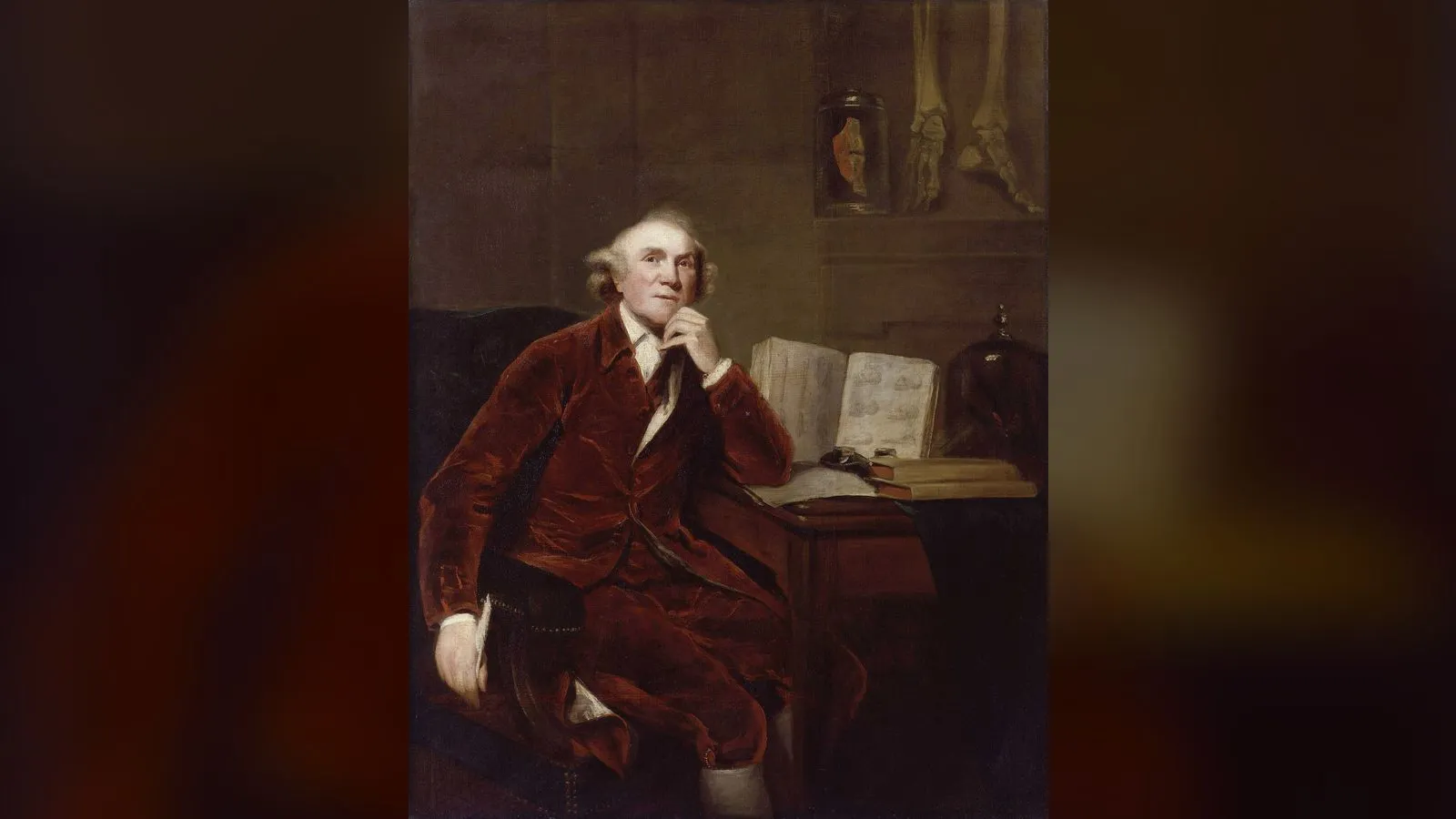

John Hunter (1728–1793)
Contents
TL;DR
- Established/Documented: Hunter is widely regarded as the father of scientific surgery, transforming the discipline from a tradition-bound craft into a field grounded in direct observation, anatomical evidence, and systematic experimentation — insights that still underpin modern surgical and pathological practice.
- Established/Documented: Hunter's acquisition of the skeleton of Charles Byrne, an Irish man known as "the Irish Giant," was carried out explicitly against Byrne's dying wishes for a burial at sea, reportedly through bribing a member of the funeral party — a serious ethical violation this card does not minimise, and one that remains a live controversy today (Byrne's skeleton is still held and displayed by the Hunterian Museum in London, and calls for its removal and burial continue).
- Disputed/Legend: The famous story that Hunter deliberately self-inoculated with venereal disease using a contaminated needle, contracting both gonorrhea and syphilis and drawing the wrong scientific conclusion from the result, is not supported by his own 1786 published treatise and is now generally regarded by scholars as likely describing an experiment performed on a third party rather than on Hunter himself — a case where a persistent, dramatic legend has significantly outpaced the documented evidence.
- Established/Documented: Hunter mentored Edward Jenner, who went on to develop the smallpox vaccine, and it was reportedly Hunter who gave Jenner the enduring scientific advice: "Why think? Why not try the experiment?" — a phrase that captures Hunter's entire approach to medicine.
- Established/Documented: Hunter's relationship with his elder brother William Hunter, himself a major figure in anatomy and obstetrics, deteriorated into a bitter, permanent estrangement over a priority dispute about who first discovered that maternal and fetal blood circulations are separate — a rift between two towering figures of Scottish medical science that was never resolved before William's death in 1783.
Key Facts
- Born
- 13 February 1728, Long Calderwood, near East Kilbride, Lanarkshire, Scotland
- Died
- 16 October 1793, St George's Hospital, London, England (aged 65)
- Known for
- Founder of scientific/experimental surgery; pioneering anatomist and pathologist; assembled one of the largest anatomical collections in history
- Key positions
- Surgeon to St George's Hospital, London (from 1768); Surgeon-General to the British Army (1790); Fellow of the Royal Society (1767)
- Notable student
- Edward Jenner, developer of the smallpox vaccine
- Legacy institution
- The Hunterian Museum, Royal College of Surgeons of England, built around his personal collection
Scottish Impact Index (SI Score)
- Global Influence
- 7/10
- Enduring Relevance
- 9/10
- Material Contribution
- 4/10
- Exceptional Achievement
- 8/10
- Lasting Legacy
- 8/10
- Recognition
- 4/10
40/60
Ranked =39th of 200 in Great Scots
Claim-Status and Evidence Note
Claims below are evidence-tiered as Established/Documented (settled by primary sources, published works, or broad scholarly consensus), Shared/Traditional (widely told and broadly accurate, if sometimes simplified), disputed (credible sources genuinely disagree), or Legend/Myth (unsupported by evidence and actively corrected here). Hunter's story contains both a genuine, serious ethical controversy that should not be softened (the Charles Byrne case) and a famous but likely fictional anecdote that should not be repeated as fact (the venereal disease self-experiment) — this card treats those two very differently, because the evidence for each is entirely different.
Timeline
Born at Long Calderwood farm, near East Kilbride, the youngest of ten children.
Moves to London, aged 20, to join his elder brother William's anatomy school as a dissection assistant; within months proves an exceptionally gifted dissector.
Trains further under leading surgeons William Cheselden (Chelsea Hospital) and Percival Pott (St Bartholomew's Hospital); runs practical anatomy classes at William's school.
Serves as an army surgeon, including on the 1761 Belle Île expedition, gaining extensive hands-on experience treating gunshot wounds.
Partners with dentist James Spence on pioneering tooth-transplant surgery.
Establishes his own independent anatomy school and private surgical practice in London.
Elected Fellow of the Royal Society; becomes recognised as a leading authority on venereal disease.
Appointed surgeon to St George's Hospital, a post he holds for the rest of his life.
A bitter priority dispute erupts with his brother William over who first discovered that maternal and fetal blood circulations are anatomically separate, permanently damaging their relationship.
Acquires the skeleton of Charles Byrne, reportedly by bribing a member of his funeral party, against Byrne's explicit deathbed wish for burial at sea; William Hunter dies the same year, the brothers never having reconciled.
Publishes A Treatise on the Venereal Disease.
Performs the first recorded successful case of artificial insemination; appointed Surgeon-General to the British Army.
Dies of a heart attack during a contentious board meeting at St George's Hospital, aged 65.
His anatomical collection, numbering close to 14,000 preparations, is purchased by the British government and presented to the Company of Surgeons (later the Royal College of Surgeons of England).
Hunter's remains are reburied in Westminster Abbey, reflecting his elevated national standing decades after his death.
Details
From a cabinet-maker's workshop to the cutting edge of anatomy
John Hunter was born in 1728 on a farm near East Kilbride, the youngest of ten children, and showed little early academic promise — he worked as a cabinet-maker's assistant as a young man, with none of the formal classical education typical of a physician of the period. His transformation began at age 20, when he travelled to London to join his elder brother William, who had already established himself as a respected and fashionable teacher of anatomy. John proved to be an extraordinarily gifted practical dissector almost immediately — within about six months, by some accounts, he had already surpassed William's own dissection skill — and quickly progressed from assistant to running the school's practical anatomy classes himself. He supplemented this hands-on training with formal study under two of the era's most respected surgeons, William Cheselden and Percival Pott, building a foundation in both craft and emerging scientific method that few surgeons of his generation could match.
War, wounds, and the birth of an evidence-based approach
Between 1760 and 1763, Hunter served as an army surgeon, including on the 1761 expedition to Belle Île off the French coast — direct, high-volume experience treating traumatic gunshot wounds that shaped his lifelong insistence on observing what the body actually does, rather than relying on inherited theory. This period fed directly into his later, highly influential work on gunshot wound treatment and on inflammation, where he arrived at a genuinely important and, at the time, counter-intuitive insight: that inflammation was the body's own response to injury or disease, not itself a pathological process to be aggressively suppressed. This reframing — treating the body's own reactions as evidence to be studied rather than symptoms to be fought — is a clear thread running through virtually everything Hunter is remembered for, and it is the central reason historians credit him as the founder of scientific, as opposed to purely craft-based, surgery.
An independent career built on relentless direct observation
After leaving military service, Hunter spent several years in an unusual and genuinely innovative partnership with dentist James Spence conducting pioneering tooth-transplant surgery, before establishing his own independent anatomy school and surgical practice in London in 1764. His reputation grew quickly: election as a Fellow of the Royal Society came in 1767, and in 1768 he secured the post of surgeon to St George's Hospital, which he held for the rest of his career. Across his working life he applied the same method to an extraordinarily wide range of subjects — the structure and regrowth of teeth, the lymphatic system, digestion, child and fetal development, and the anatomy of the circulatory system — publishing findings that in several cases remained standard medical knowledge for generations. His demonstration that maternal and fetal blood supplies are physically separate, rather than directly continuous, was a genuine advance in the understanding of pregnancy; in 1790 he also carried out the first recorded successful case of artificial insemination. The adductor canal in the thigh, a structure of continuing relevance in vascular surgery, is still known today as "Hunter's canal."
The venereal disease affair: a famous story that the evidence does not support
One of the most widely repeated anecdotes about Hunter deserves direct correction rather than repetition. The popular legend holds that Hunter, in the course of researching venereal disease, deliberately infected himself with gonorrhea using a needle contaminated from a patient, and that the sample turned out also to carry syphilis — leading Hunter to conclude, incorrectly, that gonorrhea and syphilis were simply two manifestations of a single disease, a mistaken theory that is said to have delayed accurate understanding of the two separate infections for decades, until French physician Philippe Ricord definitively separated them in 1837. This story has real dramatic appeal, and versions of it have been repeated in popular and even some scholarly accounts for over two centuries.
However, a close reading of Hunter's own 1786 publication, A Treatise on the Venereal Disease, does not describe a self-experiment at all — modern scholars examining the text conclude the relevant experiment was most likely performed on a third party, not on Hunter himself. The mistaken single-disease theory is real and well documented, and it genuinely did delay medical progress on distinguishing the two infections until Ricord's 1837 work — but the dramatic self-inoculation story that supposedly produced it appears to be a later embellishment rather than a documented fact. This card treats the theory and its consequences as established, and the self-experimentation legend as unsupported by the primary source usually cited for it.
Edward Jenner, and a single sentence that defined a method
Hunter's most consequential act of mentorship was his relationship with Edward Jenner, who trained under him before going on to develop the smallpox vaccine — one of the most significant single interventions in the history of public health. The piece of advice most frequently attributed to Hunter, and widely believed to capture his entire scientific philosophy, was his reported instruction to the young Jenner when Jenner brought him a question he could not resolve through reasoning alone: "Why think? Why not try the experiment?" Whether or not this precise phrasing is verbatim, it accurately reflects the working method that runs through Hunter's entire career, and through the empirical tradition in British medicine that Jenner's later achievement helped to embody.
The Charles Byrne case: a serious ethical violation, stated plainly
Alongside Hunter's genuine scientific achievements sits an episode that should not be softened, minimised, or treated as a quaint product of a different era's ethics. In 1783, Hunter obtained the skeleton of Charles Byrne, an Irish man known publicly as "the Irish Giant," who stood approximately 2.31 metres (7 feet 7 inches) tall and had become a well-known exhibition figure in London. Byrne, fully aware of the intense interest anatomists including Hunter had in his body, explicitly arranged and expressed a dying wish to be buried at sea specifically to prevent his remains from being dissected or displayed after death. Hunter obtained the body anyway, reportedly by bribing a member of Byrne's funeral party to substitute weights into the coffin before burial, and later published anatomical descriptions of the skeleton. Byrne's skeleton remains in the Hunterian Museum's collection to this day, and the question of whether it should finally be removed from display and given the burial Byrne explicitly requested — rather than kept on institutional exhibition against his stated wishes for well over two centuries — remains an active, unresolved ethical debate in British museum and medical circles. This card states plainly that Hunter's acquisition of Byrne's remains was carried out in direct, deliberate violation of a dying man's clearly expressed wishes, and treats that as a serious moral failing rather than a footnote to an otherwise admirable scientific career.
A related but distinct set of allegations concerns Hunter's broader acquisition of human remains — including from pregnant women — for anatomical study during a period when the supply of bodies for dissection in Britain was itself deeply ethically fraught (the "resurrectionist" body-snatching trade that supplied much of the era's anatomical teaching more broadly). Some later scholarly examination has suggested that certain mortality patterns among cases in Hunter's records may be explained by then-untreatable conditions such as pre-eclampsia rather than by deliberate harm, but the broader context — that Georgian anatomical science as a whole, including Hunter's, depended heavily on a supply chain of bodies obtained without consent — is itself part of an honest account of this period of medical history, not a separate footnote from it.
Brothers divided: the rift with William Hunter
John's relationship with his brother William, the man who had first brought him into anatomy and given him his start, deteriorated over the course of their parallel careers and collapsed entirely in 1780 over a bitter dispute about scientific priority: which brother had first discovered that the maternal and fetal blood circulations in pregnancy were anatomically separate rather than continuous. The dispute produced a permanent estrangement between the two men that was never resolved — they remained unreconciled when William died in 1783. The contrast between the brothers is itself instructive: William was the more polished, socially adept, and establishment-connected of the two, serving as obstetrician to Queen Charlotte and assembling an enormous personal collection spanning anatomy, coins, and art; John was by comparison unconventional, poorly suited to formal social advancement, and often outspoken to the point of difficulty — yet it was John, not William, who came to be remembered specifically as the founder of scientific surgery as a discipline. Notably, despite their major contributions to British medicine, neither brother was ever knighted.
The collection, and a death fitting the man
Hunter's museum-scale personal collection is one of his most tangible legacies: by the time he moved to Leicester Square in 1783, he had amassed close to 14,000 anatomical preparations drawn from more than 500 species of plants and animals, organised as a working teaching resource rather than a simple curiosity cabinet. After his death, the British government purchased the collection in 1799 and presented it to the Company of Surgeons — the direct ancestor of today's Royal College of Surgeons of England, whose Hunterian Museum remains built around his original material. Hunter died on 16 October 1793, suffering a heart attack during a contentious board meeting at St George's Hospital — a death that, whatever else can be said of it, was in keeping with a career defined by conflict, intensity, and direct confrontation rather than quiet consensus. He was initially buried at St Martin-in-the-Fields, but his remains were moved to Westminster Abbey in 1859, a mark of how thoroughly his reputation had been elevated in the decades following his death.
Did You Know
- Hunter's Leicester Square house is reported to have influenced Robert Louis Stevenson's description of Dr Jekyll's residence in The Strange Case of Dr Jekyll and Mr Hyde — an odd but fitting literary echo, given Hunter's own reputation for working with human remains obtained under ethically troubling circumstances.
- The famous story that Hunter deliberately infected himself with venereal disease to study it is not supported by his own published 1786 treatise — modern scholars believe the described experiment was most likely performed on a third party, not on Hunter himself.
- Hunter's acquisition of the skeleton of Charles Byrne, the "Irish Giant," directly violated Byrne's explicit dying wish to be buried at sea — the skeleton remains in the Hunterian Museum's collection today, and the question of whether it should finally be buried as Byrne requested remains genuinely unresolved, over 240 years later.
- Hunter performed the first recorded successful case of artificial insemination in 1790.
- Hunter's piece of advice to his student Edward Jenner — "Why think? Why not try the experiment?" — is widely regarded as capturing his entire scientific philosophy in a single sentence.
- Despite their major scientific contributions, neither John Hunter nor his brother William was ever knighted.
- The brothers' permanent estrangement, beginning in 1780 over a dispute about which of them first discovered a key fact about fetal blood circulation, was never resolved before William's death in 1783.
- Hunter's personal anatomical collection, nearly 14,000 specimens at its peak, was purchased by the British government after his death and forms the core of the Royal College of Surgeons' Hunterian Museum, still open to visitors today.
FAQ
1Why is John Hunter called the father of scientific surgery?
Because he moved surgery away from inherited tradition and toward direct anatomical observation and controlled experimentation — treating the body's own responses (such as inflammation) as evidence to study rather than symptoms to blindly suppress, an approach that underlies modern surgical and pathological science.
2Did Hunter really infect himself with a venereal disease to study it?
This famous story is not supported by his own 1786 published treatise on the subject, and modern scholars believe the described experiment was most likely carried out on someone else. The mistaken theory that gonorrhea and syphilis were the same disease is real and well documented, but the dramatic self-inoculation story usually told alongside it appears to be a later embellishment.
3What happened with Charles Byrne's skeleton?
Hunter acquired the skeleton of Charles Byrne, a very tall Irish man, in 1783, reportedly by bribing a member of his funeral party, directly against Byrne's explicit dying wish to be buried at sea specifically to avoid dissection. The skeleton remains part of the Hunterian Museum's collection today, and calls for it to finally be given the sea burial Byrne requested continue into the present.
4Was Hunter related to William Hunter, the famous anatomist and obstetrician?
Yes — William was his elder brother, and John's career began as William's dissection assistant in London in 1748. The relationship later collapsed into a permanent, unresolved estrangement after a 1780 dispute over scientific priority.
5What is Hunter's most significant lasting scientific contribution?
His demonstration that inflammation is the body's own protective response rather than a disease process in itself is often cited as his single most important conceptual contribution, alongside his broader insistence on evidence-based, experimental surgical practice.
6Did Hunter train Edward Jenner?
Yes. Jenner studied under Hunter before going on to develop the smallpox vaccine, and credited Hunter's emphasis on direct experimentation as formative to his own scientific method.
7Where can Hunter's collection be seen today?
At the Hunterian Museum, run by the Royal College of Surgeons of England, which was built around the anatomical collection the British government purchased from Hunter's estate in 1799.
8How did Hunter die?
He suffered a fatal heart attack during a heated board meeting at St George's Hospital in October 1793, aged 65.
9Where is Hunter buried?
Initially at St Martin-in-the-Fields, London; his remains were reinterred at Westminster Abbey in 1859, reflecting the extent to which his reputation had grown in the decades after his death.
10Is the ethical controversy over Hunter's body acquisitions unique to him, or typical of the period?
Both things are true at once: the broader trade in bodies obtained without consent ("resurrectionism") was a widespread feature of Georgian anatomical science, not unique to Hunter — but the Charles Byrne case specifically involved a documented, deliberate violation of one identifiable individual's clearly expressed dying wish, which is a distinct and more serious matter than the general ethical murkiness of the era's anatomy supply.
Sources and Further Reading
Primary/Institutional
- Royal College of Surgeons of England, Hunterian Museum, official biography of John Hunter: hunterianmuseum.org/about/john-hunter
- Royal College of Surgeons Library, Historical Subject Guide, John Hunter: rcseng.libguides.com
- The James Lind Library, "John Hunter (1728–93)"
Scholarly
- Clinical Infectious Diseases, "Hunter's Chancre: Did the Surgeon Give Himself Syphilis?" — scholarly examination of the self-experimentation legend and the primary-source evidence against it
- Hektoen International, "Two Great Scots: John and William Hunter" — on the brothers' careers and estrangement
- Indian Journal of Vascular and Endovascular Surgery, "John Hunter – Father of Scientific Surgery"
General
- Encyclopaedia Britannica, "John Hunter"
- University of Virginia Health Sciences Library, "John Hunter (1728–1793)" exhibit
Caveats: Myths and Disputed Claims
This card treats two very different kinds of claim about Hunter with deliberately different weight. The Charles Byrne skeleton case is established, documented, and taken seriously as a genuine ethical violation — it is not minimised as a product of "different times," and the ongoing controversy over the skeleton's continued display is noted as current and unresolved rather than historical. The venereal disease self-experimentation story, by contrast, is a widely repeated but evidently unsupported legend: Hunter's own 1786 published treatise does not describe a self-experiment, and this card corrects the popular version rather than repeating it, while preserving the genuinely documented fact that his resulting theory about venereal disease was mistaken and did delay accurate medical understanding for decades. Readers should also note that broader allegations about Hunter's use of pregnant women's remains sit within the wider, ethically troubled context of Georgian-era anatomical supply more generally, and some specific mortality patterns cited in this context have alternative medical explanations (such as untreated pre-eclampsia) that do not necessarily indicate deliberate harm — a distinction worth preserving rather than treating all such allegations as equivalent to the clearly documented Byrne case.
Card 050 · Great Scots