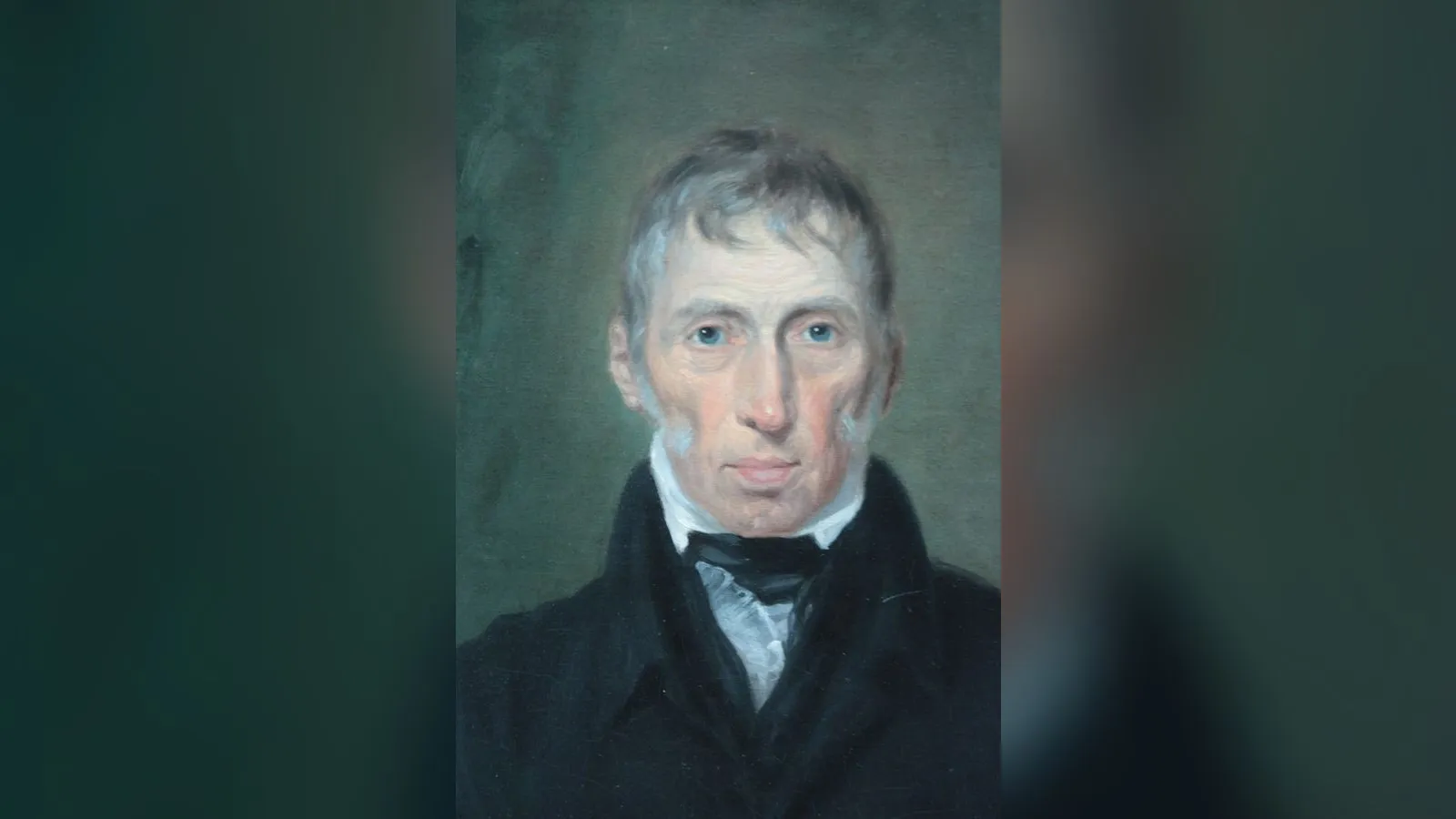

John Loudon McAdam
Contents
John Loudon McAdam, born in Ayr in 1756, changed how the world built roads. His method, a raised, well-drained bed of small broken stones packed hard by traffic, made roads cheaper and far more durable, and gave the language the word "macadam". It is also behind the word "tarmac", although McAdam himself never used tar in his roads. This card tests what McAdam invented, when, and how his name ended up on a material he did not create.
TL;DR
- established McAdam was born in Ayr in 1756, made his fortune as a merchant in New York, and returned to Scotland after the American War of Independence, where he became a trustee of the Ayrshire turnpike roads.
- established As surveyor to the Bristol Turnpike Trust from about 1816, he rebuilt roads with layers of small crushed stone on a cambered bed that shed rainwater. The method became known as macadamisation.
- established His treatises of 1816 and 1819 spread the method, and he gave evidence to parliamentary inquiries in 1810, 1819 and 1823.
- established McAdam did not use tar. Tarmac, a tar-bound macadam, was patented by the Welsh engineer Edgar Purnell Hooley in 1902, 66 years after McAdam's death.
- shared Sources disagree on several of his dates, including his birthday, when he moved to Bristol, and when he became Surveyor-General of Metropolitan Roads.
- shared McAdam's great rival was his fellow Scot Thomas Telford, who built new roads on a heavy foundation of hand-laid stone. Each thought the other's method wrong. Telford's way was stronger; McAdam's was cheaper and suited turnpike trusts that had to live on tolls.
Key Facts
- Born
- September 1756, Ayr
- New York
- From 1770, as a merchant
- Returned to Scotland
- 1783; trustee of the Ayrshire turnpike
- Moved to Bristol
- 1798 or 1802
- Bristol Turnpike Trust surveyor
- 1815 or 1816
- Treatises
- Remarks on the Present System of Road Making (1816); A Practical Essay on the Scientific Repair and Preservation of Roads (1819)
- Parliamentary evidence
- 1810, 1819, 1823
- Surveyor-General of Metropolitan Roads
- 1820s
- Died
- 26 November 1836, Moffat
- Tarmac patented
- 1902, by Edgar Purnell Hooley
Scottish Impact Index (SI Score)
- Global Influence
- 9/10
- Enduring Relevance
- 10/10
- Material Contribution
- 9/10
- Exceptional Achievement
- 9/10
- Lasting Legacy
- 9/10
- Recognition
- 5/10
51/60
Ranked =10th of 200 in Great Scots
A Note on Claims and Evidence
Each major claim carries one of three labels. established means supported by primary records, official bodies or several independent reliable sources. shared means the core fact is sound but sources disagree on details, dates or interpretation. traditional means widely repeated but not traceable to a primary or independent source.
McAdam's method and publications are well documented. His quarrel with Thomas Telford is described by Julian Glover in his biography Man of Iron (2017), largely from Telford's side; the evidence that Telford's roads lasted better comes mainly from Telford's own allies, Sir Henry Parnell and William Provis. His biography is less settled: reliable sources give different dates for his birthday, his move to Bristol, his appointment to the Bristol Turnpike Trust and his appointment as Surveyor-General. The commonest mistake about him is crediting him with tarmac.
Timeline
John Loudon McAdam is born in Ayr.
Aged 14, he goes to New York to work for his uncle, a merchant.
He returns to Scotland, buys the estate of Sauchrie in Ayrshire and becomes a trustee of the Ayrshire turnpike.
He moves to Bristol.
He gives evidence to a parliamentary inquiry on roads.
He becomes surveyor to the Bristol Turnpike Trust.
He publishes Remarks on the Present System of Road Making.
He publishes A Practical Essay on the Scientific Repair and Preservation of Roads.
He and Thomas Telford both give evidence to a parliamentary select committee on roads, and criticise each other's methods.
He gives evidence to a further parliamentary inquiry.
The macadamising of Whitehall fails, to Telford's satisfaction.
He dies at Moffat, Dumfriesshire.
Edgar Purnell Hooley patents tarmac.
Hooley registers "Tarmac" as a trademark.
Details
From Ayr to New York
established McAdam was born in Ayr in 1756. At 14 he crossed the Atlantic to work for his uncle, a merchant in New York, and he made a fortune there as a merchant and prize agent during the American War of Independence. After the war he returned to Scotland, bought the estate of Sauchrie in Ayrshire, and became a trustee of the Ayrshire turnpike, the local road authority. Over the following decade he became more and more involved in building roads himself.
shared Sources give his date of birth as 21 or 23 September 1756.
A connection with tar
established In Ayrshire McAdam ran the Kaims Colliery, which supplied the British Tar Company, a business whose partners included the 9th Earl of Dundonald. That is McAdam's only direct link with tar.
The macadam road
established McAdam moved to Bristol, and as surveyor to the Bristol Turnpike Trust he remade its roads. His method used small, angular broken stones laid in layers on a well-drained bed, raised and cambered so that rainwater ran off to the sides. The stones locked together under the weight of traffic into a hard surface. The method was cheaper than earlier road-building and lasted much longer, and it spread across Britain and abroad as "macadamisation". The first macadam road in North America, part of the National Road, was completed in the 1830s.
shared Sources disagree on when McAdam moved to Bristol, giving 1798 or 1802, and when he became surveyor to the Bristol Turnpike Trust, giving 1815 or 1816.
Spreading the word
established McAdam set out his ideas in Remarks on the Present System of Road Making in 1816 and A Practical Essay on the Scientific Repair and Preservation of Roads in 1819, and gave evidence to parliamentary inquiries in 1810, 1819 and 1823. He was appointed Surveyor-General of Metropolitan Roads. His three sons and four grandsons followed him into road-building. He is said to have declined a knighthood; his son James Nicoll McAdam was later knighted for his work on turnpike trusts.
shared Sources date his appointment as Surveyor-General to 1820 or 1827.
McAdam against Telford
established Two methods. McAdam was born in 1756, a year before Thomas Telford, and the two Scots became the best-known road engineers in Britain. Telford built new roads on a "pavement" of large stones set by hand, points upward, on a levelled and drained bed, then covered it with layers of smaller broken stone. The idea drew on the French engineer Pierre-Marie-Jérôme Trésaguet. McAdam thought the heavy base unnecessary. "I never use large stones on the bottom of a road," he said, whatever the soil beneath. Most of his work was repairing existing turnpikes, lifting and breaking up the old surface and relaying it as a thin, well-drained layer of small stones.
established The quarrel in public. Both men gave evidence to a parliamentary select committee in 1819, and each was cutting about the other. Telford regarded McAdam's method as gravel laid on mud. Asked whether he had seen Telford's celebrated road to Holyhead, McAdam replied that he understood it was a new road, as if it were none of his concern. Julian Glover, in his biography Man of Iron (2017), says Telford seems to have enjoyed the failure of the macadamised surface in Whitehall in 1827 and at Blackfriars soon after. Critics in Parliament accused McAdam of fleecing the turnpike trusts and of using pauper and child labour.
shared Which was better? Telford's allies offered test cases. On the Holloway Road in north London part of a stretch was rebuilt with Telford's base and part without, and a coach company reported that four horses could now do what six had done before. Sir Henry Parnell blamed a decline near St Albans, on a stretch maintained by McAdam's son James, on the McAdam method. These witnesses were Telford's friends. Glover concludes that McAdam "had a point": his method was simple and cheap, which mattered to trusts that had to pay their way from tolls, while Telford's was slower and far more expensive. The argument turned on the balance between building cost and upkeep, and was never settled by a fair trial.
Tarmac is not McAdam's
established McAdam's roads used no tar; he preferred free-draining materials. As traffic grew, macadam roads rutted and threw up dust, and tar began to be used to bind them. In 1901 Edgar Purnell Hooley noticed a smooth, dust-free stretch of road at Denby in Derbyshire, where a barrel of tar had spilled and been covered with slag. He patented tarmac, a mixture of tar and stone compacted with a steamroller, in 1902 and registered it as a trademark in 1903.
Death
established McAdam died at Moffat in Dumfriesshire on 26 November 1836, aged 80, while returning to his home at Hoddesdon in Hertfordshire from his annual summer visit to Scotland. He is buried in Moffat.
Did You Know?
- McAdam went to New York at the age of 14.
- He made his fortune during the American War of Independence.
- His roads used small stones packed hard by passing traffic.
- His only link with tar was a colliery that supplied a tar company.
- Tarmac was patented by Edgar Purnell Hooley in 1902.
- Hooley's idea came from spilled tar on a road in Derbyshire.
- Three of McAdam's sons and four of his grandsons became road surveyors.
- McAdam died at Moffat on his way home from a summer visit to Scotland.
- McAdam and Thomas Telford, born a year apart in south-west Scotland, became public rivals over how a road should be built.
FAQ
1Who was John Loudon McAdam?
A road builder from Ayr whose method of road construction became known as macadam.
2What is a macadam road?
A road made of layers of small broken stone on a raised, well-drained, cambered bed.
3Did McAdam invent tarmac?
No. Tarmac was patented by Edgar Purnell Hooley in 1902.
4Why is tarmac named after him?
"Tarmac" is short for tar macadam: a macadam road bound with tar.
5Where did McAdam build roads?
Most famously around Bristol, as surveyor to the Bristol Turnpike Trust.
6What did he write?
Treatises on road making published in 1816 and 1819.
7Was he knighted?
He is said to have declined a knighthood; his son James was knighted.
8Where did he make his money?
As a merchant in New York.
9When and where did he die?
At Moffat on 26 November 1836.
10When was he born?
In September 1756, in Ayr; sources differ on the exact day.
11How did McAdam's roads differ from Thomas Telford's?
Telford laid a foundation of large hand-set stones under the broken-stone surface. McAdam left the foundation out and relied on a dry, cambered bed and small stones packed by traffic.
12Were McAdam and Telford rivals?
Yes. Both gave evidence to Parliament in 1819 and each criticised the other's method. Telford's roads were stronger and dearer; McAdam's were cheaper to build.
Sources and Further Reading
Primary/Institutional
- European Route of Industrial Heritage, "John Loudon McAdam" (erih.net)
Scholarly/Critical
- Julian Glover, Man of Iron: Thomas Telford and the Building of Britain (Bloomsbury, 2017), chapter 13.
General
- Wikipedia, "John Loudon McAdam" (en.wikipedia.org)
- Wikipedia, "Tarmacadam" (en.wikipedia.org)
Caveats: Myths and Disputed Claims
- Do not say McAdam invented tarmac or used tar in his roads.
- Do not give his birth date, move to Bristol, or appointment as Surveyor-General as certain; sources differ.
- Do not say McAdam was knighted; he is said to have declined.
- Do not present Telford's victory over McAdam as proven. The comparisons were made by Telford's allies, and the question was one of cost as much as engineering.
Card 061 · Great Scots