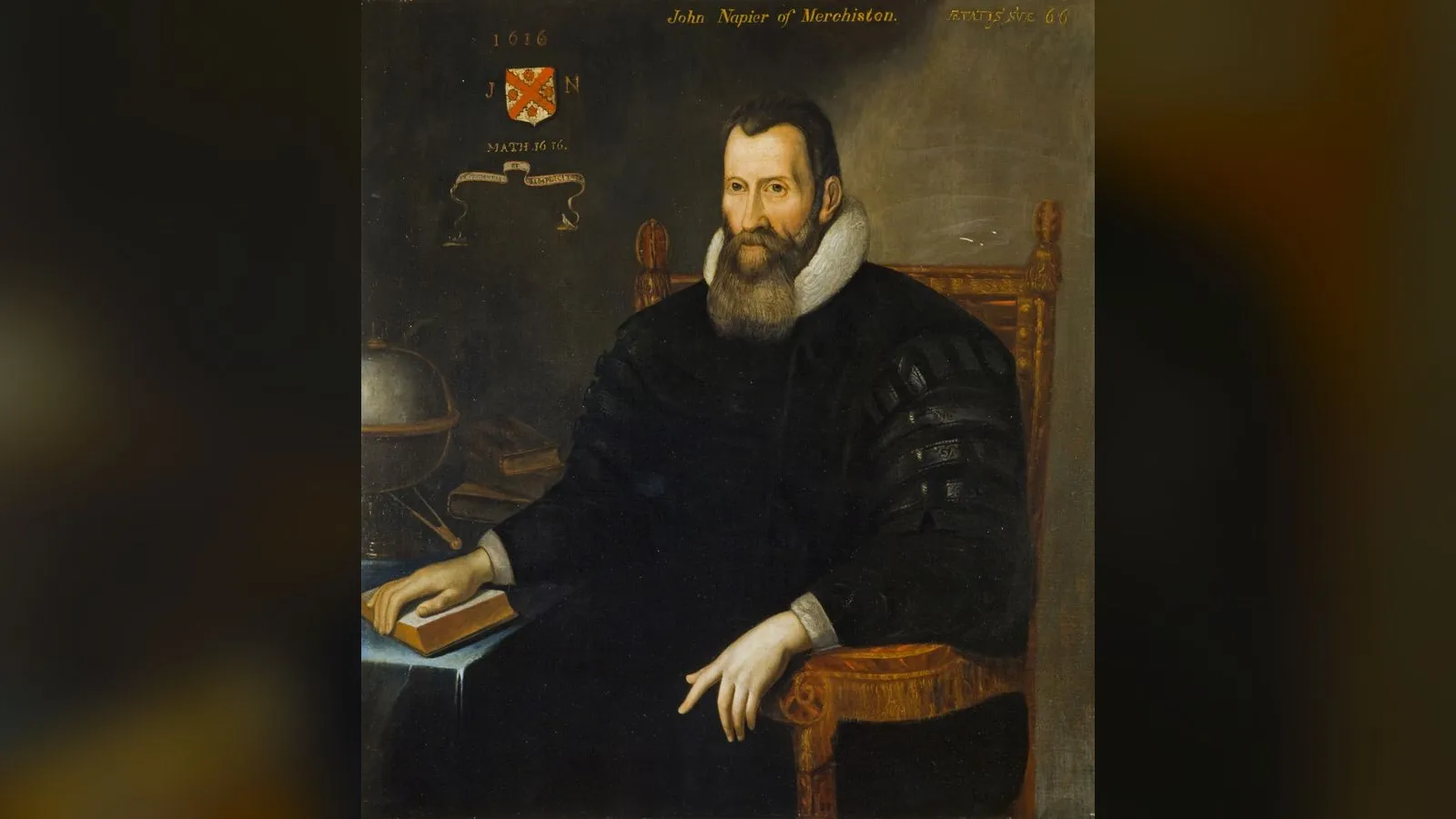

John Napier
Contents
John Napier, Laird of Merchiston near Edinburgh, invented logarithms. His 1614 book turned long multiplications and divisions into simple additions and subtractions, transforming astronomy, navigation and engineering for the next 350 years. He also devised "Napier's bones", a popular calculating aid. In his own time he had a reputation as a wizard, and he is sometimes called Scotland's Leonardo. This card tests his real achievements against the folklore.
TL;DR
- established John Napier was born in 1550 at Merchiston Tower near Edinburgh and studied at St Andrews from the age of 13. He died at Merchiston on 4 April 1617.
- established He published logarithms in Mirifici Logarithmorum Canonis Descriptio in 1614. Kepler used them, and with Henry Briggs he developed the base-10 logarithms that Briggs tabulated.
- shared The Swiss instrument-maker Jost Bürgi devised an equivalent system independently, perhaps earlier, but published only in 1620; Napier has priority by publication.
- established In Rabdologiae (1617) he described "Napier's bones", numbered rods for multiplication and division that were used as far away as China and Japan.
- traditional His reputation as a sorcerer is mostly folklore. His 1596 "secret inventions" for defence, including an armoured chariot and burning mirrors, were proposals that were never shown to have been built.
Key Facts
- Born
- 1550, Merchiston Tower, near Edinburgh
- Education
- St Salvator's College, St Andrews, from age 13
- A Plaine Discovery of the Whole Revelation of Saint John
- 1593
- "Secret inventions"
- 7 June 1596
- Logarithms published
- 1614, Mirifici Logarithmorum Canonis Descriptio
- Henry Briggs visits
- 1615
- Napier's bones
- Rabdologiae, 1617
- Died
- 4 April 1617, Merchiston, aged 67
- Buried
- St Cuthbert's, Edinburgh
- Bürgi's rival tables published
- 1620
Scottish Impact Index (SI Score)
- Global Influence
- 9/10
- Enduring Relevance
- 10/10
- Material Contribution
- 7/10
- Exceptional Achievement
- 10/10
- Lasting Legacy
- 9/10
- Recognition
- 5/10
50/60
Ranked =13th of 200 in Great Scots
A Note on Claims and Evidence
Each major claim carries one of three labels. established means supported by primary records, official bodies or several independent reliable sources. shared means the core fact is sound but sources disagree on details, dates or interpretation. traditional means widely repeated but not traceable to a primary or independent source.
Napier's mathematical works, his theological book and some legal documents survive, so his achievements are well documented. The stories of his magic come largely from local tradition and a 19th-century family memoir. Some modern sources overstate his inventions, crediting him with the slide rule, the decimal point or the constant e, none of which he invented.
Timeline
John Napier is born at Merchiston Tower.
He enrols at St Salvator's College, St Andrews.
He publishes A Plaine Discovery of the Whole Revelation of Saint John.
He signs a contract with Robert Logan of Restalrig to search Fast Castle for treasure.
He sets out his "secret inventions" for the defence of the island.
He publishes his logarithms in the Descriptio.
Henry Briggs writes enthusiastically about Napier's logarithms.
Briggs visits Napier; they agree on base-10 logarithms.
Rabdologiae describes Napier's bones.
Napier dies at Merchiston.
Jost Bürgi publishes his own logarithmic tables; Kepler dedicates his Ephemeris to Napier.
William Oughtred invents the slide rule using logarithms.
Details
Biography: Merchiston, St Andrews and Gartness
John Napier was born in 1550 at Merchiston Tower (also called Merchiston Castle), a tower house near Edinburgh that had been the family seat since the 1430s, when an ancestor became the first Napier of Merchiston. His father, Sir Archibald Napier, was a justice-depute who was knighted in 1565 and was just 16 years old when John was born. His mother, Janet Bothwell, was a sister of Adam Bothwell, Bishop of Orkney, and daughter of the judge Francis Bothwell.
At age 13 Napier was enrolled at St Salvator's College, St Andrews. There he absorbed the anti-papal sermons of Christopher Goodman, which shaped his lifelong religious convictions, and developed twin passions for theology and arithmetic. Records do not show him completing a degree. A 1560 letter from his uncle Adam Bothwell advised that John be sent "to the schools either to France or Flanders, for he can learn no good at home," and historians believe he studied on the Continent; when he returned to Scotland in 1571 he was fluent in Greek. He bought a castle at Gartness in 1574, where much of his logarithmic computation was done, and on his father's death in 1608 moved into Merchiston Castle, where he lived until his death. He married Elizabeth Stirling in 1572 (two children); after her death in 1579 he married Agnes Chisholm, with whom he had ten more children.
The invention of logarithms (1614)
Napier's motivation was intensely practical. He wrote that "nothing is more tedious… in the practice of the mathematical arts, than the great delays suffered in the tedium of lengthy multiplications and divisions, the finding of ratios, and in the extraction of square and cube roots." For astronomers and navigators handling enormous numbers, errors and time costs were crippling.
His insight was to map a geometric progression onto an arithmetic one, so that multiplication and division of numbers correspond to addition and subtraction of their logarithms (log mn = log m + log n). He conceived this kinematically — two points, one moving at constant speed along an unbounded line, the other decelerating along a finite segment — and worked at it for more than 20 years; as National Museums Scotland's curator of science Dr Tacye Phillipson puts it, "For over 20 years, Napier worked on developing methods of simplifying previously laborious and error-prone calculations." Mirifici Logarithmorum Canonis Descriptio (1614) contained 57 pages of explanation and 90 pages of tables of logarithms of trigonometric functions. He called logarithms "artificial numbers."
The impact was immediate and lasting. Kepler used logarithms to compute planetary orbits and dedicated his 1620 Ephemeris to Napier; Pierre-Simon Laplace later wrote that logarithms, "by shortening the labours, doubled the life of the astronomer" (as quoted in Howard Eves, In Mathematical Circles, Boston, 1969). Logarithmic tables and the slide rule (a logarithmic device) remained essential tools for scientists and engineers until electronic calculators arrived in the 1970s. As Wikipedia's overview summarises the scholarly view, "the development of logarithms is given credit as the largest single factor in the general adoption of decimal arithmetic."
Henry Briggs, professor of geometry at Gresham College, was so excited that he wrote to Archbishop James Ussher on 10 March 1615: "Napper, lord of Markinston, hath set my head and hands a work with his new and admirable logarithms." Briggs made the arduous journey to Edinburgh in 1615; the two reportedly spent a quarter of an hour gazing at one another in mutual admiration before speaking. Together they agreed to rebase the logarithms to base 10 with log 1 = 0 ("common logarithms"), which Briggs computed; in their Logarithmorum Chilias Prima (1617) and then his Arithmetica Logarithmica (1624), Briggs published logarithms accurate to 14 decimal places (the latter covering 30,000 natural numbers). Mirifici Logarithmorum Canonis Constructio (written before the Descriptio but published posthumously in 1619 by his son Robert) explained the construction method.
The Napier–Bürgi priority question
The Swiss court clockmaker and instrument-maker Jost Bürgi (1552–1632) independently devised an equivalent logarithmic system (his "Progress Tabulen"), probably around 1600–1610, working in the orbit of Tycho Brahe and the Kassel observatory. He published only in 1620, at the urging of Kepler, after Napier's work was already known. Kepler himself noted that Bürgi "led [the way] to these very logarithms many years before Napier's system appeared; but… instead of rearing up his child for the public benefit he deserted it in the birth." The scholarly consensus (e.g., Kathleen Clark and Clemency Montelle's 2012 study in Revue d'histoire des mathématiques, vol. 18) treats this as a genuine case of parallel, independent discovery: Napier holds priority by publication (1614 vs 1620) and his approach was more fully developed and influential, but Bürgi deserves recognition as a co-discoverer whose contribution has often been unfairly neglected.
Napier's bones (Rabdologiae, 1617)
Published in the year of his death and dedicated to his patron Alexander Seton, Rabdologiae, seu Numerationis per Virgulas described three calculating aids. The most famous, "Napier's bones" (or rods), is a set of rods — typically made of wood, bone or ivory, hence the name — each engraved with a column of a multiplication table. By aligning rods for the digits of a number and reading off rows (adding along diagonals), a user could multiply, divide and extract square and cube roots, reducing the work to simple addition. The device was based on lattice (gelosia) multiplication and the word "rabdology" (from Greek rhabdos, rod) was Napier's coinage. The bones became wildly popular, were translated into all major European languages, and examples reached China and Japan within years.
Rabdologiae also described two lesser-known devices: the promptuary (a more complex strip-based "lightning calculator" for multi-digit multiplication, sometimes called the first attempt at a calculating machine) and "location arithmetic" performed on a chessboard — a system that is one of the earliest applications of binary arithmetic as a computational aid, predating Leibniz's 1703 binary treatise by nearly a century. Neither caught on, but the chessboard work is historically remarkable. The treatise also contains an early published reference to the decimal point.
Other mathematical contributions
Beyond logarithms, Napier provided an elegant mnemonic — Napier's Rules of Circular Parts (the "Napier circle" or pentagon) — for the ten equations governing right-angled spherical triangles, plus the two "Napier's analogies" for solving spherical triangles. These were of real value to astronomy and navigation. He also improved Simon Stevin's decimal notation by systematically using the full stop as the decimal separator; the decimal point appears throughout the Constructio and Rabdologiae, and his promotion of it is the main reason it entered common use.
Religious writing: A Plaine Discovery (1593)
Napier himself considered A Plaine Discovery of the Whole Revelation of Saint John (1593) his most important work. Written in English (unlike his Latin mathematical works) so that "the simple of this island may be instructed," it applied a quasi-mathematical, proposition-by-proposition analysis to the Book of Revelation. Across 36 propositions Napier argued the Pope was the Antichrist, identified the Papacy and Islam with apocalyptic figures, and — dating the seventh trumpet to 1541 — predicted the end of the world would fall between 1688 and 1700. Dedicated to James VI, it urged the king to "reform the universal enormities of his country, and first to begin at his own house, family, and court." The book was a genuine bestseller, going through many editions and Dutch, French and German translations. It sits squarely in the violent religious tensions of Reformation Scotland: Napier sat on the General Assembly and served on committees pressing James VI to act against Catholics, against the backdrop of the "Spanish blanks plot."
The "wizard" reputation: documented activity vs folklore
Napier was widely perceived by neighbours as a magician or necromancer — a reputation fed by his black cloak, his solitary study, his interest in alchemy and his keeping of a black cockerel rumoured to be a "familiar spirit," and tales of a black spider carried in a box. The two most-repeated stories are:
- The black rooster: To find a thief among his servants, Napier secretly coated his black cockerel with soot and had each servant stroke it in a dark room, claiming the bird would identify the culprit. The guilty servant, afraid to touch it, emerged with clean hands. This is a clever piece of applied psychology, not magic.
- The drunken pigeons: Plagued by a neighbour's pigeons eating his grain, Napier scattered grain steeped in alcohol, then gathered up the intoxicated, "passive" birds — which looked supernatural to onlookers.
A genuine document survives: a 1594 contract with Robert Logan of Restalrig to search Fast Castle for hidden treasure, in which Napier was to "do his utmost diligence to search and seek out, and by all craft and ingine to find out the same, and by the grace of God either find out the same, or make it sure that no such thing has been there." The contract was apparently never fulfilled, and no gold was found when the Edinburgh Archaeological Field Society excavated the site in 1971–1986. The key caveat: many of these anecdotes were collated in 1834 by Napier's descendant Mark Napier in his Memoirs, "the sort of which could get a man a reputation for magic." Curator Tacye Phillipson of National Museums Scotland frames it well: "We now divide astronomy very strictly from astrology, and chemistry from alchemy. As a man of those times, he believed if you were interested in exploring the world, you were interested in exploring every avenue possible."
Military "secret inventions" (1596)
On 7 June 1596 Napier signed a document, now held in the Bacon Collection at Lambeth Palace Library, London, titled "Secrett Inventionis, profitabill and necessary in theis dayes for defence of this Iland." Amid fears of a renewed Spanish invasion, it listed four devices "designed by the Grace of God, and the worke of expert craftsmen": two kinds of burning mirror to ignite enemy ships at a distance, a destructive "round artillery shot" said to clear a field of living things, and a musket-proof metal chariot from which shot could be fired through small holes. The document closed: "These inventions besides devises of sayling under water with divers, other devises and strategems for harming of the enemyes by the Grace of God and worke of expert Craftsmen I hope to perform."
Crucially, there is no reliable evidence any of these was ever built. The single testing claim — that Napier demonstrated his artillery on a plain, destroying cattle and sheep — comes solely from Sir Thomas Urquhart's The Discoverie of a Most Exquisite Jewel (1652), a late and unreliable source. A reliably transmitted anecdote has Napier, near death, refusing to develop his weapons further, saying that "for the ruin and overthrow of man there were too many devices already framed." The popular claim that Napier "designed a tank and a submarine" should be handled carefully: the armoured chariot is a fair gloss on an early "tank," but the "submarine" rests only on the single undeveloped phrase about "sayling under water" — it was not one of the four described inventions.
Death, burial and legacy
Napier died on 4 April 1617 of the effects of gout at Merchiston Castle, aged 67. He was buried in the kirkyard of St Giles; after that ground was lost to build Parliament House, his remains were moved to a vault at St Cuthbert's Parish Church at the west end of Princes Street Gardens, where a wall monument to him (based on the first page of his logarithms book) stands in the vestibule.
His commemorations are extensive:
- Edinburgh Napier University is named after him and is built around Merchiston Tower, his birthplace, now a Category A listed building at the heart of its Merchiston campus. The institution began as Napier Technical College in 1964 and became a university in 1992. A bust of Napier holding his "bones" stands at the university.
- The lunar crater Neper is named after him.
- The neper (Np), a logarithmic unit used in engineering (related to the decibel; 1 neper ≈ 8.686 dB), bears his Latinised name.
- In French, Spanish and Portuguese the natural logarithm is named for him; in Finnish and Italian the constant e is named for him.
- The 1914 Napier Tercentenary celebration in Edinburgh produced a major memorial volume.
Did You Know?
- "Marvellous Merchiston": Napier's admiring nickname during his lifetime.
- A hobby, not a job: Napier regarded mathematics as recreation; he considered his anti-Catholic Revelation commentary his greatest achievement.
- Worked in near-isolation: He is often called the only person to have made a discovery of that magnitude with essentially no reliance on the work of predecessors (though he did know of related methods like prosthaphaeresis).
- Binary, a century before Leibniz: His chessboard "location arithmetic" used binary arithmetic almost 90 years before Leibniz's famous 1703 treatise.
- The bones travelled the world: Within a few years, sets of Napier's bones were being used as far away as China and Japan.
- Napier the agricultural improver: He experimented with fertilisers and was granted a patent for a hydraulic screw to pump water out of coal pits.
- End-of-the-world maths: He calculated the apocalypse would arrive in 1688 or 1700.
- A 110-decimal-place legacy: Log tables grew ever more precise, culminating in a 1964 table accurate to 110 decimal places.
FAQ
1What are logarithms?
A way of turning multiplication and division into addition and subtraction, which made long calculations much faster.
2Did Napier invent logarithms?
Yes, and he was the first to publish them, in 1614. Jost Bürgi developed an equivalent system independently but published later.
3Who was Henry Briggs?
An English mathematician who visited Napier in 1615 and produced tables of base-10 logarithms.
4What are Napier's bones?
Numbered rods used to make multiplication and division easier, described in 1617.
5Was Napier a wizard?
No. Stories such as the black cockerel that identified a thief show clever psychology, not magic.
6Did he build a tank or a submarine?
No. His 1596 military ideas were proposals, and there is no reliable evidence that any was built.
7Did he invent the decimal point?
No. He helped popularise it; decimal fractions had been introduced earlier by Simon Stevin.
8Did he invent the slide rule?
No. William Oughtred did, around 1622, building on logarithms.
9What did Napier think his greatest work was?
His anti-Catholic commentary on the Book of Revelation, published in 1593.
10What is named after him?
Edinburgh Napier University, the lunar crater Neper and the neper unit.
Sources and Further Reading
Scholarly/Critical
- Alexander Broadie, "The Rise (and Fall?) of the Scottish Enlightenment", in T. M. Devine and Jenny Wormald (eds), The Oxford Handbook of Modern Scottish History (Oxford University Press, 2012) — further reading on Napier and early Scottish science
Further Reading
- Julian Havil, John Napier: Life, Logarithms, and Legacy (Princeton University Press, 2014)
- C. G. Knott (ed.), Napier Tercentenary Memorial Volume (Longmans, Green, for the Royal Society of Edinburgh, 1915)
Caveats: Myths and Disputed Claims
- Do not present Napier's invention of logarithms without mentioning Bürgi.
- Do not call Napier a sorcerer or alchemist on the basis of folklore.
- Do not say his military inventions were built or used.
- Do not call him "Scotland's Leonardo da Vinci" as an established judgement.
- Do not credit him with inventing the decimal point, the constant e or the slide rule.
- Do not give an exact birth date.
Card 033 · Great Scots