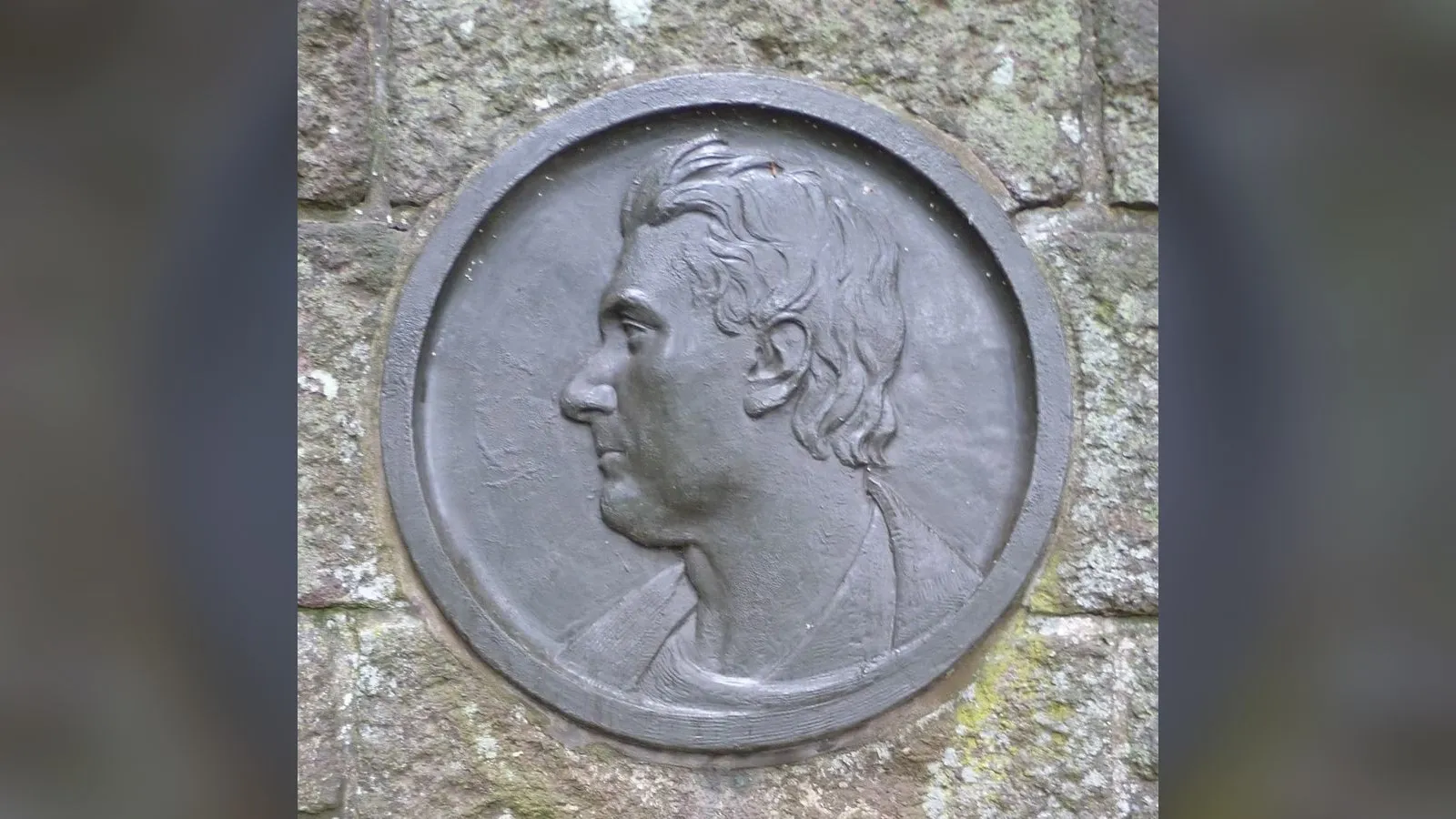

John Rennie the Elder (1761–1821)
Contents
TL;DR
- Established/Documented: Rennie was one of the two or three most significant civil engineers of his generation, designing Waterloo Bridge (called "the noblest bridge in the world" by the sculptor Canova), Southwark Bridge, the Plymouth Breakwater, the Kennet and Avon Canal, and major dock systems at London, Hull, Liverpool, and Dublin, among a vast body of work spanning canals, bridges, harbours, and land drainage.
- Disputed/Documented — a genuine, carefully balanced question: Rennie's exact role in the Bell Rock Lighthouse, alongside resident engineer Robert Stevenson (see our Great Scots card on Robert Stevenson), remains a real point of historical dispute rather than a settled matter in either direction — Rennie held the formal title of chief engineer, for a modest fee of £400, visited the site twice during construction, and proposed design modifications that Stevenson largely declined to adopt; the Northern Lighthouse Board's own institutional records ultimately credited Stevenson as the project's principal engineer, a judgment most historians have accepted, though Rennie's son later maintained that his father's advisory contribution warranted greater recognition as a genuine designer of the structure. This card presents Rennie's own documented, more limited role honestly, rather than either erasing his involvement or inflating it to match Stevenson's.
- Established/Documented: Rennie's reputation among contemporaries rested specifically on his personal integrity and rigorous honesty as much as his technical brilliance — one colleague's observation that "what I liked about Rennie was his severe truthfulness" reflects a widely shared contemporary judgment of his character, distinct from and additional to his engineering skill.
- Established/Documented: Rennie died before his most famous bridge project, London Bridge, was actually built — the design was his, completed in 1820, but construction (1824–1831) was carried out after his death by his engineer sons, John Rennie the Younger and George Rennie, a fact that complicates any simple attribution of the finished structure to Rennie alone.
- Shared/Traditional: Rennie is sometimes discussed as a rival or comparator to Thomas Telford (see our Great Scots card on Thomas Telford), given their overlapping careers and similarly vast, era-defining output of British infrastructure — a broadly fair comparison, though the two men's specific technical strengths (Rennie's mastery of masonry bridge and dock construction and land drainage; Telford's particular strength in iron construction, canals, and road systems) were genuinely distinct rather than directly competing in every respect.
- shared The two men were also personal rivals. In 1805 Telford complained to James Watt that Rennie was running down his character "in every quarter", and in the Fens after 1818 they served rival commissions. Julian Glover, in his biography Man of Iron (2017), reads Telford's complaint as a disguised attack of his own.
Key Facts
- Born
- 7 June 1761, near Phantassie, East Linton, East Lothian, Scotland
- Died
- 4 October 1821, London, England (aged 60)
- Education
- Apprenticed to millwright Andrew Meikle from age 12; Dunbar High School; University of Edinburgh (1780–83)
- Known for
- Waterloo Bridge; Southwark Bridge; London Bridge (designed, completed posthumously); Plymouth Breakwater; Kennet and Avon Canal; major British dock systems
- Key employer/mentor
- James Watt, Boulton & Watt (from 1783)
- Honours
- FRSE (1788); FRS (1798)
- Family
- Married Martha Ann Mackintosh (1790; d. 1806); sons John Rennie the Younger and George Rennie both became notable engineers
- Burial
- Crypt of St Paul's Cathedral, London
Scottish Impact Index (SI Score)
- Global Influence
- 6/10
- Enduring Relevance
- 9/10
- Material Contribution
- 6/10
- Exceptional Achievement
- 6/10
- Lasting Legacy
- 6/10
- Recognition
- 3/10
36/60
Ranked =52nd of 200 in Great Scots
Claim-Status and Evidence Note
Claims are evidence-tiered as Established/Documented (settled by primary records, institutional history, or broad scholarly consensus), Shared/Traditional (widely told and broadly accurate), disputed (credible sources genuinely differ), or Legend/Myth (unsupported and actively corrected here). The central point requiring careful, balanced treatment in Rennie's story is, again, the Bell Rock Lighthouse credit question also addressed in this series' Robert Stevenson card — this card presents Rennie's own documented, genuinely more limited contribution honestly, rather than either dismissing his formal involvement entirely or inflating it to claim equal primary credit with Stevenson.
Timeline
Born near Phantassie, East Lothian, youngest son of farmer and brewer James Rennie.
Aged around twelve, begins working under millwright and inventor Andrew Meikle (inventor of the threshing machine), who lived on the Phantassie estate.
Attends Dunbar High School.
Establishes himself as an independent millwright, with Meikle's backing.
Studies at the University of Edinburgh, combining formal academic study with continued practical millwright work.
Undertakes a study tour of English infrastructure and machinery; begins his long association with James Watt at the Boulton & Watt Soho works, Birmingham.
Relocates to London to manage machinery for the Albion Mills, supplied by Boulton & Watt.
Marries Martha Ann Mackintosh.
The Albion Mills burn down; Rennie's own independent business continues from workshops on the site.
Reports on a ship canal through the Great Glen, endorsing the line James Watt had surveyed in 1773; Thomas Telford later adopts it for the Caledonian Canal.
Engineers the Kennet and Avon Canal, including the Dundas Aqueduct and the 29-lock Caen Hill flight.
Works on the Crinan Canal in Scotland.
HMS York wrecks on the Bell Rock reef with the loss of all 491 crew, intensifying pressure for a lighthouse there.
Builds Kelso Bridge.
Undertakes major drainage works in the Lincolnshire and Norfolk Fens; revises plans for Ireland's Royal Canal (1802), earning the Freedom of Dublin in 1804.
Gives evidence, with William Jessop, to the Commons select committee that approves the Caledonian Canal.
Telford complains to James Watt that Rennie is disparaging him.
Implements steam-dredging machinery at Hull's Humber Dock, among the earliest extensive uses of the technology.
Proposes the Plymouth Breakwater in an April report; Parliament approves Bell Rock Lighthouse plans following his formal endorsement as chief engineer.
Bell Rock Lighthouse constructed, with Rennie holding the formal title of chief engineer (for a fee of £400) while Robert Stevenson serves as resident engineer managing on-site construction.
Construction begins on the Plymouth Breakwater.
Designs and builds Waterloo Bridge (originally Strand Bridge), opened on the second anniversary of the Battle of Waterloo.
Builds Southwark Bridge, with three cast-iron spans.
Parliament authorises Dunleary Harbour (later Dún Laoghaire), Ireland, where Rennie's advocacy for two piers rather than one proves correct in preventing sand drift.
Construction begins on the Custom House Docks, Dublin.
Telford begins reconstructing Rennie's Crinan Canal for the Caledonian Canal commissioners.
Appointed engineer to the Fen drainage commissioners, while Telford becomes engineer to the navigation commissioners.
Completes the design for a new London Bridge, replacing the medieval structure.
Dies in London after a brief illness, aged 60.
London Bridge is constructed posthumously by Rennie's sons, John Rennie the Younger and George Rennie, based on his design.
Following Robert Stevenson's death, the Northern Lighthouse Board formally credits Stevenson with "the honour of conceiving and executing the Bell Rock lighthouse."
Details
From a millwright's apprentice to James Watt's circle
John Rennie was born in 1761 near Phantassie in East Lothian, the youngest son of a farmer and brewer. His formative technical education came not from formal schooling but from direct apprenticeship, beginning around age twelve, under Andrew Meikle — the millwright and engineer famous as the inventor of the mechanical threshing machine, who happened to live on the Phantassie estate where Rennie grew up. This early, hands-on grounding in practical mechanical engineering set the template for Rennie's entire subsequent career: even after establishing himself independently as a millwright in 1779 and pursuing further formal study at the University of Edinburgh from 1780 to 1783, he continued to combine rigorous theoretical learning with sustained practical, mechanical experience, a combination that would distinguish his engineering approach throughout his life.
A decisive career turn came in 1783, when a study tour of English infrastructure led to his introduction to James Watt and employment at the Boulton & Watt Soho works in Birmingham — the beginning of an association with Watt that would last until Watt's own death in 1819. By 1784, Rennie had relocated to London to manage the machinery at the Albion Mills, supplied by Boulton & Watt, where he introduced significant innovations including the substitution of iron for wood in key machinery components. When the Albion Mills burned down in 1791, Rennie's own independent engineering business, already well established, continued operating from workshops on the same site, going on to supply mills, breweries, distilleries, and sugar mills across Britain and internationally — a substantial manufacturing and engineering enterprise that existed alongside, and financially underpinned, his growing career in large-scale civil engineering.
A vast body of canal, drainage, and dock engineering
Rennie's transition into large-scale civil engineering proceeded through an extensive sequence of canal projects from the early 1790s onward — including the Lancaster Canal, the Chelmer and Blackwater Navigation, Scotland's Crinan Canal, the Rochdale Canal, and, most significantly, the Kennet and Avon Canal, which occupied him from 1794 to 1810 and included major individual engineering achievements such as the Dundas Aqueduct and the remarkable 29-lock Caen Hill flight. His engineering work extended well beyond Britain's shores in practical effect if not literal geography: he revised the plans for Ireland's Royal Canal in 1802, earning the Freedom of the City of Dublin in 1804, and undertook extensive and consequential land drainage operations across the Lincolnshire and Norfolk Fens between 1802 and 1810, improving the River Witham and completing the Eau Brink Cut, a new channel for the River Ouse, shortly before his death — unglamorous but genuinely transformative work reclaiming and protecting substantial areas of agricultural land from flooding.
Rennie's dock engineering was similarly extensive, encompassing major works at Hull, Liverpool, Greenock, Leith, and London itself, including the London, East India, and West India Docks, alongside harbour improvements at Chatham, Devonport, Portsmouth, Holyhead, Ramsgate, Sheerness, and several Irish ports. At Hull's Humber Dock (1803–1809), he was among the earliest engineers to implement steam-powered bucket-chain dredging machinery at significant scale — a genuinely important technical innovation in large-scale harbour construction, even if the underlying concept may have been anticipated by others, notably Sir Samuel Bentham.
The bridges that made his public reputation
It was in bridge design, however, that Rennie achieved his most publicly celebrated distinction, combining traditional stone masonry construction with innovative techniques — including the use of cast iron in combination with stone — to achieve low, wide, elliptical arches that had previously been considered structurally impossible. His masterpiece in this respect was Waterloo Bridge (originally named Strand Bridge), built between 1811 and 1817 with nine equal arches and a strikingly flat roadway, an aesthetic and engineering achievement contemporaries rated extraordinarily highly — one assessment called it "perhaps the finest large masonry bridge ever built in this or any other country," and the celebrated Italian sculptor Antonio Canova reportedly declared it "the noblest bridge in the world," adding that it was "worth going to England solely to see Rennie's bridge." Southwark Bridge, built between 1815 and 1819 with three substantial cast-iron spans, and a string of further bridges — at Kelso, Musselburgh, Newton Stewart, and Leeds (where Rennie built two stone bridges, including one with a striking 100-foot elliptical arch, for mill owner Benjamin Gott) — extended his reputation across Britain as the era's foremost bridge engineer.
Rennie's final and most historically resonant bridge design, however, was never built during his own lifetime. He completed his design for a new London Bridge, replacing the ageing medieval structure, in 1820, but died the following year before construction began. The bridge that actually rose between 1824 and 1831 — later relocated, famously, to Lake Havasu City in Arizona in the twentieth century after London replaced it again — was built by Rennie's own engineer sons, John Rennie the Younger and George Rennie, working from their father's design. This is worth stating precisely rather than glossing over: "Rennie's London Bridge" is accurately understood as his design, executed posthumously by his sons, not a structure he personally oversaw through construction as he had with his earlier bridges.
The Plymouth Breakwater: engineering on a genuinely vast scale
Among all Rennie's works, the Plymouth Breakwater arguably captured the greatest public imagination, representing civil engineering at an almost unimaginable physical scale for its era: a mile-long wall built across Plymouth Sound in roughly 66 feet of water, ultimately containing some 3,670,444 tons of rough stone plus substantial surface masonry. Rennie proposed the scheme in an 1806 report, construction began in 1811 following formal authorisation, and the project — a landmark of maritime engineering protecting the vital naval anchorage at Plymouth — was completed, after Rennie's own death, by his son and by naval engineer Joseph Whidbey.
Bell Rock: Rennie's own documented, more limited role
The Bell Rock Lighthouse credit question, already addressed in this series' card on Robert Stevenson, deserves equally careful and balanced treatment from Rennie's own side of the story, since an honest account should neither erase his genuine formal involvement nor inflate it to claim primary credit that the documentary record does not clearly support. Following the catastrophic 1799 wreck of HMS York on the Bell Rock, with the loss of all 491 crew, pressure built for a lighthouse on the reef. When Parliament formally approved the scheme in 1806, it did so following Rennie's endorsement, and Rennie was engaged as the project's chief engineer — a title carrying real formal weight for the purposes of securing parliamentary and institutional approval, though compensated at a comparatively modest fee of £400. During the 1807–1810 construction period, Rennie visited the site twice and proposed a number of design modifications; the documented record indicates that Stevenson, as the resident engineer actually overseeing daily construction, declined most of these proposed changes.
The most direct institutional judgment on the matter came after Stevenson's own death in 1850, when the Northern Lighthouse Board's commissioners formally and explicitly credited Stevenson with "the honour of conceiving and executing the Bell Rock lighthouse" — a clear, deliberate institutional statement rather than an ambiguous or accidental one. Rennie's own son, however, later maintained that his father's advisory contributions to the project's design were substantial enough to warrant recognition of Rennie as a genuine designer and constructor of the lighthouse, not merely a nominal consulting figure. This card presents both positions honestly: Rennie's formal chief engineer title and genuine design input were real and documented, but the weight of contemporary institutional judgment and subsequent historical scholarship has favoured Stevenson as the lighthouse's true principal engineer, with Rennie's role best understood as significant senior consultation and endorsement rather than primary authorship of the finished structure.
Rennie and Telford
established Senior man, then rival. In the 1790s Rennie's reputation as a civil engineer was well ahead of Thomas Telford's. Julian Glover, in his biography Man of Iron (2017), calls him the greatest civil engineer of the age at the time of the Caledonian Canal inquiry. Both had begun as tradesmen, Rennie as a millwright and Telford as a stonemason. Telford later advised an Eskdale family that "the late Mr Rennie and myself" had both risen by serving a regular apprenticeship first.
established The Caledonian Canal. Rennie surveyed a ship canal through the Great Glen in 1793, endorsing the route James Watt had laid out in 1773. When Telford was sent north by the Treasury in 1801 he carried Watt's and Rennie's reports with him, and in 1803 he recommended the same line. Rennie gave evidence to the Commons select committee in June 1803, with William Jessop, and the canal was approved that summer, with Telford and Jessop as its engineers.
established The Crinan Canal. Rennie's Crinan Canal across Kintyre, opened in 1801, was troubled from the start. From about 1817 it was extensively rebuilt under Telford, working for the Caledonian Canal commissioners, with John Gibb and William Thomson as resident engineers.
established The road to Ireland. When Parliament first sought to improve the route between London and Dublin, it turned to Rennie. He proposed better harbours at Howth and Holyhead and an iron arch bridge across the Menai Strait that was never built. From 1810 the road and the Menai crossing passed to Telford, while Rennie continued on the harbour at Holyhead.
shared A personal feud. In 1805 Telford wrote to James Watt that, although he had never tried to injure Rennie, he heard "in every quarter" of Rennie speaking ill of his character. Glover reads the letter as an attack disguised as self-defence, aimed at Watt's good opinion. A canal investor, the Earl of Eglinton, noted that Rennie was "on the worst terms" with Telford. After 1818 they worked on opposite sides in the Fens, Rennie as engineer to the drainage commissioners and Telford to the navigation commissioners, but they tolerated each other over the Eau Brink Cut. Telford wrote politely of Rennie in his memoirs, and after Rennie's death worked with his son John on the Nene outfall. How far the rivalry was mutual rests largely on Telford's side of the correspondence.
shared Union Bridge. Glover names Rennie with Samuel Brown as designer of the Union Bridge over the Tweed near Berwick, opened in 1820. Other accounts give Brown the design and Rennie a consulting role.
Character: "severe truthfulness" as a documented professional reputation
Beyond his technical achievements, Rennie's contemporaries specifically and repeatedly praised his personal character in terms that went beyond ordinary professional courtesy. He was described as "calm, serene, and solid, like one of his own structures," and one particularly telling contemporary observation held that "what I liked about Rennie was his severe truthfulness" — a specific, documented reputation for rigorous personal and professional honesty, distinct from and additional to his recognised engineering brilliance. This reputation is corroborated by accounts of his working method: he was noted for exceptional conscientiousness in his reports and cost estimates, thoroughly investigating local conditions before committing to a project's design or budget, a practice that reflects genuine professional integrity rather than merely technical competence.
Family, honours, and a relatively brief but intensely productive life
Rennie married Martha Ann Mackintosh in 1790; she died in 1806. Of their seven children, two sons — John Rennie the Younger and George Rennie — became notable engineers in their own right, completing their father's London Bridge design and the Plymouth Breakwater after his death, while his daughter Anna married the prominent architect Charles Robert Cockerell. Rennie was elected Fellow of the Royal Society of Edinburgh in 1788 and Fellow of the Royal Society in 1798, formal recognition of his standing within the scientific and engineering establishment of his day. Despite his largely work-consumed life — his documented leisure pursuits amounted to little beyond collecting rare books, and he took only one recorded holiday, a 1816 trip to France with James Watt during which he spent much of the time inspecting Napoleon's dock works rather than simply relaxing — Rennie's relentless labour is itself credited by contemporary accounts with shortening his life. He died in London on 4 October 1821, aged 60, after a brief illness, and was buried in the crypt of St Paul's Cathedral, a mark of the highest national recognition, placing him among the small number of individuals granted burial in that specific location.
A legacy measured in infrastructure still in daily use
Rennie's practical legacy is unusually direct and tangible, even by the standards of this series' other major engineers: substantial portions of his dock, canal, drainage, and harbour infrastructure remain in active use or recognisable form today, and his general reputation for structural "firmness and solidity" — the specific quality contemporaries most consistently praised in his work — has been borne out by how well his major structures have survived the two centuries since their construction. Modern commemorations of his career include the Rennie Garden, established south of Blackfriars Bridge in London in 1862, and his 2014 induction into the Scottish Engineering Hall of Fame, alongside various more minor namings (a diesel locomotive on the Ruislip Lido Railway, a rowing boat named in his honour by Lancaster Royal Grammar School Boat Club, commemorating his earlier Lune Aqueduct work).
Did You Know
- Rennie's most famous bridge, London Bridge (the version later relocated to Lake Havasu City, Arizona), was entirely his own design but was built after his death by his sons — he never saw it constructed.
- The Italian sculptor Antonio Canova reportedly said it was "worth going to England solely to see Rennie's bridge," referring to Waterloo Bridge.
- Rennie was paid just £400 for his formal role as chief engineer on the Bell Rock Lighthouse — a modest fee reflecting a genuinely more limited, advisory role compared to Robert Stevenson's sustained, hands-on construction leadership, though Rennie's son later argued for greater recognition of his father's contribution.
- The Plymouth Breakwater, one of Rennie's most ambitious projects, ultimately contained well over 3.6 million tons of stone — an almost unimaginable scale of material for an early nineteenth-century civil engineering project.
- Rennie's specific, repeated contemporary reputation was for "severe truthfulness" as much as for his engineering brilliance — a documented character trait distinct from his technical skill.
- Rennie's nearly sole recorded holiday in his adult life was a trip to France in 1816 with James Watt, during which he reportedly spent much of his time inspecting Napoleon's dock works rather than simply resting.
- Rennie correctly predicted that Dunleary Harbour (Dún Laoghaire) in Ireland would need two piers, not the single pier initially proposed, specifically to prevent sand drift — a judgment later proven correct.
- Rennie is buried in the crypt of St Paul's Cathedral, London, a mark of the very highest national recognition granted to relatively few individuals.
FAQ
1What was John Rennie's actual role in building the Bell Rock Lighthouse?
He held the formal title of chief engineer, for a fee of £400, visited the construction site twice, and proposed design modifications that resident engineer Robert Stevenson largely declined. The Northern Lighthouse Board's own institutional records ultimately credited Stevenson as the project's principal engineer, though Rennie's genuine, documented formal involvement and endorsement were real.
2Did Rennie build London Bridge?
He designed it, completing the design in 1820, but died in 1821 before construction began. The bridge was built between 1824 and 1831 by his sons, John Rennie the Younger and George Rennie, based on his design.
3What is generally considered Rennie's masterpiece?
Waterloo Bridge (1811–1817), widely praised by contemporaries, including a reported comment from the sculptor Canova calling it "the noblest bridge in the world."
4How did Rennie's career begin?
He was apprenticed from around age twelve to millwright and inventor Andrew Meikle, combined this practical training with formal study at the University of Edinburgh, and was introduced to James Watt in 1783, beginning a long professional association.
5What made Rennie's bridges technically distinctive?
His combination of traditional stone masonry with innovative use of cast iron allowed him to build low, wide, elliptical arches that had previously been considered structurally impossible.
6Was Rennie primarily known as an engineer or as a person of particular character?
Both, genuinely — his technical achievements were substantial, but contemporaries specifically and repeatedly praised his personal integrity, with one describing his defining quality as "severe truthfulness."
7Did Rennie have engineering children?
Yes — two of his sons, John Rennie the Younger and George Rennie, became notable engineers in their own right and completed several of their father's unfinished projects, including London Bridge and the Plymouth Breakwater.
8How does Rennie compare to Thomas Telford?
Both were among the era's most significant civil engineers with broadly overlapping, extensive careers, though their particular technical strengths differed — Rennie was especially noted for masonry bridge and dock construction and land drainage, while Telford was particularly associated with iron construction, canals, and road-building.
9Were Rennie and Telford rivals?
Yes. Telford complained in 1805 that Rennie was disparaging him, and they served rival Fen commissions from 1818. Telford's own letters are the main evidence, so the balance of blame is uncertain.
10Did Rennie plan the Caledonian Canal?
He surveyed the Great Glen route in 1793 and supported Watt's line, which Telford adopted. The canal itself was built under Telford and Jessop from 1803 to 1822.
11Where is John Rennie buried?
In the crypt of St Paul's Cathedral, London — a mark of the highest level of national recognition.
12What was the scale of the Plymouth Breakwater?
Enormous: a mile-long wall built in roughly 66 feet of water, containing well over 3.6 million tons of rough stone, one of the most ambitious civil engineering projects of its era.
Sources and Further Reading
Primary/Institutional
- Institution of Civil Engineers, "John Rennie: Renowned Civil Engineer" and "John Rennie — Calm, Serene and Solid, an Engineer of 'Severe Truthfulness'"
- Scottish Engineering Hall of Fame, John Rennie profile
- Linda Hall Library, "Scientist of the Day: John Rennie the Elder"
Scholarly
- Julian Glover, Man of Iron: Thomas Telford and the Building of Britain (Bloomsbury, 2017), chapters 8, 10, 13, 14 and 15.
- Wikipedia, "John Rennie the Elder" — detailed sourced project timeline
- Zenodo archival record, "John Rennie the Elder"
- The Engineers' Company, "John Rennie (1761–1821)"
General
- Encyclopaedia Britannica, "John Rennie"
- Undiscovered Scotland, biography of John Rennie
Caveats: Myths and Disputed Claims
As with this series' Robert Stevenson card, the central point requiring careful, evidence-based treatment here is the Bell Rock Lighthouse credit question. This card presents Rennie's own role honestly and specifically: a formally titled chief engineer role, a modest fee, two site visits, and largely declined design proposals — a real but genuinely more limited contribution than Stevenson's sustained on-site construction leadership, as reflected in the Northern Lighthouse Board's own 1850 institutional judgment crediting Stevenson as the lighthouse's principal engineer. Rennie's son's later claim for greater paternal recognition is noted as a documented historical position, not dismissed outright, but this card does not treat it as overriding the weight of contemporary institutional and subsequent scholarly judgment. Readers should also note that "Rennie's London Bridge" refers accurately to his design, completed posthumously by his sons — a nuance easy to lose in casual retellings that simply credit Rennie with the finished structure.
- Do not say Rennie designed the Caledonian Canal. He endorsed the Great Glen route in 1793; the canal was designed and built under Telford and Jessop.
- Do not present the Rennie–Telford feud as one-sided. Most of the evidence comes from Telford's letters.
Card 063 · Great Scots