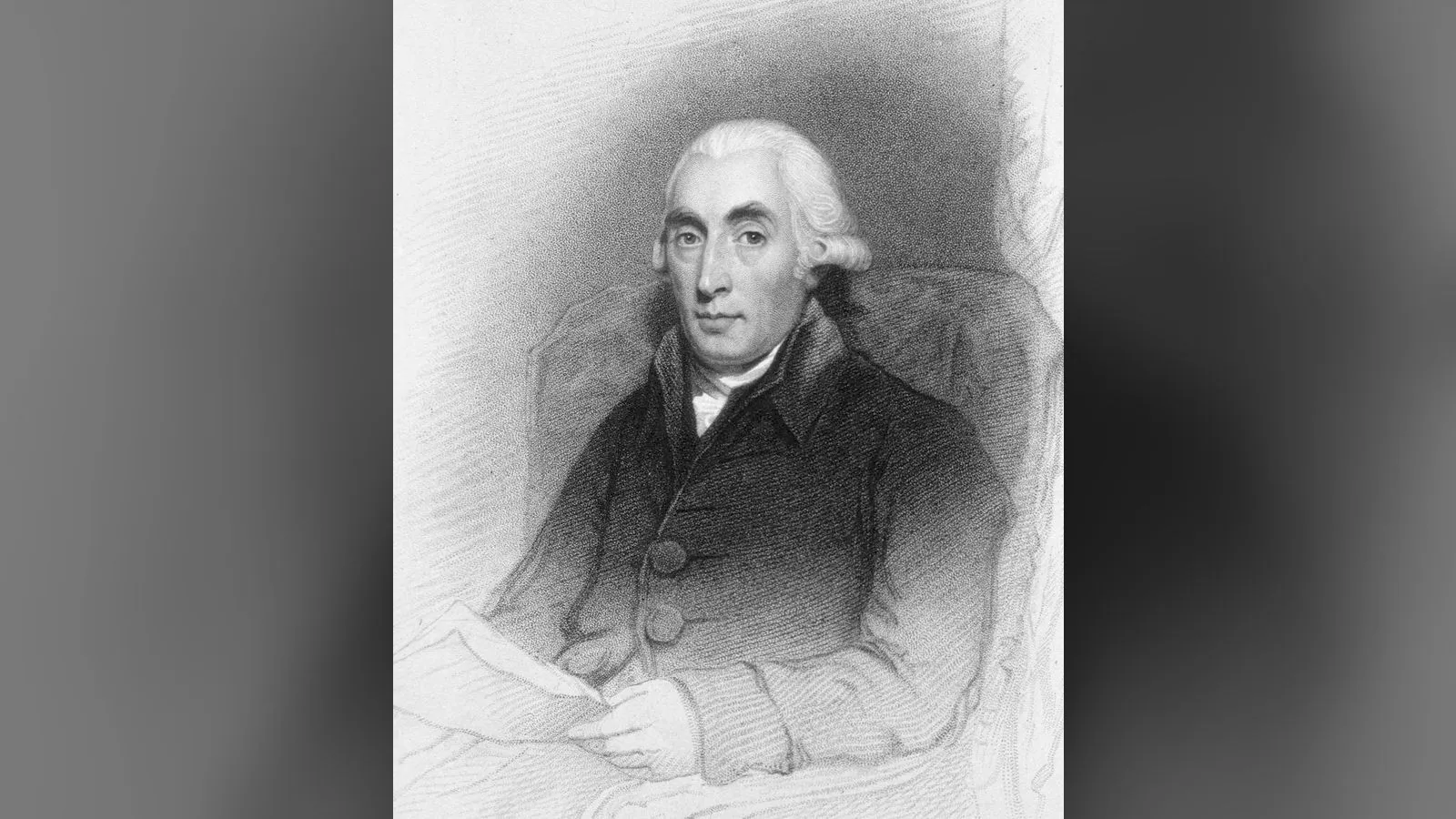

Joseph Black (1728–1799)
Contents
TL;DR
- Established/Documented. Black's discovery of "fixed air" — what we now call carbon dioxide — was one of the first genuinely quantitative chemical experiments in history, and it directly opened the door to the modern understanding that air is not a single element but a mixture of distinct gases.
- Established/Documented. His concepts of latent heat and specific heat capacity, developed in the late 1750s and early 1760s, are now considered foundational to the science of thermodynamics — a genuinely major theoretical achievement, even though he barely published any of it himself.
- Established/Documented. Black's theoretical understanding of latent heat had a direct, practical influence on James Watt's improvements to the steam engine — a real and well-documented connection between abstract Enlightenment science and the machinery of the Industrial Revolution, not a loosely implied one.
- Established/Documented. Black's teaching reached America through people as well as notes. Benjamin Franklin met him in Edinburgh in 1759 and 1771, Benjamin Rush and other Philadelphia medical students attended his lectures in the 1760s, and his Lectures on the Elements of Chemistry were reprinted at Philadelphia in 1806–07, as the literary historian Andrew Hook records in Scotland and America (1975).
- Shared/Traditional, worth precision. He is sometimes remembered mainly as a background figure to more famous contemporaries like Adam Smith and James Hutton. The historical record suggests the reverse framing is at least as fair: in his own time, Black's lectures at Edinburgh were attended by thousands of students over three decades, and it was chiefly through those students — not his own sparse publications — that his ideas spread across Britain and beyond.
Key Facts
- Born
- 16 April 1728, Bordeaux, France
- Died
- 6 December 1799, Edinburgh (aged 71)
- Family
- Sixth of twelve children of a Belfast-born wine merchant and an Aberdeenshire mother
- Education
- University of Glasgow (under William Cullen); MD, University of Edinburgh, 1754
- Key posts
- Regius Professor of Medicine, Glasgow (1757–1766); Professor of Medicine and Chemistry, Edinburgh (1766–1797)
- Major discoveries
- "Fixed air" (carbon dioxide), 1756; latent heat and specific heat, c. 1757–1762
- Notable connection
- Close friend and early supporter of James Watt
- Personal note
- Never married; left a substantial estate, meticulously divided among beneficiaries
Scottish Impact Index (SI Score)
- Global Influence
- 8/10
- Enduring Relevance
- 9/10
- Material Contribution
- 5/10
- Exceptional Achievement
- 9/10
- Lasting Legacy
- 8/10
- Recognition
- 4/10
43/60
Ranked =27th of 200 in Great Scots
How This Article Handles the Evidence
Black presents a genuinely unusual case in the history of science: a figure whose direct written output was famously sparse, and whose enormous influence was transmitted chiefly through teaching rather than publication. This article treats that teaching-centred legacy as a real and well-documented fact about how science actually spread in his era, rather than a lesser or secondary form of achievement compared to Hutton's or Smith's published books.
Timeline
Born in Bordeaux, France, to a Belfast-born wine merchant father and an Aberdeenshire mother; one of twelve children.
Sent to grammar school in Belfast at age twelve.
Begins four years of study at the University of Glasgow, coming under the influence of chemistry lecturer William Cullen.
While still a student, designs an improved analytical balance of unusually high precision for the time.
Continues medical studies at the University of Edinburgh.
Earns his MD at Edinburgh with a thesis on treating kidney stones using magnesium carbonate — research that fed directly into his subsequent chemical discoveries.
Publishes his landmark paper identifying "fixed air" (carbon dioxide) as a distinct chemical substance, through quantitative experiments on magnesia alba and limestone.
Appointed Regius Professor of the Practice of Medicine at the University of Glasgow; around this time begins his close friendship with the young instrument-maker James Watt.
Develops his theories of specific heat and latent heat through careful experimental measurement, though he publishes little of this work directly himself.
Meets Benjamin Franklin during Franklin's visit to Edinburgh.
Succeeds his own former teacher, William Cullen, as Professor of Medicine and Chemistry at the University of Edinburgh, a post he holds for over thirty years.
Benjamin Rush of Philadelphia attends his lectures as a medical student.
Dines with Franklin at David Hume's and Adam Ferguson's during Franklin's second Scottish visit.
Founding member of the Royal Society of Edinburgh.
Serves as President of the Royal College of Physicians of Edinburgh.
Declining health gradually curtails his teaching and public activity.
Charles Hope appointed as co-professor to share his teaching load.
Delivers his final lecture.
Dies peacefully at his Edinburgh home on 6 December, aged 71.
His Lectures on the Elements of Chemistry are published at Philadelphia.
Details
A cosmopolitan upbringing
Joseph Black was born in Bordeaux in 1728, not Scotland — a detail that sometimes surprises readers, though his family's roots and his own career were thoroughly Scottish. His father was a Belfast-born wine merchant working in the Bordeaux trade, and his mother came from an Aberdeenshire family also connected to the wine business; Black was the sixth of twelve children in this prosperous, multilingual household. Sent to grammar school in Belfast at twelve, he began his university education at Glasgow in 1746, where he studied under the influential chemistry lecturer William Cullen — a formative relationship Black would later, in effect, complete the circle of by succeeding Cullen directly in the chemistry chair at Edinburgh two decades later.
Fixed air: the birth of quantitative chemistry
Black's medical doctoral thesis, completed at Edinburgh in 1754, investigated the use of magnesium carbonate ("magnesia alba") in treating kidney stones — unglamorous clinical research that happened to put him directly in contact with the chemical substance at the centre of his most important discovery. Investigating magnesia alba and related substances like limestone, Black found that heating or treating them with acid released a distinct gas — which he termed "fixed air," now understood as carbon dioxide — that was measurably different from ordinary atmospheric air: denser, incapable of supporting flame or animal respiration, and precipitable out of lime-water as solid calcium carbonate, giving him a way to measure its presence and quantity precisely.
Established/Documented, and genuinely significant to the history of science: what made this work exceptional for its era was not simply the discovery itself but Black's method. He weighed his reactants and products carefully, establishing that a defined, measurable quantity of gas was involved rather than treating the phenomenon in loosely qualitative terms — an approach that helped inaugurate quantitative, measurement-based chemistry as a discipline. The French chemist Antoine Lavoisier, later a towering figure in the field in his own right, is recorded as directly acknowledging the "important revolutions" Black's discoveries had caused in the sciences.
Latent heat, specific heat, and the road to thermodynamics
Beginning around 1757 and continuing into the early 1760s, Black turned his careful, measurement-based approach to the study of heat itself. He observed a puzzling and important fact: applying continuous heat to ice at its melting point does not raise its temperature at all — it simply converts more of the ice to liquid water at the same temperature — and the same pattern holds for boiling water converting to steam. Black concluded that this heat had not disappeared but had become "latent," absorbed into the physical change of state itself rather than registering as a temperature rise. This is the origin of the modern concept of latent heat.
He complemented this with the related concept of specific heat capacity — recognising that equal masses of different substances (his own experiments compared water and mercury) require different quantities of heat to produce the same rise in temperature. Established/Documented: these two related insights are now widely regarded by historians of science as marking the effective beginning of thermodynamics as a field — a genuinely major theoretical contribution. It is a striking fact about Black's career that he himself formally published very little of this work; it survived and spread chiefly through the detailed lecture notes his students took down and carried with them.
The Watt connection: theory meets the Industrial Revolution
Established/Documented, and one of the more concrete links between Enlightenment science and the Industrial Revolution: Black's friendship with James Watt began around 1757 at the University of Glasgow, where Watt worked as an instrument maker. Black provided Watt with both intellectual engagement and, at points, direct financial support, and Watt's own later account of his thinking credits his understanding of Black's latent heat theory as a genuine, practical spur to his critical improvements on Thomas Newcomen's existing steam engine design — specifically, insight into why so much heat (and therefore fuel) was being wasted in the repeated heating and cooling of the engine's cylinder, which led Watt toward his separate-condenser design. This is not a vague, ceremonial connection between two famous contemporaries; it is a documented case of abstract thermal theory feeding directly into one of the most consequential mechanical inventions in history.
A teacher first, a publisher second
Black held professorships first at Glasgow (from 1757) and then, succeeding his own teacher Cullen, at Edinburgh from 1766 until poor health forced his retirement from active lecturing in the mid-1790s. By most accounts he was an extraordinary teacher: his lectures, delivered in a distinctive quiet but exceptionally clear voice, drew hundreds of students annually by the 1790s, and he is estimated to have taught something in the region of 5,000 students across his career, using careful experimental demonstration to make chemistry accessible even to relatively young students. Many of his former pupils went on to hold chemistry professorships themselves at Cambridge, Oxford, Glasgow, and Edinburgh, meaning Black's specific approach to and understanding of chemistry propagated across Britain's universities largely through this teaching lineage rather than through his own printed output.
Shared/Traditional, but well supported by the documented pattern of his career: Black's reluctance to publish is generally understood as reflecting a perfectionist temperament rather than any lack of material or confidence — he continued refining and re-testing his ideas for years, and much of what is now attributed to him as settled science was, during his own lifetime, known chiefly through student lecture notes circulating informally rather than through his own formal papers.
Within the Scottish Enlightenment circle
Black was closely connected to the leading figures of the Scottish Enlightenment in Edinburgh, maintaining real friendships with Adam Smith, David Hume, and geologist James Hutton — the last of whom he was buried near, in Greyfirars Kirkyard, after his death. He was a founding member of the Royal Society of Edinburgh in 1783 and served as President of the Royal College of Physicians of Edinburgh from 1788 to 1790, reflecting his standing within both the medical and broader scientific establishment of the city.
Black and the Americans
established Franklin's host. The literary historian Andrew Hook, in Scotland and America (1975), places Black in the circle that entertained Benjamin Franklin on both his Scottish visits. In 1759 Franklin met Black alongside Hume, Kames, Robertson, Cullen and the Monros. When he returned in 1771, Black was a guest at the large dinner Hume gave in his honour and again at Adam Ferguson's a few days later. Franklin's friendships in this circle opened Edinburgh to the American medical students he sponsored.
established Teacher of the Philadelphia doctors. Hook lists Black among Benjamin Rush's teachers in 1766–68, with Cullen, Monro secundus, Russell and Gregory. Rush and the other Edinburgh-trained Americans, Morgan, Shippen and Kuhn, became professors in the Philadelphia medical school founded in 1765 on the Edinburgh model, so Black's chemistry, taught inside the medical course, reached America through the men who built its first medical faculty.
established The book in America. Black's lectures appeared in print only after his death, edited by John Robison. Hook records an American edition of the Lectures on the Elements of Chemistry at Philadelphia in 1806–07, part of a wave of American reprints of Scottish Enlightenment works after the Revolution. In 1829 Mitchell King, addressing the centenary of the St Andrew's Society of Charleston, praised Black as the man who had "paved the way for the splendid achievements of modern chemistry" (as quoted by Hook). When the Boston scholar George Ticknor visited Edinburgh in 1819, Walter Scott pointed out to him the houses of the old Enlightenment figures, Black's among them.
Death and an orderly legacy
Black's health declined from 1793 onward; Charles Hope was appointed as a co-professor to share his teaching duties in 1795, and Black delivered his final lecture in 1797. He died peacefully at his Edinburgh home in December 1799, aged 71, having never married. A small, characteristic detail: he left a substantial estate — reportedly around £20,000, a considerable sum for the period — which he arranged to be divided with precise, methodical care among his beneficiaries, in a manner biographers have noted as entirely consistent with the exacting, careful habits of mind that defined his scientific work.
Modern legacy
Black's reputation today rests on a genuinely substantial foundation: the identification of carbon dioxide as a distinct chemical substance through rigorous quantitative method, and the theoretical groundwork of latent and specific heat that underpins modern thermodynamics — achievements that, combined with his documented direct influence on Watt's steam engine improvements, place him among the most consequential figures of the Scottish Enlightenment's scientific wing, even though his own name is less widely known today than Smith's or Hutton's. A lunar crater bears his name, and a 2011 archaeological excavation at the University of Edinburgh recovered scientific instruments attributed to his own laboratory work — tangible physical evidence, more than two centuries later, of the meticulous experimental practice that defined his career.
Did You Know
- Joseph Black was born in Bordeaux, France, not Scotland — though his family and career were thoroughly Scottish.
- His MD thesis on treating kidney stones with magnesium carbonate led, almost by accident, directly to his discovery of carbon dioxide.
- He taught an estimated 5,000 students over his career at Edinburgh, and it was largely through their notes — not his own published papers — that his most important ideas spread.
- His friendship with a young Glasgow instrument-maker, James Watt, helped shape the theoretical understanding behind Watt's crucial improvements to the steam engine.
- Antoine Lavoisier, one of the most celebrated chemists in history, personally credited Black with causing "important revolutions" in the sciences.
- He designed an unusually precise analytical balance while still a student — an instrument that became a standard piece of laboratory equipment.
- He is buried in Greyfriars Kirkyard, Edinburgh, near his friend and fellow Enlightenment figure James Hutton.
- Benjamin Franklin met him in Edinburgh on both of Franklin's Scottish visits, in 1759 and 1771.
- Despite his enormous scientific influence, he published remarkably little in his own lifetime, a trait biographers attribute to perfectionism rather than a lack of ideas.
Frequently Asked Questions
1What exactly did Joseph Black discover?
Two major things: "fixed air" (carbon dioxide), identified through careful quantitative experiments in 1756 as a distinct chemical substance rather than simply part of ordinary air; and the closely related concepts of latent heat and specific heat capacity, developed through the late 1750s and early 1760s, now considered foundational to thermodynamics.
2Did Joseph Black actually influence the steam engine?
Yes, directly and documentedly. His friend James Watt credited an understanding of Black's latent heat theory with helping him identify why Newcomen's existing steam engine design wasted so much fuel — insight that fed into Watt's crucial separate-condenser improvement.
3Why isn't Joseph Black as famous today as Adam Smith or James Hutton?
Largely because he published very little of his own major work directly — his ideas spread mainly through the thousands of students who attended his Edinburgh lectures over three decades and carried his teaching forward themselves, rather than through widely read books bearing his own name.
4Was Black a chemist or a doctor?
Both, in the manner typical of his era — his formal training and professorships were in medicine, but his most significant and lasting contributions were to chemistry and physics.
5How is he connected to the rest of the Scottish Enlightenment?
Closely — he was a personal friend of Adam Smith and David Hume, was buried near James Hutton, and was a founding member of the Royal Society of Edinburgh in 1783, placing him firmly within Edinburgh's central Enlightenment intellectual circle.
6Why did he publish so little?
Biographers generally attribute this to a perfectionist temperament rather than any shortage of ideas or results — he continued testing and refining his findings for years, and much of his most important work is known today largely through detailed notes taken by his own students.
7Did Joseph Black know Benjamin Franklin?
Yes. He was among the Edinburgh circle who entertained Franklin in 1759 and again in 1771, when he dined with him at David Hume's and Adam Ferguson's.
8Did Black's teaching reach America?
Yes, through students such as Benjamin Rush, who attended his lectures in 1766–68 and became a professor in Philadelphia, and through the Philadelphia edition of his Lectures on the Elements of Chemistry in 1806–07.
Sources and Further Reading
Primary/Institutional
- Joseph Black (1728–1799) — University of Edinburgh, School of Chemistry
- Joseph Black (1728–1799) — Our History, University of Edinburgh
Scholarly
- Joseph Black, carbon dioxide, latent heat, and the beginnings of the discovery of the respiratory gases — American Journal of Physiology
- Joseph Black — Britannica
- Andrew Hook, Scotland and America: A Study of Cultural Relations, 1750–1835 (Blackie, 1975), chapters 2, 4 and 6
- Alexander Broadie, "The Rise (and Fall?) of the Scottish Enlightenment", in T. M. Devine and Jenny Wormald (eds), The Oxford Handbook of Modern Scottish History (Oxford University Press, 2012) — further reading on Black and the Scottish Enlightenment
General
Caveats: Myths and Disputed Claims
- "Black was a minor figure overshadowed by Smith and Hutton." This article makes the case for the opposite reading: measured by direct student influence and later scientific consequence, his impact was arguably at least as large, even if his personal fame has not endured as widely.
- The exact extent of Black's direct financial support of Watt varies somewhat between sources in specific figures; this article states the relationship and its intellectual influence as solidly documented while treating precise financial details with appropriate caution.
- His reluctance to publish is treated here as a matter of documented biographical pattern and reasonable historical inference (perfectionism) rather than a fully resolved psychological explanation.
Card 038 · Great Scots