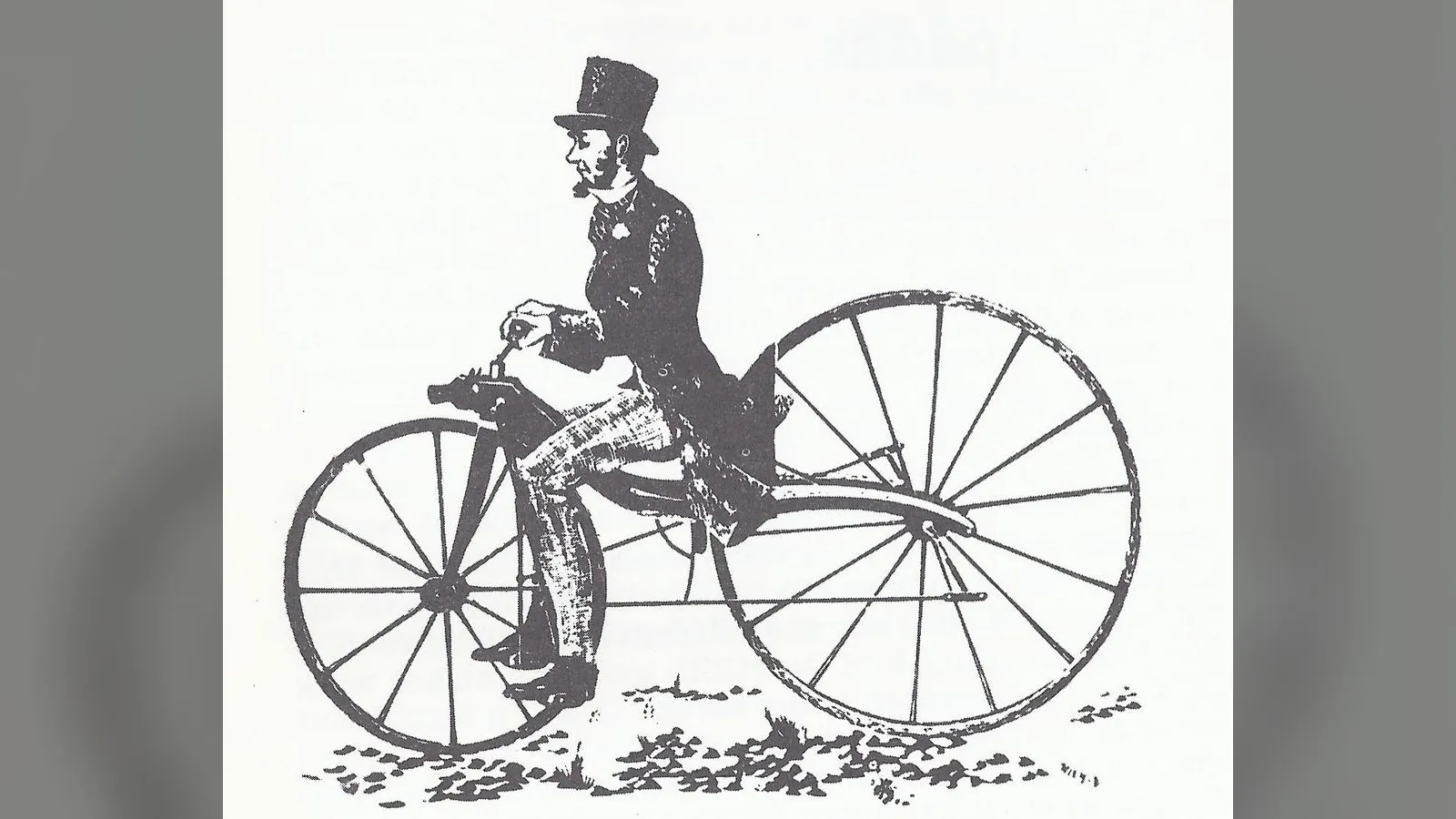

Kirkpatrick Macmillan
Contents
Kirkpatrick Macmillan, a blacksmith from Keir in Dumfriesshire, is famous as the inventor of the bicycle. The story says that around 1839 he built a two-wheeler driven by foot treadles, and in 1842 rode it to Glasgow, where he was fined for knocking down a child. It is a good story, and it is on plaques, cycle routes and museum labels. But no machine, drawing, patent or record from his lifetime survives, and cycling historians have seriously questioned it. This card tests what can and cannot be shown.
TL;DR
- established Kirkpatrick Macmillan was a blacksmith, born in the parish of Keir in Dumfriesshire in 1812, who died there on 26 January 1878.
- traditional He is said to have built, around 1839, a wooden two-wheeler whose rear wheel was driven by treadles and connecting rods, making it the first self-propelled bicycle.
- traditional He is said to have ridden it to Glasgow in 1842 and been fined five shillings for knocking down a pedestrian in the Gorbals. The newspaper report of that incident names no one.
- established The Macmillan story was put together in the 1890s by James Johnston, a relative, who set out "to prove that to my native country of Dumfries belongs the honour of being the birthplace of the invention of the bicycle."
- established Leading cycling historians, including Nicholas Oddy and David V. Herlihy, doubt the claim. Herlihy notes there is "no contemporary documentary evidence that a pedal-crank design was applied to a 2-wheeled vehicle" in Macmillan's time.
Key Facts
- Born
- 2 September 1812, parish of Keir, Dumfriesshire
- Trade
- Blacksmith, Courthill smithy, Keir Mill
- Reputed invention
- Treadle-driven two-wheeler, c.1839
- Reputed Glasgow ride
- 1842
- Died
- 26 January 1878, Keir
- Story assembled by
- James Johnston, 1890s; The Gallovidian, Winter 1899
- Gavin Dalzell's machine
- c.1845–1846, Lesmahagow
- Thomas McCall's velocipedes
- 1869, Kilmarnock
- "Macmillan" replica
- Built by McCall for the 1896 Stanley Show; Dumfries Museum
- Courthill plaque
- 1939: "He builded better than he knew"
Scottish Impact Index (SI Score)
- Global Influence
- 6/10
- Enduring Relevance
- 8/10
- Material Contribution
- 5/10
- Exceptional Achievement
- 5/10
- Lasting Legacy
- 6/10
- Recognition
- 6/10
36/60
Ranked =52nd of 200 in Great Scots
A Note on Claims and Evidence
Each major claim carries one of three labels. established means supported by primary records, official bodies or several independent reliable sources. shared means the core fact is sound but sources disagree on details, dates or interpretation. traditional means widely repeated but not traceable to a primary or independent source.
This is a disputed invention. Macmillan's life is documented, but his machine is not: there are no written records from the time, no patent and no surviving original. The story was collected about 50 years later, after his death, by a relative with a clear aim. Historians who have examined the evidence regard much of it as myth, though some think he may have experimented with treadle-driven machines.
Timeline
Kirkpatrick Macmillan is born in the parish of Keir.
Karl Drais demonstrates his pedal-less running machine in Germany.
Macmillan is said to build his treadle-driven two-wheeler.
A Glasgow newspaper reports an unnamed "gentleman from Dumfries-shire" on a velocipede knocking over a pedestrian in the Gorbals.
Gavin Dalzell of Lesmahagow builds a treadle-driven two-wheeler.
Macmillan loses his wife, a baby and his ten-year-old son.
Thomas McCall of Kilmarnock builds rear-driven velocipedes.
Macmillan dies at Keir.
James Johnston researches and promotes Macmillan's claim.
A "Macmillan" machine built by McCall is shown at the Stanley Show.
Johnston publishes his case in The Gallovidian.
The Courthill smithy plaque is unveiled for the supposed centenary.
Details
The blacksmith of Keir
established Kirkpatrick Macmillan was born in the parish of Keir, near Thornhill in Dumfriesshire, in 1812, and worked as a blacksmith at the family smithy at Courthill, Keir Mill. In 1865 he lost his wife, a baby and his ten-year-old son. He died at Keir on 26 January 1878, aged 65, and was largely forgotten until his claim was promoted after his death.
The machine
traditional According to the story, Macmillan built a wooden two-wheeler with iron-rimmed wooden wheels: a steerable front wheel and a larger rear wheel, driven by treadles linked to the rear wheel by connecting rods. The rider pushed the treadles back and forth, so his feet never touched the ground. That would have made it a true self-propelled bicycle, unlike Karl Drais's running machine of 1817, which the rider pushed along with his feet.
The ride to Glasgow
traditional The story says Macmillan rode to Glasgow in 1842 and was fined five shillings for knocking down a pedestrian in the Gorbals, making him the first person fined for a cycling offence.
established The only evidence is a Glasgow newspaper report of a "gentleman from Dumfries-shire... bestride a velocipede... of ingenious design" who knocked over a pedestrian. It does not name the rider. Johnston later identified him as Macmillan. The historian Alastair Dodds doubted that a newspaper of the time would have called a blacksmith a "gentleman".
How the story was made
established The Macmillan claim was assembled in the 1890s by James Johnston, a corn trader, tricyclist and relative of Macmillan. In The Gallovidian in 1899 he wrote that his aim was "to prove that to my native country of Dumfries belongs the honour of being the birthplace of the invention of the bicycle." At Johnston's request, the Kilmarnock joiner Thomas McCall built a "Macmillan" machine for the 1896 Stanley Show; it is now in Dumfries Museum. Sceptics argue that its design is a composite of two velocipedes McCall himself had built in 1869.
Dalzell and McCall
established For more than 50 years the inventor of the treadle bicycle was generally thought to be Gavin Dalzell of Lesmahagow, who built one around 1845–1846; his machine survives in a Glasgow museum. The claim that Dalzell copied Macmillan's design comes from Johnston's campaign.
What historians say
established Several cycling historians have examined the claim critically. In 1990 Nicholas Oddy concluded that the bicycle did not develop until after 1860 and that the evidence for Macmillan is so thin that the popular account is largely myth, though he thinks Macmillan probably experimented with treadle tricycles, as many people did. In 2024 he returned to the subject, arguing that later defences of the story had been one-sided. David V. Herlihy writes that there is "no contemporary documentary evidence that a pedal-crank design was applied to a 2-wheeled vehicle" at that time.
shared Some sources state that around 1840 Macmillan was living in Glasgow and working at the Vulcan Foundry rather than at Courthill. This is repeated but hard to confirm.
Remembering Macmillan
established Despite the doubts, Macmillan is widely commemorated. A plaque on the Courthill smithy, unveiled in 1939 for the supposed centenary, reads "He builded better than he knew." A popular story also holds that his niece Mary Marchbank secretly rode the machine and became the first woman cyclist, but its origin is unknown.
Did You Know?
- Karl Drais's running machine of 1817 had no pedals; riders pushed it with their feet.
- Macmillan's machine was said to be driven by treadles and rods, not rotating pedals.
- No original Macmillan machine survives.
- The machine in Dumfries Museum was built by Thomas McCall in 1896.
- The 1842 newspaper report does not name the rider.
- For 50 years Gavin Dalzell was thought to be the inventor.
- The Courthill plaque reads "He builded better than he knew."
- The story of his niece as the first woman cyclist has no known source.
FAQ
1Did Kirkpatrick Macmillan invent the bicycle?
He is traditionally credited with it, but there is no contemporary evidence, and historians doubt the claim.
2What is he said to have built?
A wooden two-wheeler with a rear wheel driven by treadles and connecting rods, around 1839.
3Was he fined in Glasgow?
A newspaper reported an unnamed rider fined in 1842; Macmillan was linked to it only later.
4Who promoted his claim?
James Johnston, a relative, in the 1890s.
5Is his bicycle in a museum?
No original survives. The machine in Dumfries Museum was built by Thomas McCall in 1896.
6Who was Gavin Dalzell?
A Lesmahagow man who built a treadle bicycle around 1845–1846 and was long thought to be the inventor.
7What do historians say?
Many, including Nicholas Oddy and David V. Herlihy, think the story is largely myth.
8Could he have built something?
Possibly; Oddy suggests he probably experimented with treadle tricycles.
9When did he die?
On 26 January 1878, at Keir.
10Why is he so well known?
Because his claim was promoted after his death and is commemorated on plaques and cycle routes.
Sources and Further Reading
Scholarly/Critical
- Nicholas Oddy, "MacMillan Revisited", International Cycling History Conference, 2024, Glasgow School of Art repository (radar.gsa.ac.uk)
General
- BikeRadar, "This legendary tale about the inventor of the bicycle is a myth" (bikeradar.com)
- Wikipedia, "Kirkpatrick Macmillan" (en.wikipedia.org)
Further reading (books, not consulted online)
- David V. Herlihy, Bicycle: The History (Yale University Press, 2004)
Caveats: Myths and Disputed Claims
- Do not state that Macmillan invented the bicycle as fact.
- Do not present 1839 as a documented date.
- Do not say the 1842 newspaper report names Macmillan.
- Do not describe the Dumfries Museum machine as Macmillan's original.
- Do not call Mary Marchbank the first woman cyclist as fact.
Card 069 · Great Scots