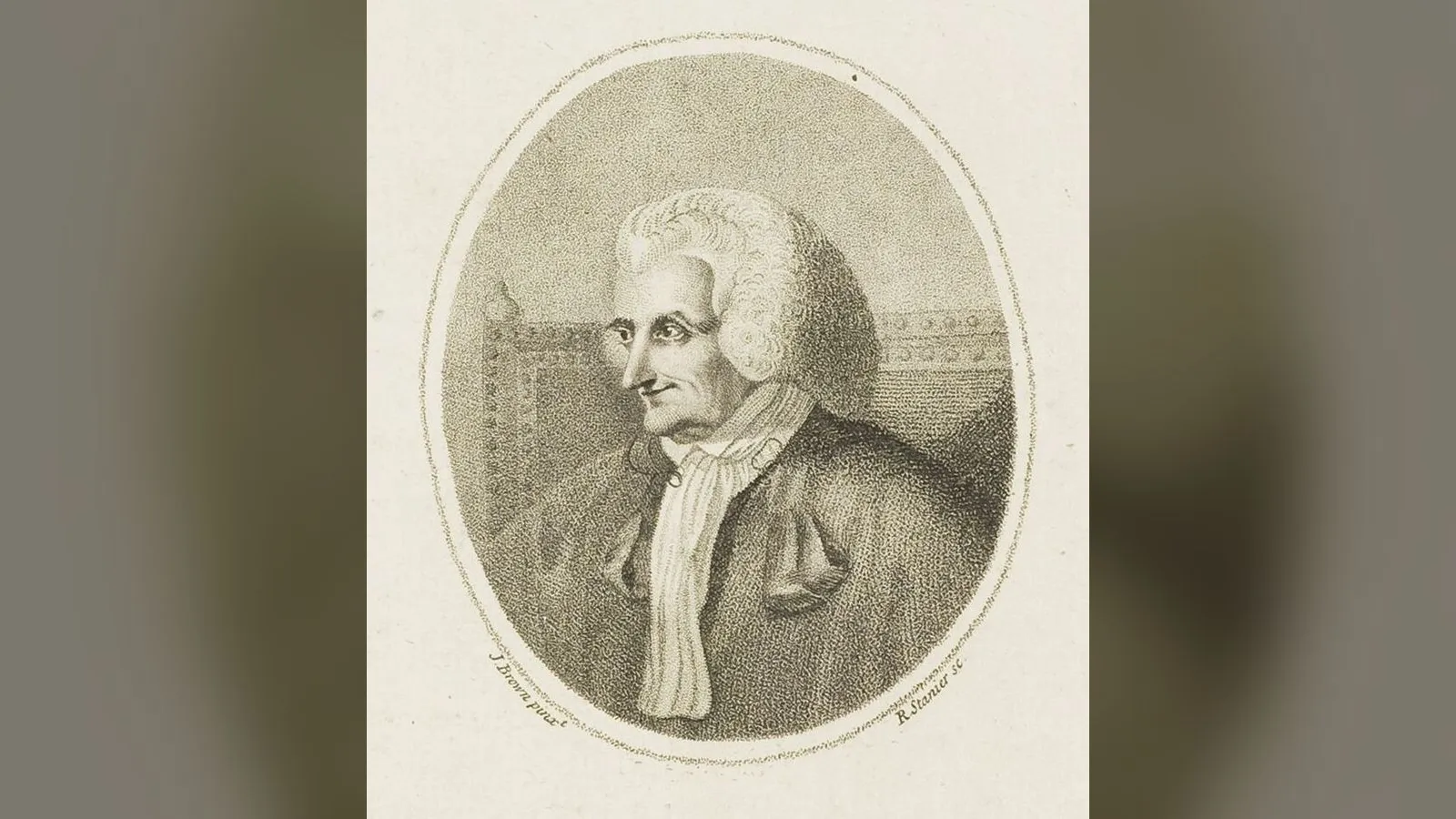

Lord Monboddo
Contents
James Burnett, Lord Monboddo, was a Scottish judge and philosopher of the Enlightenment. He argued that the orang-outang was a kind of human that lacked only speech, wrote huge works on the origin of language and on ancient philosophy, and was mocked by Samuel Johnson for believing in men with tails. He is sometimes called a forerunner of Darwin. He also voted against Joseph Knight's freedom in Scotland's landmark slavery case. This card tests what he actually believed, and which stories about him are myth.
TL;DR
- established James Burnett was born at Monboddo House, Kincardineshire, and baptised on 25 October 1714. He became an advocate in 1737 and a judge of the Court of Session, as Lord Monboddo, in 1767. He died in Edinburgh on 26 May 1799.
- established In Of the Origin and Progress of Language (6 volumes, 1773–1792) he argued that the orang-outang was human, social and tool-using, lacking only speech, so that language was a human invention.
- established He believed in tailed men, on the evidence of travellers' reports, and was ridiculed for it by Johnson and others.
- traditional The popular claim that he thought all babies were born with tails, which midwives secretly cut off, has not been traced to any source from his time.
- established In the Joseph Knight case of 1778 the Court of Session ruled that slavery was not recognised in Scots law. Monboddo was one of the four judges in the minority who voted against Knight.
Key Facts
- Born
- Monboddo House, Kincardineshire; baptised 25 October 1714
- Educated
- Aberdeen (graduated 1729), Edinburgh, Groningen
- Advocate
- 1737
- Judge of the Court of Session
- 1767, as Lord Monboddo
- Of the Origin and Progress of Language
- 6 volumes, 1773–1792
- Antient Metaphysics
- 6 volumes, 1779–1799
- Johnson and Boswell's visit
- 21 August 1773
- Joseph Knight case
- Decided 15 January 1778; Monboddo in the minority
- Died
- 26 May 1799, Edinburgh; buried in Greyfriars
Scottish Impact Index (SI Score)
- Global Influence
- 3/10
- Enduring Relevance
- 7/10
- Material Contribution
- 1/10
- Exceptional Achievement
- 7/10
- Lasting Legacy
- 4/10
- Recognition
- 2/10
24/60
Ranked =143rd of 200 in Great Scots
A Note on Claims and Evidence
Each major claim carries one of three labels. established means supported by primary records, official bodies or several independent reliable sources. shared means the core fact is sound but sources disagree on details, dates or interpretation. traditional means widely repeated but not traceable to a primary or independent source.
Monboddo's own books, Boswell's journals, court notes and modern scholarship, especially Silvia Sebastiani's 2021 study, document his life and ideas well. Many colourful anecdotes about him come from later compilations. Whether he anticipated Darwin is a matter of interpretation, and most modern scholars think the label is misleading. The numbered notes in the text refer to the numbered list of cited sources below.
Timeline
James Burnett is baptised, having been born at Monboddo House.
He graduates from Aberdeen.
He is admitted to the Faculty of Advocates.
He serves as a curator of the Advocates' Library.
He becomes a founding member of the Select Society.
Working on the Douglas Cause, he meets the "savage girl" of Champagne in Paris.
He becomes a judge of the Court of Session as Lord Monboddo.
The first volume of Of the Origin and Progress of Language is published.
Johnson and Boswell visit him at Monboddo House.
The Court of Session rules for Joseph Knight; Monboddo is in the minority.
The first volume of Antient Metaphysics is published.
John Kay's etching "Contemplation" mocks his belief in tailed humans.
Monboddo dies in Edinburgh.
Details
1. Life and career
Monboddo was raised in a Jacobite and Episcopalian family.[1] After school at Laurencekirk he graduated from Aberdeen in 1729, studied at Edinburgh, and finished his training in Roman (civil) law at Groningen.[4] He joined the bar in 1737.[4] His early fame came from the Douglas Cause, a sprawling inheritance dispute across Scotland, France and England, in which he acted for the young Douglas heir.[4]
He was also a central figure in Edinburgh's clubs:
- He was curator of the Advocates' Library from 1751 to 1756, overlapping with David Hume's time as its keeper (6 February 1752 to 8 January 1757). In November 1754 Monboddo ("James Burnet") was one of three curators who objected to books Hume had ordered from the London dealer Thomas Osborne. A draft minute called them "indecent Books unworthy of a place in a learned Library" (per The Library, "Two Lost Items of Humeana"; see also Dickson 1932 and Harris 1966, cited by Sebastiani).
- He was a founding member of the Select Society (1754–64). According to the Society's minute book in the National Library of Scotland, cited by Sebastiani, he was elected to its board of presidents three years running and chaired "more than a dozen times (while Hume, for instance, only did so twice)."
- From 1754 he was part-owner of the Canongate Theatre, a stake he gave up when he became a judge in 1767[7] and took the title Lord Monboddo.[5]
His Edinburgh house at 13 St John Street was known for learned suppers.[4][13] Robert Burns celebrated his daughter Elizabeth Burnett ("Address to Edinburgh", 1786; an elegy after her death from consumption in 1790).[14] He died in 1799 and is buried in Greyfriars Kirkyard.[4]
2. The two great works
- Of the Origin and Progress of Language (6 vols, 1773–92). Volume I appeared in May 1773.[1] A chapter on the orang-outang was added in the second edition (1774).[1][15]
- Antient Metaphysics (6 vols, 1779–99). The last volume came out in the year he died.[1][16]
Sebastiani describes the two works as overlapping "in their topics and in their method" and as "very large and very repetitive". Both attacked the "materialistic and mechanical science" of Hobbes, Locke, Newton, Berkeley and Hume. In their place he offered "the old philosophy of Plato and Aristotle". Monboddo called modern philosophy a "mad philosophy" gripped by "a desperate aversion to mind, and a passionate love for matter."[1]
He paid for the printing himself, and the print run was only about three hundred copies (Richard Sher, cited by Sebastiani). That fits his deliberate contempt for "polite" commercial publishing,[1] and it partly explains why his ideas reached the public mainly through caricature.[1]
Linguistics claim (Disputed / overstated in popular sources): Wikipedia calls him "a founder of modern comparative historical linguistics", and the University of Edinburgh's alumni profile calls him the "founder of modern comparative historical linguistics". Some popular sites even credit him with the first "single-origin" theory of humanity. Historians of linguistics are more cautious:
- Lyle Campbell lists Monboddo (1774) among several writers, from Schultze and Coeurdoux onward, who discussed Sanskrit's relationship to European languages before Sir William Jones's famous 1786 statement.[17]
- Garland Cannon notes that Jones avoided claiming Sanskrit as the parent of the Indo-European languages, "as Monboddo, Schlegel, and others unwarily did."[18]
He is better described as an important early comparative speculator on language. "Founder" overstates it.
3. The orangutan and "proto-evolution"
What he actually argued (Established). Sebastiani reduces the argument to a syllogism: "orangutans were human; they did not speak; ergo language was not original, but a historical product." In the eighteenth century, "orang-utan" (Malay for "man of the woods") was a generic label for all the great apes then known, Asian and African. Monboddo wrote that orang-outangs "are exactly of the human form; walking erect… they use sticks for weapons; they live in society; they make huts of branches of trees."[1] Their muteness was his evidence that speech is acquired, not innate. The idea came largely from Rousseau's Discourse on Inequality (1755), especially its note X. From Rousseau he also took the concept of perfectibilité.[1]
The case for "forerunner" (Disputed). Arthur O. Lovejoy's classic essay "Monboddo and Rousseau" (Modern Philology, 1933) concluded: "With some wavering, he extended Rousseau's doctrine of the identity of species of man and the chimp into the hypothesis of common descent of all the anthropoids, and suggested by implication a general law of evolution." Encyclopædia Britannica goes further, saying he "anticipated principles of Darwinian evolution."[7][19] Wikipedia goes further still: "Some credit him with anticipating in principle the idea of natural selection that was read by (and acknowledged in the writings of) Erasmus Darwin." That claim is sometimes linked to his breeder's grasp of inheritance, in horses and in people.
The case against (the stronger modern view). Sebastiani (2021) takes Monboddo more seriously than most earlier scholars. Even so, she rejects Tim Ingold's reading of him as a proto-Darwinian: "Monboddo was very distant from Charles Darwin… Monboddo's fundamental question was not the continuity between the human and the animal worlds, but its discontinuity." For Monboddo, animals "were condemned by their limited nature to repetition and fixity". Variability was a uniquely human trait, and "his inclusion of the orangutan within humankind was his way of preserving such a divide."[1]
In other words, he did not argue that humans descended from apes. He redrew the boundary of "human" so that it included the apes. His "evidence" also included mermaids, giants, cyclopes and blemmyes, gathered by piling up testimony rather than by observation or experiment.[1]
The Darwin link is thin. Erasmus Darwin cited "Lord Monboddo's learned work on the Origin of Language" in The Temple of Nature (1803). That note is about the common origin of European languages and peoples, not biological transformation.[20][21] Even sympathetic summaries say it is uncertain whether Charles Darwin ever read Monboddo.[4][7]
A fairer description is "a speculative pioneer of the anthropology of human origins, whose claims about apes and language anticipate questions Darwin later answered, not Darwin's theory."
4. The tails story: what is real and what is myth
Documented (Established): Monboddo did defend the existence of "men with tails", and at length.
- In Origin and Progress of Language vol. I (1773/74) he relied on the Swedish traveller Nils Mattson Kiöping's report of Nicobar islanders with "tails like those of cats".[1]
- He checked Kiöping's credibility by writing to Linnaeus, who confirmed the source and supplied other authorities.[1]
- He claimed he could find living witnesses that "a man in Inverness … had a tail, about half a foot long."[1][8]
- Antient Metaphysics vol. III (1784) extended the list of human "varieties" to mermaids and tailed peoples.[1]
- He questioned Joseph Banks, Daniel Solander and James Bruce, and "remained disappointed" when none of them had seen tailed men. In May 1784 Banks consoled him with a German traveller's account "favourable to the system of mankind having in a former period… been endowed with a tail."[1][8]
- The East India Company surgeon Nicolas Fontana examined Nicobar islanders and in 1799 reported "no sort of projection whatever on the os Coccygis of either sex". He suggested the "supposed tail" was probably a strip of cloth hanging down behind.[1]
Contemporary mockery (Established):
- On 16 August 1773, at Boswell's table, Sir Adolphus Oughton "laughed at Lord Monboddo's notion of men having tails, and called him a Judge, a posteriori."[22]
- Boswell also records Johnson's barb: "Other people have strange notions; but they conceal them. If they have tails, they hide them; but Monboddo is as jealous of his tail as a squirrel."[1][23][24]
- In June 1773 an Edinburgh schoolmaster wrote of "an ugly tail with which his Lordship is disgracefully painted in this Island."[1]
- John Kay's 1784 etching "Contemplation" shows him at work beneath a picture of naked children with tails. The National Portrait Gallery describes this as referring to "his much ridiculed assertion that humans originally had them."[25]
- A later-printed anecdote (1866) has Lord Kames refusing to go before him "that I may see your tail".[26] It should be treated as tradition.
The midwife version (Legend/Myth, pending new evidence): Jessica Straley's Evolution and Imagination in Victorian Children's Literature (Cambridge University Press) states flatly that Monboddo "was famously convinced that all humans are born with tails and that midwives, doctors, and nurses conspiratorily clip them off after birth." I found no passage in his works and no eighteenth- or nineteenth-century source that says this. The most detailed modern study of his tail arguments (Sebastiani 2021) discusses tailed peoples reported by travellers and never mentions midwives.[1] Wikipedia's claims that he held the midwife belief and "retracted" it in a letter to Sir John Pringle of 16 June 1773 could not be checked against the letter, which is printed in William Knight's Lord Monboddo and Some of His Contemporaries (1900).[4][27][28]
The most likely explanation is that satire turned his real, testimony-based belief in tailed human varieties into a claim about every newborn. That is an editorial inference, not a proven chain. It is best treated as the midwife detail as a later embellishment, not as his view.
5. Eccentricity, Johnson and Boswell
The 1773 visit (Established, primary source). On 21 August 1773 Boswell took Johnson to Monboddo House.[29] Boswell admitted "Lord Monboddo and Dr Johnson did not love each other." Johnson nonetheless said he "would go two miles out of his way to see Lord Monboddo."[22]
Monboddo met them "drest in a rustick suit" and a "little round hat", introduced himself as "Farmer Burnett", and served "a farmer's dinner".[30] The two men argued over "whether the savage or the London shopkeeper had the best existence; his lordship, as usual, preferring the savage." Boswell nonetheless "saw both Dr Johnson and him liking each other better every hour."[22] Johnson later said that Monboddo "had talked no paradoxes to-day". He added that, "from his appearance in London, he thought him all paradox."[31]
Johnson's dismissive remarks (Established). Johnson treated the idea of teaching the orang-outang to speak "with ridicule", and quipped: "I should have thought it not possible to find a Monboddo; yet HE exists."[22] Elsewhere Boswell records Johnson calling Monboddo's speculation on "whether men went upon all four" "very idle" conjecture.[32] He also records Johnson objecting to "a judge's calling himself Farmer Burnett."[31]
The playwright Samuel Foote called Monboddo "an Elzevir edition of Johnson", meaning a pocket-sized one.[22] Monboddo's own contempt is reported only at second hand: George Birkbeck Hill quotes him saying Johnson "had compiled a dictionary of a barbarous language."[33] Tier this Shared/Traditional.
The relationship was cordial enough on the surface. In 1777 Boswell gave Monboddo a presentation copy of Johnson's Journey, and Monboddo "begged" that it be marked as from the author.[34] So "hostility" is a fair word for their ideas, but too strong a word for their manners.
Horseback travel (Shared/Traditional, well attested):
- A 19th-century editor of Boswelliana notes that "He visited London every year, accomplishing the journey on horseback."[4][12]
- Birkbeck Hill says he "always went on horseback, even after he had passed his eightieth year."[33]
- His reason is less secure. Ralph Straus's Carriages and Coaches (1912) says that "so late as 1770" Monboddo refused to "sit in a box drawn by brutes."[35] That fits his admiration for the ancients, but it is an unsourced secondary claim.
- A related tradition has him putting his wig in a sedan chair and walking home in the rain.[26] Tier that Shared/Traditional.
Servants running beside his carriage (Unsupported): No source has been found for this, and it sits oddly with the well-attested habit of refusing carriages altogether.
6. Enlightenment rivals: Hume, Smith and Kames
Monboddo was a declared opponent of the Newtonian experimental method and of Hume's philosophy. He once called Hume "the greatest enemy of his country" (Antient Metaphysics I, 1779, p. 301). He also rejected the "historical method of his fellow-Scots, based on the assumption of human uniformity", the stadial history of Adam Smith and John Millar. Against it he stressed human "variety" and a sharp break between nature and history, siding with Rousseau (Sebastiani).[1]
He was no simple crank outside the movement, however. Sebastiani firmly places him "in the Enlightenment debates, to which I think he belonged."[1] Other scholars label him "counter-Enlightenment" or "anti-Enlightenment", so his classification is itself disputed.[1][19]
His fellow judge Lord Kames was a staunch intellectual rival.[4] Kames mocked Monboddo's reliance on the French writer de Maillet as having "no more pride than to swallow a French-man's spittle" (reported by John Ramsay of Ochtertyre).[1][7]
7. The Joseph Knight case (1778)
What the court decided (Established). Joseph Knight had been enslaved in Jamaica and brought to Scotland by John Wedderburn of Ballindean. The Sheriff of Perth had found that "the state of slavery is not recognised by the laws of this kingdom, and is inconsistent with the principles thereof."[36] On 15 January 1778 the Court of Session upheld the Sheriff.[2][37] Judges in the majority included Kames ("we sit here to enforce right, not to enforce wrong"), Auchinleck ("Is a man a slave because he is black? No. He is our brother") and Hailes.[2][37]
Monboddo's position (Established). Lord Hailes's notes show four judges against Knight: Lord President Arniston, Lords Covington and Elliock, and Monboddo.[2] Monboddo held that "religion says nothing against slavery", quoted St Paul's "servants obey your masters", and gave a Roman-law argument: "Unless it can be proved that slavery is contrary to the jus gentium, there can never be turpitude in it."[1][3]
This connected directly to his philosophy. He thought it "equally certain" that "a great part of mankind are by nature doomed to be slaves", in Aristotle's sense of natural slavery. Sebastiani adds a nuance: skin colour "played no role in his pro-slavery argument." His hierarchy rested on "blood and lineage", not race.[1] R.J.W. Mills (2024) goes further, arguing that his defence of a black ancient Egypt as the source of all civilisation, directed against Hume's racist footnote, has been underappreciated. Mills still confirms that he "voted against Knight in 1778."[3][38]
Conflicting vote count. The Judicial Office for Scotland's 2022 plaque and James Robertson's account give a majority of ten to four.[2][37] Wikipedia and Sebastiani give eight to four.[1][36][39][40] The sources agree on the four dissenters. The fair summary is "a large majority (reported as 10–4 or 8–4), with Monboddo among the four dissenters."
Significance. Robertson says the ruling meant slavery "became illegal in Scotland", twenty-nine years before the 1807 abolition of the slave trade.[2] More precisely, the court refused to enforce colonial slavery or "perpetual service" in Scotland.[41] It did not end Scottish colliers' and salters' hereditary bondage, which was dismantled by separate Acts in 1775 and 1799.
8. Reputation and reassessment
Mocked in his lifetime and after (Established):
- Kay's caricatures.[1]
- Thomas Love Peacock's novel Melincourt (1817), in which an orangutan, "Sir Oran Haut-ton", stands for Parliament.[4] Peacock quotes Antient Metaphysics in his notes.[42][43]
- Dickens's "Monboddo doctrine touching the probability of the human race having once been monkeys" in Martin Chuzzlewit (1844).[4][44]
Scholarly revival (Established trend, disputed conclusions). Modern scholarship runs from E.L. Cloyd's biography (Clarendon Press, 1972), through Robert Wokler's work on Monboddo and Kames (1988) and Alan Barnard's anthropology, to Sebastiani (2021) and Mills (2021, 2024). Together they have turned "credulous", "bizarre" and "eccentric" into a serious subject. Sebastiani argues that he "founded his 'science of man' on an epistemology of legal evidence", weighing travellers' reports the way a judge weighs witnesses.[1][45]
The same scholars show that the reassessment cuts both ways. Sebastiani writes that "his world of variety was peopled by superior and inferior classes of men, reflecting the hierarchical order of nature."[1]
9. Against the plough: Monboddo in the Select Society
Monboddo was among the most active members of Edinburgh's Select Society (1754–64). He presided at more than a dozen meetings, while Hume did so only twice, and he proposed fourteen debate topics. They included "Whether the modern method of improvement by making large farms be not ruinous to the Country?" The naturalist John Walker remembered an "elaborate speech" in which Monboddo argued that "the plough was the most destructive instrument to mankind that ever was invented", because spade cultivation fed more people and bred hardier ones. He later kept a large number of cottagers on his Kincardineshire estate as a "monument" to the way land had been populated in "antient times". Fredrik Albritton Jonsson shows that these eccentric-sounding views fed into a serious strand of Highland policy that favoured smallholdings and spade husbandry.
Did You Know?
- Monboddo met Johnson dressed as "Farmer Burnett", in a rustic suit and a little round hat.
- Johnson said Monboddo was "as jealous of his tail as a squirrel".
- Monboddo wrote to Linnaeus to check a traveller's report of tailed people in the Nicobar Islands.
- Only about 300 copies of his great works were printed, at his own expense.
- He is said to have ridden from Edinburgh to London on horseback even past the age of 80.
- Robert Burns wrote verses in praise of his daughter, Elizabeth Burnett.
- Thomas Love Peacock's novel Melincourt (1817) has an orang-outang standing for Parliament, inspired by Monboddo.
- He called David Hume "the greatest enemy of his country".
FAQ
1Who was Lord Monboddo?
James Burnett, a Scottish judge and philosopher of the 18th century.
2What did he argue about orang-outangs?
That they were human, social and tool-using, but had not developed speech.
3Was he a forerunner of Darwin?
Most modern scholars say no. He widened the definition of "human" to include apes; he did not argue that humans evolved from them.
4Did he believe in people with tails?
Yes. He relied on travellers' reports and was widely mocked for it.
5Did he believe midwives cut off babies' tails?
No source from his lifetime has been found for that claim; it appears to be a later embellishment.
6What did Johnson think of him?
Johnson mocked his ideas, though the two met cordially in 1773.
7Did he really ride to London on horseback?
That is well attested by 19th-century writers, though his reasons are less certain.
8How did he vote in the Joseph Knight case?
Against Knight's freedom. He was one of four judges in the minority.
9Did he found comparative linguistics?
That overstates it. He was one of several early writers who speculated about links between Sanskrit and European languages.
Sources and Further Reading
Cited sources (numbers match the notes in the text)
- Monboddo's 'ugly tail': the question of evidence in Enlightenment sciences of man
- Slavery, Terrorism, Law, and Justice - The Bottle Imp
- Misunderstanding Monboddo on ‘Race’, Slavery and the Black Egyptian Origins of All Civilization
- James Burnett, Lord Monboddo
- James Burnett, Lord Monboddo: Biography on Undiscovered Scotland
- James Burnett - Lord Monboddo
- James Burnett, Lord Monboddo
- Monboddo’s ‘ugly tail’: the question of evidence in enlightenment sciences of man: History of European Ideas: Vol 48 , No 1 - Get Access
- Introduction How the child lost its tail
- James Burnet, Lord Monboddo - Citizendium
- James Burnett, Lord Monboddo - Students
- The Project Gutenberg eBook of Boswelliana, by Charles Rogers
- scotlandsplaces.gov.uk
- Elizabeth Burnett
- (PDF) Lord Monboddo's Ourang-Outang and the Origin and Progress of Language
- James Burnett, Lord Monboddo (1714-1799)
- (PDF) Why Sir William Jones got it all wrong, or Jones’ role in how to establish language families
- Sir William Jones, language families, and Indo-European
- Lord Monboddo’s Anti-Enlightenment. Conjectural History, Human Nature, and the Teleological Foundation of Language
- Erasmus Darwin’s Temple of Nature
- The Project Gutenberg e-Book of The Temple of Nature; Author: Erasmus Darwin.
- The Journal of a Tour to the Hebrides with Samuel Johnson, LL.D.
- The Origin of Man
- Curious Myths of the Middle Ages (1876)/Tailed Men - Wikisource, the free online library
- NPG D16263; Contemplation (James Burnett, Lord Monboddo) - Portrait - National Portrait Gallery
- WALKING IN WIGS
- Lord Monboddo and Some of His Contemporaries - William Angus Knight - Google Books
- Sir John Pringle, 1st Baronet
- Monboddo House
- A Journey to the Western Islands of Scotland
- The Project Gutenberg eBook of Life of Johnson, by _James Boswell_, Esq..
- record details
- The Project Gutenberg eBook of Footsteps of Dr. Johnson, by George Birkbeck Hill.
- record details
- The Project Gutenberg eBook of Carriages and Coaches, by Ralph Straus.
- Joseph Knight (slave)
- Plaque marks historic slavery case at Court of Session
- R. J. W. Mills, Misunderstanding Monboddo on ‘Race’, Slavery and the Black Egyptian Origins of All Civilization - PhilPapers
- Knight v. Wedderburn is Upheld - African American Registry
- Joseph Knight (slave) facts for kids
- Joseph Knight
- Melincourt (novel)
- Melincourt
- Have you heard of Lord Monboddo?
- Silvia Sebastiani, Monboddo’s ‘ugly tail’: the question of evidence in enlightenment sciences of man - PhilPapers Further reading
- Fredrik Albritton Jonsson, Enlightenment's Frontier: The Scottish Highlands and the Origins of Environmentalism (Yale University Press, 2013)
- E. L. Cloyd, James Burnett, Lord Monboddo (Clarendon Press, 1972)
Caveats: Myths and Disputed Claims
- Do not say he believed all babies are born with tails that midwives remove.
- Do not call him a forerunner of Darwin without qualification.
- Do not call him the founder of comparative historical linguistics.
- Do not say he made his servants run beside his carriage; no source has been found.
- Do not present the Porteous Riots story, the Kames tail joke or the wig in the sedan chair as established.
- Do not give a single vote count for the Knight case; sources give ten to four or eight to four.
- Do not place Monboddo House in Angus; it is in Kincardineshire.
Card 027 · Great Scots