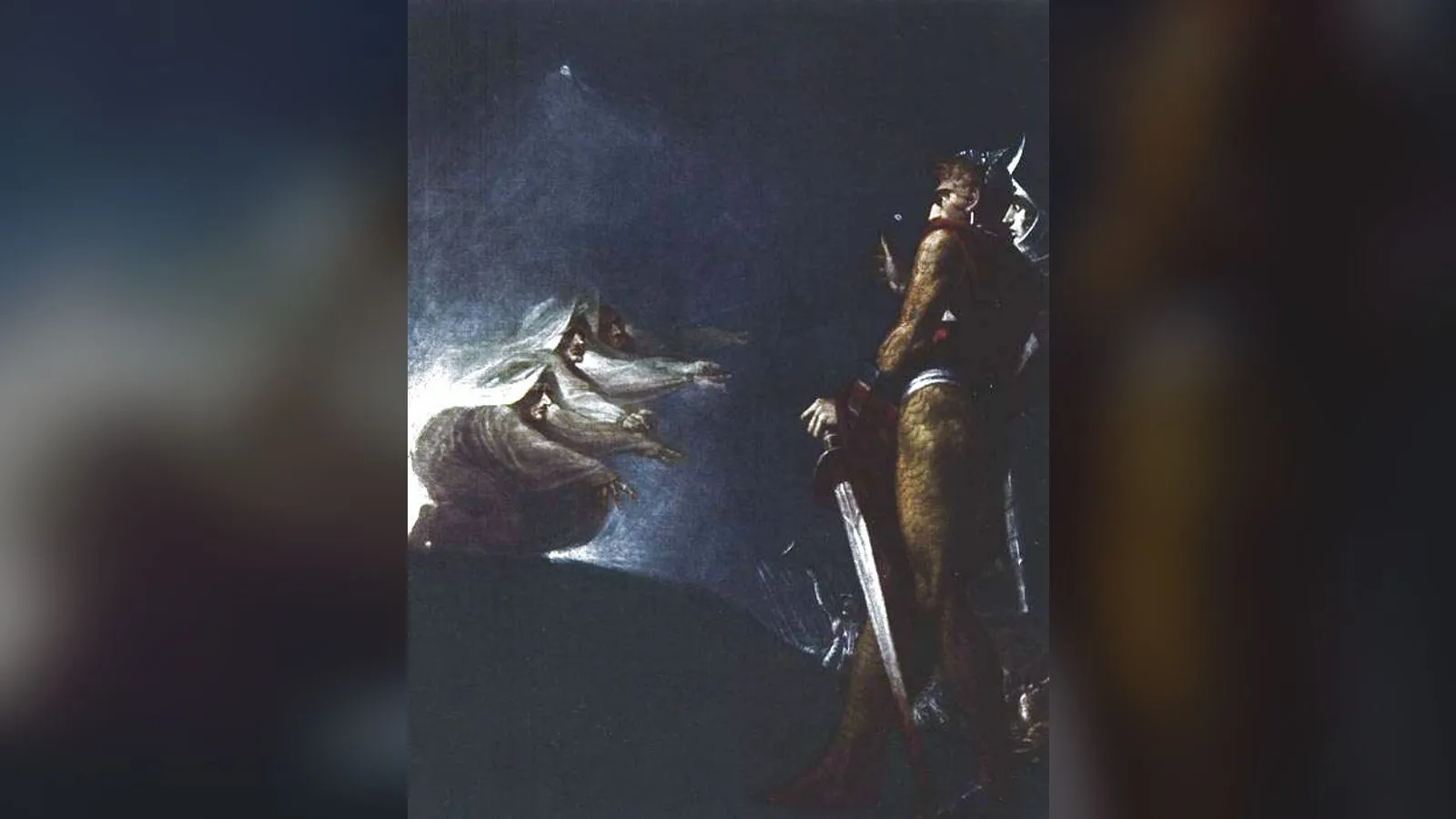

Macbeth
Contents
The real Macbeth, Mac Bethad mac Findláich, was King of Scots from 1040 to 1057. He killed King Duncan in battle, ruled for 17 years, made a pilgrimage to Rome, and was buried among the kings on Iona. Shakespeare's Macbeth, a guilt-crazed murderer who reigns for a few bloody weeks, is a very different man. This card tests what the early records say about the real king, and how the legend grew.
TL;DR
- established Macbeth, born around 1005, was Mormaer (ruler) of Moray and had a real claim to the throne through his own royal descent and through his wife Gruoch, granddaughter of Kenneth III.
- established Duncan I was killed in battle against Macbeth's men near Elgin on 14 August 1040, not murdered in his bed. Macbeth then reigned for 17 years.
- established In 1050 Macbeth went on pilgrimage to Rome, where, according to the chronicler Marianus Scotus, he "scattered money like seed to the poor".
- established He was defeated by Siward of Northumbria in 1054 but survived, and was killed by Malcolm, Duncan's son, at Lumphanan on 15 August 1057. He was buried on Iona.
- established Banquo is fictional. He was invented by Hector Boece around 1527, and Shakespeare took him from Holinshed's Chronicles.
Key Facts
- Gaelic name
- Mac Bethad mac Findláich
- Born
- c.1005
- Father
- Findláech mac Ruaidrí, Mormaer of Moray
- Queen
- Gruoch, granddaughter of Kenneth III
- Duncan I killed
- 14 August 1040, near Elgin, in battle
- Reign
- 1040–1057 (17 years)
- Pilgrimage to Rome
- 1050
- Battle against Siward
- 27 July 1054
- Killed
- 15 August 1057, Lumphanan, Aberdeenshire
- Buried
- Iona
- Successor
- Lulach, his stepson, killed 1058
- Shakespeare's play
- c.1606
Scottish Impact Index (SI Score)
- Global Influence
- 7/10
- Enduring Relevance
- 9/10
- Material Contribution
- 2/10
- Exceptional Achievement
- 5/10
- Lasting Legacy
- 5/10
- Recognition
- 8/10
36/60
Ranked =52nd of 200 in Great Scots
A Note on Claims and Evidence
Each major claim carries one of three labels. established means supported by primary records, official bodies or several independent reliable sources. shared means the core fact is sound but sources disagree on details, dates or interpretation. traditional means widely repeated but not traceable to a primary or independent source.
The early sources for Macbeth are brief: Irish annals, the chronicler Marianus Scotus, and a few king-lists and poems. None calls him a tyrant. The villainous Macbeth was built up over centuries by later writers, above all Hector Boece in 1527, whose history flattered the Stewart kings descended from Duncan. Holinshed's Chronicles passed Boece's story to Shakespeare. Some details, including Macbeth's birth year and the exact year of his death, vary between sources.
Timeline
Macbeth is born, son of Findláech, Mormaer of Moray.
Findláech is killed, probably by his nephews.
Macbeth's cousin Gille Coemgáin is burned to death with 50 men.
Duncan I becomes king.
Duncan is killed in battle against Macbeth near Elgin; Macbeth becomes king.
Macbeth goes on pilgrimage to Rome.
Macbeth takes Norman knights into his service.
Siward of Northumbria defeats Macbeth, but Macbeth keeps his throne.
Macbeth is killed at Lumphanan and buried on Iona.
His stepson Lulach is killed by Malcolm III.
Hector Boece's history invents Banquo.
Holinshed's Chronicles (second edition) retells Boece's story.
Shakespeare writes Macbeth.
Details
1. Origins and Background: A Son of Moray, A Grandson of Kings
The real Macbeth was born around 1005, the son of Findláech mac Ruaidrí, Mormaer of Moray. A mormaer (literally "great steward") was effectively a regional sub-king or earl who ruled a province on the king's behalf, raising armies, administering justice and enjoying near-royal status. Moray, in the north around the Moray Firth and Inverness, was a powerful and semi-autonomous territory.
Macbeth's lineage gave him a real claim to the throne. His paternal ancestry, preserved in the Irish genealogies of the Rawlinson B.502 manuscript, traced the Moray dynasty back to Loarn, of the Cenél Loairn of Dál Riata — a rival line to the Cenél nGabráin from which the southern (Dunkeld/Alpín) kings claimed descent. His mother is traditionally named Doada/Donada and said to be a daughter of King Malcolm II (Máel Coluim mac Cináeda), though Andrew of Wyntoun's Orygynale Cronykil makes her a granddaughter rather than a daughter. Either way, Macbeth was closely tied by blood to the reigning royal house.
The political background was one of relentless dynastic feud between branches of the royal kindred. Macbeth's father Findláech was killed around 1020, probably by his nephews Máel Coluim and Gille Coemgáin. Gille Coemgáin — who became Mormaer of Moray — was himself burned to death with fifty of his men in 1032, very possibly at Macbeth's instigation. Macbeth then became Mormaer of Moray and married Gille Coemgáin's widow, Gruoch.
Tanistry — why Macbeth's claim was legitimate. Early medieval Scotland did not practise primogeniture (succession by the eldest son). Instead it used tanistry, a Gaelic system in which the king was succeeded by an eligible adult male of the wider royal family (the derbfine, a kin-group spanning several generations), with the heir — the tanaise or "tanist" — often designated in advance. Crucially, the system tended to alternate the kingship between competing branches. This is the key to understanding the period: under tanistry, a cousin killing a cousin to take the throne was not an aberration but, effectively, how the system worked. As Encyclopaedia Britannica notes, "members of collateral branches seem to have been preferred to descendants," and "this system in practice led to many successions by the killing of one's predecessor." Macbeth's seizure of the crown was therefore a legitimate move within the rules of his own society — not the monstrous crime Shakespeare depicts. (Tanistry was finally abolished, fittingly, under James VI and I.)
2. The Killing of Duncan I (1040): A Battle, Not a Murder
The historical Duncan I (Donnchad mac Crínáin) was nothing like Shakespeare's venerable, white-bearded monarch. He was a young man — he came to the throne in 1034 aged around 33 and was about 39 when he died — and a notably unsuccessful war-leader. The Prophecy of Berchán dubs him "the man of many sorrows." In 1039–40 he led a disastrous campaign south to besiege Durham that ended in humiliating failure.
In 1040, Duncan turned north and led an army into Moray — Macbeth's own territory — apparently on a punitive expedition. There, on 14 August 1040, he was killed in battle at Bothnagowan (modern Pitgaveny) near Elgin, by the men of Moray led by Macbeth. The near-contemporary chronicler Marianus Scotus records that Duncan was killed by his dux (war-leader) Macbethad son of Findláech, who then succeeded to the kingdom for seventeen years. The Annals of Tigernach say Duncan was slain "at an immature age," and Alan Orr Anderson's Early Sources of Scottish History renders the entry as Duncan being "slain by his subjects, at an immature age." The Irish annals describe death in battle or at the hands of his own people — never assassination in a bedchamber.
This is the single most important distinction in the whole story. The traditional "murdered in bed at Inverness while a guest" narrative is pure literary invention — it does not appear in any of the early sources (the Chronicle of Melrose, the Annals of Ulster, the Annals of Tigernach, Marianus Scotus). It originates in the much later legendary tradition (Boece, then Holinshed) and was dramatised by Shakespeare. The historical reality was a legitimate military confrontation between two royal claimants. As the British Library bluntly summarises: "Wrong, Duncan dies in battle against Macbeth."
3. Macbeth's Reign (1040–1057): Seventeen Successful Years
Here is the fact that Shakespeare's shadow has almost entirely erased: Macbeth was a good king who reigned successfully for seventeen years. No near-contemporary source calls him a tyrant. The contemporary Duan Albanach, which survives in a form dating from the reign of Malcolm III, calls him "Mac Bethad the renowned." The 11th-century Prophecy of Berchán — a verse "history" cast as prophecy — calls him "the generous king of Fortriu," and continues: "The red, tall, golden-haired one, he will be pleasant to me among them; Scotland will be brimful west and east during the reign of the furious red one." His byname was Rí Deircc, "the Red King."
The strongest single piece of evidence for the stability of his reign is his pilgrimage to Rome in 1050. Marianus Scotus — the contemporary Scottish-Irish monk based on the Continent — records that "the king of Scotland, Macbeth, scattered money like seed to the poor, at Rome" (the Dictionary of National Biography, 1885–1900, preserves the Latin seminando, "as if sowing"). No king could leave his realm for the many months such a journey required unless his hold on power was secure and his deputies trustworthy. He was the first reigning Scottish monarch to make the pilgrimage. The visit also reflects the growing reach of Roman Christianity in Scotland; the reforming Pope Leo IX held the see at the time. In 1052 Macbeth took Norman knights expelled from England into his service — possibly the first introduction of such continental men-at-arms into Scotland.
Gruoch — the real Lady Macbeth. Macbeth's queen, Gruoch ingen Boite, was no scheming villainess but a royal princess in her own right: the granddaughter of King Kenneth III (Cináed), through her father Boite. (Her own brother and other male relatives were killed by Malcolm II, who was clearing rivals from his grandson Duncan's path — giving Gruoch's family a genuine grievance against Duncan's line.) Her marriage to Macbeth fused two royal claims. She appears in history not as a murderer but as a co-ruler and church patron: a surviving grant of land to the Culdee (Céli Dé) monks of Loch Leven on St Serf's Inch names "Machbet filius Finlach... et Gruoch filia Bodhe, rex et regina Scottorum" — "Macbeth son of Finlay and Gruoch daughter of Bodhe, king and queen of Scots." (Scholars note the surviving charter text also references "Malcolm son of Duncan," which casts some doubt on its exact form, though the substance is generally accepted.) The joint grant strongly suggests Macbeth and Gruoch governed as partners. They had no children together, but Macbeth accepted Gruoch's son Lulach as his heir.
4. Defeat and Death (1054–1057)
Duncan's young son Malcolm (the future Malcolm III "Canmore") had fled after his father's death and grown up in exile, ultimately at the court of Edward the Confessor. He never gave up his claim. In 1054, his cause was taken up by Siward, Earl of Northumbria, who led a large Anglo-Danish army into Scotland.
The Battle of Dunsinane was fought on 27 July 1054 (also called the Battle of the Seven Sleepers). It was a bloody affair — the Annals of Ulster record "3,000 Scots and 1,500 English" dead, figures that "can be taken as meaning very many on both sides" — and ended in defeat for Macbeth, who was forced to concede territory to Malcolm. But Macbeth was not killed and was not deposed. He retreated to his northern heartland and continued to reign for three more years. This is one of Shakespeare's clearest distortions: in the play, Dunsinane is the final battle and Macbeth dies there. Siward's son Osbeorn and a kinsman were both killed in the real battle — the historical kernel behind the play's "young Siward."
Macbeth's end came at the Battle of Lumphanan in Aberdeenshire on 15 August 1057, where Malcolm's forces finally defeated and killed him; this date is independently confirmed by the contemporaries Marianus Scotus and the Annals of Tigernach. (The Annals of Ulster, by contrast, place his death — and Lulach's — under 1058, and confusingly name his killer "Mael Sechlainn," an error for Máel Coluim/Malcolm.) Local tradition around Lumphanan preserves "Macbeth's Well," where he is said to have drunk before the fight; "Macbeth's Stone," where his head was supposedly struck off; and "Macbeth's Cairn," his traditional burial spot — though the nearby Peel Ring of Lumphanan, long associated with him, is actually a 13th-century earthwork built some 200 years after his death.
Macbeth's body was taken to Iona and buried in the Reilig Odhráin, the ancient royal cemetery beside the abbey founded by St Columba, where his predecessors as kings of Scots lay; the 14th-century chronicler John of Fordun states that "both these kings, Machabeus and Lulath, were buried in the Island of Iona." A 1549 inventory recorded that the cemetery held the graves of "48 Scottish kings, eight Norwegian Kings, and four Irish Kings," though none of the royal markers survive and their inscriptions were already illegible by the late 1600s. Burial on Iona was the supreme royal honour — confirmation that, whatever Malcolm's faction thought of him, Macbeth died and was buried a legitimate king of Scots.
5. Lulach — The Forgotten Successor
After Lumphanan, Macbeth's supporters did not simply submit to Malcolm. They placed Lulach mac Gille Coemgáin — Gruoch's son by her first husband, and thus Macbeth's stepson — on the throne. Lulach has a real distinction: he is the first king of Scots for whom inauguration details survive, crowned at Scone (probably around 8 September 1057). His nicknames, Tairbith ("the Unfortunate") and Fatuus ("the Simple" or "the Foolish"), suggest a weak ruler. He reigned only a few months before Malcolm ambushed and killed him at Essie in Strathbogie on 17 March 1058. Lulach too was buried on Iona.
Lulach matters because his very accession underscores Macbeth's legitimacy: a faction strong enough to crown Macbeth's heir shows that Macbeth's kingship rested on real dynastic and political support — through Gruoch's descent from Kenneth III — rather than on naked usurpation. Lulach's son Máel Snechtai would later be Mormaer of Moray, and the Moray line would trouble the Canmore dynasty for generations.
6. Shakespeare's Sources: A Chain of Distortion
Shakespeare did not invent his Macbeth from scratch, nor did he have access to the early annals. His direct source was Raphael Holinshed's Chronicles of England, Scotland, and Ireland (the second edition of 1587). But Holinshed was the last link in a chain that grew steadily more fictional:
- John of Fordun, Chronica Gentis Scotorum (c.1363–1385): an early attempt at a continuous Scottish national history, already shaped by legend.
- Hector Boece (Boethius), Scotorum Historiae (1527): a humanist "history" dedicated to James V that is, in Britannica's words, "a glorification of the Scottish nation, based on legendary sources, and is more interesting as romance than as history." Boece freely blended fact with folklore.
- Holinshed (1577/1587): translated and compiled Boece's account into English.
- Shakespeare (c.1606): dramatised Holinshed.
Boece's propaganda purpose is the crux. Boece wrote to please the ruling Stewart dynasty, which descended from Duncan and Malcolm Canmore — the very kings Macbeth had opposed. So Boece had every incentive to blacken Macbeth and ennoble his enemies. His most consequential invention was the character of Banquo and his son Fleance, presented as the ancestors of the Stewart kings. Boece's Scotorum Historiae is the first known text in which Banquo and Fleance appear at all — they exist in no earlier source. They are wholly fictitious: in the first decade of the 19th century the antiquary George Chalmers demonstrated that the Stewarts actually descended from Walter FitzAlan, son of the Breton knight Alan Fitz Flaad (a family from Dol-de-Bretagne and Shropshire, kin to the FitzAlan Earls of Arundel) — men who arrived in Britain well after Macbeth's time. As one scholarly summary puts it, Boece introduced Banquo and Fleance "to fabricate an ancient Scottish lineage for the Stewarts." Even within Holinshed, Banquo is an accomplice in Duncan's murder — it was Shakespeare who whitewashed him into a virtuous innocent.
7. Shakespeare's Macbeth (c.1606): A Play for a Scottish King
Shakespeare's company, the Lord Chamberlain's Men, became the King's Men under the patronage of James VI and I after his accession to the English throne in 1603. Macbeth — probably written around 1606 — reads as a play crafted to please this Scottish king on multiple levels.
- A Scottish subject. James was a Scot now ruling England; a Scottish history play honoured his homeland and heritage.
- The Banquo flattery. James believed himself descended from Banquo. The witches' prophecy that Banquo "shalt get kings, though thou be none," and the vision of eight kings (with Banquo's line stretching "to the crack of doom" and carrying "treble sceptres" symbolising the union of England, Scotland and Ireland), are a direct compliment to James and his dynasty. Making Banquo noble rather than a murderer was both politically prudent and dramatically useful.
- The horror of regicide. James was an exponent of the divine right of kings, and the play's depiction of the cosmic catastrophe unleashed by killing an anointed king reinforced his political theology.
- The Gunpowder Plot. The play was written soon after the November 1605 plot to blow up King and Parliament. Critics have long detected echoes: the Porter's joke about an "equivocator" alludes to the doctrine of equivocation used at the 1606 trial of the Jesuit Henry Garnet; the play's atmosphere of treason, conspiracy and a near-miss for the rightful line resonates with the plot, and Fleance's escape mirrors James's own survival.
- Witches and demonology. James was fascinated by witchcraft and had personally written Daemonologie (1597) and been involved in the North Berwick witch trials of 1590. The Weird Sisters tapped directly into the king's known obsessions. (Scholars debate how directly Shakespeare drew on Daemonologie and the pamphlet Newes from Scotland; some see clear borrowing, others only common belief.)
This is the natural companion piece to our James VI and I profile in the "Great Scots" collection: Macbeth is, among other things, a sophisticated act of royal flattery aimed squarely at that king.
Lady Macbeth versus Gruoch. Shakespeare's Lady Macbeth — the goading, ambition-maddened wife who calls on spirits to "unsex" her and is finally destroyed by guilt — bears essentially no resemblance to the historical Gruoch, a royal heiress and church patron who co-signed her husband's charters as queen. The famous sleepwalking "out, damned spot" scene (Act 5, Scene 1) is entirely Shakespeare's invention: it has no basis in Holinshed or any historical source. It is one of the supreme dramatic depictions of guilt in world literature — and it is fiction.
8. Shakespeare vs History: The Distortions at a Glance
| Element | Shakespeare's Play | Historical Record |
|---|---|---|
| Duncan | Old, wise, saintly king | Young (~39 at death), rash, militarily incompetent |
| Macbeth's claim | Treacherous usurper with no right | Legitimate claimant under tanistry, via his own and Gruoch's royal descent |
| The killing of Duncan | Secret murder, stabbed asleep as a guest at Inverness | Killed in open battle near Elgin, 14 August 1040 |
| Macbeth's reign | Brief, bloody, paranoid tyranny | Stable and successful for 17 years; pilgrimage to Rome in 1050 |
| Lady Macbeth | Murderous instigator who goes mad and (off-stage) kills herself | Gruoch, royal heiress and co-ruler; her fate unknown |
| Banquo | Noble, virtuous friend, murdered by Macbeth | Wholly fictitious — invented by Boece c.1527 |
| Dunsinane | Final battle; Macbeth killed there by Macduff | Real battle (1054); Macbeth defeated but reigned 3 more years |
| Death | Slain by Macduff ("not of woman born") at Dunsinane | Killed at Lumphanan, 1057; buried with royal honour on Iona |
| The witches | Literary device drawing on James's demonology | No historical basis |
9. The Play's Legacy and the "Curse"
Macbeth became one of the most performed and quoted works in the English language — and the most superstition-laden. Theatrical folklore holds that speaking the name "Macbeth" inside a theatre invites disaster, so actors call it "the Scottish Play" (or "the Bard's Play," or "Mackers"). The traditional origin story claims a coven of witches cursed the play in revenge for Shakespeare's use of real incantations; a parallel legend says the boy actor playing Lady Macbeth died at the very first performance c.1606 (a tale generally regarded as a later invention, often attributed to the critic Max Beerbohm). The ritual to undo an accidental utterance: leave the theatre, turn around three times, spit, swear or quote another Shakespeare line, then ask to be readmitted.
More soberly, scholars point out that Macbeth is short, popular and frequently staged — so statistically it sees more mishaps — and that it features dangerous stage combat and dim lighting. The "curse" is best understood as folklore that endures because the play's supernatural subject matter makes every coincidence feel meaningful.
The deeper legacy is artistic. Shakespeare took what was, at root, Tudor-era Scottish political propaganda and transmuted it into a universal tragedy about ambition, conscience and the corrosion of the soul. That is the paradox at the heart of this article: the play is a masterpiece and a slander. Its psychological truth is profound; its historical truth is almost nil.
10. Macbeth in Scottish National Identity
Modern Scottish historiography has substantially rehabilitated the historical Macbeth. He is frequently described as the last truly Gaelic, or "last Celtic," king of Scots — his successor Malcolm III took the throne with English help and inaugurated a more Anglo-Norman, southward-looking monarchy. For many Scots, the real Macbeth is a figure of pride: a capable, pious, independent Gaelic ruler whose reputation was trashed centuries later by a Tudor propagandist and an English playwright writing to flatter a king.
The landscape keeps the memory alive. Lumphanan in Aberdeenshire preserves Macbeth's Well, Macbeth's Stone and Macbeth's Cairn, and the Peel Ring there was taken into state care in 1957 — the 900th anniversary of his death. Elgin and Moray were the heart of his power base. Dunsinane Hill in Perthshire still carries his name in popular imagination, and Iona holds his grave among the kings of Scots. Today's Scots can hold both Macbeths in mind at once: the thrilling villain of the world's stages, and the real, capable king of Alba who deserves to be remembered on his own terms.
Did You Know?
- The real Macbeth's nickname was Rí Deircc — "the Red King." A near-contemporary verse calls him "the red, tall, golden-haired one."
- Macbeth was the first reigning King of Scots to make a pilgrimage to Rome (1050), where the chronicler Marianus Scotus says he "scattered money like seed to the poor."
- Banquo never existed. He was invented around 1527 by Hector Boece to give the Stewart kings a glorious fictional ancestor. The antiquary George Chalmers later showed the Stewarts actually descended from a Breton family (the FitzAlans) who arrived in Britain after Macbeth's time.
- The historical Duncan was young, not old — probably about 39 when he died — and he died in battle, not murdered in his sleep.
- Macbeth reigned for 17 years; Shakespeare compresses the whole story into what feels like a few blood-soaked weeks.
- Macbeth and his queen Gruoch jointly granted land to monks at Loch Leven, signing as "king and queen of Scots."
- Macbeth, his stepson Lulach, and even Duncan were all reportedly buried on Iona — a 1549 inventory of the royal cemetery there counted 48 Scottish kings.
- King James VI and I, for whom the play was likely written, had personally authored a book on witchcraft — Daemonologie (1597).
- The Peel Ring of Lumphanan, long pointed out as the site of Macbeth's last stand, is actually a 13th-century castle built around 200 years too late.
- Actors won't say the play's name in a theatre — it's "the Scottish Play."
FAQ
1Was Macbeth a real king?
Yes. He was King of Scots from 1040 to 1057.
2Did Macbeth murder Duncan in his bed?
No. Duncan was killed in battle near Elgin in 1040.
3Did Macbeth have a right to the throne?
Yes. Under the Gaelic system of tanistry, he and his wife both had royal descent.
4Was Macbeth a tyrant?
No early source calls him one. He ruled for 17 years and was secure enough to go to Rome.
5Was Banquo real?
No. Hector Boece invented him around 1527.
6Who was the real Lady Macbeth?
Gruoch, a royal princess, granddaughter of Kenneth III. Her fate is unknown.
7Did Macbeth die at Dunsinane?
No. He was defeated in 1054 but survived, and was killed at Lumphanan in 1057.
8Where is Macbeth buried?
On Iona, the burial place of Scottish kings.
9Why did Shakespeare make him a villain?
His source, Holinshed, followed Boece's hostile account, and the play flattered James VI and I, who believed he was descended from Banquo.
10Why do actors call it "the Scottish Play"?
Because of theatrical superstition that saying "Macbeth" in a theatre brings bad luck.
Sources and Further Reading
Scholarly/Critical
- Roger A. Mason, "Civil Society and the Celts: Hector Boece, George Buchanan and the Ancient Scottish Past", in Edward J. Cowan and Richard J. Finlay (eds), Scottish History: The Power of the Past (Edinburgh University Press, 2002)
Further reading
- Alex Woolf, From Pictland to Alba, 789–1070 (Edinburgh University Press, 2007)
- John Marsden, Alba of the Ravens: In Search of the Celtic Kingdom of the Scots (Constable, 1997)
Caveats: Myths and Disputed Claims
- Do not say Macbeth murdered Duncan in his bed.
- Do not present Banquo or Fleance as historical.
- Do not present Lady Macbeth's sleepwalking or suicide as history.
- Do not give Macbeth's birth year, birthplace or mother as certain.
- Do not give the date of his death as beyond dispute; some annals say 1058.
- Do not say Macbeth was killed at Dunsinane.
- Do not present the Lumphanan sites, or the Peel Ring, as genuine relics of his death.
- Do not present the "curse of the Scottish Play" as anything but folklore.
Card 006 · Great Scots